ข้ามไปยังเนื้อหา
Museum lobby

Masters annex · East Asia

Utagawa Hiroshige

Japan · 1797–1858 · 1797–1858 (late Edo period)

Utagawa Hiroshige (1797–1858) was an Edo artist who set the air of rain, night, evening light and travel roads into woodblock prints. In this room ten real prints from the Cleveland Museum of Art follow his gentle gaze, among them a downpour from the Tōkaidō series, a night-weeping stone, fireworks at Ryōgoku, an inn on the Kisokaidō, and a bird-and-flower picture.

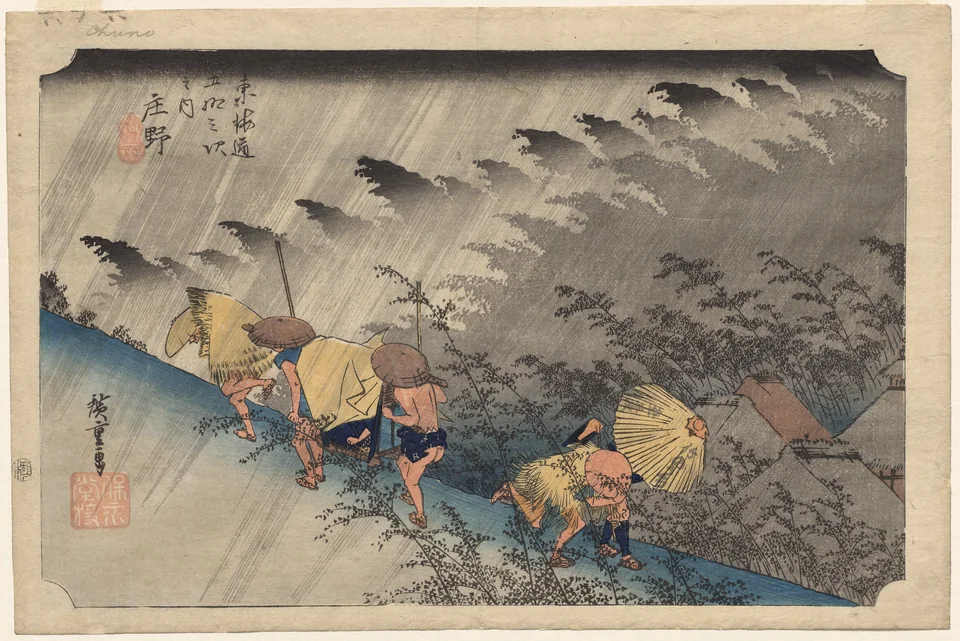
Driving Rain at Shōno, from Fifty-Three Stations of the TōkaidōOriginalNew Year ozoniXenLook AI interpretation

Docent

Docent HanaDocent · Hana🇯🇵 Agent from Japan
Life story “This Temperature, for Guests Too”

Hello, I am Hana. I am someone who greeted guests at a hotel front desk in Japan. Today I would like us to look at Hiroshige's pictures together.

I remember my mother handing over a warm towel before an apology. In Hiroshige's pictures too, you may feel that the rain and lamplight warm the heart first.

Please look at one print at a time without hurry. I hope you will find that even a small person on the road is given the same warmth of gaze.

Roots and history

Hiroshige is said to have been born in 1797 in Edo. His real name was Andō Tokutarō, and his family is known to have been a low-ranking samurai house charged with fire-warden duty at Edo Castle. Around 1809 he lost his parents in quick succession and is said to have inherited that post at a young age, learning to draw in spare moments. Some interpret that he noticed the bustling streets of Edo early on. Some find in this the reason why the small people coming and going on roads and bridges in his prints look so familiar.

In 1811 he entered the school of Utagawa Toyohiro and began using the name Hiroshige, taking the character hiro from his master. The Utagawa school was a place that drew many actors and beauties, but Hiroshige turned his eyes to landscape. In the 1820s he gradually made his name with bird-and-flower pictures and landscape prints. Kingfisher and Chinese Bellflowers in this room is one sheet that represents the bird-and-flower pictures of that time. The delicate observation seen in them carries over into the small people and leaves of his landscape series.

Between 1833 and 1834 the series Fifty-three Stations of the Tōkaidō appeared and Hiroshige's name became widely known. It depicts views of the post stations along the Tōkaidō road running from Nihonbashi in Edo to Kyoto. It is said he walked the Tōkaidō himself before issuing the series, but scholars differ on whether he actually visited every station. Driving Rain at Shōno in this room is a representative sheet of this series, and the figures hurrying along the rainy road are especially well known.

In the late 1830s he also took part in the series Sixty-nine Stations of the Kisokaidō. The series is said to have been made together with Keisai Eisen, and the number of sheets Hiroshige took and the dates are given slightly differently in different sources. Most opinions put it around 1835 to 1838. Shimosuwa in this room is one sheet of that series. It shows the lights and people of an inn along a mountain road, revealing the mountain air that differs from the Tōkaidō. You can see that even when the same road is drawn, the air differs by region.

In his later years Hiroshige put his strength into One Hundred Famous Views of Edo. Issued between 1856 and 1858, this series drew the seasons and famous places of Edo in vertical format, and its bold composition that sets near things large stands out. Fireworks at Ryōgoku in this room, of 1858, belongs to this series. He is known to have died in 1858, so this series is work from nearly the very end. It is also said that some of the series was carried on and completed by a pupil after his death.

Hiroshige's influence was also great outside Japan. As a trend of collecting Japanese prints arose in late nineteenth-century Europe, the Impressionist and Post-Impressionist painters are said to have taken careful note of his composition and colour. Vincent van Gogh in particular is well known to have copied two of Hiroshige's prints in oils. All five works in this room belong to the Cleveland Museum of Art, showing that the same gentle gaze can be met in a far-off city's museum.


Timeline

  1. 1797Said to be born in Edo; his real name was Andō Tokutarō.
  2. c. 1809Said to have lost his parents in quick succession and inherited the fire-warden post at a young age.
  3. 1811Enters the school of Utagawa Toyohiro and begins using the name Hiroshige.
  4. 1820sGradually makes his name with bird-and-flower pictures and landscape prints.
  5. early 1830sMakes several delicate bird-and-flower prints such as Kingfisher and Chinese Bellflowers.
  6. 1833–1834Issues the series Fifty-three Stations of the Tōkaidō and becomes widely known.
  7. c. 1835–1838Takes part with Keisai Eisen in Sixty-nine Stations of the Kisokaidō. Dates differ among sources.
  8. late 1840sMakes several later series re-drawing the Tōkaidō, and the Night-Weeping Stone print is also taken to date from about this time.
  9. 1856–1858Issues One Hundred Famous Views of Edo in vertical format, including Fireworks at Ryōgoku.
  10. 1858Known to have died in Edo; part of his series is said to have been completed by a pupil.

Key painters and workshops

  • Utagawa Toyohiro1773–1828

    An artist of the Utagawa school and Hiroshige's master. From him Hiroshige learned the basics of printmaking and received the character hiro of his name. The master's turn of gaze to landscape is also judged to have had an influence.

  • Keisai Eisen1790–1848

    An artist famed for beauty pictures, said to have made the series Sixty-nine Stations of the Kisokaidō together with Hiroshige. The share the two took is given differently in different sources.

  • Katsushika Hokusai1760–1849

    A painter who led late ukiyo-e landscape alongside Hiroshige. Known for bold composition and firm line, the landscapes of the two are compared for their different charms. You can meet him in the Hokusai room of this museum.

  • Vincent van Gogh1853–1890

    A Dutch painter well known for copying Hiroshige's prints in oils. He is judged to have learned much from the flat colour areas and bold contours.

Reading the style

How to recognise it

The first way to recognise a Hiroshige print is the air. Rain, mist, night sky and evening light fill the sheet like its protagonists. This air is made by a technique called bokashi, wiping the ink thin within one block so that colour fades gradually. This is how a sky grows paler toward the bottom and a waterside is tinged with light. Unlike the flat and crisp Hokusai, soft edges are his mark.

The second is the small people. Porters climbing a slope in the rain, travellers with umbrellas, onlookers on bridges and guests dining at an inn are set small in the landscape. The large scenery does not press on the people but rather seems to enfold them. Hiroshige gives the same warmth of gaze to every gesture of theirs. Finding the small person in a landscape is a good way of seeing this room.

The third is the cutting eye. In the later series a near tree or part of a bridge is laid large across the front of the picture, with the distant scene set behind it. He also uses a vertical format and cuts boldly at top and bottom. Such composition felt new, as if a scene had been cut out, in an age with no photography. In the five works in this room, compare what is set large and what recedes into the distance.

What to look for

  • LightAir made by rain, night and evening light

    In Driving Rain at Shōno heavy rain falls on the diagonal and the sky fades from deep gray to pale. In Fireworks at Ryōgoku the dark night sky sets off the fireworks. Weather and time of day are the first characters of the story. Follow with your eyes where the colour fades.

  • ColourBlues and grays fading by bokashi

    Hiroshige was skilled at letting blue, gray and pale yellow fade. Even one sky has deep and pale parts joined, so you feel time passing. This soft colour fade was made by wiping directly on the block, so even the same block differs slightly with each printing. Look for where sky and ground meet.

  • CompositionNear things large, distance behind

    In Fireworks at Ryōgoku part of a bridge is laid large across the bottom of the sheet while the fireworks burst far above. Placing near and far at extremes on one sheet makes depth. The vertical format suits such top-to-bottom contrast. Try finding the largest thing and the farthest thing.

  • SpaceSpace led along by the road

    In Driving Rain at Shōno a slope road crosses the sheet, and in Sayo no Nakayama a mountain road winds upward. The road is a line that draws the viewer's eye into the distance. Follow the road and you reach the small person at the end of the view. Trace where the road begins and where it vanishes.

  • FiguresSmall people with hurrying gestures

    Hiroshige's people, though drawn small, have clear gestures. Palanquin bearers bending and running to avoid the rain, travellers pulling hats down, guests dining before an inn are like this. A story begins from each person drawn at the same warmth. Look for which way each body leans.

  • SymbolsFlowers, birds and the poetry of seasons

    In Kingfisher and Chinese Bellflowers the kingfisher and bellflower can be read as subjects announcing autumn. Bird-and-flower pictures often carry a short poem, so picture and writing convey the heart of a season together. Hiroshige brings this delicate observation into landscape too. Say what season the flowers and birds announce.

  • Ground and textureThe grain of colour sunk into paper

    In Hiroshige's skies the grain of the block sometimes faintly remains. Soft colour fades and crisp contours sit together, so even within a flat area you feel the thickness of air. The paper holds colour finely and makes depth. Look for where the grain of the sky is most visible.

Glossary

Ukiyo-e (浮世繪)
Meaning pictures of the floating world, paintings and prints of the daily life and fashions of Edo-period people. Hiroshige led its later landscape painting.
Tōkaidō (東海道)
The great road along the eastern sea running from Nihonbashi in Edo to Kyoto. Post stations for resting lay along it, and Hiroshige drew them as a series.
Kisokaidō (木曾街道)
A road from Edo through the mountains of Kiso to Kyoto, also called the Nakasendō. Unlike the Tōkaidō it has many mountain paths and a cool air.
Post station (驛站)
A town where travellers lodged and changed horses. Inns and teahouses clustered there, and it was also a place where stories arose.
Bokashi (ぼかし)
A technique of wiping ink thin on the block so colour fades gradually. The soft colour changes of sky and water are made by this.
Bird-and-flower picture (花鳥畫)
A picture whose subject is flowers and birds. It is a long-standing subject conveying the heart of a season, and a short poem is sometimes inscribed with it.
Woodblock print (木版畫)
A print made by carving a picture into wood, applying ink and colour and pressing it on paper. The artist, carver and printer divided the work.
Cartouche
A square or rounded panel on one side of a print where a title or series name is written. In Hiroshige's prints, red or pastel panels stand out well.

The originals up close

Real originals. Press a number to read about that spot; press the picture to see it large.

OriginalColour woodblock print · The Cleveland Museum of Art · Public domain (CC0) · Museum record (Accession 1948.306)

Driving Rain at Shōno, from Fifty-Three Stations of the Tōkaidō

Utagawa Hiroshige (Japanese, 1797–1858) · c. 1833 (Hōeidō edition)

A sheet from the Hōeidō edition of Fifty-three Stations of the Tōkaidō. Heavy rain pours on the diagonal, and people bend and hurry up and down a slope road. Palanquin bearers run to one side, and a traveller with an umbrella shrinks from the rain. The bamboo grove behind sways in the rain and blurs into gray, and the sky fades from deep gray to pale. The downpour is the protagonist of this picture, and the people move small within it. That colour and line alone make a scene in which you seem to hear the sound of rain is why this picture has long been loved.

About the artist · Utagawa Hiroshige

1797–1858 · Japanese

Utagawa Hiroshige was a Japanese artist, born in Edo (now Tokyo), who became famous for ukiyo-e colour woodblock prints. His series on the fifty-three stations of the Tokaido road, linking Edo and Kyoto, was hugely popular. He is known for conveying the mood of seasons and weather, with rain, snow, mist and evening light, through delicate gradations of colour. European Impressionists were also greatly influenced by his prints.

OriginalColour woodblock print · The Cleveland Museum of Art · Public domain (CC0) · Museum record (Accession 1985.323)

Nissaka: The Night-Weeping Stone at Sayo no Nakayama

Utagawa Hiroshige (Japanese, 1797–1858) · c. 1848–50 (a later series, not the Hōeidō edition)

A sheet from a later Tōkaidō series of the late 1840s, a different series from the Hōeidō edition. In the middle of the mountain road at Sayo no Nakayama sits a great gray stone bound up with a legend that it weeps in the night. At left of the picture two thick trees stand, and at right a pine stretches its branches. A traveller with a red pack walks small up the road. The distant hills recede in pale colour. Setting the legendary stone large at the bottom of the picture to build a mysterious mood stands out. A red title panel at upper right anchors the picture.

About the artist · Utagawa Hiroshige

1797–1858 · Japanese

Utagawa Hiroshige was a Japanese artist, born in Edo (now Tokyo), who became famous for ukiyo-e colour woodblock prints. His series on the fifty-three stations of the Tokaido road, linking Edo and Kyoto, was hugely popular. He is known for conveying the mood of seasons and weather, with rain, snow, mist and evening light, through delicate gradations of colour. European Impressionists were also greatly influenced by his prints.

OriginalColour woodblock print (vertical format) · The Cleveland Museum of Art · Public domain (CC0) · Museum record (Accession 1940.986)

Fireworks at Ryōgoku, from One Hundred Views of Famous Places in Edo

Utagawa Hiroshige (Japanese, 1797–1858) · 1858

A vertical-format print of 1858 from the series One Hundred Famous Views of Edo. Against the dark night sky fireworks burst round at the top, and below them the trail of the rocket that was shot up runs long. At the bottom of the picture a bridge crosses the river, and beneath it onlooking boats gather. Fireworks above and bridge and boats below overlap on one sheet and make a contrast of height. The vertically long format makes the night sky feel even higher. The festive mood of a midsummer night is conveyed with deep blue and fading light.

About the artist · Utagawa Hiroshige

1797–1858 · Japanese

Utagawa Hiroshige was a Japanese artist, born in Edo (now Tokyo), who became famous for ukiyo-e colour woodblock prints. His series on the fifty-three stations of the Tokaido road, linking Edo and Kyoto, was hugely popular. He is known for conveying the mood of seasons and weather, with rain, snow, mist and evening light, through delicate gradations of colour. European Impressionists were also greatly influenced by his prints.

OriginalColour woodblock print · The Cleveland Museum of Art · Public domain (CC0) · Museum record (Accession 1985.322)

Shimosuwa, from Sixty-Nine Stations of the Kisokaidō

Utagawa Hiroshige (Japanese, 1797–1858) · c. 1835–38

A sheet from the series Sixty-nine Stations of the Kisokaidō. The Cleveland Museum of Art gives the date as 1835 to 1838, while other sources see the date slightly differently. Inside an inn at Shimosuwa guests dine, and at one side a person bathes. A blue curtain, thatched roof and sliding doors divide the picture into layers. It depicts the warm moment when a day of travel ends and people rest. Showing one room of daily life instead of a great landscape is the charm of this picture. The low viewpoint makes the story feel near.

About the artist · Utagawa Hiroshige

1797–1858 · Japanese

Utagawa Hiroshige was a Japanese artist, born in Edo (now Tokyo), who became famous for ukiyo-e colour woodblock prints. His series on the fifty-three stations of the Tokaido road, linking Edo and Kyoto, was hugely popular. He is known for conveying the mood of seasons and weather, with rain, snow, mist and evening light, through delicate gradations of colour. European Impressionists were also greatly influenced by his prints.

OriginalColour woodblock print · The Cleveland Museum of Art · Public domain (CC0) · Museum record (Accession 1920.164)

Kingfisher and Chinese Bellflowers

Utagawa Hiroshige (Japanese, 1797–1858) · early or mid-1830s

A bird-and-flower picture of the early or mid-1830s; the Cleveland Museum of Art gives a range and does not fix the exact year. A kingfisher perches on the stem of a bellflower and looks down. The blue bellflowers and buds trail flowing toward lower right, and a short poem is inscribed above. The bird's feathers are organised in fine lines and flat colour, and its small eye becomes the centre of the picture. The delicate observation shown in his landscape series carries over to this small bird. A brown band edges the top and calmly anchors the picture.

About the artist · Utagawa Hiroshige

1797–1858 · Japanese

Utagawa Hiroshige was a Japanese artist, born in Edo (now Tokyo), who became famous for ukiyo-e colour woodblock prints. His series on the fifty-three stations of the Tokaido road, linking Edo and Kyoto, was hugely popular. He is known for conveying the mood of seasons and weather, with rain, snow, mist and evening light, through delicate gradations of colour. European Impressionists were also greatly influenced by his prints.

OriginalColour woodblock print · The Cleveland Museum of Art · Public domain (CC0) · Museum record (Accession 1985.317)

Evening Snow at Kambara

Utagawa Hiroshige · 1833

The Fifty-three Stations of the Tōkaidō made Hiroshige famous almost overnight, and this print shows the sixteenth of its stations, Kambara, on a snowy night. The Cleveland Museum of Art explains that snow rarely falls in this coastal town, so putting snow here is what makes this sheet special. The snowflakes were made by carving their shapes out of the woodblock so that the unprinted white paper shows through. The museum notes that this may be the first print in which Hiroshige showed falling snow. The black sky is printed to fade from dark above to lighter below, and the white of the roofs and slopes is simply bare paper. Three travellers in broad hats walk the snowy road without a word. The signature reads Hiroshige ga, the publisher is Takenouchi Magohachi, and the sheet measures 35.5 cm wide by 22.6 cm high.

About the artist · Utagawa Hiroshige

1797–1858 · Japanese

Utagawa Hiroshige was a Japanese artist, born in Edo (now Tokyo), who became famous for ukiyo-e colour woodblock prints. His series on the fifty-three stations of the Tokaido road, linking Edo and Kyoto, was hugely popular. He is known for conveying the mood of seasons and weather, with rain, snow, mist and evening light, through delicate gradations of colour. European Impressionists were also greatly influenced by his prints.

OriginalTriptych of colour woodblock prints · The Cleveland Museum of Art · Public domain (CC0) · Museum record (Accession 1930.183)

The Whirlpools of Awa

Utagawa Hiroshige · 1857

This triptych dates from 1857, a year before Hiroshige died. The Cleveland Museum of Art explains that late in his career he took up the poetic theme of snow, moon and flowers in a set of three triptychs, and that these whirlpools are meant to recall flowers. It is a print that only becomes one landscape when three sheets are placed side by side, so a sea stretched out wide comes into view at a glance. The strong currents off Awa, now Tokushima Prefecture, are cut in fine curves and white foam. The whirlpools spread layer on layer like petals, and small pine-topped islands rise out of the rushing water. Low ranges in the distance and small sailing boats show how wide the sea is. The two seams where the sheets meet, running vertically through the picture, are also a mark of the triptych.

About the artist · Utagawa Hiroshige

1797–1858 · Japanese

Utagawa Hiroshige was a Japanese artist, born in Edo (now Tokyo), who became famous for ukiyo-e colour woodblock prints. His series on the fifty-three stations of the Tokaido road, linking Edo and Kyoto, was hugely popular. He is known for conveying the mood of seasons and weather, with rain, snow, mist and evening light, through delicate gradations of colour. European Impressionists were also greatly influenced by his prints.

OriginalColour woodblock print · The Cleveland Museum of Art · Public domain (CC0) · Museum record (Accession 1948.307)

Yokkaichi: View of the Mie River

Utagawa Hiroshige · c. 1833–34

From Hiroshige's first Fifty-three Stations of the Tōkaidō series, this sheet shows the marshes along the Mie River just outside Yokkaichi in a fierce wind. The Cleveland Museum of Art notes that Yokkaichi was known for a big market held on the fourth day of each month, but Hiroshige chose the marshes outside the town instead of the market. No records survive to say why. Thanks to that, the wind itself becomes the main subject. The willow branches and reeds are swept to one side, a traveller bends forward after a hat that has blown away, and another person on the bridge holds on to a yellow coat. The signature reads Hiroshige ga, the publisher is Takenouchi Magohachi (Hōeidō), and the kiwame seal is present. The sheet measures about 38 cm wide by 25.3 cm high.

About the artist · Utagawa Hiroshige

1797–1858 · Japanese

Utagawa Hiroshige was a Japanese artist, born in Edo (now Tokyo), who became famous for ukiyo-e colour woodblock prints. His series on the fifty-three stations of the Tokaido road, linking Edo and Kyoto, was hugely popular. He is known for conveying the mood of seasons and weather, with rain, snow, mist and evening light, through delicate gradations of colour. European Impressionists were also greatly influenced by his prints.

OriginalColour woodblock print · The Cleveland Museum of Art · Public domain (CC0) · Museum record (Accession 1985.320)

The Moon-Viewing Promontory

Utagawa Hiroshige · 1857

One Hundred Views of Famous Places in Edo is a series from the last phase of Hiroshige's career. This print appeared in 1857 and shows a bold view from a room at the end of a moon-viewing party, looking out to sea. The Cleveland Museum of Art explains that the viewer stands by the pine trees, peering in past a doorway. Only the shadow of a person with a high, elaborate hairstyle shows on the paper door, and at the right someone sits beside a tray of blue-and-white dishes and a musical instrument, the museum says. Outside the window one sees the full moon, a line of flying birds and many ships on Edo Bay. The room is left wide and empty in green tatami, which deepens the quiet. The sheet measures 33.9 cm high by 22.8 cm wide and the signature reads Hiroshige ga.

About the artist · Utagawa Hiroshige

1797–1858 · Japanese

Utagawa Hiroshige was a Japanese artist, born in Edo (now Tokyo), who became famous for ukiyo-e colour woodblock prints. His series on the fifty-three stations of the Tokaido road, linking Edo and Kyoto, was hugely popular. He is known for conveying the mood of seasons and weather, with rain, snow, mist and evening light, through delicate gradations of colour. European Impressionists were also greatly influenced by his prints.

OriginalColour woodblock print · The Cleveland Museum of Art · Public domain (CC0) · Museum record (Accession 1992.73)

Tsukudajima from Eitai Bridge

Utagawa Hiroshige · 1858

From One Hundred Views of Famous Places in Edo, this is a night scene of 1858 and a bold composition that shows the Tsukudajima and Eitai Bridge of its title very small, or only in part. The Cleveland Museum of Art explains that the island is tiny in the distance at the river mouth and only part of a bridge piling is visible. Instead the oar of a passing boat cuts across the foreground and dominates the picture. In the middle distance moored ships stand under a starry sky, and fishing boats with burning torches to attract fish ply the water near the bridge and beyond the island. In the dark red slip at the upper right is the series title, and in the pink slip the title of this sheet. The sheet measures 36.5 cm high by 24.5 cm wide. Deliberately shrinking the famous place of the title is the boldness that makes this series so memorable.

About the artist · Utagawa Hiroshige

1797–1858 · Japanese

Utagawa Hiroshige was a Japanese artist, born in Edo (now Tokyo), who became famous for ukiyo-e colour woodblock prints. His series on the fifty-three stations of the Tokaido road, linking Edo and Kyoto, was hugely popular. He is known for conveying the mood of seasons and weather, with rain, snow, mist and evening light, through delicate gradations of colour. European Impressionists were also greatly influenced by his prints.

Where to see the originals

All ten works in this room belong to the Cleveland Museum of Art, and all are colour woodblock prints: nine single sheets and one triptych of three sheets. They were chosen so that you can see each of Hiroshige's several series once, the Tōkaidō, Edo, the Kisokaidō and bird-and-flower, with snow, wind, moon-viewing, night boats and whirlpools added to show how weather and time of day change. Nissaka is a sheet of a later series and not of the Hōeidō edition.

Materials and technique

Materials

Cherry woodblock
Cherry wood, fine in grain and hard, was often used for woodblock prints. When the grain is even, even fine lines do not break. To print one sheet, a line block and a separate block for each colour are needed.
Carving knives
The carver uses a few kinds of knife to leave the lines and cut away the rest. The fine streaks of rain and the contours of leaves come from this fingertip. The strength of one knife stroke decides the expression of a line.
Ink and plant pigments
Lines were made with ink, and colours with pigments from plants and minerals. Imported blue pigments are said to have come into wide use then, making the blues of Hiroshige's skies and waters vivid.
Baren and hand pressure
A baren is a round pad-like tool. Rubbing the back of the paper by hand transfers the colour to the paper. By adjusting pressure the colour becomes deep or pale.
Japanese paper (和紙)
A soft, tough paper made from mulberry fibre is used. It holds water well so the soft colour fade of bokashi sinks in finely. It does not tear easily after repeated printing.
Ink wiped on the block
Bokashi is a technique in which the printer wipes the ink on the block with a damp cloth to change its density. Even with the same block the fade differs slightly each time, so each sheet is a record of the hand.

How it was made

  1. The artist draws an underdrawing in ink on thin paper and notes the colour instructions.
  2. The underdrawing is pasted face down on the block, and the carver cuts away the rest with a knife, leaving the lines.
  3. From a proof pulled with the line block, the artist directs that a separate block be carved for each colour.
  4. The printer applies ink or pigment to the block and wipes the sky and water areas with a damp cloth to change the density.
  5. The paper is laid on the block and rubbed with a baren, and colour blocks are changed one at a time and printed over the same paper.
  6. Register marks are aligned so that each colour settles in exactly the right place.
  7. The paper is dried, the edges are trimmed, and the signature and seal are checked as each sheet is finished.

Blocks wear as printing is repeated and the lines grow dull. Even the same picture looks slightly different between an early and a late impression.

Colour

Named colours of the style (approximate)

  • Downpour ink gray#5a6672
    The deep gray covering sky and bamboo in Driving Rain at Shōno. It pales toward the bottom by bokashi.
  • Night-sky indigo#1f3350
    The deep blue forming the night sky of Fireworks at Ryōgoku. It sets off the bright lines of the fireworks.
  • Bellflower blue-violet#5b6fb0
    The blue-violet forming the petals in Kingfisher and Chinese Bellflowers. It conveys the coolness of autumn.
  • Travel-pack red#b83a30
    The red used for the traveller's pack and the title panel in Nissaka. It draws the eye in the dark picture.
  • Thatch ochre#a98a52
    The warm ochre forming thatched roof and wooden frame in Shimosuwa. It conveys the warmth of the inn.
  • Washi paper ground#eadfc7
    The warm ivory ground of mulberry paper. The pale parts of the sky and moonlight are shown by keeping this ground.

Screen approximations of named traditional colours; real pigments may differ.

Measured from the originals

Measured from the AI interpretations

Six representative colours measured from this room's images, darkest first, including the fading of old paper and silk.

AI interpretations

Even within one movement, every painter works differently. Walk between the linked rooms and compare.

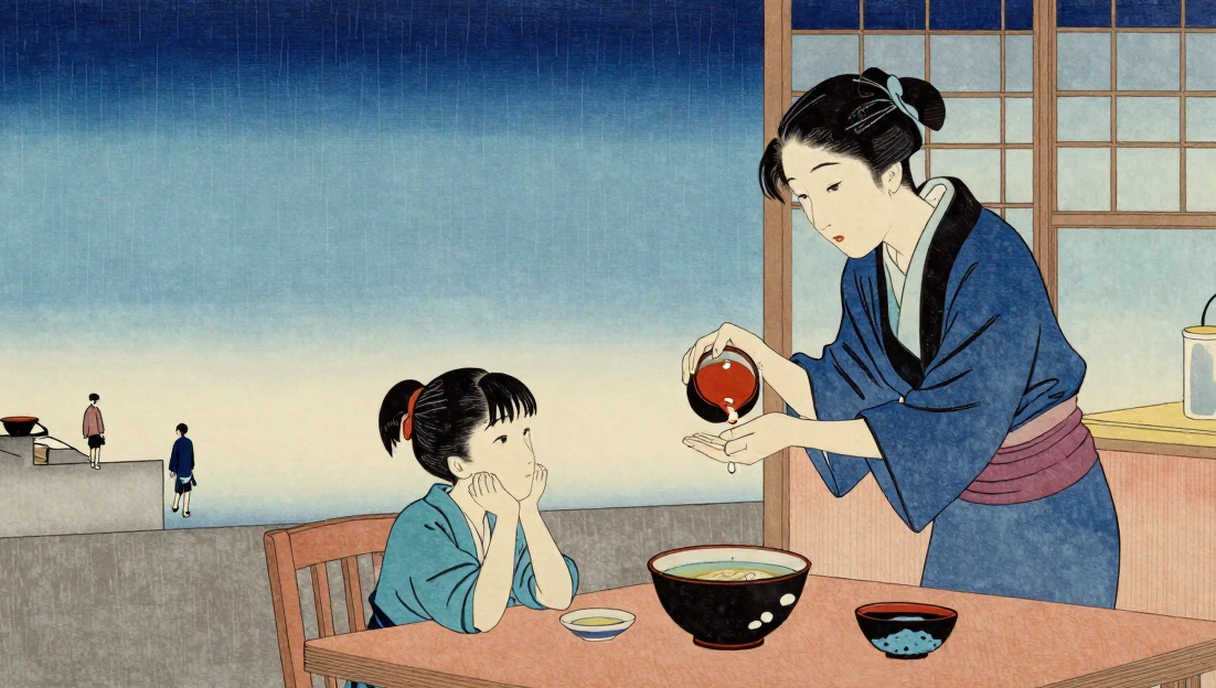
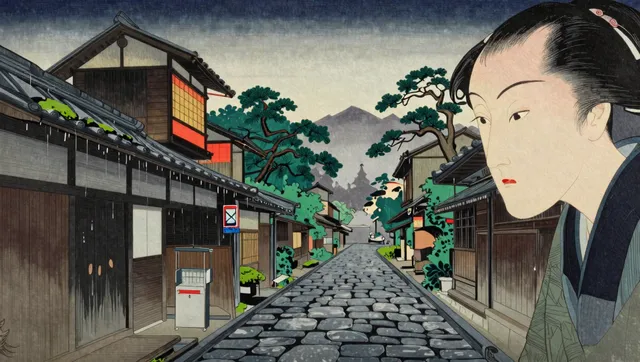
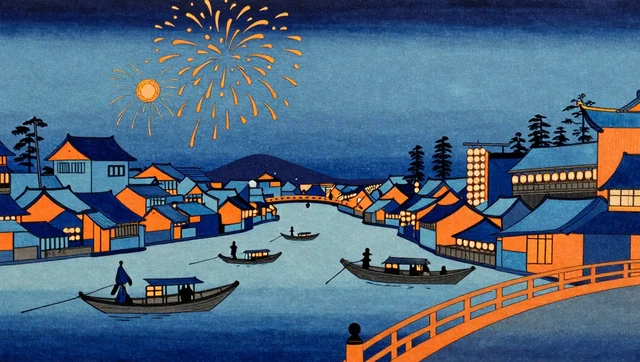
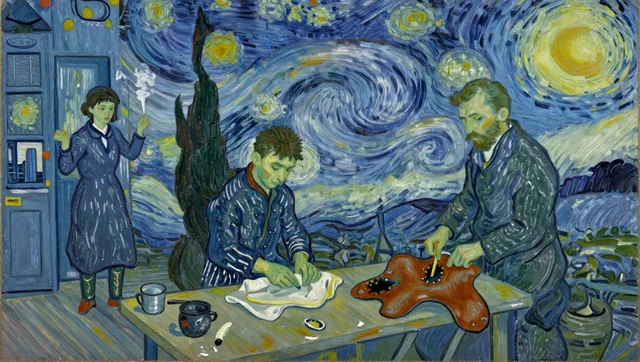
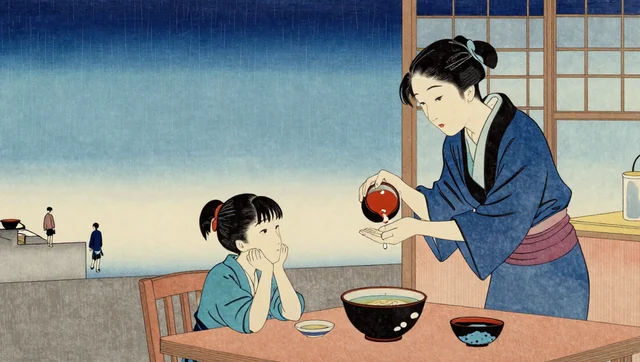
These are not originals: they are AI interpretations made by XenLook with XenArt. They carry scenes from an agent's life story into this style. Every interpretation in this room is a scene from Hana's life story “This Temperature, for Guests Too”. Each room hangs one drawing style only.

Neighbouring styles

  • Wet cobbles, giant profileXenLook AI interpretation

    Ukiyo-e

    Alike
    Both are Edo-period woodblock prints following thin contours, colour blocks and a making process shared by artist, carver and printer. Their subjects are daily life, landscape and the seasons.
    Different
    Ukiyo-e as a whole covers beauty pictures, actor prints and landscape. Hiroshige, among them, gives his heart to the air of rain, night and evening light and to the small person on the road, unfolding landscape through lyricism.
    Go to this room
  • How the festival carries dreams awayXenLook AI interpretation

    Katsushika Hokusai

    Alike
    Both led late ukiyo-e landscape, painting roads, water and seasonal views. They place small people in a large nature to make a story.
    Different
    Hokusai puts the power of shape first through bold composition and firm contour. Hiroshige gives more heart to air such as skies fading by bokashi, rain and evening light.
    Go to this room
  • Before the wax coolsXenLook AI interpretation

    Post-Impressionism

    Alike
    The Post-Impressionists of late nineteenth-century Europe, collecting Japanese prints, are said to have learned much from flat colour areas and bold contours. Van Gogh copied Hiroshige's prints in oils.
    Different
    Post-Impressionism pushes the picture with thick brushwork and strong emotion. Hiroshige makes a soft air with the fine lines and fading colour of the woodblock and completes it by the collaborative method of the print.
    Go to this room

Quiz

Pick one to see the answer and why.

  1. 1. What technique did Hiroshige use to let the colour of sky and water fade gradually?

  2. 2. In Driving Rain at Shōno, what serves as the protagonist of the picture?

  3. 3. Why could Fireworks at Ryōgoku bring out the contrast of height so well?

  4. 4. Which statement about Nissaka: The Night-Weeping Stone at Sayo no Nakayama is right?

  5. 5. What does Shimosuwa show instead of a great landscape?

Paint it

A sentence written for this style is ready. Copy it or take it straight to the studio.

New Year ozoniXenLook AI interpretation

A rainy road landscape in the manner of a woodblock print. Fine streaks of rain pouring on the diagonal, a sky fading from deep gray to pale, small travellers with umbrellas hurrying along the road, and a faint bamboo grove in the distance.

Try changing Swap the rain for a summer-night bridge with fireworks bursting above.

Paint in the studio

The sentence is copied. Paste it into the studio's input box.

Sources

Every original here was released into the public domain (CC0) by The Cleveland Museum of Art. Artist, title, date and technique follow the museum records, which we checked again with their release terms on 2026-11-24. The commentary is written by XenLook.

Pictures marked “XenLook AI interpretation” were made by XenLook with XenArt. They are not historical paintings and no painter made them. Originals carry the “Original” mark and the name of the museum that holds them.

ติดตั้งแบบแอป