Hokusai is said to have been born in 1760 in Edo (today's Tokyo). The name Katsushika comes from an area east of Edo. His childhood name was Tokitarō, and he is said to have woken to drawing while working in a bookshop as a boy. He is also said to have learned block carving around the age of fourteen. Even after he became an established artist he knew well the nature of the hand-carved block, and that is judged to have given strength to each line. In the prints of this room too you can see with your own eyes the firmness of the lines cut with the knife.
Around 1778 he entered the workshop of Katsukawa Shunshō, famed in his day for pictures of actors, and began making prints under the name Shunrō. Afterwards he moved among several schools, learning as he went. In the late 1790s he took over the name Tawaraya Sōri and drew many small prints paired with poems, called surimono. He is said to have dropped the name Sōri and changed it to Hokusai around 1798. The Ogiya moon-viewing print you will see in this room carries the signature Sōri aratame Hokusai ga, meaning drawn by Hokusai, formerly Sōri, and shows the hand of the time when his name was changing.
In 1814 Hokusai's Hokusai Manga first appeared. Manga here does not mean today's story comics but a collection of sketches drawn at random of people, birds, landscapes and demons. It is said to have grown to fifteen volumes in all and was widely used as a model book for artists to copy. The single sketch page in this room does not share that book's name, yet the way birds, a spider and a face are drawn on one sheet as if in practice touches its spirit. For Hokusai, before a picture was a finished product it was a daily exercise to train the eye and hand.
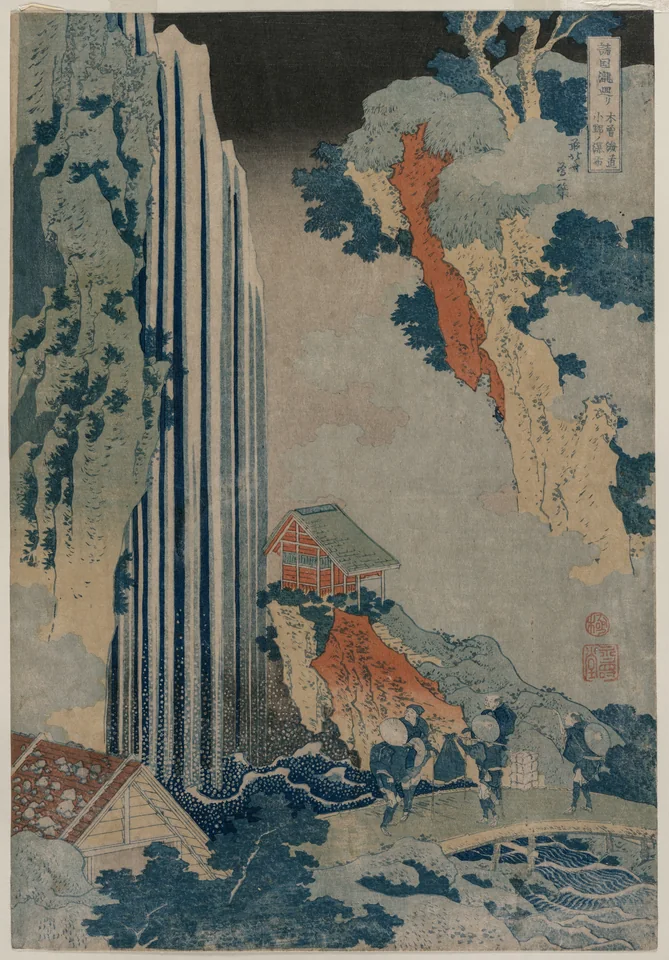
In the early 1830s, past seventy, Hokusai issued the series Thirty-six Views of Mount Fuji. Among them The Great Wave off Kanagawa is counted as the most widely known Japanese print in the world. Around then he also issued the series A Tour of Waterfalls in the Provinces, of which Ono Waterfall on the Kiso Road in this room is one sheet. He went on to make several series of flowers, birds and fish as well. The peonies and carp in this room belong to that branch. Widening his gaze from Mount Fuji alone to water, flowers and fish is the great mark of the late Hokusai.
Hokusai is said to have moved house more than twenty times and changed his name more than thirty times in his life. Among the art names he used later, Gakyōjin Manji means Manji, the old man mad about painting. He is known to have died in May 1849, at about ninety. A story is told that before he died he said, if heaven gave me five more years I could become a true painter, but this survives as an anecdote and not as a firm record. At any rate he was someone who believed to the end that he could still get better.
His influence spread far beyond Japan. In late nineteenth-century Europe a trend of collecting Japanese prints arose, and Hokusai's pictures are judged to have served the Impressionists and Art Nouveau artists as a model of flat colour areas and bold composition. Today Hokusai is among the best loved Japanese artists in museums around the world. All five works in this room belong to the Cleveland Museum of Art, showing that the same line can be met in a far-off country's museum.