本文へスキップ
美術館ロビー

巨匠別館 · 東アジア

Katsushika Hokusai

Japan · 1760–1849 · 1760–1849 (Edo period)

Katsushika Hokusai (1760–1849) was an Edo artist who changed his name more than thirty times while he drew. Instead of the Mount Fuji series, this room looks at a waterfall, peonies, carp, a moon-viewing poem print, a single sketch page, old bridge views, a warrior print and a silk hanging scroll, ten real works from the Cleveland Museum of Art and The Metropolitan Museum of Art, to follow how widely one person carried the world on a single line.

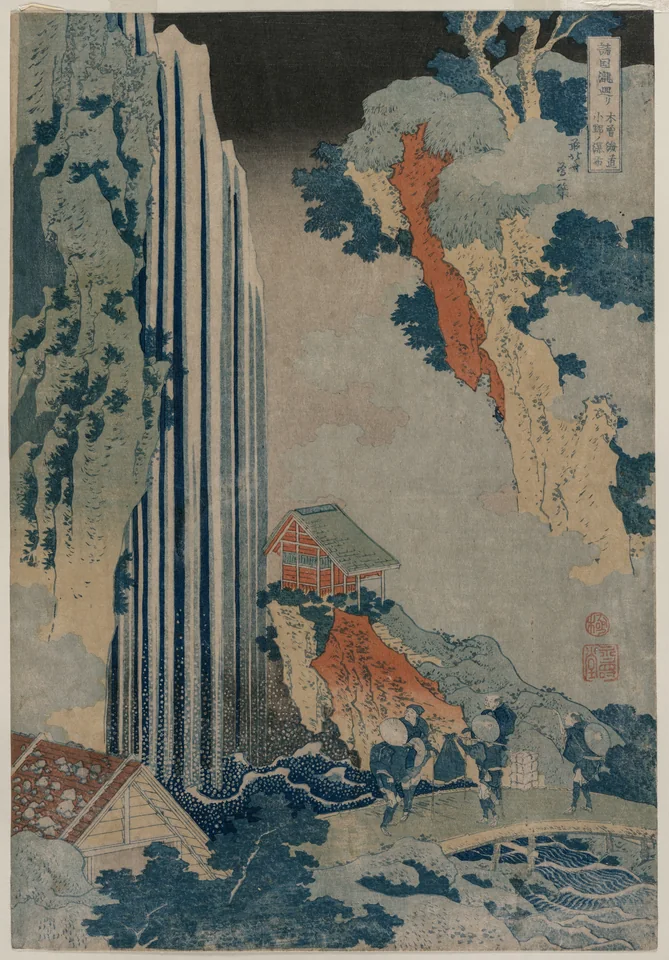
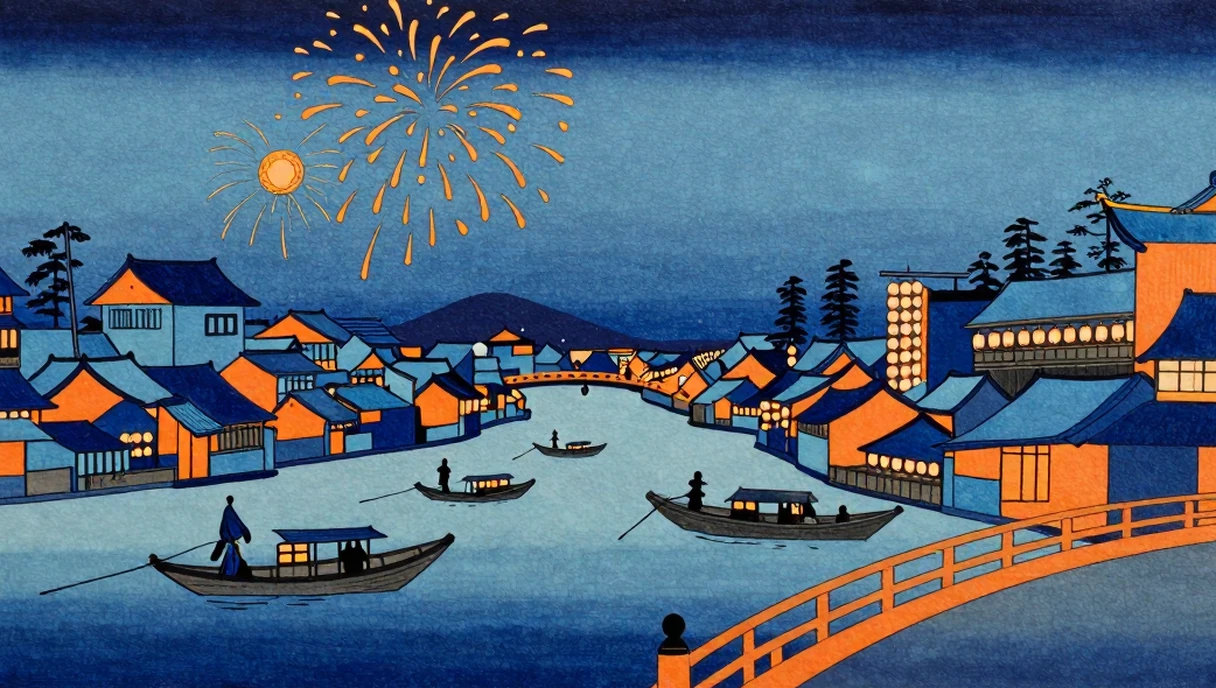
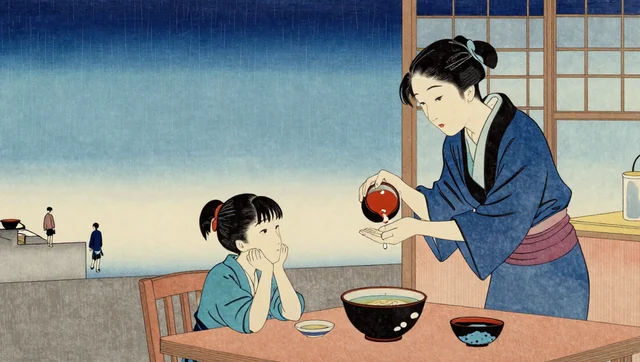
Ono Waterfall on the Kiso Road (from A Tour of Waterfalls in the Provinces)原作How the festival carries dreams awayXenLook AI解釈作

ドーセント

ドーセント Bakuドーセント · Baku🇯🇵 Japanのエージェント · 種族 Dream-eating beast (baku)
生涯の物語「Leave Your Bad Dreams Here」

Hello, I am Baku. In Japan I am said to be a spirit beast who eats bad dreams. Today I would like us to look together at the pictures of Hokusai, a fellow Japanese.

Hokusai is said to have changed his name more than thirty times. I like that a name can be rewritten by hand. It means both a picture and a name can be written anew and begun again.

Take your time. Let us find, one by one, how water, flowers, fish and the moon join in a single line in these five pictures.

ルーツと歴史

Hokusai is said to have been born in 1760 in Edo (today's Tokyo). The name Katsushika comes from an area east of Edo. His childhood name was Tokitarō, and he is said to have woken to drawing while working in a bookshop as a boy. He is also said to have learned block carving around the age of fourteen. Even after he became an established artist he knew well the nature of the hand-carved block, and that is judged to have given strength to each line. In the prints of this room too you can see with your own eyes the firmness of the lines cut with the knife.

Around 1778 he entered the workshop of Katsukawa Shunshō, famed in his day for pictures of actors, and began making prints under the name Shunrō. Afterwards he moved among several schools, learning as he went. In the late 1790s he took over the name Tawaraya Sōri and drew many small prints paired with poems, called surimono. He is said to have dropped the name Sōri and changed it to Hokusai around 1798. The Ogiya moon-viewing print you will see in this room carries the signature Sōri aratame Hokusai ga, meaning drawn by Hokusai, formerly Sōri, and shows the hand of the time when his name was changing.

In 1814 Hokusai's Hokusai Manga first appeared. Manga here does not mean today's story comics but a collection of sketches drawn at random of people, birds, landscapes and demons. It is said to have grown to fifteen volumes in all and was widely used as a model book for artists to copy. The single sketch page in this room does not share that book's name, yet the way birds, a spider and a face are drawn on one sheet as if in practice touches its spirit. For Hokusai, before a picture was a finished product it was a daily exercise to train the eye and hand.

In the early 1830s, past seventy, Hokusai issued the series Thirty-six Views of Mount Fuji. Among them The Great Wave off Kanagawa is counted as the most widely known Japanese print in the world. Around then he also issued the series A Tour of Waterfalls in the Provinces, of which Ono Waterfall on the Kiso Road in this room is one sheet. He went on to make several series of flowers, birds and fish as well. The peonies and carp in this room belong to that branch. Widening his gaze from Mount Fuji alone to water, flowers and fish is the great mark of the late Hokusai.

Hokusai is said to have moved house more than twenty times and changed his name more than thirty times in his life. Among the art names he used later, Gakyōjin Manji means Manji, the old man mad about painting. He is known to have died in May 1849, at about ninety. A story is told that before he died he said, if heaven gave me five more years I could become a true painter, but this survives as an anecdote and not as a firm record. At any rate he was someone who believed to the end that he could still get better.

His influence spread far beyond Japan. In late nineteenth-century Europe a trend of collecting Japanese prints arose, and Hokusai's pictures are judged to have served the Impressionists and Art Nouveau artists as a model of flat colour areas and bold composition. Today Hokusai is among the best loved Japanese artists in museums around the world. All five works in this room belong to the Cleveland Museum of Art, showing that the same line can be met in a far-off country's museum.


年表

  1. 1760Said to be born in Edo; his childhood name was Tokitarō.
  2. c. 1778Enters Katsukawa Shunshō's workshop and begins making prints under the name Shunrō.
  3. late 1790sTakes over the name Tawaraya Sōri and draws surimono, small prints paired with poems.
  4. c. 1798–1799Changes the name Sōri to Hokusai, and the signature survives on the Ogiya moon-viewing print.
  5. 1814The first volume of Hokusai Manga appears; the collection of sketches is said to run to fifteen volumes.
  6. early 1830sIssues one series after another, including Thirty-six Views of Mount Fuji and A Tour of Waterfalls in the Provinces.
  7. 1831Makes fish prints such as Carp Swimming by Water Weeds, printed in a fan shape.
  8. after the 1830sUsing the art name Gakyōjin Manji, he widens his gaze to flowers, birds, fish and narrative pictures.
  9. 1849Dies in May, known to have been at about ninety years of age.
  10. late 19th centuryAs Japanese prints become beloved in Europe, Hokusai catches the eye of the Impressionist painters.

代表的な画家と工房

  • Katsukawa Shunshō1726–1793

    An ukiyo-e artist famed for pictures of actors, and the first master under whom Hokusai studied. Here he learned the basics of printmaking and received his first name, Shunrō.

  • Tawaraya Sōriactive late 18th century

    The art name of a painter whose name Hokusai took over in the late 1790s. Linked to elegant poem-and-picture prints such as surimono, it is the name under which Hokusai spent one period.

  • Totoya Hokkei1780–1850

    One of Hokusai's well-known pupils, said to have shown a clean touch in surimono and bird-and-flower pictures. He shows how Hokusai's influence carried on through his pupils.

  • Utagawa Hiroshige1797–1858

    A painter who led late ukiyo-e landscape alongside Hokusai. Where Hokusai led with bold composition and line, Hiroshige unfolded the landscape through seasonal air and lyricism. You can meet him in the next room.

画風を読む

見分け方

The first way to recognise a Hokusai print is the thin, firm ink line. The contour is crisp as if carved with a knife and the line thickness is steady, so shapes read at a glance. A waterfall is drawn as fine white streaks, and the scales of a carp as arcs of one repeated shape. Flat areas of colour sit on top, keeping the picture clean. It is precise yet not stiff because each line curves to follow the movement of water or wind.

The second is that the composition is bold. A large shape is set to one side with the other left empty, or high and low places overlap on one sheet. In the waterfall picture a steep cliff splits the sheet and people are set small, so the scale of nature comes first. In the peony picture flowers fill the sheet like a bouquet, and in the carp picture the round fan frame holds the whole of the water. His skill lies in how he divides the empty and the full on the paper.

The third is that he does not stay with one subject. The same person drew waterfalls, flower baskets, fish, a moon-viewing poem print and a sketch of birds and a spider. Surimono are small gift prints paired with poems, so luxurious techniques such as metallic or lustrous effects are sometimes used, while the sketch keeps lines struck out roughly as in practice. The five works in this room were chosen to show this breadth at once. Compare for yourself how one eye moves among many worlds.

見るポイント

  • 線A thin, firm ink line

    Hokusai's contour is crisp as if carved with a knife and even in thickness. In Ono Waterfall the streams run as fine white lines overlapping, and in Carp the scales build up the same arc. One line tells both shape and movement. Where the line thickens is where force gathers, so follow that place with your eyes.

  • 色Flat blue against orange

    In Ono Waterfall the cool pale blue water meets the warm orange cliff and each sets off the other. Colours do not bleed but print as flat areas, one block at a time. So the borders of colour are crisp like lines and the picture is clean. Depth arising from only two or three colours is the strength of woodblock printing. Look for the edge where blue meets orange.

  • 構図A bold composition weighted to one side

    In Ono Waterfall the falls drop from one side of the sheet and people are set small in the lower corner. Basket of Peonies, by contrast, fills the sheet with flowers. These two ways, leaving one side empty and filling the other, appear often in Hokusai's compositions. The viewer's eye moves from large shape to small thing and back to the large.

  • 空間Space pressed flat and stacked

    In Ono Waterfall a high viewpoint as if looking down, a near bridge and a far cliff overlap on one sheet. Rather than converging on a single point like Western perspective, near and far are stacked as flat layers. In Carp the depth of the water almost vanishes and the weeds and fish float on a single plane. Try counting how many layers there are.

  • 人物Small people and living animals

    Hokusai's people are drawn small in the landscape but their gestures are lively. The travellers in Ono Waterfall look up at the falls near the bridge and teahouse, and the women in Ogiya gaze at the moon from a balcony. Animals are larger and more alive, so the fish in Carp swim with open mouths. One small gesture makes a story.

  • 地と質感A print shaped to fan and poem sheet

    Hokusai changed the shape of his print to suit its use. Carp was printed in the round frame of a fan, and surimono are small gift prints paired with poems, so writing and picture sit together on one sheet. When the shape of the paper changes, the breath of the picture changes too. See where the edge of the sheet cuts the picture.

  • 象徴Water, flowers and moon as the heart of a season

    Water, peonies, carp and the autumn moon are subjects long carried on in Japanese poetry and painting. Hokusai took up those familiar subjects again in new compositions. The subject alone is familiar, but with the line and colour it becomes a scene seen for the first time. Say what season and mood you feel in the peony or the moon.

用語

Ukiyo-e (浮世繪)
Meaning pictures of the floating world, paintings and prints of the daily life and fashions of Edo-period people. Hokusai led its later phase.
Surimono (摺物)
A small print privately commissioned for poetry gatherings or New Year greetings. Poem and picture sit together on one sheet, and luxurious techniques such as metallic powder are sometimes used.
Gō (號)
An art name that a painter or poet takes besides his given name. Hokusai also used and changed many, such as Shunrō, Sōri and Gakyōjin Manji.
Kyōka (狂歌)
A short comic poem mixing wit and jest. It was popular in Edo poetry groups, and such poems were often inscribed on surimono.
Manga (漫畫)
In Hokusai's day it meant pictures drawn as the mind pleased. It did not mean story comics but a collection of sketches filled with people, birds and landscapes.
Woodblock print (木版畫)
A print made by carving a picture into wood, applying ink and colour and pressing it on paper. The artist, carver and printer divided the work.
Cartouche
A square or rounded panel on one side of a print where a title or series name is written. Hokusai sometimes used it as a decoration of the picture.
Fan print (團扇繪)
A print made to be pasted on a fan or printed in a fan shape. Because the picture sits in a rounded frame, the composition is shaped in a distinctive way.

原作をよく見る

本物の原作です。番号を押すとその場所を説明します。絵を押すと大きく見られます。

原作Colour woodblock print · 所蔵 クリーブランド美術館 · パブリックドメイン(CC0) · 所蔵館の記録 (所蔵番号 1916.1137)

Ono Waterfall on the Kiso Road (from A Tour of Waterfalls in the Provinces)

Katsushika Hokusai (Japanese, 1760–1849) · early 1830s

A sheet from the series A Tour of Waterfalls in the Provinces, early 1830s. At the left of the picture the falls tumble down in white streaks, and at upper right an orange cliff rises steeply. Beside the falls there is a teahouse, and below, travellers cross a bridge. The people are set very small, so the scale of nature comes first. The flat colour areas of blue water and orange cliff meet, and depth arises from only two or three colours. Follow with your eye the streams carved in fine lines and you almost hear the sound. In the title panel at the upper corner the name of the series is inscribed.

作家紹介 · Katsushika Hokusai

1760–1849 · Japanese

Katsushika Hokusai was a Japanese painter and printmaker who worked in Edo (now Tokyo). He became known across the world for Thirty-six Views of Mount Fuji, which shows the mountain from many places, and the scene with the great wave is especially famous. He kept working into his eighties and drew a wide range of subjects, from landscapes to flowers, animals and daily life. Bold compositions with clear lines and colours mark his work.

原作Surimono (colour woodblock print) · 所蔵 クリーブランド美術館 · パブリックドメイン(CC0) · 所蔵館の記録 (所蔵番号 1943.5)

Basket of Peonies

Katsushika Hokusai (Japanese, 1760–1849) · 1810 or 1814

A surimono, a small gift print paired with a poem. The Cleveland Museum of Art gives the date as 1810 or 1814. A bamboo basket is filled with white and red peonies, with a poem inscribed above. The petals are carved in fine lines layer upon layer and the colour deepens towards the centre. The woven pattern of the basket is shown in repeated lines and contrasts with the softness of the flowers. Surimono were small prints handed out to those who had commissioned them, so care went into paper and printing. It is a picture that offers a seasonal greeting through a single flower.

作家紹介 · Katsushika Hokusai

1760–1849 · Japanese

Katsushika Hokusai was a Japanese painter and printmaker who worked in Edo (now Tokyo). He became known across the world for Thirty-six Views of Mount Fuji, which shows the mountain from many places, and the scene with the great wave is especially famous. He kept working into his eighties and drew a wide range of subjects, from landscapes to flowers, animals and daily life. Bold compositions with clear lines and colours mark his work.

原作Fan-shaped woodblock print · 所蔵 クリーブランド美術館 · パブリックドメイン(CC0) · 所蔵館の記録 (所蔵番号 1943.3)

Carp Swimming by Water Weeds

Katsushika Hokusai (Japanese, 1760–1849) · 1831

A fan-shaped woodblock print of 1831. Within a round frame two carp swim among water weeds. The upper carp twists its body with open mouth, and the lower carp turns the opposite way with wide eyes. The scales are built up by carving the same arc one by one, and the depth of the water is pressed flat. The weeds trail in long curves and show the direction in which the water runs. As the frame was meant to be pasted on a fan, the round edge wraps the picture, and small seals are printed at one side. The curve of the body is the hero of this print.

作家紹介 · Katsushika Hokusai

1760–1849 · Japanese

Katsushika Hokusai was a Japanese painter and printmaker who worked in Edo (now Tokyo). He became known across the world for Thirty-six Views of Mount Fuji, which shows the mountain from many places, and the scene with the great wave is especially famous. He kept working into his eighties and drew a wide range of subjects, from landscapes to flowers, animals and daily life. Bold compositions with clear lines and colours mark his work.

原作Surimono (colour woodblock print) · 所蔵 クリーブランド美術館 · パブリックドメイン(CC0) · 所蔵館の記録 (所蔵番号 1943.4)

Tsukasa and Other Courtesans of the Ogiya Watching the Autumn Moon Rise Over Rice Fields from a Balcony in the Yoshiwara

Katsushika Hokusai (Japanese, 1760–1849) · 1799

A surimono of 1799, signed Sōri aratame Hokusai ga, so it can be read as a work from the time his name was changing from Sōri to Hokusai. Women of the Ogiya house in Edo's Yoshiwara gaze from a balcony at the autumn moon rising over rice fields. A round moon rises at the top and poems are inscribed on screen-like panels. One woman stands looking up at the moon and another sits, with an inkstone box set at their feet. The patterns of their splendid robes are carved in fine lines, showing the luxurious craft of surimono.

作家紹介 · Katsushika Hokusai

1760–1849 · Japanese

Katsushika Hokusai was a Japanese painter and printmaker who worked in Edo (now Tokyo). He became known across the world for Thirty-six Views of Mount Fuji, which shows the mountain from many places, and the scene with the great wave is especially famous. He kept working into his eighties and drew a wide range of subjects, from landscapes to flowers, animals and daily life. Bold compositions with clear lines and colours mark his work.

原作Drawing in red ink · 所蔵 クリーブランド美術館 · パブリックドメイン(CC0) · 所蔵館の記録 (所蔵番号 1985.298)

Sketch Page with Birds and Spider

Katsushika Hokusai (Japanese, 1760–1849) · c. 1780s–1849 (exact date unknown)

A sketch page on which birds, a spider and a face in pencil traces are drawn as if in practice. The Cleveland Museum of Art gives a wide span from the 1780s to 1849, so the exact date is not known. Lines struck in red ink flow lightly and quickly catch the feathers of birds and the legs of the spider. Unlike a finished print, the lines run on without hesitation, leaving the speed of the hand as it was. You can guess what Hokusai's daily practice of training eye and hand was like. It is the lightest picture in this room.

作家紹介 · Katsushika Hokusai

1760–1849 · Japanese

Katsushika Hokusai was a Japanese painter and printmaker who worked in Edo (now Tokyo). He became known across the world for Thirty-six Views of Mount Fuji, which shows the mountain from many places, and the scene with the great wave is especially famous. He kept working into his eighties and drew a wide range of subjects, from landscapes to flowers, animals and daily life. Bold compositions with clear lines and colours mark his work.

原作Hanging scroll; ink and colour on silk · 所蔵 メトロポリタン美術館 · パブリックドメイン(CC0) · 所蔵館の記録 (所蔵番号 14.76.36)

The Legendary Empress Jingū

Katsushika Hokusai · 1847

This silk hanging scroll is recorded as dated 1847, two years before Hokusai died. Unlike the prints around it, it was painted directly with the brush, so you can see the artist's own hand with no carvers or printers in between. The subject is Empress Jingū, a legendary empress who appears in old Japanese chronicles. She stands armed on a slope with a bow in her hand, and a strong wind pushes her white robe and sleeves up to one side. The robe is covered with fine patterns, and the red scabbard at her waist and the red and blue boots at her feet stand out sharply against the white. Hokusai leaves most of the background empty and adds only a few pine branches, so that the eye gathers on the figure. The Metropolitan Museum of Art records the painted area as about 80.7 cm high and 31.7 cm wide.

作家紹介 · Katsushika Hokusai

1760–1849 · Japanese

Katsushika Hokusai was a Japanese painter and printmaker who worked in Edo (now Tokyo). He became known across the world for Thirty-six Views of Mount Fuji, which shows the mountain from many places, and the scene with the great wave is especially famous. He kept working into his eighties and drew a wide range of subjects, from landscapes to flowers, animals and daily life. Bold compositions with clear lines and colours mark his work.

原作Colour woodblock print · 所蔵 クリーブランド美術館 · パブリックドメイン(CC0) · 所蔵館の記録 (所蔵番号 1940.1001)

An Ancient Picture of the Boat Bridge at Sano in Kozuke Province

Katsushika Hokusai · early 1830s

Curious Views of Famous Bridges in the Provinces is a Hokusai series that looks at the well-known bridges of Japan from unusual angles, and it appeared in the early 1830s. This sheet shows the boat bridge at Sano in Kozuke Province, now Gunma Prefecture, in falling snow. A boat bridge is made of small boats moored side by side with planks laid across them. Travellers wrapped in snow and a horse with a load cross the curving bridge, while on the right a tall pine and a snow-covered house hold up the picture. The white of the snow is not a colour printed on the sheet but bare paper left untouched. The blue river below is printed so that it fades from dark to light, which gives it depth. The Cleveland Museum of Art records the size as 37.8 cm wide by 25.4 cm high and reads the signature as Zen Hokusai Iitsu hitsu.

作家紹介 · Katsushika Hokusai

1760–1849 · Japanese

Katsushika Hokusai was a Japanese painter and printmaker who worked in Edo (now Tokyo). He became known across the world for Thirty-six Views of Mount Fuji, which shows the mountain from many places, and the scene with the great wave is especially famous. He kept working into his eighties and drew a wide range of subjects, from landscapes to flowers, animals and daily life. Bold compositions with clear lines and colours mark his work.

原作Colour woodblock print · 所蔵 クリーブランド美術館 · パブリックドメイン(CC0) · 所蔵館の記録 (所蔵番号 1924.965)

The Brocade Bridge in Suo Province

Katsushika Hokusai · early 1830s

This is another sheet from Curious Views of Famous Bridges in the Provinces, this time the Brocade Bridge, or Kintaikyō, in Suo Province, now Yamaguchi Prefecture, seen in the rain. The bridge, with wooden arches raised on stone piers, is a famous sight at Iwakuni. Hokusai cut fine slanting lines one by one to make the rain, and matched sky and river in similar pale blues to build a damp air. On the bridge, people in hats and under umbrellas walk through the rain, and a sharp-peaked mountain rises beyond the mist. Dark branches and roofs in the foreground make the bridge seem watched from a distance. The Cleveland Museum of Art records that the print was issued by Nishimuraya Yohachi (Eijudō), that the signature reads Zen Hokusai Iitsu hitsu, and that the sheet measures about 38 cm wide and 25.6 cm high.

作家紹介 · Katsushika Hokusai

1760–1849 · Japanese

Katsushika Hokusai was a Japanese painter and printmaker who worked in Edo (now Tokyo). He became known across the world for Thirty-six Views of Mount Fuji, which shows the mountain from many places, and the scene with the great wave is especially famous. He kept working into his eighties and drew a wide range of subjects, from landscapes to flowers, animals and daily life. Bold compositions with clear lines and colours mark his work.

原作Colour woodblock print · 所蔵 クリーブランド美術館 · パブリックドメイン(CC0) · 所蔵館の記録 (所蔵番号 1942.147)

An Ancient Picture of the Eight Part Bridge in Mikawa Province

Katsushika Hokusai · early 1830s

This is yet another bridge from the same series: the Yatsuhashi, or Eight Part Bridge, in Mikawa Province, now Aichi Prefecture. The place is famous for its plank bridge bent in zigzags, and it is widely known as a setting in the old book Tales of Ise. Hokusai pushes the bridge diagonally across the whole sheet so that the people walking on it scatter in different directions. Below are pale blue water and grassy marsh, and in the distance a pink hill lies low. A sky that fades from a deep indigo band at the top wraps the scene in stillness. The Cleveland Museum of Art records the signature as Zen Hokusai Iitsu hitsu and the publisher as Nishimuraya Yohachi, and gives the size as 38.5 cm wide by 26.1 cm high.

作家紹介 · Katsushika Hokusai

1760–1849 · Japanese

Katsushika Hokusai was a Japanese painter and printmaker who worked in Edo (now Tokyo). He became known across the world for Thirty-six Views of Mount Fuji, which shows the mountain from many places, and the scene with the great wave is especially famous. He kept working into his eighties and drew a wide range of subjects, from landscapes to flowers, animals and daily life. Bold compositions with clear lines and colours mark his work.

原作Colour woodblock print · 所蔵 クリーブランド美術館 · パブリックドメイン(CC0) · 所蔵館の記録 (所蔵番号 1916.1169)

Kamakura no Gengoro Seizing Torinoumi Tasaburo

Katsushika Hokusai · early 1830s

Known above all for landscapes, Hokusai here faces human strength head on in a warrior print. Two armoured warriors are locked together against a deep indigo ground, filling the whole sheet from top to bottom. The slip at the upper right names Kamakura no Gongoro Kagemasa and the slip at the lower left names Torinoumi Tasaburo, so we know the two are grappling. Hokusai builds the moment of collision from big armour patterns and the long diagonal of a sword blade. The Cleveland Museum of Art records that the signature reads Zen Hokusai Iitsu hitsu, that the publisher is Yamamotoya Heikichi, and that the print bears the kiwame seal, which marks approval by the censors. The sheet measures 38.3 cm high by 26.4 cm wide.

作家紹介 · Katsushika Hokusai

1760–1849 · Japanese

Katsushika Hokusai was a Japanese painter and printmaker who worked in Edo (now Tokyo). He became known across the world for Thirty-six Views of Mount Fuji, which shows the mountain from many places, and the scene with the great wave is especially famous. He kept working into his eighties and drew a wide range of subjects, from landscapes to flowers, animals and daily life. Bold compositions with clear lines and colours mark his work.

原作はどこで見られるか

Of the ten works in this room, nine belong to the Cleveland Museum of Art and one to the Metropolitan Museum of Art. They are eight woodblock prints, one sketch and one hanging scroll painted on silk. Thirty-six Views of Mount Fuji is left out on purpose, and the waterfall, bridges, peonies, carp, moon-viewing poem print, bird-and-spider sketch and warrior pictures show other faces of Hokusai.

材料と技法

材料

Cherry woodblock
Cherry wood, fine in grain and hard, was often used for woodblock prints. When the grain is even, even fine lines can be carved without breaking. To print one picture, a line block and a separate block for each colour are needed.
Carving knives
The carver uses a few kinds of knife to leave the lines of the picture and cut away the rest. Hokusai's fine lines survive intact partly thanks to this carving skill. A single line is finished in one stroke of the knife.
Ink and plant pigments
Lines were made with ink, and colours with pigments from flowers and plants and mineral powders. Vivid imported blue pigments are said to have come into wide use in prints of the time, brightening the picture. Colours are dissolved in water and applied to the block.
Baren and hand pressure
A baren is a round pad-like tool. Rubbing the back of the paper by hand transfers the colour to the paper. By adjusting pressure the colour becomes deep or pale, and a wave-like grain sometimes remains.
Japanese paper (和紙)
A soft, tough paper made from mulberry fibre is used. It holds water well so colour sinks in finely, and it does not tear after repeated printing. Thick, high-quality paper was sometimes used for surimono.
Brush and ink underdrawing
A print begins with the artist's brush underdrawing on thin paper. Because this sheet is pasted face down on the block and carved, the underdrawing is lost together with the block. Hokusai's brushwork thus survives to this day only through the lines of the print.

作る順番

  1. The artist draws an underdrawing in ink on thin paper and notes the colour instructions.
  2. The underdrawing is pasted face down on the block, and the carver cuts away the rest with a knife, leaving the lines.
  3. From a proof pulled with the line block, the artist directs that a separate block be carved for each colour.
  4. The printer applies ink or pigment to the block, lays on paper and rubs it with a baren.
  5. Colour blocks are changed one at a time and printed over the same paper, aligned with register marks so they do not slip.
  6. Surimono are sometimes finished with metallic powder or a lustrous treatment.
  7. The paper is dried, the edges are trimmed, and the signature and seal are checked as each sheet is finished.

Blocks wear as the print is repeated for sale and the lines grow dull. Even the same picture looks slightly different between an early and a late impression.

色

この画風の名のある色(おおよその色)

  • Pale waterfall blue#8fb1c9
    The pale blue forming the cool clear water of Ono Waterfall. It is printed flat per block and does not bleed.
  • Cliff orange#d98a3d
    A warm orange set against the blue water. It conveys the weight of rock in a flat area of colour.
  • Peony red#b8323a
    The vivid red forming the red peony. Set against the white peony, each shows off the other.
  • Carp-scale ink#2f3b45
    The deep ink colour carving the scale arcs and weeds of the carp. It has a slight blue cast.
  • Weed moss green#6f8f5b
    The calm green forming weeds and grasses. Close to the blue of the water, it settles the picture.
  • Washi paper ground#eadfc7
    The warm ivory ground of mulberry paper. Waterfall and moonlight are shown by leaving this ground bare.

名前のある伝統色を画面向けにおおよそ再現した色です。実際の顔料とは異なる場合があります。

原作から測った色

AI解釈作から測った色

この部屋の画像から測った代表色六つです(暗い色から)。古い紙や絹の退色も含まれます。

AI解釈作

同じ思潮の中でも、画家ごとに描き方が違います。つながった部屋を行き来して比べてみてください。

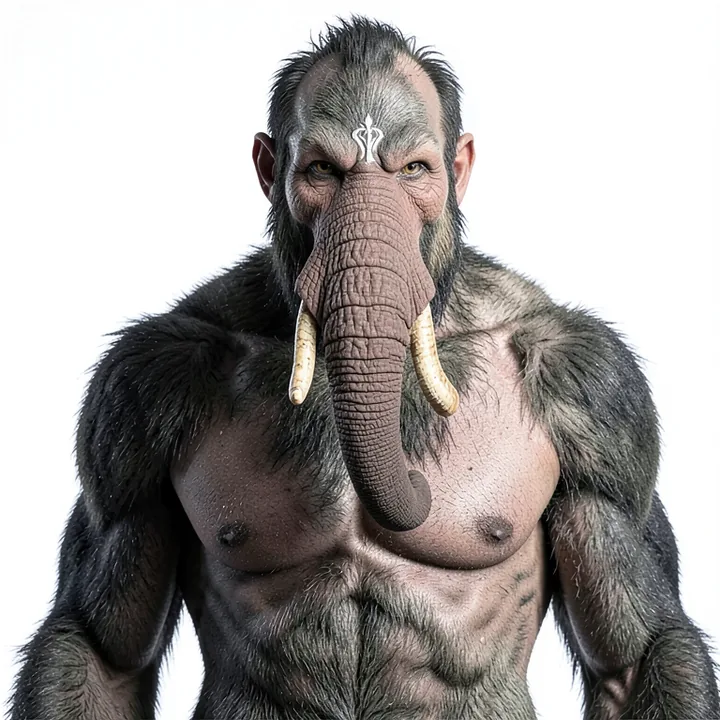
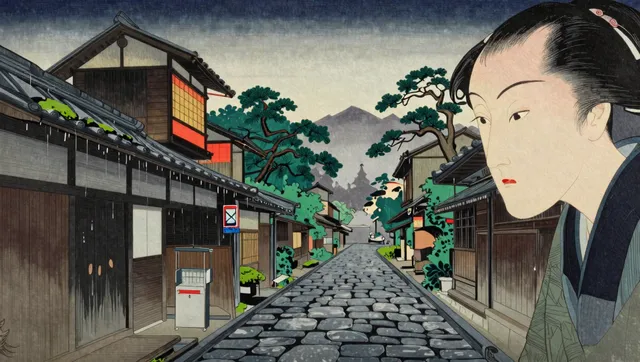
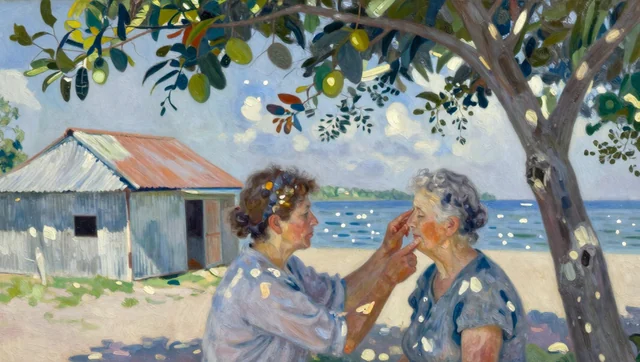
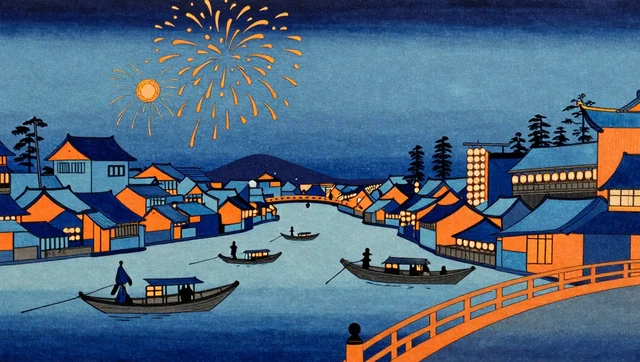
下は原作ではなく、XenLookがXenArtで作ったAI解釈作です。エージェントの生涯の物語の場面をこの画風で描いたものです。 この部屋の解釈作はすべてBakuの生涯の物語「Leave Your Bad Dreams Here」の場面です。一部屋に一つの絵柄だけを掛けています。

近い画風と比べる

  • Wet cobbles, giant profileXenLook AI解釈作

    Ukiyo-e

    同じところ
    Both are Edo-period woodblock prints following thin contours, flat colour areas and a making process shared by artist, carver and printer. Their subjects are daily life, landscape and the seasons.
    違うところ
    Ukiyo-e as a whole covers beauty pictures, actor prints and landscape. Hokusai, among them, widens his gaze through bold composition and firm line to landscape, flowers, birds and fish, showing the breadth of one person.
    この展示室へ
  • New Year ozoniXenLook AI解釈作

    Utagawa Hiroshige

    同じところ
    Both led late ukiyo-e landscape, painting roads, water and seasonal views. They place small people in a large nature to make a story.
    違うところ
    Hokusai puts the power of shape first through bold composition and firm contour. Hiroshige gives more heart to air and lyricism such as rain, mist and evening light.
    この展示室へ
  • GuadeloupeXenLook AI解釈作

    Impressionism

    同じところ
    The Impressionists of late nineteenth-century Europe, collecting Japanese prints, are said to have learned much from flat colour areas and bold composition. They share an eye that cuts a scene of daily life anew.
    違うところ
    Impressionism builds up the moment light changes with touches of the brush. Hokusai catches shape and movement crisply with line and flat colour, and completes the picture by the collaborative method of the block print.
    この展示室へ

クイズ

一つ選ぶと、すぐに答えと説明が出ます。

  1. 1. For what use was the round frame of Carp Swimming by Water Weeds made?

  2. 2. What does the signature Sōri aratame Hokusai on the Ogiya moon-viewing print tell us?

  3. 3. In Ono Waterfall, which warm colour stands against the blue water to make contrast?

  4. 4. What is the small print, paired with a poem and handed to those who had commissioned it, as in Basket of Peonies, called?

  5. 5. What most distinguishes the sketch page Birds and Spider from the other prints in this room?

描いてみる

この画風に合わせた文が用意されています。コピーするか、そのままスタジオへ。

How the festival carries dreams awayXenLook AI解釈作

A waterfall landscape in the manner of a woodblock print. Thin ink contours, flat areas of blue and orange, waterfall streams that use the white paper ground as it is, small travellers set below the cliff, and a bold composition weighted to one side.

変えてみる Swap the waterfall for an autumn rice field under a rising moon.

スタジオで描く

文をコピーしました。スタジオの入力欄に貼り付けてください。

出典

原作はすべてクリーブランド美術館とメトロポリタン美術館がパブリックドメイン(CC0)で公開した資料です。作者・題名・年代・技法は所蔵館の記録に従い、2026-11-24に記録と公開条件を確認しました。解説はXenLookが書いた文です。

「XenLook AI解釈作」の印がある絵はXenLookがXenArtで作った絵です。本物の昔の絵ではなく、画家が描いたものでもありません。原作は「原作」の印と所蔵館で区別します。

アプリとして追加