تخطَّ إلى المحتوى
Museum lobby

Masters annex · The Americas

Winslow Homer

United States · 1836–1910 · 1860s to 1900s

Winslow Homer (1836–1910) was an American painter, born in Boston, who began as a magazine illustrator, drew the front lines of the Civil War, and later painted the crashing surf at Prouts Neck, Maine. Besides oil he gladly used watercolour, wood engraving and etching, and after he began to use watercolour steadily at Gloucester in 1873 he seldom travelled without paper, brushes and paints. The six works in this room show the sea after a storm, girls waiting on a beach, a small canoe on a mountain lake, soldiers asleep in camp, two sailors taking the noon sun, and women working in a field.

Early Morning After a Storm at SeaOriginalPrologue: the longest dayXenLook AI interpretation

Docent

Docent ChloeDocent · Chloe🇺🇸 Agent from United States
Life story “Counting to Three”

Hello, I am Chloe. I grew up by the sea in Santa Cruz, California, and my father was a lifeguard. So in front of a picture of waves my heart runs to the water first. This room belongs to a man who watched the sea for a very long time.

When I cut a film I first decide what goes inside the frame and what stays out. Homer drew for a magazine at the front in wartime, so his eye for choosing what to show and what not to show was unusual.

In front of each picture, go slowly and count only to three. One, who is inside the picture. Two, who is looking at them. Three, what is left outside. Then look once more.

Roots and history

Winslow Homer was born on 24 February 1836 in Boston, Massachusetts. At nineteen he was apprenticed to J. H. Bufford, a commercial lithographer in Boston, and for two years did repetitive work such as sheet-music covers, which Homer later remembered as a treadmill experience. By 1857 he had declined an offer to join the staff of Harper's Weekly and chosen the path of the freelance illustrator. A remark of his is recorded: from the time he took his nose off that lithographic stone he had no master and never would. He opened his own studio in Boston, and his career as an illustrator lasted nearly twenty years. The plain line and sense of large mass he gained there support his work throughout life.

Soon Homer moved to New York, the publishing and art centre of the country. Until 1863 he attended classes at the National Academy of Design and studied briefly with Frederick Rondel, who taught him the basics of oil painting. In about a year of self-training he is said to have been producing excellent oil work. His mother tried to raise family funds to send him to Europe for study, but instead Harper's Weekly sent him to the front lines of the Civil War (1861–1865). He sketched camp and commanders on the banks of the Potomac, quiet moments as well as chaotic ones. The wood engraving Army of the Potomac — Sleeping on Their Arms in this room is a scene printed in Harper's Weekly at that time, showing not the fighting but the weary time.

From his war sketches Homer made oil paintings: Sharpshooter on Picket Duty (1862), Home, Sweet Home (1863) and Prisoners from the Front (1866), and from 1863 to 1866 he showed such subjects at the National Academy of Design every year. In December 1866 Homer sailed from Boston to France and stayed close to a year. During that time Prisoners from the Front hung at the Exposition Universelle in Paris. He did not study formally, but he painted landscape in Paris and in the rural village of Cernay-la-Ville, and the Cleveland Museum of Art explains that the small oil Women Working in a Field in this room was probably painted there. It also notes that the subject resembles the peasant labour Millet painted.

In the summer of 1873 Homer began to use watercolour steadily at Gloucester, Massachusetts. His technique is described as natural, fluid and confident from the start, though critics were at first puzzled; one said a child with an ink bottle could not have done worse. Even so the watercolours sold, improving his finances considerably, and thereafter he seldom travelled without paper, brushes and paints. A Fisherman's Daughter in this room is a watercolour from just that Gloucester period. In 1876 Snap the Whip and Breezing Up were exhibited at the Centennial Exposition in Philadelphia. In 1878 he spent a year as a guest at Houghton Farm in the Adirondacks.

From 1881 to 1882 Homer spent two years in the fishing village of Cullercoats, Northumberland. The subjects of those paintings were working men and women and their daily heroism, and Homer wrote of the women as working bees. In 1883 he moved to Prouts Neck, Maine, living in a remodelled carriage house on the family property seventy-five feet from the ocean. From the mid-1880s he painted monumental sea scenes, and in Eight Bells (1886) two sailors carefully take their bearings on deck. The image was cut as an etching the next year. In the winters of 1884–85 he went to Florida, Cuba and the Bahamas and made a series of watercolours on a commission for Century Magazine. From 1888 to 1903 he also visited Key West often.

Homer often visited the North Woods Club near Minerva, New York, in the Adirondacks, on summer fishing trips, and there experimented with watercolour. Mink Lake, Adirondacks in this room is such a mountain scene. Among his large late paintings is The Gulf Stream (1899), which shows a Black sailor adrift in a damaged boat, surrounded by sharks as a waterspout approaches. By 1900 Homer had finally reached financial stability, because museums paid good prices for his paintings and he received rents from real estate. He died in 1910 at the age of seventy-four in his Prouts Neck studio and was buried in Mount Auburn Cemetery in Cambridge. The studio is a National Historic Landmark, owned by the Portland Museum of Art, which offers tours.


Timeline

  1. 1836Born on 24 February in Boston, Massachusetts.
  2. 1855–57Apprenticed at nineteen to a Boston lithographer, and in 1857 declines a staff post at Harper's Weekly to work freelance.
  3. 1861In October, sent by Harper's Weekly, he sketches the army camps on the banks of the Potomac.
  4. 1862–66Paints war oils such as Sharpshooter on Picket Duty, Home, Sweet Home and Prisoners from the Front.
  5. 1866–67Leaves Boston in December and spends close to a year in France, while Prisoners from the Front hangs at the Paris Exposition Universelle.
  6. 1873In summer begins to use watercolour steadily at Gloucester and paints A Fisherman's Daughter.
  7. 1881–82Spends two years in the fishing village of Cullercoats, Northumberland, painting working men and women.
  8. 1883Moves to Prouts Neck, Maine, and begins living in a remodelled carriage house by the sea.
  9. 1886–87Paints the oil Eight Bells in 1886 and the next year cuts the same scene as an etching.
  10. 1899–1910Paints The Gulf Stream in 1899 and dies in 1910 at seventy-four in his Prouts Neck studio.

Key painters and workshops

  • Winslow Homer1836–1910

    An American painter who began as an illustrator and painted war, sea and working people in oil, watercolour and print. He taught no school but strongly influenced later generations.

  • Jean-François Millet1814–1875

    The peasant painter of the French Barbizon school. Homer's pictures from his French stay are described as resembling Millet's peasant labour.

  • Frederick Rondel1826–1892

    A French-born American painter of the Hudson River school. The teacher from whom Homer briefly learned the basics of oil painting in New York.

  • Thomas Eakins1844–1916

    A Realist painter of Philadelphia, often compared with Homer because he taught pupils in a school and privately, which Homer never did.

Reading the style

How to recognise it

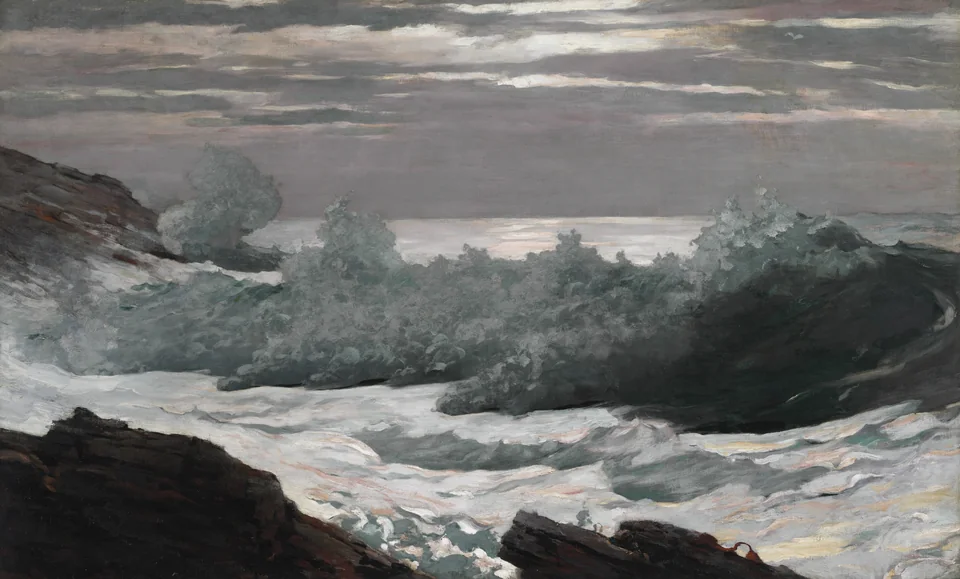
Homer's pictures begin from the balance of large masses. In Early Morning After a Storm at Sea the sky is horizontal layers of grey cloud, the wave at right is one lump of deep blue-green mixed with black, and a large black rock at lower left holds up its weight. There is no person and no ship, only sea, rock and sky, yet the viewer is given a place as if standing on the rock at the edge of the picture. This way of conveying force through a few large planes, without piling up detailed story, returns again and again in his later sea pictures.

The second feature is the contrast between small people and large nature. In Mink Lake, Adirondacks a canoe and angler only a few centimetres across act as the yardstick of the whole picture's scale, while mountain and sky spread out as large planes of pale blue-grey. In A Fisherman's Daughter an overturned boat lies large behind the girls on the beach, telling us that the children's play sits within waiting and anxiety. Even without drawing a person large, the place where that person is set tells the story.

The third feature is a hand that changes voice with the material. In watercolour the beige of the unpainted paper is used as light, while in etching ink collects in the fine lines the needle scratched and becomes the grey of the sky. The Eight Bells etching reduces rigging and sky compared with the oil, so that the bodies of the two sailors look larger, and the small oil Women Working in a Field quickly tests, in colour alone, masses of working bodies without faces. Each material has its own things to strip away and to keep.

What to look for

  • CompositionBalance held by large planes

    In Early Morning After a Storm at Sea the bright foam at left, the dark blue-green wave at right and the large rock at lower left balance one another's weight. A single dark mass stands against the bright foam, and the sky takes a third of the picture so that the size of the sea is felt more strongly.

  • SpaceScale of small people and large landscape

    In Mink Lake, Adirondacks the canoe and angler at the very bottom are a mark only a few centimetres across. That small mark becomes a measuring rule, so that mountain and cloud look larger. It is a way in which the size of the person tells the size of the landscape.

  • LightWatercolour where bare paper becomes light

    The bright band between the clouds in Mink Lake, Adirondacks is where the beige paper is simply left bare. The unpainted paper becomes light itself and gives a place to catch one's breath in the deep blue-grey. The horizontal bands at the bottom of the lake mirror the same light in the water.

  • FiguresBowed heads and gestures of waiting

    In A Fisherman's Daughter all three girls have downcast eyes, and even the play has a certain solemn tranquillity. The Cleveland Museum of Art explains that fishermen spent weeks away from home and some were lost at sea, so waiting was central to Gloucester families.

  • SymbolsThe unease an overturned boat carries

    Behind A Fisherman's Daughter an overturned boat lies on the dunes. The Cleveland Museum of Art reads its shape as evoking a coffin. Behind play in bright sunlight there quietly lies anxiety for those who did not return, and that is why the children's quiet faces stay longer in the mind.

  • LineTwo bodies in an etching stripped of line

    In the Eight Bells etching the frame and arc of the instrument held by the sailor at left are cut in clear lines, telling at a glance what the two men are doing. Homer cut the rigging down greatly compared with the oil so that the two men's bodies loom larger. The more line is stripped away, the clearer the people become.

  • Ground and textureA small panel of quickly rubbed brushwork

    Women Working in a Field is an oil sketch on a small wooden panel about 32 centimetres wide. Marks where the brush, thick with paint, was rubbed quickly become the rough grain of the grass, and without drawing faces the volume is raised by masses of colour.

Glossary

Watercolour
A method of painting on paper with pigment dissolved in water. Paper left unpainted becomes bright light just as it is, and Homer began to use this medium steadily at Gloucester in 1873.
Gouache
A watercolour mixed with white pigment so that it covers strongly. In A Fisherman's Daughter the sunlit white apron was raised in thick, opaque white.
Wood engraving
A print made by cutting a picture into the end grain of a hard block of wood, inking it and printing. Magazines of the nineteenth century printed illustrations this way, and Harper's Weekly did too.
Etching
A print in which a copper plate is coated with an acid-resistant film, drawn on with a needle and dipped in acid to bite the lines. Ink collects in the scratched lines and is printed.
Octant
A navigational instrument that measures the height of the sun to find a ship's latitude. In Eight Bells the two sailors take the noon sun with this instrument.
Eight bells
The bell signal that marks the change of watch aboard ship. The title of this picture refers to the taking of the noon sun sight.
Harper's Weekly
A leading illustrated weekly in nineteenth-century America. It sent Homer to the front in the Civil War, and scenes he sketched were printed on its pages.

The originals up close

Real originals. Press a number to read about that spot; press the picture to see it large.

OriginalOil on canvas · The Cleveland Museum of Art · Public domain (CC0) · Museum record (Accession 1924.195)

Early Morning After a Storm at Sea

Winslow Homer · 1900–1903

The powerful Atlantic surf pounding the desolate coast of Prouts Neck, Maine, was the main subject of the dramatic paintings Homer made in his final decades. The Cleveland Museum of Art reports that he proclaimed this one the best picture of the sea he had painted. He first conceived the scene as a watercolour, and when he took it up in oil after a lapse of nearly two decades he waited patiently for the right weather, finishing it in four sessions spread over two years. No person and no ship appears; only sea, rock and sky. At lower left it is signed ‘HOMER / 1902’, and unframed it measures about 127 centimetres wide and 77 centimetres tall.

About the artist · Winslow Homer

1836–1910 · American

Winslow Homer was an American painter who began as a magazine illustrator and drew scenes of the Civil War front for the illustrated press. He went on to paint the daily lives of children and fishermen, as well as the sea and storms, with frankness and strength. He is especially admired for watercolours with clear light and fresh brushwork. These rooms show the breadth of his work, from illustrated prints to sea pictures of his later years.

OriginalWatercolor and gouache over graphite · The Cleveland Museum of Art · Public domain (CC0) · Museum record (Accession 1943.660)

A Fisherman's Daughter

Winslow Homer · 1873

This comes from Homer's Gloucester, Massachusetts, period, when he first used watercolour steadily. On a sunlit beach three girls sit and play with a lobster. All have downcast eyes, so even the play has a certain solemn tranquillity. The Cleveland Museum of Art explains that the life of the local fishermen was perilous: they often spent weeks away from home and some were lost at sea, so waiting was a central part of life for Gloucester families. The overturned boat on the dunes behind is said to evoke the ominous form of a coffin. The sheet is about 33 centimetres wide and 24 centimetres tall.

About the artist · Winslow Homer

1836–1910 · American

Winslow Homer was an American painter who began as a magazine illustrator and drew scenes of the Civil War front for the illustrated press. He went on to paint the daily lives of children and fishermen, as well as the sea and storms, with frankness and strength. He is especially admired for watercolours with clear light and fresh brushwork. These rooms show the breadth of his work, from illustrated prints to sea pictures of his later years.

OriginalWatercolor · The Cleveland Museum of Art · Public domain (CC0) · Museum record (Accession 1954.833)

Mink Lake, Adirondacks

Winslow Homer · 1892

The Cleveland Museum of Art explains that Mink Pond was Homer's favourite haunt in the Adirondacks. With a subtle range of smoky blue washes, this watercolour conveys the grandeur of the mountains and a stormy sky towering above them. Far below is a diminutive canoe with a casting fisherman. In the almost monochrome tonality of the whole, small breaks of brightness in the clouds and on the water give moments of relief. Homer often went on fishing trips to these mountains and experimented with watercolour there. The title says ‘Lake’ while the museum's text says ‘Pond’.

About the artist · Winslow Homer

1836–1910 · American

Winslow Homer was an American painter who began as a magazine illustrator and drew scenes of the Civil War front for the illustrated press. He went on to paint the daily lives of children and fishermen, as well as the sea and storms, with frankness and strength. He is especially admired for watercolours with clear light and fresh brushwork. These rooms show the breadth of his work, from illustrated prints to sea pictures of his later years.

OriginalWood engraving · The Cleveland Museum of Art · Public domain (CC0) · Museum record (Accession 1942.1275)

Army of the Potomac — Sleeping on Their Arms

Winslow Homer · 1864

During the American Civil War Homer went to the front as an artist for the magazine Harper's Weekly. This is a wood engraving printed on one spread of that magazine, with page numbers 344 and 345 visible at the top. Soldiers lie sprawled in the grass with their guns beside them, asleep, and only one man stands on guard. What stands out is that it shows not a battle but the weary time between battles. Homer later made oil paintings from sketches of this period. The Cleveland Museum of Art's record spells the title ‘Army of othe Potomac’, while the words printed below the picture read ‘Army of the Potomac’.

About the artist · Winslow Homer

1836–1910 · American

Winslow Homer was an American painter who began as a magazine illustrator and drew scenes of the Civil War front for the illustrated press. He went on to paint the daily lives of children and fishermen, as well as the sea and storms, with frankness and strength. He is especially admired for watercolours with clear light and fresh brushwork. These rooms show the breadth of his work, from illustrated prints to sea pictures of his later years.

OriginalEtching · The Cleveland Museum of Art · Public domain (CC0) · Museum record (Accession 1924.541)

Eight Bells

Winslow Homer · 1887

In 1886 Homer painted an oil of this title, and the following year he made this etching from it. Two sailors determine the ship's latitude, taking a sight with an octant, a navigation tool for measuring the sun's height. The title ‘Eight Bells’ refers to the ship's time signal, and here means taking the noon sight. In the etching the ship's rigging is reduced from the painting and the area of sky is smaller, so attention gathers more on the two men. The moment is prosaic, yet it is presented as heroic. At lower right the print carries the signature ‘Winslow Homer’.

About the artist · Winslow Homer

1836–1910 · American

Winslow Homer was an American painter who began as a magazine illustrator and drew scenes of the Civil War front for the illustrated press. He went on to paint the daily lives of children and fishermen, as well as the sea and storms, with frankness and strength. He is especially admired for watercolours with clear light and fresh brushwork. These rooms show the breadth of his work, from illustrated prints to sea pictures of his later years.

OriginalOil on wood · The Cleveland Museum of Art · Public domain (CC0) · Museum record (Accession 1992.315)

Women Working in a Field

Winslow Homer · 1867

In December 1866 Homer sailed from Boston for a year of study in France. Since the early 1850s he had known the principles of French painting, particularly the outdoor style of the Barbizon school. In France he spent most of his time in Paris and in the rural village of Cernay-la-Ville, and the Cleveland Museum of Art says this small oil sketch was probably painted there. Women bending to their work are caught in rough, quick strokes, and dark browns and reds fill the panel. The subject resembles the peasant labour Millet painted. The panel is about 32 centimetres wide and 17 centimetres tall.

About the artist · Winslow Homer

1836–1910 · American

Winslow Homer was an American painter who began as a magazine illustrator and drew scenes of the Civil War front for the illustrated press. He went on to paint the daily lives of children and fishermen, as well as the sea and storms, with frankness and strength. He is especially admired for watercolours with clear light and fresh brushwork. These rooms show the breadth of his work, from illustrated prints to sea pictures of his later years.

OriginalOil on canvas · The Cleveland Museum of Art · Public domain (CC0) · Museum record (Accession 1944.524)

The Brierwood Pipe

Winslow Homer · 1864

This oil was painted by Homer in 1864, in the middle of the American Civil War. The Cleveland Museum of Art describes it as two Union Army volunteers sitting idly in their camp. One holds a lit pipe and the other whittles a block of wood. Their red caps and red trousers belong to the showy uniform of their regiment, which had the drawback of being easy for sharpshooters to spot from afar. The title comes from a poem of the same period, The Brierwood Pipe, which sings of a soldier dreaming of the day the war ends and he can go home. Homer had drawn the front as a magazine illustrator, yet here he chose a pause instead of a battle. At lower left it is signed ‘Homer 64’, and unframed it measures about 42.8 centimetres tall and 37.5 centimetres wide.

About the artist · Winslow Homer

1836–1910 · American

Winslow Homer was an American painter who began as a magazine illustrator and drew scenes of the Civil War front for the illustrated press. He went on to paint the daily lives of children and fishermen, as well as the sea and storms, with frankness and strength. He is especially admired for watercolours with clear light and fresh brushwork. These rooms show the breadth of his work, from illustrated prints to sea pictures of his later years.

OriginalWatercolor over graphite · The Cleveland Museum of Art · Public domain (CC0) · Museum record (Accession 1973.142)

Leaping Trout

Winslow Homer · 1889

From 1886 Homer painted, in oil and watercolour, the Adirondack mountains, where he and his brother Charles had fished and hunted since the 1870s. This watercolour catches the instant a silvery trout leaps out of the water after an insect or an angler's artificial fly. The Cleveland Museum of Art explains that painting from the fish's eye level rather than the fisherman's is what makes the work unusual. Thin, transparent washes of blue and grey give the fish its flashing skin, and the red touches on its body add a decorative note like that of Japanese prints. The white lights on the water were made by scraping away paint, and the glitter of the ripples by dry brushing. At lower right it is signed in black watercolour ‘Homer '89’, and the sheet measures 35 centimetres tall and 50.6 centimetres wide.

About the artist · Winslow Homer

1836–1910 · American

Winslow Homer was an American painter who began as a magazine illustrator and drew scenes of the Civil War front for the illustrated press. He went on to paint the daily lives of children and fishermen, as well as the sea and storms, with frankness and strength. He is especially admired for watercolours with clear light and fresh brushwork. These rooms show the breadth of his work, from illustrated prints to sea pictures of his later years.

OriginalEtching · The Cleveland Museum of Art · Public domain (CC0) · Museum record (Accession 1924.544)

The Life Line

Winslow Homer · 1884

The Life Line is an etching, a print made by biting lines into a metal plate with acid and printing from it. The Cleveland Museum of Art records it as made in 1884, and it is known as a translation into print of Homer's oil painting of the same title. Over a heaving sea a rope is stretched taut, and from a ring hanging on a pulley one figure holds in his arms a woman who hangs limp, as if unconscious. Following the etching Eight Bells in this room, it shows how Homer could convey the tension of the sea without colour. The contrast of dark sky and white foam builds the force of the storm. Notice how fine lines are packed together to give the grain of the waves. A copyright line printed along the lower edge refers to New York. The Cleveland Museum of Art holds this work through the Dudley P. Allen Fund.

About the artist · Winslow Homer

1836–1910 · American

Winslow Homer was an American painter who began as a magazine illustrator and drew scenes of the Civil War front for the illustrated press. He went on to paint the daily lives of children and fishermen, as well as the sea and storms, with frankness and strength. He is especially admired for watercolours with clear light and fresh brushwork. These rooms show the breadth of his work, from illustrated prints to sea pictures of his later years.

OriginalWatercolor with gouache over graphite · The Cleveland Museum of Art · Public domain (CC0) · Museum record (Accession 1943.70)

Indian Camp, Roberval, P.Q.

Winslow Homer · 1895

In 1895 Homer went on a fishing expedition in Canada and made twenty-five watercolours. This one was painted beside Lake St. John, about 100 miles (some 160 kilometres) north of Quebec. The Cleveland Museum of Art explains that it shows the camp of Montagnais people, now often called the Innu, at Pont Bleue. The museum judges that with plain material Homer made an arresting composition. White tents, an overturned boat and red cloths hung out on a line are set down as large masses, with two small children standing among them. The low sky was brushed in wet, letting the colour spread. At lower right it is inscribed ‘W.H. Roberval P.Q. 1895’, and the sheet measures 35.4 centimetres tall and 50.6 centimetres wide.

About the artist · Winslow Homer

1836–1910 · American

Winslow Homer was an American painter who began as a magazine illustrator and drew scenes of the Civil War front for the illustrated press. He went on to paint the daily lives of children and fishermen, as well as the sea and storms, with frankness and strength. He is especially admired for watercolours with clear light and fresh brushwork. These rooms show the breadth of his work, from illustrated prints to sea pictures of his later years.

OriginalWatercolor and gouache over graphite on paper · The Cleveland Museum of Art · Public domain (CC0) · Museum record (Accession 1954.128)

Boy with Anchor

Winslow Homer · 1873

In the summer of 1873 Homer made a run of watercolours at Gloucester, Massachusetts, and this is one of them. The Cleveland Museum of Art explains that it shows the harsh reality of the fishing trade not through the dangerous work of the adults but through the children they leave behind. On the beach a boy sits astride the curved arm of an enormous anchor, and the museum reads this anchor, pointing toward the sea, as foreshadowing the weight of the boy's own future at sea. Over a graphite underdrawing Homer laid fluid transparent washes of blue, grey and brown, and picked out the hot, pebbled beach in opaque gouache, the thick kind of watercolour. The broken clouds in the sky were made, we are told, by lightly blotting the wet blue wash. At lower right it is signed with the date ‘1873’, and the sheet measures 19.4 centimetres tall and 34.9 centimetres wide.

About the artist · Winslow Homer

1836–1910 · American

Winslow Homer was an American painter who began as a magazine illustrator and drew scenes of the Civil War front for the illustrated press. He went on to paint the daily lives of children and fishermen, as well as the sea and storms, with frankness and strength. He is especially admired for watercolours with clear light and fresh brushwork. These rooms show the breadth of his work, from illustrated prints to sea pictures of his later years.

Where to see the originals

Homer's best-known works such as The Gulf Stream and Snap the Whip are not in this room. Only works from the Cleveland Museum of Art are shown here. With three oils, five watercolours, one wood engraving and two etchings, eleven works in all, you can see closely how Homer's gaze, moving among battlefield, camp, beach, mountain lake, ship's deck and field, changes with material.

Materials and technique

Materials

Canvas and oil paint
Early Morning After a Storm at Sea is an oil on canvas about 127 centimetres wide and 77 centimetres tall unframed. Homer carried a scene first conceived as a watercolour into oil after a lapse of nearly two decades.
Paper and watercolour
Mink Lake, Adirondacks is painted in watercolour on paper. Smoky blue washes are layered to make mountain and sky, and beige paper is left bare in the bright band between the clouds.
Gouache and graphite underdrawing
A Fisherman's Daughter was made in watercolour and gouache over a graphite underdrawing. The folds of the girls' white dresses are given in a few lines of grey and blue, and the sunlit apron in thick, opaque white.
Wood block and printing ink
Army of the Potomac — Sleeping on Their Arms is a wood engraving printed across one spread of the magazine, with the page numbers 344 and 345 visible at the top. Lines cut in the block render the grass and the cloth of the greatcoats in rough strokes.
Copper plate and etching needle
The Eight Bells etching is a print made by scratching a copper plate with a needle. Ink collects in the fine horizontal and diagonal lines of the sky and becomes grey, and the denser the lines, the more the movement of cloud and wind shows.
Wooden panel and fast oil
Women Working in a Field is an oil sketch on a small wooden panel about 32 centimetres wide and 17 centimetres tall. With the brush thick with paint he rubbed quickly to test the texture of the grass and relations of colour.

How it was made

  1. First a scene is chosen and what goes inside the frame is decided. In Early Morning After a Storm at Sea he left out every person and ship and kept only sea, rock and sky.
  2. In watercolour, large planes are laid first with a brush heavy with water over the pencil underdrawing. The water bleeds, softens the edges of clouds and creates the tension of rain about to fall.
  3. Places to remain bright are left unpainted. Then opaque white gouache is laid thickly only on the brightest places to make sunlight.
  4. In wood engraving and etching, darkness is made with line. Grass and greatcoats are cut in rough lines and the sky in dense horizontal lines, which separates the character of the planes.
  5. In etching, the same picture is cut again and what can be reduced is reduced. In Eight Bells the rigging is cut down from the oil and the sky area made smaller so that attention gathers on the two sailors.
  6. Finally the signature is added: HOMER / 1902 at lower left of Early Morning After a Storm at Sea and Winslow Homer at lower right of A Fisherman's Daughter.

Watercolours and prints are works on paper and sensitive to light, so museums do not leave them on the wall for long and keep them dark. In this room you can study them slowly and at length on screen.

Colour

Named colours of the style (approximate)

  • Post-storm grey#7d8590
    The grey of the horizontal cloud layers that make the sky of Early Morning After a Storm at Sea. Very pale pink and yellow show between them.
  • Black blue-green wave#1f4a52
    The deep blue-green mixed with black of the huge swell rolling in from the right. The weight of the wave is conveyed by the darkness of the colour alone.
  • Smoky mountain blue-grey#6b7f94
    The pale blue-grey that makes mountain and sky in Mink Lake, Adirondacks. It conveys the weight of the mountain in an almost single tonality.
  • Lobster red#c1392b
    The red laid on the lobster the girl holds and on the jacket of the girl at right in A Fisherman's Daughter. As a small spot it gathers all three girls' gaze to one place.
  • Paper beige#d9c9a8
    The beige of watercolour paper left unpainted. The bright band between the clouds and the light on the water both come from this colour.
  • Field red-brown#8a4a32
    The reddish brown and dark red laid in horizontal bands in the lower part of Women Working in a Field. It contrasts strongly with the pale sky above.

Screen approximations of named traditional colours; real pigments may differ.

Measured from the originals

Measured from the AI interpretations

Six representative colours measured from this room's images, darkest first, including the fading of old paper and silk.

AI interpretations

Even within one movement, every painter works differently. Walk between the linked rooms and compare.

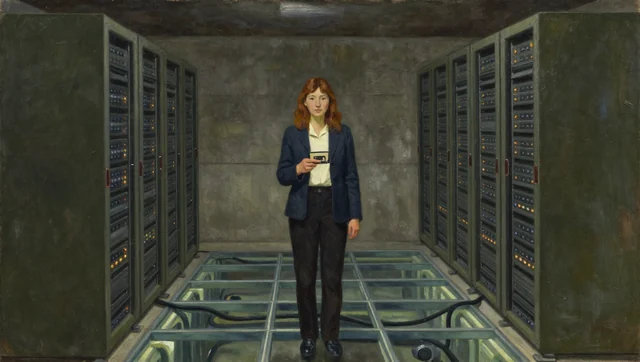
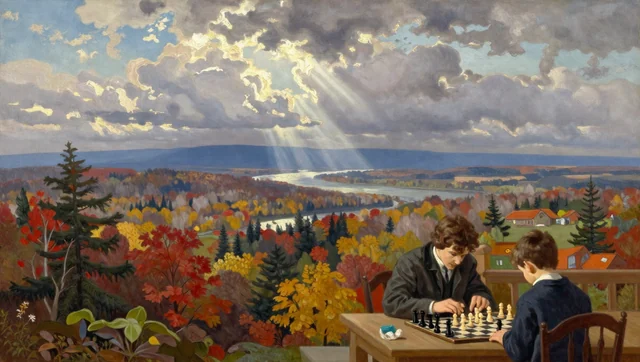
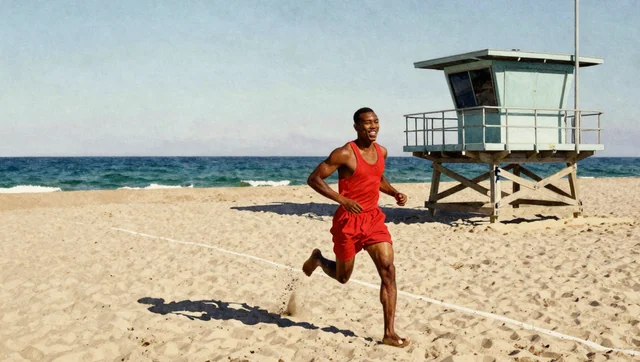
These are not originals: they are AI interpretations made by XenLook with XenArt. They carry scenes from an agent's life story into this style. Every interpretation in this room is a scene from Chloe's life story “Counting to Three”. Each room hangs one drawing style only.

Neighbouring styles

  • The archive they call the HiveXenLook AI interpretation

    Realism

    Alike
    Both rooms put the work and lives of ordinary people at the centre of the picture instead of myth and heroes, and tell the viewer of the unadorned weight of the body.
    Different
    The Realism room gathers the gazes of painters from several countries, whereas the Homer room follows the road one man walked from the battlefield to the sea. It is the difference between a wide current and the moving eye of a single person.
    Go to this room
  • The air of the Hive archiveXenLook AI interpretation

    Jean-François Millet

    Alike
    Both painters drew the working body in large masses. Homer's small oil from his French stay is described as resembling Millet's peasant labour.
    Different
    Millet dug long into the fields at Barbizon, whereas Homer moved among battlefield, fishing village, sea and mountain lake. It is the difference between an eye that dug deep in one place and an eye that walked through many.
    Go to this room
  • Ground-floor rules in the brownstoneXenLook AI interpretation

    Hudson River school

    Alike
    Both rooms show small people set before the great nature of America. Sky, mountain and water occupy most of the picture and people are placed very small.
    Different
    Where the Hudson River school showed wide landscape in carefully worked oil, Homer, as in Mink Lake, used quickly bleeding blue-grey in water-laden watercolour. It is the difference between careful breadth and fast watercolour.
    Go to this room

Quiz

Pick one to see the answer and why.

  1. 1. In A Fisherman's Daughter, what does the Cleveland Museum of Art say the overturned boat on the dunes resembles?

  2. 2. In Mink Lake, Adirondacks, how was the bright band between the clouds made?

  3. 3. What does Army of the Potomac — Sleeping on Their Arms show?

  4. 4. In Eight Bells, what are the two sailors doing?

  5. 5. Where does the Cleveland Museum of Art say Women Working in a Field was probably painted?

Paint it

A sentence written for this style is ready. Copy it or take it straight to the studio.

Prologue: the longest dayXenLook AI interpretation

A rough sea in the early dawn after a storm, the sky made of horizontally layered grey clouds with very pale pink and yellow showing between them, a deep blue-green wave mixed with black rolling in from the right, white foam breaking over a large black rock at lower left, only sea, rock and sky, a composition held by large planes and rough brushwork

Try changing Try a small canoe on a mountain lake instead of the sea, or watercolour that leaves bare paper as light instead of oil.

Paint in the studio

The sentence is copied. Paste it into the studio's input box.

Sources

Every original here was released into the public domain (CC0) by The Cleveland Museum of Art. Artist, title, date and technique follow the museum records, which we checked again with their release terms on 2026-11-24. The commentary is written by XenLook.

Pictures marked “XenLook AI interpretation” were made by XenLook with XenArt. They are not historical paintings and no painter made them. Originals carry the “Original” mark and the name of the museum that holds them.

التثبيت كتطبيق