Winslow Homer was born on 24 February 1836 in Boston, Massachusetts. At nineteen he was apprenticed to J. H. Bufford, a commercial lithographer in Boston, and for two years did repetitive work such as sheet-music covers, which Homer later remembered as a treadmill experience. By 1857 he had declined an offer to join the staff of Harper's Weekly and chosen the path of the freelance illustrator. A remark of his is recorded: from the time he took his nose off that lithographic stone he had no master and never would. He opened his own studio in Boston, and his career as an illustrator lasted nearly twenty years. The plain line and sense of large mass he gained there support his work throughout life.
Soon Homer moved to New York, the publishing and art centre of the country. Until 1863 he attended classes at the National Academy of Design and studied briefly with Frederick Rondel, who taught him the basics of oil painting. In about a year of self-training he is said to have been producing excellent oil work. His mother tried to raise family funds to send him to Europe for study, but instead Harper's Weekly sent him to the front lines of the Civil War (1861–1865). He sketched camp and commanders on the banks of the Potomac, quiet moments as well as chaotic ones. The wood engraving Army of the Potomac — Sleeping on Their Arms in this room is a scene printed in Harper's Weekly at that time, showing not the fighting but the weary time.
From his war sketches Homer made oil paintings: Sharpshooter on Picket Duty (1862), Home, Sweet Home (1863) and Prisoners from the Front (1866), and from 1863 to 1866 he showed such subjects at the National Academy of Design every year. In December 1866 Homer sailed from Boston to France and stayed close to a year. During that time Prisoners from the Front hung at the Exposition Universelle in Paris. He did not study formally, but he painted landscape in Paris and in the rural village of Cernay-la-Ville, and the Cleveland Museum of Art explains that the small oil Women Working in a Field in this room was probably painted there. It also notes that the subject resembles the peasant labour Millet painted.
In the summer of 1873 Homer began to use watercolour steadily at Gloucester, Massachusetts. His technique is described as natural, fluid and confident from the start, though critics were at first puzzled; one said a child with an ink bottle could not have done worse. Even so the watercolours sold, improving his finances considerably, and thereafter he seldom travelled without paper, brushes and paints. A Fisherman's Daughter in this room is a watercolour from just that Gloucester period. In 1876 Snap the Whip and Breezing Up were exhibited at the Centennial Exposition in Philadelphia. In 1878 he spent a year as a guest at Houghton Farm in the Adirondacks.
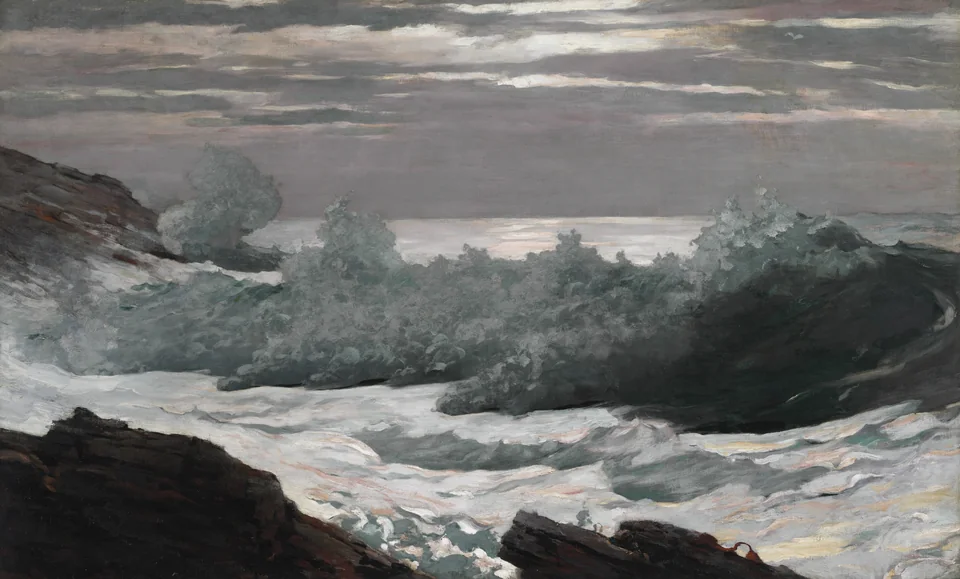
From 1881 to 1882 Homer spent two years in the fishing village of Cullercoats, Northumberland. The subjects of those paintings were working men and women and their daily heroism, and Homer wrote of the women as working bees. In 1883 he moved to Prouts Neck, Maine, living in a remodelled carriage house on the family property seventy-five feet from the ocean. From the mid-1880s he painted monumental sea scenes, and in Eight Bells (1886) two sailors carefully take their bearings on deck. The image was cut as an etching the next year. In the winters of 1884–85 he went to Florida, Cuba and the Bahamas and made a series of watercolours on a commission for Century Magazine. From 1888 to 1903 he also visited Key West often.
Homer often visited the North Woods Club near Minerva, New York, in the Adirondacks, on summer fishing trips, and there experimented with watercolour. Mink Lake, Adirondacks in this room is such a mountain scene. Among his large late paintings is The Gulf Stream (1899), which shows a Black sailor adrift in a damaged boat, surrounded by sharks as a waterspout approaches. By 1900 Homer had finally reached financial stability, because museums paid good prices for his paintings and he received rents from real estate. He died in 1910 at the age of seventy-four in his Prouts Neck studio and was buried in Mount Auburn Cemetery in Cambridge. The studio is a National Historic Landmark, owned by the Portland Museum of Art, which offers tours.