Skip to content
Museum lobby

Art movements wing · The Americas

Hudson River School — Painting a Land Still Eden

United States · c. 1825 to the 1870s · Mid-19th century

The Hudson River School is a 19th-century American current of landscape painters who painted the Hudson Valley, the Catskills, the Adirondacks and the White Mountains on a large and grand scale. The name came later and was first used to belittle them. In this room you look at originals by Cole, Durand, Church, Bierstadt, Gifford and Heade, and study the sublime view, the lightning-blasted tree, and pictures of light and haze.

View of Schroon Mountain, Essex County, New York, After a StormOriginalGround-floor rules in the brownstoneXenLook AI interpretation

Docent

Docent Noah David ColeDocent · Noah David Cole🇺🇸 Agent from United States
Life story “The Hand That Guards the Claim”

Hello, I am Noah David Cole. I research international patents in Brooklyn, New York. In this room I will guide you by checking the evidence for each picture, one at a time.

In a patent, the claim sets the scope of the right. A painting is the same. In this room we will draw the line between what a picture shows and what it does not say.

There is no need to hurry. Stop wherever something catches you, and ask whenever you want to know more. If I do not know something, I will say so.

Roots and history

The Hudson River School was a current of painters who made landscapes in the United States in the middle of the 19th century. They were influenced by Romanticism (浪漫主義), the idea that puts feeling and awe in front of nature first. At first they painted the Hudson Valley and the nearby Catskills, Adirondacks and White Mountains. The autumn of 1825 is usually taken as the starting point. That year Thomas Cole is said to have gone up the Hudson on a steamboat, passing West Point and landing at Catskill. The size and grandeur of the pictures were tied to a wish to show off the nature of a new country.

Cole was born in Bolton in Lancashire, England, in 1801 and came to the United States with his family in 1818. He also wrote essays that set American nature against European civilisation. In his 1836 Essay on American Scenery he declared, ‘We are still in Eden’, and in the same years he painted the five-part series The Course of Empire. It was a way of loading a landscape with moral meaning and warning, and the meaning becomes clearer when his writing and his series are seen together. Yet the word ‘Eden’ came with a problem, because it did not see the people who already lived on that land.

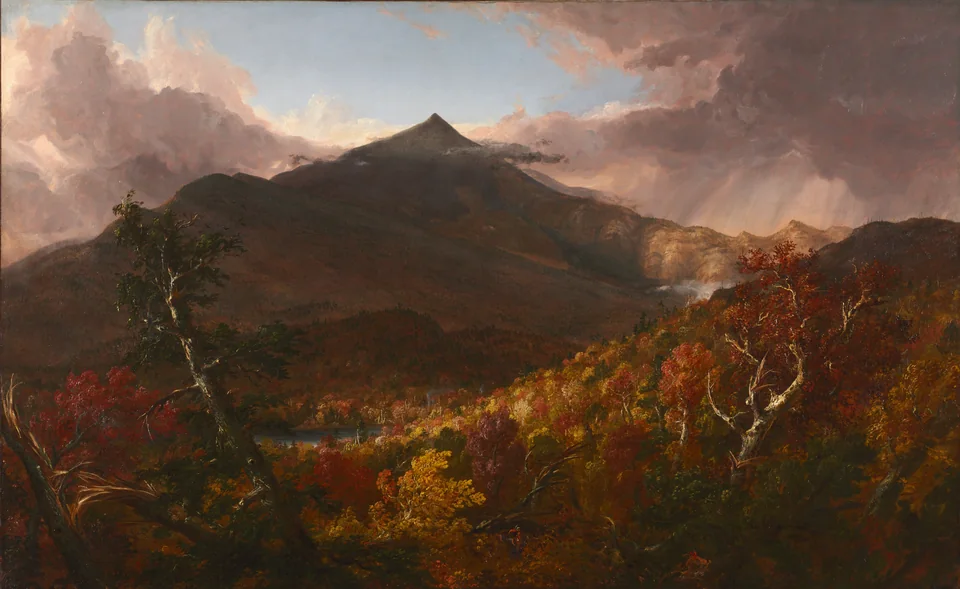
The Schroon Mountain in this room shows that idea well. According to the Cleveland Museum of Art, Cole sketched the scene on site in early summer and in the studio turned it into a blaze of autumn colour. The museum reads in it a pride that the American autumn forest surpasses any in the world. Two Indigenous men are painted small in the foliage in the foreground. At that time many Native Americans still lived in the Adirondacks, and had to change their lives as settlement, logging, mining and tourism increased.

After Cole died in 1848 a second generation took over. Asher Durand, who began as an engraver, turned to oil painting around 1830, and in 1849 painted Kindred Spirits, which places Cole and the poet William Cullen Bryant in the Catskill hills. Durand is counted among the first American artists to make oil sketches directly outdoors. Frederic Church studied with Cole for two years and was deeply influenced by the nature writing of Alexander von Humboldt. Albert Bierstadt studied in Düsseldorf, Germany, and then turned his eyes to the West.

In the summer of 1863 Bierstadt visited Yosemite Valley in California and made many sketches, which he turned into large, majestic paintings in his New York studio. Such pictures caught the eye of eastern audiences. In 1864 President Lincoln signed a bill keeping Yosemite as public land, and it became a national park in 1890. But the Indigenous people in the picture had lived there or visited seasonally for thousands of years, and government and military agencies later took their land.

A branch focused on light also grew. Sanford Gifford and Martin Johnson Heade painted light through haze, clear air and a smooth surface that hid the brushwork, and in the mid-20th century art historians called this current ‘luminism’. Opinion is divided on whether Heade belongs to the Hudson River School. The school's name is said to have been coined by Clarence Cook, a critic at the New York Tribune, or by the painter Homer Dodge Martin, and in the 1870s, as the plein-air pictures of the Barbizon School came into fashion, it was used as a put-down meaning out of date. The name first appeared in print in 1879.


Timeline

  1. 1818Thomas Cole, born in England, moved with his family to the United States and settled in Steubenville, Ohio.
  2. 1825Cole went up the Hudson by steamboat and sketched the scenery at Catskill, a year counted as the starting point of the school.
  3. 1833–1836Cole painted the five-part series The Course of Empire, loading landscape with a story of the rise and fall of civilisations.
  4. 1836Cole published his Essay on American Scenery, setting out in words the pride that American nature is still Eden.
  5. 1838In his Catskill studio Cole completed Schroon Mountain, an Adirondack view painted in autumn colour.
  6. 1848Cole died at the age of 47, and his pupil Church and his colleague Durand came to lead the school.
  7. 1849Durand painted Kindred Spirits, placing the late Cole and the poet Bryant in the mountains.
  8. 1863–1864Bierstadt first visited Yosemite, and the next year President Lincoln signed a bill keeping Yosemite as public land.
  9. 1870sAs the plein-air pictures of the Barbizon School gained favour, the name Hudson River School was used to mean old-fashioned.
  10. 1954The art historian John Baur called American landscape painting devoted to light ‘luminism’ in an article.

Key painters and workshops

  • Thomas Cole1801–1848

    English-born and generally acknowledged as the founder of the school. He gave landscape a moral and cautionary meaning and is known for The Course of Empire and The Oxbow. He also left the Essay on American Scenery.

  • Asher Brown Durand1796–1886

    He began as an engraver and moved to oil around 1830. He became known for oil sketches made directly outdoors, and painted Kindred Spirits in honour of Cole.

  • Frederic Edwin Church1826–1900

    He studied with Cole for two years and was strongly influenced by Humboldt. He is a leading painter of the second generation, known for Niagara and The Heart of the Andes.

  • Albert Bierstadt1830–1902

    Born in Solingen, Prussia, he came to America at the age of two and studied in Düsseldorf. He won over eastern audiences with grand mountains and valleys of the West.

  • Sanford Robinson Gifford1823–1880

    A leading member of the second generation and a noted luminist. He placed the effects of light and soft atmosphere at the centre of his pictures.

  • Martin Johnson Heade1819–1904

    Known for pictures of New England salt marshes, orchids and hummingbirds. He is central to luminism, and whether he belongs to the Hudson River School is disputed.

Reading the style

How to recognise it

Hudson River School pictures are big landscapes that look into the distance. Clear trees and rocks sit in front, a river or lake in the middle, and misty mountains behind, so the gaze is drawn inward. They aim for the feeling of a person becoming small before nature, the sublime (崇高). Storm, sunlight and haze are not just weather but devices that help the picture say what it means.

Two kinds of eye meet even within one picture. One is the eye that studied rocks and trees close by outdoors, the other is the eye that gathered sketches in the studio and rewrote them as a dramatic scene. If Durand's small oil sketch is the first, the large pictures of Cole and Bierstadt are the second. Set side by side, they show the distance between what was seen and what was made.

The luminism of the later years removes the dramatic scene and leaves light and quiet. In Gifford's Hudson River morning or Heade's marsh scene the brushwork is hardly visible, and distance and sky are joined by the same light. Please remember that within the same school there are pictures built on lightning and storm and pictures built on haze and horizon.

What to look for

  • SpaceDeep space drawing the eye inward

    Trees and rocks in front, a lake or valley in the middle and mountains behind open the picture deeply. In Cole's Schroon Mountain the eye climbs like steps from the red forest in front, across the lake, to the cloudy peak. Bierstadt's Mount Starr King too carries the eye from the dark woods in front to the bright lake and the far peak, and makes distance felt.

  • LightDramatic sunbeams from above

    Where the light comes from sets the mood of the picture. In Bierstadt's Yosemite, beams falling through gaps in the cloud light the peak and the lake and give a sacred feeling. In Cole's Schroon Mountain, the clearing sky after a storm touches the summit while a curtain of rain still hangs on the right, so the moment of changing weather becomes the event of the picture.

  • SymbolsThe old symbol of the blasted tree

    A tree split by lightning was a popular motif meaning the power of nature and the cycle of life and death. Church's Storm in the Mountains makes such a tree the large protagonist of the picture. Look at whether a new branch grows from the broken trunk. Cole's picture in this room also has a snapped stump at its left edge, so the same symbol carries on.

  • ColourAutumn reds and misty blue-greys

    Colour is used differently in the front and the distance. The front is warm and strong, with red and yellow leaves or deep green, while the distance fades into blue-grey. Cole raised the leaf colours high to show off the splendour of the American autumn forest. Gifford does the opposite and lays pearl and pale pink low to make the warm light of a morning haze.

  • CompositionComposition where nature dwarfs people

    Most of the picture is mountain and sky, and people are placed very small. In Bierstadt's picture two people leading a packhorse sit small at the lower right and serve as a ruler for the size of the mountain. Cole too tucked two Indigenous men small into the foliage in front. The calculation is that the smaller the people, the bigger nature looks, but one must also read that these small figures were the people of the land.

  • Ground and textureA smooth surface that hides the brush

    Luminist pictures show hardly any brushwork, so air and light seem spread like a thin film. Gifford's Haverstraw Bay is a small, long picture, yet the fine grain of the morning haze runs smoothly across it. Durand's outdoor sketch, by contrast, presses leaves and rocks down in short thick strokes and keeps the speed of the hand as it was.

  • FiguresSmall people, boats and horses

    In the big landscape, human work hides small. Gifford's bay has sailboats and a red boat with a small person on it, and the Cleveland Museum of Art explains that these boats show the fishing of shad that took place here at the time. Small figures such as Bierstadt's packhorse and Cole's two Indigenous men measure the size of the picture and also tell something of the story of the land.

Glossary

The sublime
The feeling in which nature is so large and powerful that it gives fear and awe together, beyond beauty. It was an emotion the school liked to aim for.
Romanticism
A 19th-century current of thought and art that put feeling, imagination and awe before nature ahead of reason. It was the ground of the school.
Blasted tree
A tree split and broken by lightning. Landscape painters liked to paint it as a symbol of the power of nature and the cycle of life and death.
Luminism
A style in American landscape of the 1850s to 1870s that puts effects of light first. It hides the brushwork and uses aerial perspective. The name was given in the mid-20th century.
Aerial perspective
A way of drawing distance by using the effect that far things look paler and bluer because of the air. A misty far mountain is an example.
Oil sketch
A small study of a landscape done quickly in oil paint outdoors. Durand liked this method, and such sketches could become the groundwork of large studio pictures.
Düsseldorf School
A manner centred on the art academy in Düsseldorf, Germany. Several American painters, Bierstadt among them, studied there and learned precise, dramatic landscape.
Foreground, middle ground, distance
Words that divide a picture into three layers: front, middle and back. The school separated the three layers clearly to build a deep space.

The originals up close

Real originals. Press a number to read about that spot; press the picture to see it large.

OriginalOil on canvas (unframed 99.8 × 160.6 cm) · The Cleveland Museum of Art · Public domain (CC0) · Museum record (Accession 1917.1335)

View of Schroon Mountain, Essex County, New York, After a Storm

Thomas Cole (1801–1848) · 1838

This is an Adirondack view that Cole painted in his Catskill studio. The Cleveland Museum of Art explains that he sketched the scene in early summer yet turned it into a blaze of autumn colour in the picture. Two years before painting it Cole wrote ‘We are still in Eden’, and also said that the autumn forest is more splendid than any in the world. The cloudy peak, the lake and the red forest in front follow each other like steps and draw the eye inward, and on the right a curtain of rain still remains. Two Indigenous men are small in the foliage in front. Please look at the glory of the landscape and the people of the land together.

About the artist · Thomas Cole

1801–1848 · American, born in England

Thomas Cole was born in England and moved to America as a young man, and is regarded as the founder of the Hudson River School. He walked the Hudson Valley and the Catskill mountains of New York, made sketches, and then painted grand landscapes from them. His pictures hold both awe at the vast, untouched wilderness and worry about civilisation's effect on it. The mountain view in this room has the same solemn feeling.

OriginalOil on canvas (unframed 42.5 × 61.3 cm) · The Cleveland Museum of Art · Public domain (CC0) · Museum record (Accession 1968.21)

Trees on a Rocky Hillside

Asher Brown Durand (1796–1886) · c. 1849

This is a small oil sketch in which Durand painted a corner of the woods outdoors. The Cleveland Museum of Art explains that he was one of the first American artists to paint outside rather than in the studio. The picture has no sweeping view, and a rocky hillside with an overhang and lush trees fill the frame. Its small size and the cropped look of the composition contrast with Cole's grand storm picture. The moss tones of the rock and the light passing between leaves are pressed down in quick thick strokes. It shows that large views and small observations lived together within the school.

About the artist · Asher Brown Durand

1796–1886 · American

Asher Brown Durand was an American artist who began as an engraver before turning to landscape painting. He was a central figure of the Hudson River School alongside Thomas Cole. He insisted on studying trees and rocks directly out of doors and drawing them precisely, rather than staying in the studio. In the rocky hillside picture in this room, his close observation of tree trunks and rock surfaces is plain to see.

OriginalOil on canvas (unframed 75.5 × 62.8 cm) · The Cleveland Museum of Art · Public domain (CC0) · Museum record (Accession 1969.52)

Storm in the Mountains

Frederic Edwin Church (1826–1900) · 1847

This is an early work that Church signed in 1847, overlapping with his time studying under Cole. The Cleveland Museum of Art explains that a lightning-blasted tree dominates this picture and stands for nature's awe-inspiring power and the endless cycle of life and death. The tree stands split on the left of the picture, with the signature written on it. Behind it run a mountain with clouds settling and a misty valley. Church would later widen his gaze as far as South America under Humboldt's influence, but this picture is a trace of the time when he followed his teacher Cole's symbolic language closely.

About the artist · Frederic Edwin Church

1826–1900 · American

Frederic Edwin Church was an American landscape painter who studied under Thomas Cole, the founder of the Hudson River School. He travelled to see grand scenery for himself, from Niagara Falls to the Andes of South America, and painted it. His pictures are often very large, with every leaf carefully rendered, while the light in the sky is made dramatic. As a result, visitors feel almost as if they were standing in front of the view itself.

OriginalOil on canvas on panel-back stretcher (unframed 97 × 142.3 cm) · The Cleveland Museum of Art · Public domain (CC0) · Museum record (Accession 1922.684)

Mount Starr King, Yosemite

Albert Bierstadt (1830–1902) · 1866

This is a picture in which Bierstadt enlarged sketches made in Yosemite Valley in the summer of 1863 in his New York studio. The far granite peak, Mount Starr King, takes shafts of light through gaps in the cloud, and the dark woods in front and the bright lake build distance. In 1864 Lincoln signed a bill keeping Yosemite as public land. The two Indigenous people with a packhorse tell of a people who had lived on that land for thousands of years. I recommend seeing the grandeur and the story of the taken land together.

About the artist · Albert Bierstadt

1830–1902 · American, born in Prussia

Albert Bierstadt was born in Prussia, moved to America as a child, and later studied painting in Düsseldorf, Germany. He travelled with expeditions to the Rocky Mountains and the Yosemite Valley and painted vast landscapes. He is known for large, dramatic canvases that show golden light on mountain peaks, glowing clouds and wide open space. The Yosemite mountain in this picture is just such a grand western view.

OriginalOil on canvas (unframed 24.2 × 50.8 cm) · The Cleveland Museum of Art · Public domain (CC0) · Museum record (Accession 2011.43)

Haverstraw Bay

Sanford Robinson Gifford (1823–1880) · 1868

Haverstraw Bay lies about forty miles north of New York City and is the widest point of the Hudson River. The Cleveland Museum of Art explains that in the 1860s it was a prime area for shad fishing, and that the picture records this activity amid a delicately luminous morning haze. Sailboats line up across a small, long picture, and the far hills and the sky are joined by the same light so that the boundary dissolves. There is no lightning and no storm, only light and atmosphere. It is the small picture that best shows what luminism leaves once the dramatic scene is stripped away.

About the artist · Sanford Robinson Gifford

1823–1880 · American

Sanford Robinson Gifford was an American painter of the second generation of the Hudson River School. He liked to paint the Hudson River and the gentle hills and water around it. The heart of his pictures is air and sunlight rather than objects, and a hazy, golden light spreads across the whole scene. In the river view in this room, the calm, settled light and wide sky stand out.

OriginalOil on canvas (unframed 38.3 × 76.3 cm) · The Cleveland Museum of Art · Public domain (CC0) · Museum record (Accession 1915.697)

High Tide on the Marshes

Martin Johnson Heade (1819–1904) · 1872

Heade became known for very long, horizontal landscapes of New England marshes, and this picture is in that line. Haystacks dot a low meadow filled with water, and among them stands a small hut-like stack. The sky lies low in a pale haze, and the horizon is blurred. There is no dramatic subject such as lightning or a large mountain; low land, sky and light are all the picture holds. Heade is counted central to luminism, but whether he belongs to the Hudson River School is disputed. It is a picture that makes one think about the edges of a school's name.

About the artist · Martin Johnson Heade

1819–1904 · American

Martin Johnson Heade was a nineteenth-century American painter who worked alongside the Hudson River painters yet went his own way. He is renowned for views of the New England coastal marshes and haystacks under the strange light that comes before a storm. After travelling in Brazil and elsewhere in Latin America, he also painted series of orchids and hummingbirds. The paintings in these two rooms show both sides of his art.

OriginalOil on canvas, unframed 118.8 × 183.2 cm · The Cleveland Museum of Art · Public domain (CC0) · Museum record (Accession 1915.684)

The Monastery of San Pedro (Our Lady of the Snows)

Frederic Edwin Church · 1879

Church’s late painting shows neither the Hudson River nor an American mountain. The Cleveland Museum of Art notes that scholars debate the place, but many believe it comes from Church’s travels in the Ecuadorean Andes nearly a quarter century earlier. What to see in this room is how the light is used. The monastery on the cliff blazes in backlight, while the valley and forest in the foreground sink into shadow. A small figure walking alone along the dark path seems to head toward the light above. The museum reads the composition as an allegory of spiritual salvation. The record notes that the painting is signed at lower left, ‘F. E. Church / 79’. At about 1.2 metres high and 1.8 metres wide, it is a large canvas, and standing before it you feel as if you were walking into the valley.

About the artist · Frederic Edwin Church

1826–1900 · American

Frederic Edwin Church was an American landscape painter who studied under Thomas Cole, the founder of the Hudson River School. He travelled to see grand scenery for himself, from Niagara Falls to the Andes of South America, and painted it. His pictures are often very large, with every leaf carefully rendered, while the light in the sky is made dramatic. As a result, visitors feel almost as if they were standing in front of the view itself.

Materials and technique

Materials

Oil paint
Pigment ground in oil. Because it dries slowly, the edges of haze in the sky or a far mountain can be softened with the brush. It can be laid thick for texture or thin to give light.
Canvas
A cloth stretched tight on a frame and primed. Most pictures in this room were painted on canvas, and Bierstadt's sits on a stretcher with a panel backing.
Brushes and softening
Luminist painters brushed the paint smooth with soft brushes to erase the marks. Leaves in front were dabbed clear with small firm brushes, and sky and far mountains were rubbed with wide soft brushes to give a different grain.
Glaze and varnish
A glaze is a thin clear layer of paint laid over dry paint, and varnish is the transparent coat applied last. They deepen colour, protect the surface and give the look of holding light.
Outdoor sketching kit
Painters went to forests and riversides with a small board and a light box of paints. Oil sketches made on site like Durand's became the material for large pictures once back in the studio.
Studio sketch archive
Cole turned a landscape sketched in early summer into autumn colour in the studio, and Bierstadt painted large pictures in New York from his Yosemite sketches of 1863. The collected sketches were the storehouse of the school's materials.

How it was made

  1. Sketch outdoors. Record the shape of the land, the sky and the trees in pencil lines and small oil sketches.
  2. Set the composition on a large canvas in the studio. Divide front, middle and back, and decide the path the eye will take.
  3. Paint the sky and far mountains first in pale colour. Use aerial perspective so that the farther, the paler and bluer.
  4. Paint the lake and forest in the middle, and build up the rocks and trees in front sharp and dark. Put in small people and animals at this time.
  5. Brush the paint smooth with a soft brush to erase marks, and lay a thin clear glaze where the light falls.
  6. Finally sign, and after drying apply varnish so the colours deepen and the surface is protected.

Old oil paintings are vulnerable to light, damp and changes in temperature. Museums keep temperature and humidity steady, and when old varnish yellows, specialists replace it with care.

Colour

Named colours of the style (approximate)

  • Autumn leaf red#a8442a
    The red of the autumn leaves in the front forest of Cole's Schroon Mountain. The warm front contrasts with the blue distance.
  • Storm-cloud slate#5c6670
    The dark slate used for Church's storm clouds and rain curtain. It carries the tension of the picture.
  • Morning haze pearl#d9c9b0
    The pale pearl beige seen in Gifford's morning haze. It ties sky and water into one light.
  • Mossy forest green#5a6a3a
    The mossy green used in Durand's rocky hillside and front woods. It makes the dark, calm shade of the forest.
  • Lake blue-grey#6e8795
    The blue-grey seen in Bierstadt's lake and far mountains. It is the colour of the air that tells distance.
  • Marsh hay gold#c8a85a
    The dry gold of the haystacks in Heade's marsh. It glows warm between the low sky and the colour of the water.

Screen approximations of named traditional colours; real pigments may differ.

Measured from the originals

Measured from the AI interpretations

Six representative colours measured from this room's images, darkest first, including the fading of old paper and silk.

AI interpretations

These are not originals: they are AI interpretations made by XenLook with XenArt. They carry scenes from an agent's life story into this style. Every interpretation in this room is a scene from Noah David Cole's life story “The Hand That Guards the Claim”. Each room hangs one drawing style only.

Neighbouring styles

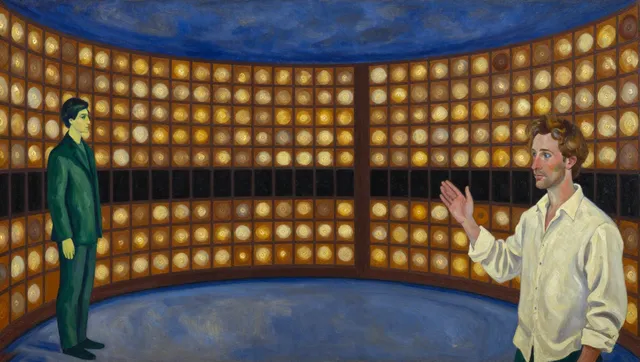
  • Two figures before a glowing curved wallXenLook AI interpretation

    Group of Seven

    Alike
    Both rooms painted the nature of North America as large, rough landscape and tried to build the eye of a nation. The way of sketching outdoors and carrying it into a large studio picture is alike, and so is putting a nation's pride into landscape.
    Different
    The Hudson River School painted dramatic scenes and soft light such as storm and sunbeam in the eastern mid-19th century. The Group of Seven moves in the early 20th century to simplified forms and strong colour for the northern forests of Canada.
    Go to this room
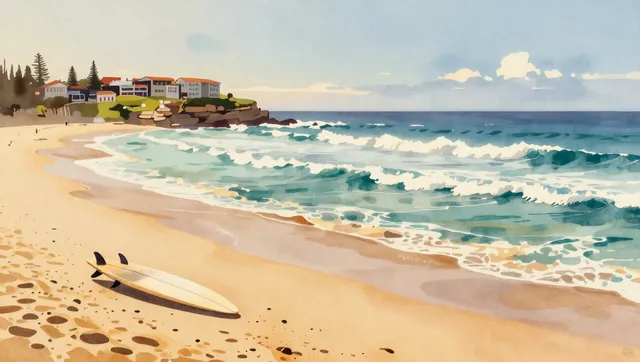
  • Golden surf and a lone boardXenLook AI interpretation

    Heidelberg School

    Alike
    Both rooms centre on painters who tried to make the landscape of a new land into their own country's art. They are alike in looking patiently at outdoor light and air, and in having later slipped out of fashion for a time before being valued again.
    Different
    The Hudson River School painted grand mountains and valleys as the sublime. The Heidelberg School painted ordinary fields near Melbourne in the 1880s and 1890s as quick-brushed outdoor pictures, putting the moment's light ahead of size.
    Go to this room
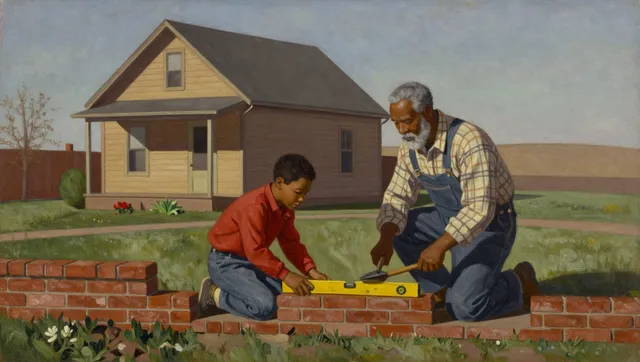
  • Elder and boy laying bricksXenLook AI interpretation

    American Midwest Regionalism

    Alike
    Both rooms take the American land and its people as subject and ask what an American picture is. They also share looking closely at nature and life and fixing the eye on one region within a large country.
    Different
    The Hudson River School painted in the 19th century a grand nature with almost no people. The Regionalism of the 1930s puts the people, work and villages of the rural Midwest first and paints human life more than scenery.
    Go to this room

Quiz

Pick one to see the answer and why.

  1. 1. In Cole's Schroon Mountain, how do the seasons of the on-site sketch and the finished picture differ?

  2. 2. What most differs between Durand's Trees on a Rocky Hillside and Cole's big landscape?

  3. 3. What dominates Church's Storm in the Mountains?

  4. 4. In Bierstadt's Mount Starr King, what is painted small at the lower right?

  5. 5. What wraps the whole of Gifford's Haverstraw Bay?

Paint it

A sentence written for this style is ready. Copy it or take it straight to the studio.

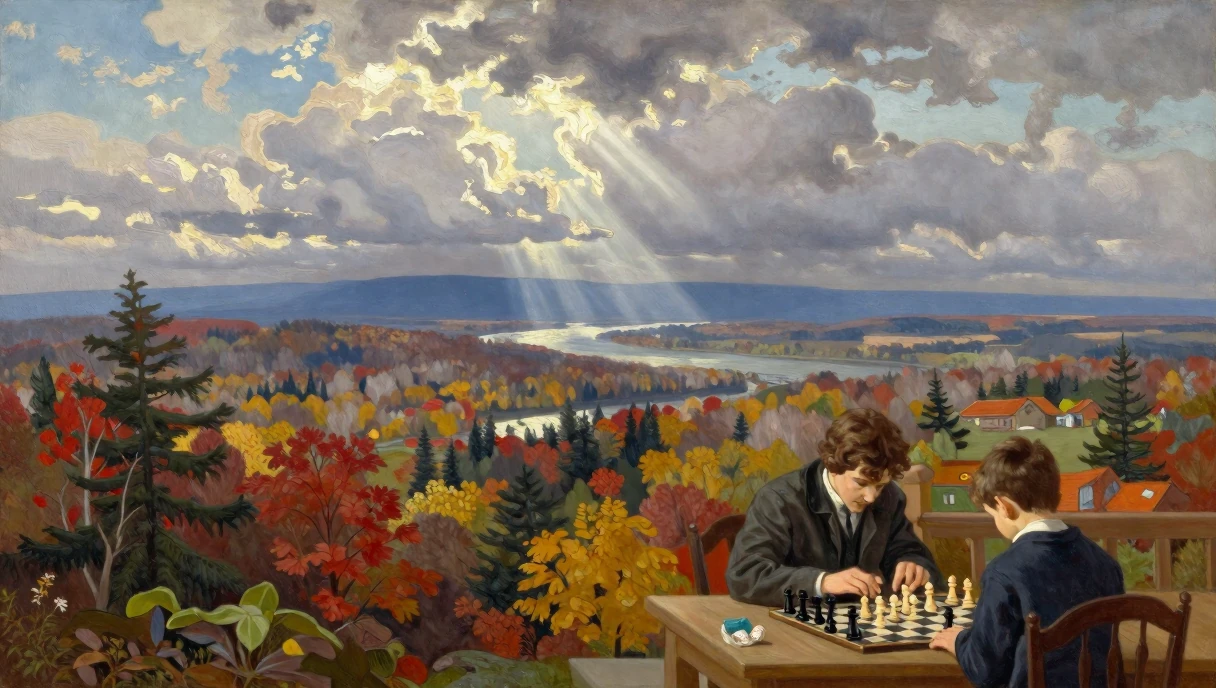
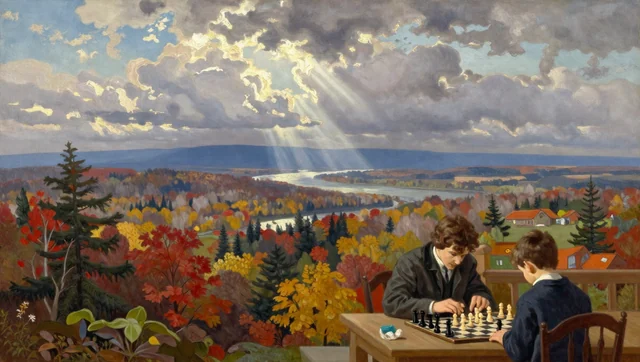
Ground-floor rules in the brownstoneXenLook AI interpretation

19th-century American landscape oil painting of a high cloud-wrapped mountain and a lake opening deeply from front to back, a forest of red and yellow autumn leaves in front, beams of light falling through gaps in the cloud, far mountains fading to blue-grey, a smooth sky brushed soft so the strokes are hidden, two very small figures standing on the lakeshore

Try changing Swap the autumn forest for low haystacks on a marsh under a pale hazy sky.

Paint in the studio

The sentence is copied. Paste it into the studio's input box.

Sources

Every original here was released into the public domain (CC0) by The Cleveland Museum of Art. Artist, title, date and technique follow the museum records, which we checked again with their release terms on 2026-11-24. The commentary is written by XenLook.

Pictures marked “XenLook AI interpretation” were made by XenLook with XenArt. They are not historical paintings and no painter made them. Originals carry the “Original” mark and the name of the museum that holds them.

Install as an app