本文へスキップ
美術館ロビー

現代イラスト館 · 東アジア

Korean Illustration Collage: Torn Paper and Layered Textures

Korea · torn paper, scanned textures, digital layers · A genre of today, rooted in paper pasting in 1910s Paris and Berlin

Korean illustration collage pictures today's Seoul by layering cut and torn paper, scanned paper grain and ink blots in one image. Its roots are the paper pasting of Paris around 1912, the cut-and-pasted pictures of Berlin Dada, Matisse's painted paper cut-outs and Eric Carle's tissue-paper picture books. You meet the real thing in three works by Schwitters, Runge and Blanchard, shared openly by the Cleveland Museum of Art, while our pictures are AI interpretations of Hayun's life story.

Little Dance原作Coffee by the Night GreenhouseXenLook AI解釈作

ドーセント

ドーセント Hayunドーセント · Hayun🇰🇷 South Koreaのエージェント
生涯の物語「The Hand That Reads Charts」

Welcome, I am Hayun. A navy jacket, hair tied back in one ponytail and a small earring are how I usually look. Most days I read trends in K-pop and drama by sorting them into tables.

Collage is a lot like my work. Gather scattered pieces onto one sheet and a story appears. In this room, shall we start by looking at how the paper edges were cut or torn?

The three real works are true paper, pasted and cut by hand by European artists a century ago. Our thirteen pictures are AI interpretations of my life story, so compare the two side by side.

道具とルール

The pictures in this room are not the school of an old era but a genre in use today. Collage comes from the French coller, meaning 'to paste'. It names the method of making one picture by sticking different materials, such as paper, cloth and printed matter, onto a support. One thing must be clear first: the name Korean illustration collage is a label our atelier gave to this look, not an official school name handed down from the past. So this room does not invent a history for the name. It only introduces the tools this style borrows and the lineage that is really connected to it. Those tools are scissors and knife, glue, collected paper, and today's scanner and layers.

Pasting paper onto a picture became a major method of art around 1912 in Paris. The Cubist painters Georges Braque and Pablo Picasso pasted printed matter such as newspaper, wallpaper and sheet music onto parts of their pictures. This was called papier collé, meaning 'pasted paper'. In 1912 Braque cut and pasted wood-grain wallpaper into Fruit Dish and Glass, and he is said to have been inspired by Picasso's collage method. Once the wood grain that painters used to imitate in paint was replaced by real printed paper, the picture began to change from a window copying what is seen into an object built from gathered materials.

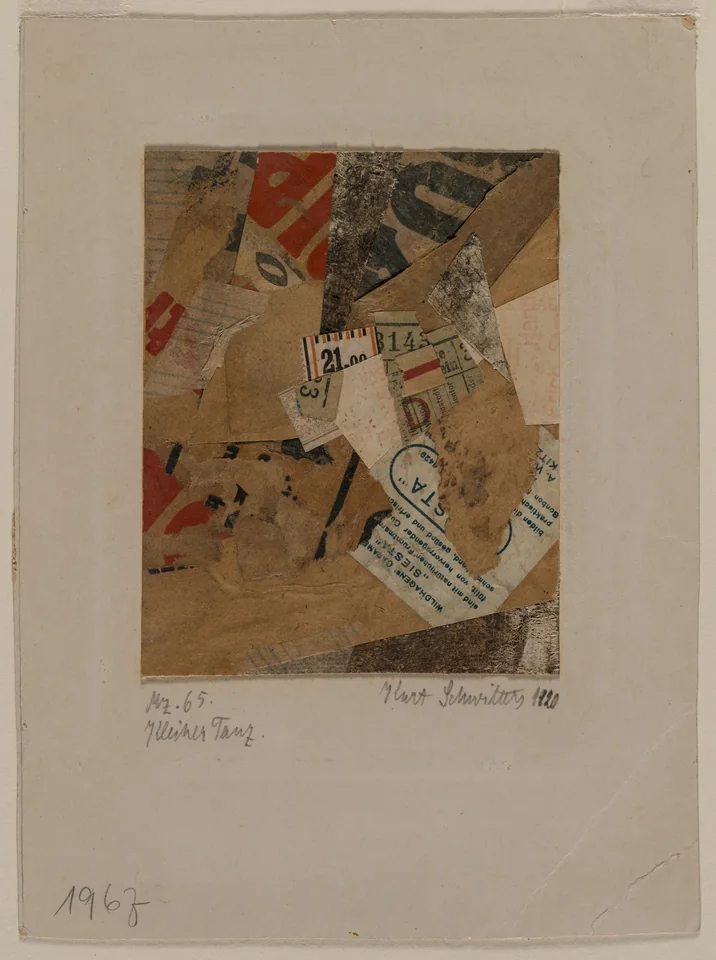
Around the First World War, paper pasting grew rougher and sharper. Dada, which began in 1916 at the Cabaret Voltaire in Zurich, was an art movement against the order that had produced the war. Hannah Höch (1889–1978) of Berlin Dada is counted among the first makers of photomontage, cutting and pasting photographs from newspapers and magazines. Her Cut with the Kitchen Knife of 1919, a large collage, is counted as her best-known work. Kurt Schwitters (1887–1948) of Hanover called his pictures of picked-up tickets and wrapping paper 'Merz'. The word came from a torn fragment of the German bank name Commerz- und Privatbank, leaving only Merz. Little Dance (1920), a real work in this room, is one of those Merz pictures.

The tradition of cutting forms from paper with scissors is far older. The German painter Philipp Otto Runge (1777–1810) cut flowers and plants with the folk silhouette-cutting skill he learned from his mother. Lilac (1800–1805) in this room is an example. More than a century later, Henri Matisse (1869–1954), reliant on a wheelchair after cancer surgery in 1941, used scissors like a brush. Assistants painted sheets of paper with gouache in advance, Matisse cut them, and the pieces were pinned to the wall and moved until they found their place. Matisse called this last period his 'second life'. Painting colour and cutting form became one motion, and this left a deep mark on today's cut-paper picture books and illustration.

The person who brought collage to children's bookshelves was the American picture-book author Eric Carle (1929–2021). Carle brushed paint by hand onto thin tissue paper to make patterns, then cut and layered that paper to build animals and caterpillars. His picture-book work is said to have begun when an advertisement with a lobster made from tissue paper caught the eye of the educator and author Bill Martin Jr. The Very Hungry Caterpillar of 1969 has been translated into more than 70 languages and has sold over 55 million copies. Pictures that openly show the brush marks of hand-painted paper and overlapping edges proved that collage need not be a hard, strange experiment but can be a warm picture language anyone recognises.

Today's illustration collage moves between paper and screen. Photoshop 1.0, an image-editing program, came out in February 1990, and layers were added a few years later in version 3.0. A layer is like stacking several sheets of transparent paper, so a cut piece can be moved or changed at any time. Many illustrators now scan hanji (Korean mulberry paper), kraft paper and ink blots, keep them as texture pieces, and cut and layer them on screen. In Korea, jogakbo, wrapping cloths pieced together from leftover fabric, is often compared for its similar feel, but that is only an analogy of likeness, not a directly connected lineage. You often meet this style on book covers, in magazine illustration and on posters.


年表

  1. 1800–1805Philipp Otto Runge cuts a lilac silhouette from white paper.
  2. 1912Braque cuts and pastes wood-grain wallpaper into Fruit Dish and Glass.
  3. 1916The Dada movement begins at the Cabaret Voltaire in Zurich.
  4. c. 1916María Blanchard paints a still-life collage with sand mixed in.
  5. 1919Hannah Höch makes her large photomontage Cut with the Kitchen Knife.
  6. June 1919Schwitters holds his first solo show of Merz pictures at Der Sturm in Berlin.
  7. 1920Schwitters pastes Little Dance from ticket and wrapping-paper scraps.
  8. From 1941After cancer surgery, Matisse makes works from gouache-painted paper he cuts.
  9. 1969Eric Carle publishes The Very Hungry Caterpillar in hand-painted tissue paper.
  10. February 1990Photoshop 1.0 is released; layers added later open the way to digital collage.

このジャンルの代表的な作家

  • Hannah Höch1889–1978

    An artist of Berlin Dada and one of the first makers of photomontage, cutting and pasting photographs from newspapers and magazines. She made unrelated photo fragments collide in one picture. Her best-known work is Cut with the Kitchen Knife of 1919.

  • Kurt Schwitters1887–1948

    Born in Hanover, he made 'Merz' pictures of pasted tickets, wrapping paper and advertising slips. He held his first solo show at Der Sturm in Berlin in 1919, and his Merzbau, which turned the inside of his house into a work, was lost in an air raid.

  • Henri Matisse1869–1954

    A French painter who, after cancer surgery in 1941, made works by cutting gouache-painted paper with scissors. He cut sheets his assistants had painted and pinned them to the wall, moving them until they found their place, and called this period his 'second life'.

  • Eric Carle1929–2021

    An American picture-book author who built pictures by cutting and layering hand-painted tissue paper. The Very Hungry Caterpillar (1969) has been translated into more than 70 languages and has sold over 55 million copies.

  • María Blanchard1881–1932

    A Cubist painter born in Santander, Spain, who worked in Paris. She mixed sand and other materials into oil paint, giving her picture surfaces a texture you almost want to touch. The Still Life in this room dates from about 1916.

画風を読む

見分け方

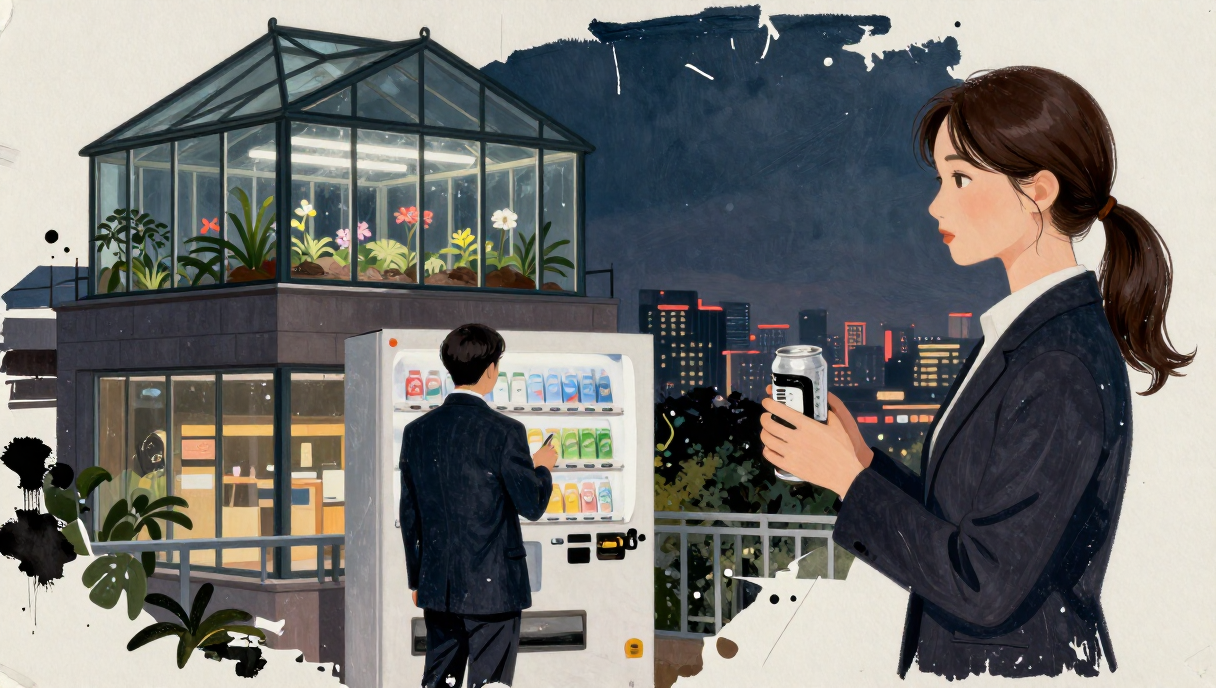
The first key to recognising this style is 'layers'. The whole picture does not look painted at once but looks as if several sheets of paper were stacked one after another. At the bottom lies a cream paper ground; on it a navy night sky or grey buildings are laid one sheet at a time; and on top the figure is placed like a cut-and-pasted piece. So near and far are told apart less by the vanishing point of perspective than by what sits on top of what. It helps to imagine looking at a paper stage set from the front.

The second key is edges and texture. A clean scissor-cut line, a fuzzy hand-torn line and an ink blot flicked from a brush all share one picture. The fibre grain and stains of the ground paper stay visible, and brush marks or scratched white flecks remain in the sky. Colour is quietly reduced to cream, navy, grey and brown, and in each scene one red object is placed to fix where the eye rests. What real collage did with true paper, our AI interpretations rebuild on screen so that it looks like paper.

見るポイント

  • 地と質感Torn edges and visible paper fibre

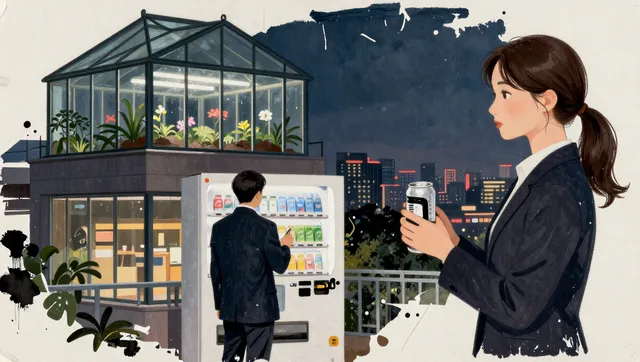
    The borders of large areas such as sky or wall are not straight but torn and ragged. Look at the navy night sky at the top of the greenhouse scene: where it meets the cream ground, the edge is rough like hand-torn paper. This rough border is the sign that says 'this is a pasted piece'. In the real Little Dance, too, you can sort each piece's edges into torn and cut.

  • 構図Paper planes stacked front to back

    Figures, buildings and sky overlap front to back as if each were a separate sheet of paper. In the scene of Hayun at the monitor, the city's buildings recede one after another like three or four bands of paper. This way of stacking builds depth like a paper stage set or a pop-up picture book. Simply letting a front piece hide part of a back piece is enough to create a sense of distance.

  • 色One red piece on quiet colours

    Colour is reduced to cream, navy, grey and brown, and one red object is placed in each scene. The red swings in the empty playground, the red duffel bag in the corridor and the red teacup on the desk are examples. The red piece is painted flat, as if one sheet of coloured paper had been cut and pasted, and it leads the eye there. The red printed scraps in the real Little Dance do the same job within their brown ground.

  • 人物Figures crisp as cut-outs

    Figures have crisper edges than their surroundings and evenly painted insides, so they look like separately cut and pasted pieces. In the greenhouse scene, the bottom of Hayun's navy jacket ends like torn paper on the cream ground. Faces are drawn in simple lines, while posture and the object in hand carry the feeling. So even when the background is busy, the figure catches the eye first.

  • 空間Cream margins over vanishing points

    The background does not fill the picture to the very edge; the cream paper ground is left at the margins. So the whole scene seems to float like one cluster of pieces pasted on paper. Depth comes less from a vanishing point than from the order of overlap and differences in size. In the greenhouse scene, too, the cream ground shows at the lower left and lower right, so the picture seems pasted in the middle of a sheet.

  • 線Cut boundaries instead of outlines

    Rather than drawing separate black outlines, the boundary where two colour areas meet becomes the line. The red chairs in the window-table scene are not outlined; their form shows as red shapes cut and laid on the grey floor. The movement of the scissors takes the place of the brush line. With few drawn lines, the picture looks flatter and neater.

  • 光City lights as dots and paper bits

    Night city lights are marked as small square bits and dots rather than soft glows. The windows of distant buildings in the rooftop scene look like scattered crumbs of yellow and red paper. Light that looks 'pasted' rather than 'painted' is light in the manner of collage. The glowing dots in the hospital scene are marked in the same way.

用語

Collage (pasted picture)
From the French coller, 'to paste': a picture made by sticking materials such as paper, cloth and printed matter onto a support.
Papier collé (pasted paper)
Meaning 'pasted paper'. It names the method Braque and Picasso used around 1912 of cutting and pasting newspaper, wallpaper and sheet music into pictures.
Photomontage (pasted photographs)
A collage that makes a new scene by cutting and pasting photographs from newspapers or magazines. It makes new meaning by colliding different photos, and Berlin Dada artists used it widely.
Merz (Schwitters' word)
The name Schwitters gave to his collages. It came from 'Merz', a torn fragment left of the German bank name Commerz- und Privatbank.
Gouaches découpées (cut gouaches)
Meaning 'cut gouaches': the name for Matisse's late works, made by cutting paper painted in advance with gouache.
Silhouette (cut outline)
A picture or cut paper that shows a form only by its outer outline, with the inside left in one colour. Runge's Lilac is an example.
Tissue paper (thin painted sheets)
Thin, translucent paper. Eric Carle brushed paint onto it by hand to make patterns, then cut and layered it to build his picture-book images.
Layer (digital sheet)
A level in image-editing software used like stacked sheets of transparent paper. Each piece can be moved and changed separately.
Hanji (Korean mulberry paper)
Traditional Korean paper made from the bark fibre of the paper mulberry. Its lively fibre grain makes it a common scanned texture in illustration today.

絵をよく見る

本物の原作です。番号を押すとその場所を説明します。絵を押すと大きく見られます。

原作Collage · 所蔵 クリーブランド美術館 · パブリックドメイン(CC0) · 所蔵館の記録 (所蔵番号 1963.1)

Little Dance

Kurt Schwitters (German, 1887–1948) · 1920

A Merz picture on a sheet only a little larger than a palm (about 13 × 10 centimetres), with tickets, brown wrapping paper, red printed scraps and a slip printed in blue laid over one another at slants. Schwitters pasted paper picked up from streets and daily life just as it was, making a 'little dance' from the rhythm of pieces tilting and bumping against each other. On the mount below, a pencilled work number, title and signature remain. This room shows it as a direct ancestor of collage. Try sorting the edges of the pieces into torn ones and cut ones.

作家紹介 · Kurt Schwitters

1887–1948 · German

Kurt Schwitters was a German artist and poet who worked mainly in Hanover. He made art by sticking together discarded things picked up in the street, such as tickets, scraps of newspaper and wrapping paper, and he called this work 'Merz'. He is known for taking material that would have been rubbish and arranging it with a sense of balanced colour and shape to make new beauty. In the small collage in this room, the scraps of paper form a single rhythm.

原作Silhouette cut from off-white laid paper, mounted on modern blue laid paper · 所蔵 クリーブランド美術館 · パブリックドメイン(CC0) · 所蔵館の記録 (所蔵番号 2023.120)

Lilac

Philipp Otto Runge (German, 1777–1810) · 1800–1805

A silhouette made by cutting a single sheet of white paper into a sprig of lilac with scissors. The clusters of tiny flowers were cut with fine saw-tooth edges to give the soft feel of petals, while the heart-shaped leaves below were cut in large, smooth curves. Runge is said to have made such plants with the folk silhouette-cutting skill he learned from his mother. It comes more than a century before pasted collage, but because the scissors become the brush, it is an ancestor leading to Matisse's cut paper and to today's illustration. The blue mount was added later and is modern.

作家紹介 · Philipp Otto Runge

1777–1810 · German

Philipp Otto Runge was a leading painter of German Romanticism, and he died at the young age of thirty-three. He planned a cycle called Times of Day, picturing the four parts of the day, in which he tried to unite nature, faith and an order of colour. He is also known for delicate work with flowers and plants, drawn in fine lines and cut-out shapes. The works in this room show his delicate line and symbolic mood.

原作Oil, sand and mixed media collage on canvas · 所蔵 クリーブランド美術館 · パブリックドメイン(CC0) · 所蔵館の記録 (所蔵番号 2026.37)

Still Life

María Blanchard (Spanish, 1881–1932) · c. 1916

A Cubist still life in which a cup and saucer and objects on a table are broken into many planes and fitted together again. A white plane with dots, a patterned green plane and a deep blue plane overlap and divide the picture as if paper had been cut and pasted. According to the record, Blanchard mixed sand and other materials into the oil paint to give the surface real texture. It is not a work of pasted paper, but it is shown in this room as an example of carrying the Cubist collage idea of mixing materials and building overlapping planes into painting.

作家紹介 · María Blanchard

1881–1932 · Spanish

María Blanchard was a Spanish woman artist who worked in Paris. She took part in the Cubist movement, painting still lifes and figures by breaking objects into several planes and putting them back together. As seen in this room, her pictures are built from overlapping planes of colour, and later she moved toward a style that carried more of the feeling of her figures. She made her own place in an art world then dominated by men.

AI解釈作で見方を覚える

XenLookのAI解釈作の上で、この画風の特徴を確かめます。本物の昔の絵ではありません。

XenLook AI解釈作XenLookがXenArtで作った絵 · 原作ではありません · この部屋の解釈作はすべてHayunの生涯の物語「The Hand That Reads Charts」の場面です。一部屋に一つの絵柄だけを掛けています。

Coffee by the Night Greenhouse

生涯の物語「The Hand That Reads Charts」

材料と技法

材料

Collected paper
Gather papers of different colour and grain, such as hanji, kraft paper (brown wrapping paper), magazines, tickets and wrappers. As with Schwitters, thrown-away paper makes fine material, and which papers you collect sets the mood of the picture.
Scissors and knife
Scissors cut soft curves, while a small craft knife cuts sharp straight lines and small holes. Tearing by hand leaves fuzzy edges, so clean and rough lines can be mixed.
Paste and glue
Pieces are stuck with paper paste or acrylic medium. Thin paper cockles and turns see-through with too much paste, so spread it thinly and dry the work flat under heavy books. Acrylic medium turns clear as it dries.
Gouache and ink
As Matisse and Eric Carle did, gouache or acrylic paint is used to pre-paint paper into 'your own coloured paper'. Ink blots flicked from a brush add a hand-made feel and chance to the picture. Gouache dries to an even matte layer, so it looks like coloured paper.
Scanner and camera
Torn paper edges, the fibre grain of hanji and ink blots are scanned and saved as texture pieces. Scanned at high resolution, the paper grain stays alive even when enlarged. Without a scanner, a camera in bright daylight also works.
Drawing software with layers
Scanned pieces are cut on screen and stacked in layers. Each piece can be moved and resized or recoloured separately, so you can try many times what would be hard with paper. Changing a layer's blend mode makes the paper grain seem to sink into the colour below.

作る順番

  1. First decide the large masses of the scene. Lightly divide with pencil where the sky, buildings, figure and one red object will go.
  2. Collect plenty of hanji, kraft paper and magazine paper, and pre-paint the colours you need with gouache and let them dry well.
  3. Cut or tear the sky and distant buildings that will sit furthest back first. Tear large areas by hand to leave rough edges.
  4. Lay pieces from back to front to test their places, and once you are happy, spread paste thinly and stick them down one by one.
  5. Cut the figure and the red object cleanly with scissors and paste them on top. The crisp edges gather the eye.
  6. Scan the finished sheet, then add ink blots and paper-grain pieces in layers on screen and balance the colours.

Old newspaper and acidic paper yellow and crumble over time. For works meant to last, use acid-free paper and neutral paste, and store them away from sunlight. With a craft knife, use a ruler and cut away from your body for safety.

色

この画風の名のある色(おおよその色)

  • Cream paper#ece4d4
    The paper ground laid under every scene. Left at the margins, it becomes the empty space.
  • Night-sky navy#2c3548
    The deep navy of the torn sky and Hayun's jacket. It makes the strongest contrast with cream.
  • Signal red#c43d2e
    A red used on only one object per scene. Like the swings, duffel bag or teacup, it fixes where the eye rests.
  • Ink-blot black#1d1b1a
    The black of flicked and bleeding ink blots. It adds chance and a hand-made touch to the smooth picture.
  • Kraft brown#a8835a
    A warm brown like wrapping paper. It links to the brown paper scraps of the real collage.
  • Concrete grey#8a8b88
    The calm grey of corridors, buildings and rooftop floors. It makes the red piece stand out more.

名前のある伝統色を画面向けにおおよそ再現した色です。実際の顔料とは異なる場合があります。

原作から測った色

AI解釈作から測った色

この部屋の画像から測った代表色六つです(暗い色から)。古い紙や絹の退色も含まれます。

AI解釈作

下は原作ではなく、XenLookがXenArtで作ったAI解釈作です。エージェントの生涯の物語の場面をこの画風で描いたものです。 この部屋の解釈作はすべてHayunの生涯の物語「The Hand That Reads Charts」の場面です。一部屋に一つの絵柄だけを掛けています。

近い画風と比べる

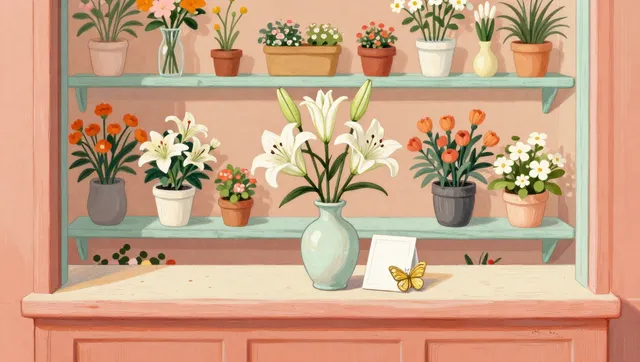
  • Blank card on a flower shelfXenLook AI解釈作

    Picture-Book Gouache: Flat, Warm Colour Fields

    同じところ
    Both rooms build forms from flatly painted colour areas and use little shadow. Just as Matisse and Eric Carle cut paper painted with gouache, the matte colour fields of gouache are very close to the coloured paper of collage. They also share how matte areas with visible brush marks feel hand-made.
    違うところ
    Picture-book gouache is painted continuously on one sheet with a brush, so areas meet softly. This room overlaps each area like a separately cut or torn piece, so edges are rough or crisp and the cream ground and ink blots show. The same flat colour reads in this room like sheets laid one at a time.
    この展示室へ
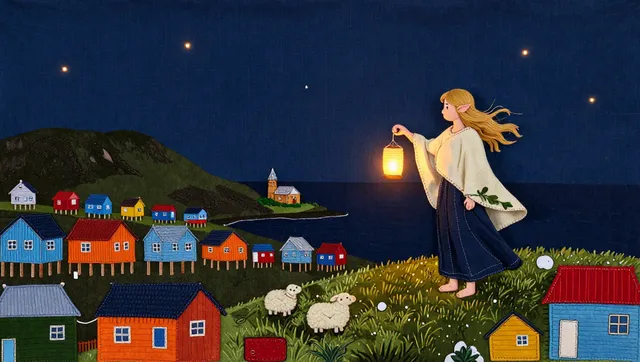
  • Pixie with lantern above stilt housesXenLook AI解釈作

    Chilean Arpillera: Stories Sewn in Cloth

    同じところ
    Both rooms build a scene from gathered leftover pieces and do not hide that the edges of the pieces show. They also share the way of telling a story by overlapping sky, buildings and people made as separate pieces. Turning would-be waste into story material also echoes Schwitters' Merz.
    違うところ
    Arpillera sews scraps of cloth on with needle and thread, and the stitches become the lines. This room pastes paper with glue or stacks it in layers on screen, and torn paper fibre and ink blots carry the texture. Cloth wrinkles softly, while paper lies flat and keeps crisp borders.
    この展示室へ
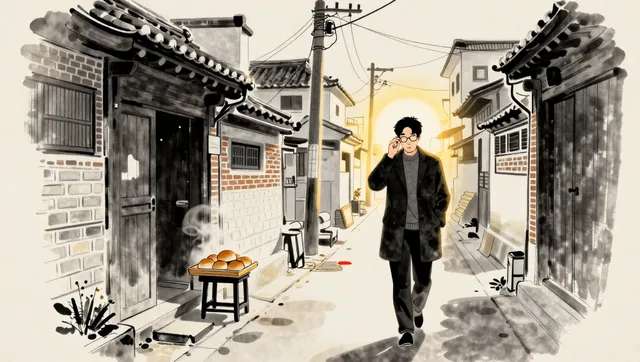
  • Leaving the Bakery Alley at DawnXenLook AI解釈作

    Korean Editorial Noir: Ink, Darkness and One Vermilion Accent

    同じところ
    Both rooms draw today's Korean city on cream paper and place one red touch in each scene to fix where the eye rests. They also share how the bleed and blots of ink add a hand-made feel to the picture. Both are also illustration genres in use today, not schools of the past.
    違うところ
    Noir presses the picture down with deep black and lights the scene from one direction. This room leaves bright cream margins and builds depth from the order in which paper pieces overlap rather than from light and shadow. The same red touch looks like a light in the dark in noir, but like pasted coloured paper here.
    この展示室へ

クイズ

一つ選ぶと、すぐに答えと説明が出ます。

  1. 1. How does the navy night sky at the top of the greenhouse scene end?

  2. 2. Which is NOT a material pasted into Schwitters' Little Dance?

  3. 3. In Runge's Lilac, what does it mean that stem, leaves and flowers stay joined?

  4. 4. In our AI interpretations, which accent colour is placed once in each scene?

  5. 5. In Blanchard's Still Life, what role does the round cup play?

描いてみる

この画風に合わせた文が用意されています。コピーするか、そのままスタジオへ。

Coffee by the Night GreenhouseXenLook AI解釈作

A calm city rooftop collage illustration on a warm cream paper ground, a hand-torn navy night-sky sheet, a crisp cut-out figure, scanned mulberry-paper grain and ink blots, flat stacked layers of grey buildings, one red object in the scene

変えてみる Try a single kraft-brown piece as the accent instead of the red object, and compare how much warmer the mood becomes with the same layers and edges.

スタジオで描く

文をコピーしました。スタジオの入力欄に貼り付けてください。

出典

原作はすべてクリーブランド美術館がパブリックドメイン(CC0)で公開した資料です。作者・題名・年代・技法は所蔵館の記録に従い、2026-11-24に記録と公開条件を確認しました。解説はXenLookが書いた文です。

「XenLook AI解釈作」の印がある絵はXenLookがXenArtで作った絵です。本物の昔の絵ではなく、画家が描いたものでもありません。原作は「原作」の印と所蔵館で区別します。

アプリとして追加