In mid-nineteenth-century France, a painter earned a name by having work chosen for the annual state exhibition, the Salon. The jurors liked smoothly finished pictures of myth and history, and treated a landscape of rough brushmarks as if it were unfinished. In 1863 so many works were rejected that, with the permission of Emperor Napoleon III, a separate Salon des Refusés was held. The young painters who would become the Impressionists got to know one another in this climate.
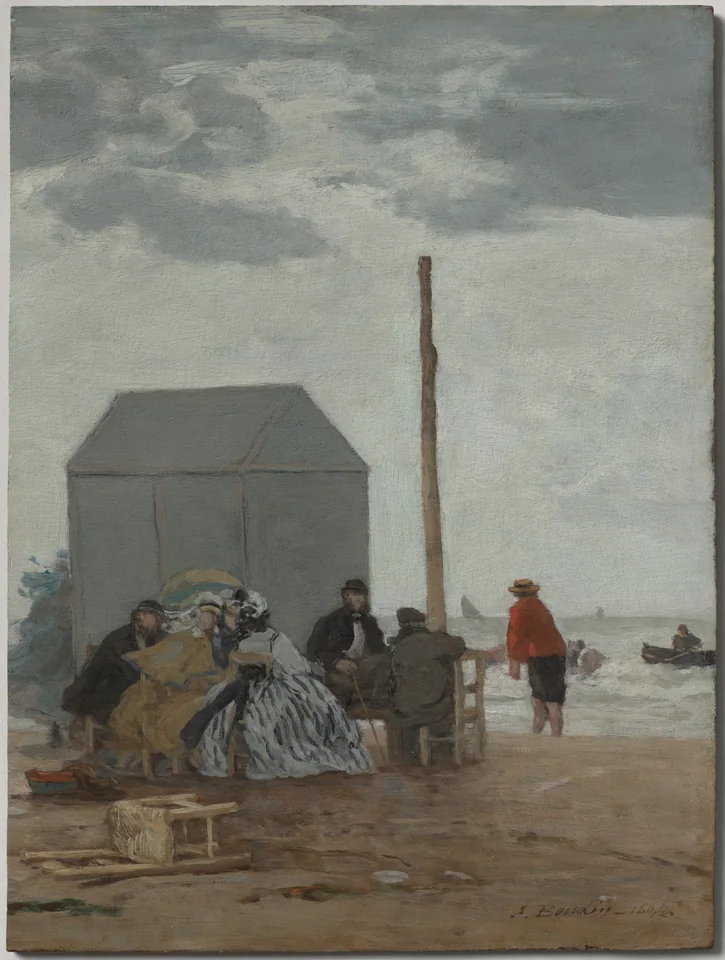
Painting landscape out of doors was older than Impressionism. Eugène Boudin was among the first to work outside on the Normandy coast, and Corot is said to have called him the 'king of skies'. Around 1858 Boudin met Monet, then about seventeen, and urged him to paint landscape outdoors. As paint in tin tubes spread in the mid-century, it also became far easier to carry an easel out of the studio, where colours had once been ground by hand.
In April 1874, some thirty painters held an exhibition in the Paris studio of the photographer Nadar, independent of the Salon. Monet's Impression, Sunrise (1872) showed a morning in the port of Le Havre, his hometown. The critic Louis Leroy mocked the picture in the newspaper Le Charivari, and from that review the word 'Impressionists' spread. The name was meant as a jibe, yet the painters adopted it, and it is the name we use today.
The group held eight exhibitions in all between 1874 and 1886. Camille Pissarro was the only painter who took part in every one. Born on the island of Saint Thomas in the Danish West Indies, he was something like the elder brother of the circle, and Cézanne is said to have called him a father. Cézanne, Seurat, Gauguin and van Gogh are all said to have learned from him. He never shrank from teaching younger colleagues in front of the canvas.
The circle also included a woman painter and a wealthy patron. Berthe Morisot married Eugène Manet in 1874, and she sent work to every exhibition except 1879, the year her daughter Julie was born. Gustave Caillebotte helped pay for exhibitions and bought his colleagues' pictures, and on his death he left that collection to the French state. After some controversy the bequest was accepted and became the core of the Impressionist holdings of the French Republic.
Alfred Sisley was born in Paris to English parents and painted almost nothing but landscape. He returned again and again to the Seine, the Loing and the canals near Moret, and is counted the most consistent of the Impressionists in painting outdoors. Monet moved to Argenteuil in 1871 and painted the banks of the Seine, and from 1883 he made his home at Giverny and shaped its pond. The habit of painting the same place again across seasons and hours took root in these years.
The group ended with its eighth exhibition in 1886, because their paths had parted. Younger painters such as Seurat and Signac moved toward pointillism, dividing light more strictly into dots, while van Gogh and Gauguin went the way of putting into colour what stayed in the heart rather than the impression on the eye. Yet the change in the measure of completeness, from smoothness to a living moment, could not be undone. That is the greatest legacy Impressionism left.