The geometric pattern of Islamic art did not appear out of empty ground. It inherited the ornament of the Roman and Byzantine Mediterranean and of Sasanian Persia, and some scholars think it was inspired by Roman knotwork in second-century Syria. The Umayyad Mosque in Damascus (709–715) already had window screens of undulating, interlacing strapwork forming six-pointed stars. In places of faith such as the mosque and the Qur’an there was a strong tendency to avoid images of people and animals, so craftsmen filled that space with geometric pattern, scrolling plant ornament (arabesque) and writing. In this way the pattern itself became a language that carried belief.
These patterns can be drawn with nothing but a straightedge and a compass. You draw a circle, divide its circumference into equal steps, mark the points and join them to make stars and polygons. Abu al-Wafa’ al-Buzjani (940–998), a Persian mathematician who worked in tenth-century Baghdad, wrote A Book on Those Geometric Constructions Which Are Necessary for a Craftsman, explaining to artisans how to draw polygons inside circles. In the early Islamic period architecture was counted as a branch of practical geometry, and every building project involved a geometer (muhandis). Pattern was an art of calculation and order, not only of skilled hands.
Girih is Persian for ‘knot’: a pattern of angled lines that pass over and under one another and run on like a strap. The earliest girih are dated to around 1000, and the form spread widely in the 11th and 12th centuries. Such patterns survive on the Kharraqan towers near Qazvin in Iran (1067) and on the gateway of the Ribat-i Malik caravanserai in Uzbekistan. The kinds of star multiplied too: the simple stars and lozenges of the ninth century widened to stars of six to thirteen points by the 13th century, and to fourteen- and sixteen-point stars in the 16th. The Darb-e Imam shrine in Isfahan (1453) shows a two-level design, with a smaller pattern set again inside a larger one.
In the book, writing came first. Early Qur’ans were written on parchment in an angular script called Kufic, often in a wide horizontal format. The ‘Blue Qur’an’, written in gold Kufic on parchment dyed with indigo, is thought to date from between the 8th and 10th centuries, but when, where and for whom it was made is still debated by scholars. Ibn Muqla (died 940), a vizier in tenth-century Baghdad, or his brothers are considered the originators of the ‘proportioned script’, in which letter sizes are set by the dot (nuqta), the height of the alif and a circle whose diameter equals that height. The man who perfected the system was Ibn al-Bawwab of Baghdad in the early 11th century.
The work of decorating a book with gold and colour is called illumination. Ibn al-Bawwab is said to have worked as a house decorator before moving to book illumination and then to calligraphy. His Qur’an in the Chester Beatty Library in Dublin is counted as the earliest example of a Qur’an written on paper, and he illuminated it himself. The text pages are decorated in blue, gold and sepia; between verses he set small clusters of blue dots, and at every fifth and tenth verse a gold marker. At the opening of a book comes the shamsa, a round ornament whose name means ‘little sun’, and small shamsas in the margins tell the reader that five or ten verses have passed.
The same principles took on a different face in each region. In Seljuq-period Iran a richly ornamented East Persian Kufic was written on paper, while in North Africa and al-Andalus the rounded Maghribi script, which branched off from Kufic, was written with a pointed pen in lines of even thickness. Yaqut al-Musta’simi of Baghdad (died 1298) is famous for the story that, when the Mongol army swept through the city in 1258, he hid in a minaret to finish his calligraphy practice. In the Ottoman Empire illumination was called tezhip, ‘ornamenting with gold’, and was kept as a craft separate from painting (taswir); Qur’ans received fully decorated opening pages called levha.
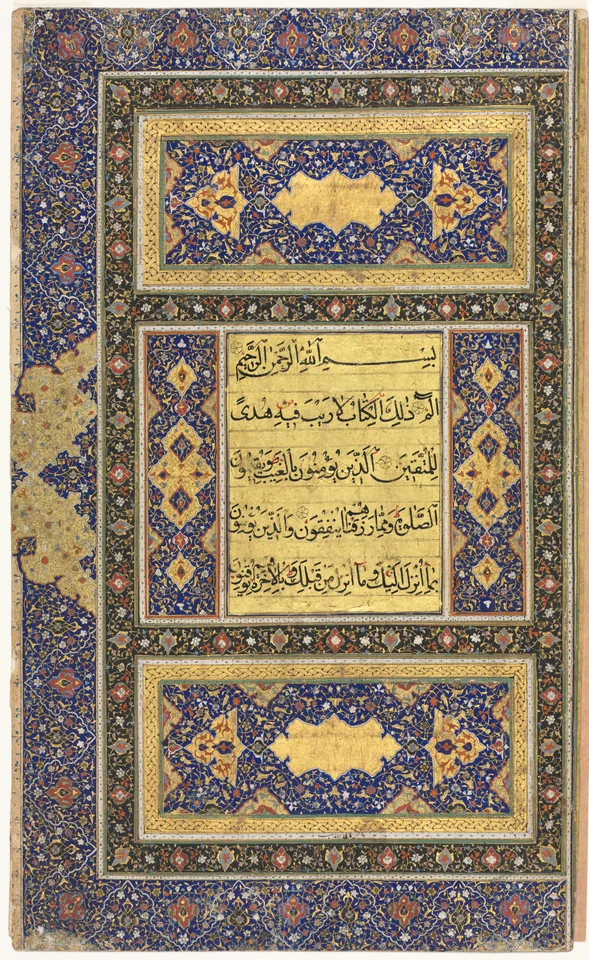
Look at a 16th-century Qur’an opening from Safavid-period Herat and you see centuries of tradition gathered on one page: gold lines of script in cloud bands and blue panels full of flowering scrolls. The pattern did not stay in the book. It moved to tiles and wooden lattice windows, to doors and pulpits (minbar), and the 13th-century minbar of the Mosque of Ibn Tulun in Cairo remains an early example of geometric pattern built in wood. Today craftsmen and students still learn these patterns by dividing a circle with the same straightedge and compass, and mathematicians study the symmetry in their construction. Weaving an endless net from a single circle still goes on.