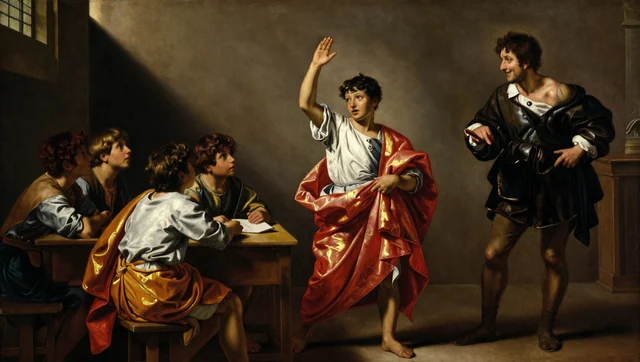
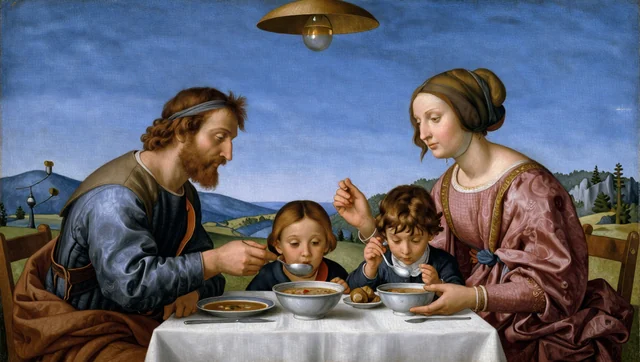
The name Renaissance comes from the Italian word rinascita, ‘rebirth’. The stage on which painting changed was a set of cities: Florence, Rome and Venice. Merchants, bankers, popes and city republics ordered pictures for church walls, altarpieces and private homes, and the painter was not someone waiting alone for inspiration but the head of a workshop called a bottega. Pupils often handled the underpainting and the background while the master painted the faces and key passages, which is why so many museum labels today read ‘and workshop’.
In early fifteenth-century Florence the architect Filippo Brunelleschi is said to have worked out linear perspective, a way of turning visible space into lines and mathematics. The story that he demonstrated it with a mirror in front of the Baptistery around 1420 is famous, but the evidence is indirect, so ‘is said to’ is the safe phrase. In the late 1420s Masaccio used the method in the Holy Trinity (about 1427) in Santa Maria Novella to open what looks like a real chapel inside the wall, and in the mid-1430s Leon Battista Alberti wrote the principles down in his treatise On Painting.
Italian painters and scholars of the fifteenth century began to read ancient Greek and Roman sculpture and writing again, a current we call humanism. The proportions of the body and the stories of myth took their place beside Bible scenes as subjects for pictures. Andrea Mantegna, who worked in Padua, studied ancient reliefs and painted firm, sculptural figures, and he spread his compositions far beyond his own city through engravings cut on copper. Prints were one of the fastest ways for a design to travel, and painters beyond the Alps learned from those sheets of paper too.
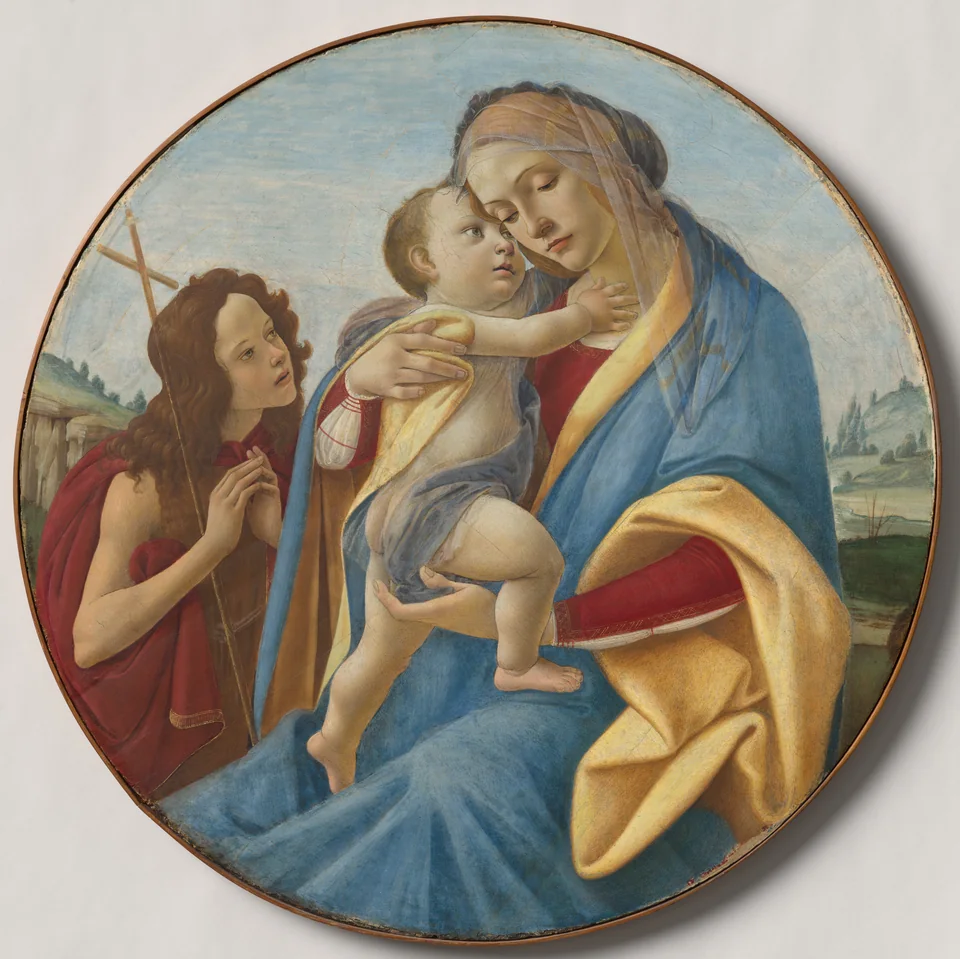
The materials changed too. At first tempera, pigment bound with egg yolk, was the main medium, and because it dries fast, painters built up fine layers of small strokes. From the later fifteenth century the oil technique developed in the north reached Italy, and painters such as Giovanni Bellini of Venice used slow-drying oil paint to make soft transitions of light. Giorgione and Titian, who carried this tradition on, led Venetian painting by laying colour over colour on canvas, and their approach in turn shaped the direction of European painting as a whole. That difference shows on the surfaces of the works below.
Around 1508 the young Raphael left Florence for Rome at the invitation of Pope Julius II. In the same year Michelangelo took on the ceiling of the Sistine Chapel, which he painted from 1508 to 1512. Before touching paint, both men tested the poses of the body again and again in drawing, and the studies that survive show the process of thought more frankly than the finished works do. That is why the works by Raphael and Michelangelo in this room are both drawings: a finished wall painting cannot travel, but thought on paper could make its way to a museum.
The Sack of Rome in 1527 by the troops of Emperor Charles V struck a heavy blow to the city’s role as an art centre, and many artists left. In Venice, meanwhile, Titian ran a large workshop and answered commissions from kings and emperors. As a result several versions of one composition circulated, and where the master’s hand ends and the workshop’s begins is still debated by scholars. The Cleveland Adoration of the Magi is one such case, so in this room we keep the credit as ‘Titian and workshop’.
It was later generations who fixed ‘Renaissance’ as the name of an age. The painter and writer Giorgio Vasari, in his 1550 Lives of the Most Excellent Painters, Sculptors, and Architects, built the story that the glory of antiquity had been forgotten and then revived by the painters of Florence. The French word ‘Renaissance’ became widely established as the name of a period through the writing of nineteenth-century historians. So it is worth remembering that the name mixes the pride of the people of that time with the gaze of those who came after. It helps to read today’s name apart from the words of the people of that time.