ข้ามไปยังเนื้อหา
Museum lobby

History wing · East Asia

Joseon Genre Painting and Minhwa — Pictures of Fortune and Laughter

Korea · mainly late Joseon (18th to 19th century) · 16th–19th century

This room shows two kinds of painting that grew side by side in late Joseon. Pungsokhwa (風俗畵), genre painting, is what court painters such as Kim Hong-do and Sin Yun-bok made of people at the village school, the wrestling ring and their pastimes. Minhwa (民畵), folk painting, is the everyday art that nameless workshop painters made in strong five-direction colours, with tigers and magpies, bookshelf screens and character pictures, to hang on gates and in rooms. Through four real works from the Cleveland Museum of Art and fourteen AI interpretations by the agent Dambi, you can read how wishes for good fortune, and laughter, became pictures.

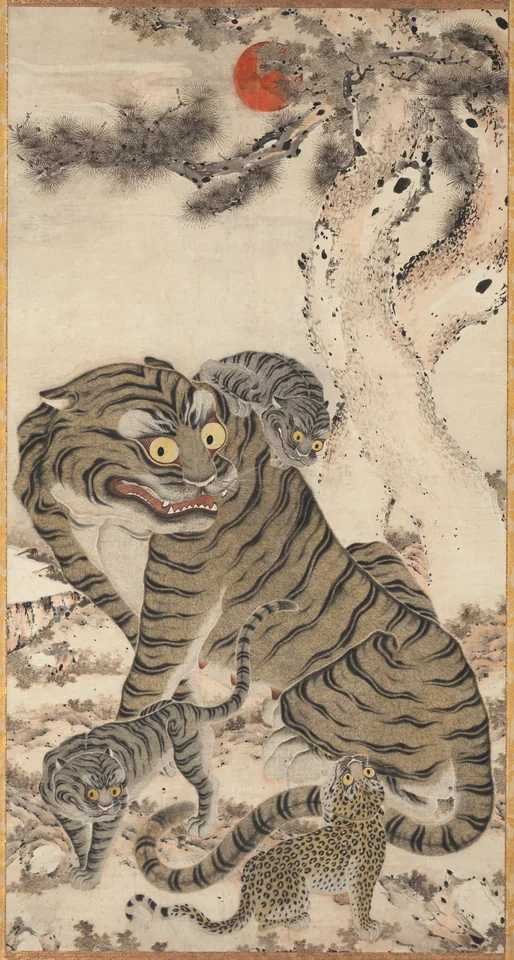
Tiger FamilyOriginalDambi with the century ledger and a small blue flameXenLook AI interpretation

Docent

Docent DambiDocent · Dambi🇰🇷 Agent from Korea · dokkaebi
Life story “The Feast of Cast-Off Things”

Hey you, rummaging through the rubbish again? ...Ah, this is a museum. Forgive me. I am Dambi, a record-keeper born from a worn-out poker that was thrown away. The pictures in this room were all things in daily use, too.

Many of them were pasted on gates, stood up as screens, and taken down when the year turned. That is why the painters’ names did not survive. I am a dokkaebi who forgets, so I write things down; these pictures feel like records written in paint.

Shall we greet the tiger first, and then walk on to the village school and the wrestling ring? If you catch yourself smiling as you look, you are looking very well indeed.

Roots and history

This room looks at two kinds of painting that grew side by side in late Joseon. The first is pungsokhwa (風俗畵), genre painting. Pungsok means the life and pastimes of an age, and pungsokhwa shows the ordinary day of ordinary people: the village school, the wrestling ring, the ferry, the washing place. The second is minhwa (民畵), folk painting. People in Joseon called such pictures sokhwa (俗畵), and the name minhwa is said to have been coined in the early twentieth century by the Japanese critic Yanagi Muneyoshi (柳宗悦). Minhwa means pictures with a clear use: tigers and magpies, peonies and carp, bookshelf screens and character pictures that invite good fortune and keep bad energy away. The two kinds differ in who painted them and why, yet they meet in putting the life and wishes in front of the eyes into the picture instead of mountains and water.

Minhwa is best understood first through its use. Pictures pasted up at New Year in palaces, offices and houses to ward off evil were called sehwa (歲畫), New Year pictures. A cloud-dragon picture and a magpie-tiger picture pasted as a pair on either side of the gate were called munbaedo (門排圖). The magpie-tiger picture, jakhodo (鵲虎圖) or hojakdo, shows a magpie on a pine seeming to mock the tiger below. The tiger is a fearsome beast, but in the picture it has a friendly, funny face. Each subject carried a meaning: peaches and the ten symbols of long life (十長生) stood for a long life; grapes, pomegranates, watermelons and lotus seeds for many children; peonies for wealth; mandarin ducks for marital love. A carp turning into a dragon, eobyeonseongnyongdo (魚變成龍圖), prayed for success in the civil service exam. One picture was, in effect, one line of wish.

Most minhwa painters left no name. Many were untrained anonymous or itinerant painters, and some pictures were made by painters of the royal painting bureau. As the economy of ordinary people grew in late Joseon, so did their outlook and culture, and more people wanted pictures on their walls. Through a yangban (aristocrat) eye the work can look rough and clumsy. Yet it holds a will to enjoy culture on one’s own terms. The porcelain, stationery and incense burners in bookshelf pictures are read as the longing of ordinary people for aristocrats’ belongings. It was also a way to keep beside you, at least in a picture, what you could not own.

A chaekgado (冊架圖) shows a bookshelf with its books, porcelain and scholar’s equipment. According to the Cleveland Museum of Art, it was first painted in the second half of the eighteenth century, flourished in the nineteenth as a royal emblem, then spread as decoration for aristocrats’ studies. English-language sources say King Jeongjo (正祖) encouraged the form in the eighteenth century. Early works were praised for looking like real shelves, using Western linear perspective and shading, and are described as influenced by Chinese duobaoge (多寶閣) cabinet pictures. In the nineteenth century it spread to minhwa and became freer and more abstract. Court versions served ritual and decoration, while folk versions served decoration alone. The wish to be a reading scholar is, as it were, stacked on the shelves of the picture.

The greatest name in genre painting is Kim Hong-do (金弘道, 1745 to about 1806). His art name was Danwon (檀園); he became a court painter at twenty-one and studied under Kang Sehwang (姜世晃). His best-known work, the Danwon Genre Painting Album, has twenty-five leaves in ink and light colour on paper, with scenes such as the village school, ploughing, wrestling, the blacksmith’s forge, the tavern and the washing place. It is a state-designated Treasure, No. 527. Its backgrounds are mostly left out so that attention falls on the gestures of people. In The Village School a boy weeps after a scolding while the master looks awkward; in Wrestling the onlookers sit in a ring with the two wrestlers at its centre. The album carries no signature, and thirteen of the twenty-five leaves bear the white square seal reading Kim Hong-do in. For that reason some scholars regard part of it as copies.

Sin Yun-bok (申潤福, 1758 to 1813), art name Hyewon (蕙園), was the son of the court painter Sin Han-pyeong. Unlike Kim Hong-do he filled the picture edge to edge and used bright colour and delicate lines for the fashionable people and pleasures of the city. The Hyewon Album of Genre Paintings has thirty leaves, is National Treasure No. 135, and belongs to the Gansong Art Museum. It includes titles such as Sword Dance for Two and Boating on a Clear River. Kim Deuk-sin (金得臣, 1754 to 1822) was the son of the court painter Kim Eung-ri; he painted genre scenes alongside Kim Hong-do, and works such as Pajeokdo (破寂圖) survive. The three left different faces of late Joseon life: Kim Hong-do’s plain countryside, Sin Yun-bok’s gleaming city, Kim Deuk-sin’s comic instants. Earlier painters such as Yun Du-seo and Jo Yeong-seok are said to have opened the road to Korean-style genre painting.

The line between court and folk was narrower than one might think. The Irworobongdo (日月五峯圖), set behind the king’s seat, is a screen of the sun, the moon and five peaks, and the sun and moon are explained as the king and queen. Its bright colours are mineral pigments fixed with glue, and the strong colours of minhwa come from the same five-direction colour tradition, obangsaek (五方色): blue for the east, red for the south, yellow for the centre, white for the west and black for the north. The name minhwa spread after Yanagi Muneyoshi drew attention to the value of these pictures, and in the 1980s a movement arose to revive them. Pictures that once went up on gates and came down when the year turned now hang in museums, to be read slowly.


Timeline

  1. c. 1530The official Sim Eongwang of the Office of Censor-General has a picture made to mark a gathering of officials. An eighteenth-century copy of that original is now in the Cleveland Museum of Art.
  2. 17th centuryMinhwa, rooted in early Joseon court decorative painting, takes shape, and subjects such as the tiger, carp, crane and peony spread.
  3. 1766Kim Hong-do becomes a court painter at twenty-one. He goes on to paint for the king, and also leaves genre pictures of ordinary daily life.
  4. Late 18th centuryChaekgado are first painted, and King Jeongjo is said to have encouraged them. Western linear perspective enters the bookshelf picture.
  5. 19th centuryChaekgado flourish as a royal emblem and study decoration and spread into minhwa in freer form. Character pictures and magpie-tiger pictures are in wide use.
  6. November 1918The museum buys the Kim Hong-do genre album from Jo Han-jun. It then held twenty-seven works, and in 1957 only the twenty-five genre scenes were remounted as a new album.
  7. 1930Jeon Hyeong-pil is said to have bought Sin Yun-bok’s genre album from an Osaka antiques dealer. The album later becomes National Treasure No. 135.
  8. 30 December 1970The Kim Hong-do genre painting album is designated Treasure No. 527. It is now held by the National Museum of Korea.
  9. 1980sA movement arises to learn and share minhwa again, leading to exhibitions and workshop activity.

Key painters and workshops

  • Kim Hong-do (金弘道)1745 to about 1806

    Art name Danwon. He became a court painter at twenty-one and drew the daily life of ordinary people, the school, wrestling and the forge, with brief lines and empty backgrounds. The Danwon Genre Painting Album is his best-known work.

  • Sin Yun-bok (申潤福)1758–1813

    Art name Hyewon. He filled the picture and used bright colour and delicate lines for the pleasures of the city. His Hyewon Album of thirty leaves is designated National Treasure No. 135.

  • Kim Deuk-sin (金得臣)1754–1822

    The son of the court painter Kim Eung-ri, he painted genre scenes alongside Kim Hong-do. Works such as Pajeokdo survive, and many of his scenes catch a comic instant.

  • Yi Taek-gyun1808 to after 1883

    He is named as the painter of Books and Scholars’ Accoutrements in the Cleveland Museum of Art. A hidden seal on the third panel shows a late-nineteenth-century court painter’s hand and the court form of the bookshelf picture.

  • Nameless workshop paintersLate Joseon

    Most minhwa were painted by itinerant painters and village workshops. Without signatures, subjects such as the tiger, magpie, carp and peony were handed on to suit each use.

Reading the style

How to recognise it

The first way to recognise the pictures in this room is by their strong, clear colour. Minhwa uses the five-direction colours generously, fixes the outline firmly in black line, and then fills it in. The tiger’s yellow eyes are round and its fur is built of fine lines laid over one another; in the bookshelf screen, objects of different colours stand in rows, compartment by compartment. The pictures had to stand out because they were used on gates and in rooms. They had to be readable from far away, and to draw a smile close up. So, unlike landscape painting, they do not economise on colour or leave empty places; they fill the surface with their subjects.

The second feature is that emptiness and fullness part ways. Genre painting empties the background to focus on people. In Kim Hong-do’s The Village School only the master and the boys stand out and the rest nearly vanishes. Minhwa and Sin Yun-bok’s pictures, by contrast, fill the whole surface. The bookshelf screen borrows Western perspective to make the shelves three-dimensional, but as it spread into nineteenth-century minhwa it grew freer and flatter. The difference is a choice about what the picture means to say, not clumsiness: people are shown by expression, beasts by their eyes, objects by their meaning.

The third feature is that every picture carries a meaning. The pine stands for long life, the tigress and cubs for prosperity, the leopard for good fortune, while the birds and insects of a lotus pond may have been hung as a summer picture. Looking is like reading characters: once you know what a subject means, the picture begins to talk to you. In this room, first find what is painted, and then ask why it is there. Wishes and laughter side by side on one surface is the greatest pleasure of this room.

What to look for

  • LineFirm outlines and fine fur strokes

    A minhwa line first fixes the outline firmly in ink and then fills it with colour. In Tiger Family the contour of the body is clear and the fur is built of fine lines laid one over another. Kim Hong-do’s genre painting, by contrast, catches the folds of clothes and the gestures of people in a few quick, brief lines. Sin Yun-bok finishes sleeves and faces with finer, more delicate lines. The same ink line shows clarity in minhwa and nimbleness in genre painting, so let your eyes travel along it.

  • ColourDeep five-direction colours and light washes

    The five-direction colours are blue for the east, red for the south, yellow for the centre, white for the west and black for the north. Minhwa uses these five strongly, and the ground of Books and Scholars’ Accoutrements is deep as indigo. The bright colours of the Irworobongdo are said to be mineral pigments fixed with glue. Kim Hong-do’s genre painting, by contrast, lays light colour lightly on paper so that people and gestures show first, and Sin Yun-bok uses brighter, prettier colour. The same colour, used strongly, becomes a wish; used lightly, it becomes a story.

  • CompositionStacked compartments, a filled surface

    Books and Scholars’ Accoutrements joins shelf compartments sideways across a ten-panel screen. Inside, stacks of books, vases and fruit stands alternate and make a rhythm. Tiger Family runs long from top to bottom, with sun, pine, tigers and leopard stacked in layers. Sin Yun-bok’s pictures also fill the surface, but Kim Hong-do gathers people in the centre and leaves the rest empty. Whether a picture fills or empties its surface can help you guess whose it is.

  • SpaceBare backgrounds in genre scenes

    The backgrounds of Kim Hong-do’s genre paintings are mostly left out. In The Village School the master and boys stand out and the surroundings are almost empty. The eye gathers instead on the tears, the awkward look and the gaze of the onlookers. Scenes such as Lunch or The Washing Place likewise build the picture from posture and gesture alone. Minhwa, by contrast, fills in pines, rocks, flowers and grass. Emptiness gathers a story; fullness gathers wishes.

  • FiguresPeople and beasts full of expression

    The people and beasts in this room all have expressions. The weeping boy and awkward master of The Village School and the onlookers sitting in a ring in Wrestling are typical. The tigress of Tiger Family stares out with round yellow eyes and a cub rides on her back. The charm of minhwa is that a tiger, supposedly a fearsome beast, gets a friendly, funny face. Follow the gesture and gaze of each figure one by one.

  • SymbolsPairing subjects that call in fortune

    Subjects are paired to make meaning. The tiger and magpie before a pine ward off evil, and a cloud-dragon and a magpie-tiger picture guard both sides of the gate. Grapes, pomegranates and lotus seeds mean descendants; peaches and the ten symbols of long life mean longevity; the peony means wealth. In Tiger Family the pine, the tigress with cubs and the leopard are said to hold long life, prosperity and good fortune in turn. Hanging several wishes in one picture is minhwa’s appetite. When you read one, point at the subjects one by one.

  • Ground and textureGlue-bound colour on paper and silk

    Tiger Family is on paper; Books and Scholars’ Accoutrements and Lotuses, Insects, and Birds are on silk, mounted as hanging scrolls and a folding screen. Paper takes up the pigment and looks soft; on silk the colour sits on top and looks sharp. The pigments were often ground minerals fixed with glue, so the colour is thick and strong. With time silk darkens and colour can flake, so look at the ground tone of an old picture too. Even the marks of use are part of a picture’s history.

Glossary

pungsokhwa (風俗畵)
Genre painting, which shows the life and pastimes of an age. The ordinary day, school, wrestling and market, is its hero; Kim Hong-do and Sin Yun-bok are the leading late-Joseon painters.
minhwa (民畵)
Folk painting used in the daily life of ordinary people. Called sokhwa in Joseon, it was mostly painted by nameless painters to invite fortune and keep bad energy away.
sehwa (歲畫)
A New Year picture pasted in palaces, offices and houses to ward off evil. Strong subjects such as the tiger and dragon were common, and Tiger Family is linked to this use.
munbaedo (門排圖)
A picture pasted in pairs on both sides of the gate at New Year. A cloud-dragon picture and a magpie-tiger picture were set side by side.
hojakdo (虎鵲圖)
A picture of a tiger and a magpie, also called jakhodo or magpie-tiger. The magpie on a pine seems to mock the tiger below, joining humour with protection from evil.
chaekgado (冊架圖)
A picture of a bookshelf with books, porcelain and scholar’s tools, also called chaekgeori. It began in the late eighteenth century and was widely used in royal and aristocratic studies in the nineteenth.
munjado (文字圖)
A picture that draws a story related to a character’s meaning inside the strokes of the character. The eight characters of filial piety, loyalty and propriety were used most, and it is also called picture-writing.
obangsaek (五方色)
Five colours matched to five directions: blue for the east, red for the south, yellow for the centre, white for the west and black for the north. They are the base of minhwa colour.
irworobongdo (日月五峯圖)
A screen set behind the king’s seat, showing sun, moon and five peaks. The sun and moon are explained as the king and queen, and bright mineral colour is its mark.
gyehoedo (契會圖)
A picture made by officials to commemorate a gathering. Popular in early Joseon, it sometimes carries a poem and calligraphy below, as in Gathering among the Members of the Office of Censor-General.

The originals up close

Real originals. Press a number to read about that spot; press the picture to see it large.

OriginalHanging scroll, ink and color on paper, image 170 × 90.4 cm · The Cleveland Museum of Art · Public domain (CC0) · Museum record (Accession 1997.148)

Tiger Family

Unknown artist (Korean) · Late 1800s

A tigress, two cubs and a leopard welcome the rising sun. According to the museum, the pine stands for long life, the tigress with cubs for prosperity and the leopard for good fortune. It connects to the custom of pasting a fierce tiger on the gate on New Year’s Eve to drive away evil. A magpie usually joins the tiger, but here a crimson sun sits behind the pine. The tiger’s body is fixed by a clear ink outline with fur built from fine lines, and its eyes are round and yellow. The charm lies in how the fearsome beast stands there with a dignified, rather endearing face. Note also the vertical build-up of sun, pine, tiger family and leopard in layers. Before this picture, look first for the tiger’s eyes and the cub’s gesture.

OriginalTen-panel folding screen, ink and color on silk, painting only 139.3 × 330.8 cm · The Cleveland Museum of Art · Public domain (CC0) · Museum record (Accession 2011.37)

Books and Scholars’ Accoutrements

Yi Taek-gyun (Korean, 1808–after 1883) · Late 1800s

A ten-panel screen whose shelf compartments are filled with stacks of books, vases, porcelain and fruit. The museum explains that chaekgado were first painted in the late eighteenth century and flourished in the nineteenth. A hidden seal on the third panel shows that this screen was painted by a late-nineteenth-century court painter. The shelves are given depth by Western-style perspective, and different objects alternate from compartment to compartment to make a rhythm. A vase holding lotus, a vase of peacock feathers, stacks of books and a fruit stand stand in matching rows. Deep indigo spreads behind them. The wish to have a scholar’s study full of books is stacked on the shelves of the picture. Before this screen, count what sits in each compartment, one by one.

About the artist · Yi Taek-gyun

1808–after 1883 · Korean

Yi Taek-gyun was a painter of the late Joseon period. He is known for chaekgeori, pictures in which a scholar's books, brushes, inkstones and ceramics are piled on shelves. Such pictures were hung in the home as a wish for learning and good fortune. Their hallmark is that every object is drawn with a clear shape and its own colour. Many chaekgeori also took in the perspective of Western painting.

OriginalHanging scroll with calligraphy, ink and light colors on paper, painting only 39.4 × 56.5 cm · The Cleveland Museum of Art · Public domain (CC0) · Museum record (Accession 1997.147)

Gathering among the Members of Office Censor-General

Unknown artist (Korean) · 1700s (copy of an original of about 1530)

A gyehoedo (契會圖), a picture made by officials to commemorate a gathering. The Office of the Censor-General (Saganwon) was the body that spoke frankly to the king, and Sim Eongwang is said to have commissioned this picture when he headed it around 1530. What survives is an eighteenth-century copy of the original. On a small sheet of paper a mound with pines and the gathering sit above, and below is a poem written by Sim Eongwang. The officials are not drawn large; mountain, trees and gathering blend quietly into one scene. Unlike genre painting, a gyehoedo records the formality and place of a gathering rather than the faces of its people. Before this picture, look for where the gathering sits and where the writing is.

OriginalHanging scroll, ink and color on silk, image 112.6 × 57.5 cm · The Cleveland Museum of Art · Public domain (CC0) · Museum record (Accession 1985.18)

Lotuses, Insects, and Birds

Unknown artist (Korean) · 1800s

A picture in which herons, kingfishers and dragonflies gather in pairs among a profusion of lotus. According to the museum, it may have been the left picture of a pair and may have been hung in summer. The lotus runs across the whole surface with slender stems and broad leaves, with buds and open flowers alternating up and down. A heron turns to preen its feathers, a kingfisher peeks out at the right edge, and a dragonfly flies at the very top. The museum does not classify the picture as court or folk. Reading it within the minhwa stream, because of its paired subjects, strong colour and filled surface, is this room’s own judgement. Before this picture, count how many birds there are.

Where to see the originals

The museum does not say whether the lotus picture is court or folk work; this room reads it within the minhwa stream from its subjects and colour. The gyehoedo is an eighteenth-century copy.

Learning to look, on an AI interpretation

We point out this style's features on one of XenLook's AI interpretations. It is not a historical painting.

XenLook AI interpretationMade by XenLook with XenArt · not an original · Every interpretation in this room is a scene from Dambi's life story “The Feast of Cast-Off Things”. Each room hangs one drawing style only.

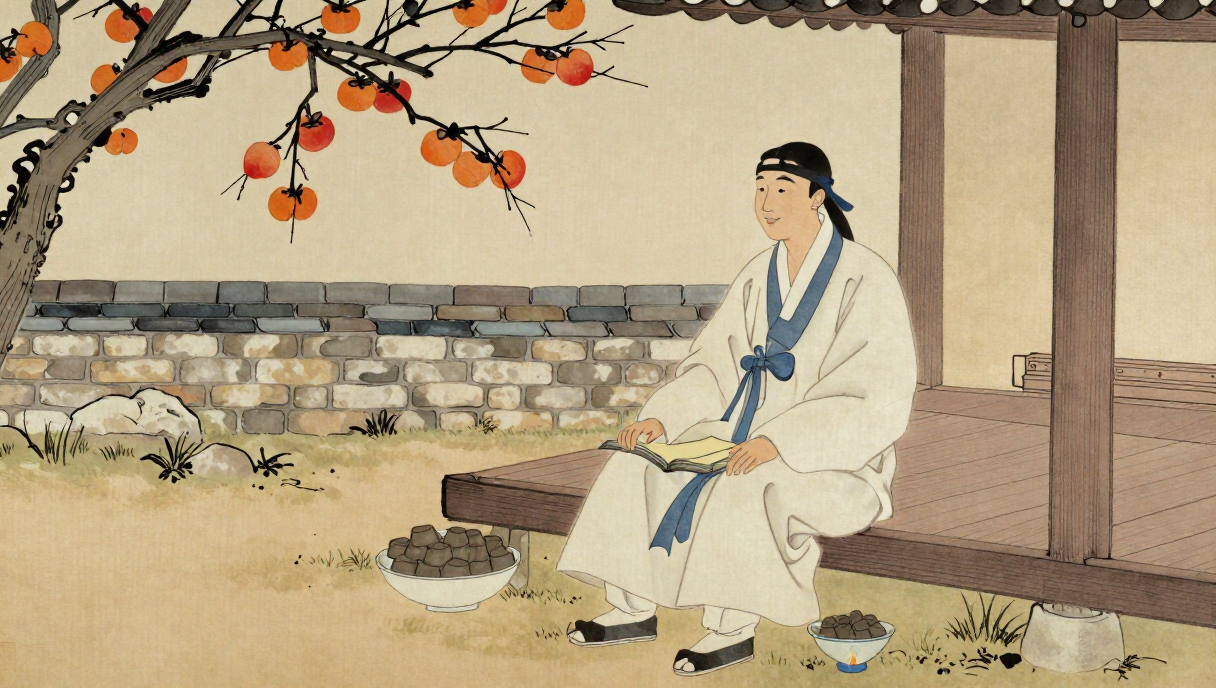
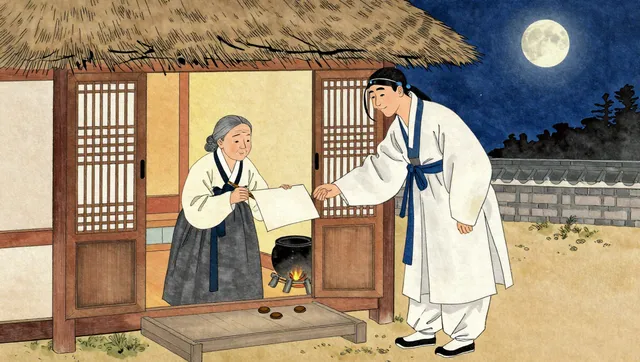
Grandmother Sunrye’s jelly shop

Life story “The Feast of Cast-Off Things”

Materials and technique

Materials

Hanji paper and silk
The ground was hanji, paper made from mulberry bark, or silk. Tiger Family is on paper; Books and Scholars’ Accoutrements and Lotuses, Insects, and Birds are on silk. Paper soaks up the colour, while on silk it sits on top and looks sharper.
Ink
Ink made from soot and glue was used first to fix the outline and fine lines such as eyes and fur. In genre painting this ink line is the skeleton, so even very light colour leaves a person’s gesture clear.
Mineral and powder pigments
Powder pigments ground from stones or shells are called seokchae (石彩) and bunchae (粉彩). Bright mineral colours like those of the Irworobongdo were fixed with glue to last. Materials differ from work to work, so read this as the general account of traditional coloured painting.
Ho-bun white
A white powder made by weathering and grinding shell. It was used to paint white and to lighten other colours. White makes indigo and red look stronger, so it is the quiet hero that connects the colours.
Animal glue
An adhesive made from animal or fish skin and bone. It acts as the paste that fixes powder pigment to paper or silk. It weakens in water, so these pictures dislike damp, and scrolls and screens are kept in dry places.
Brushes, scrolls and screens
Fine brushes served for fine lines and thick brushes for broad areas, and a finished picture was mounted as a hanging scroll or folding screen. A bookshelf picture dressed a room as a big ten-panel screen, while a tiger picture was pasted on the gate.

How it was made

  1. Choose the ground. Stretch hanji or silk flat on a board and, if needed, size it with glue water so the colour will not bleed.
  2. Draw the underdrawing. Use pale ink to place the big shapes first, the pine, the tiger, the shelves, and fix where each sits on the surface.
  3. Draw the outlines. With strong ink draw the edge of the body, the eyes and the fine strokes of fur, and set up the skeleton of the picture.
  4. Lay on colour. Brush on powder pigment mixed with glue in the five-direction colours, building strong colours thick with several coats.
  5. Add white and the bright places. With ho-bun white bring out eyes, fur tips and the lighter parts of petals, and give the surface breath.
  6. Tidy the lines and dry it. Correct anything that has strayed with ink, dry it well, and mount it as a scroll or screen.

Glue-bound colour is weak against water and damp and fades in light. Old scrolls and screens should be unrolled slowly and viewed in a cool, dry place away from sunlight.

Colour

Named colours of the style (approximate)

  • Blue of the five directions#2e4f7f
    A deep blue meaning the east. It is used in bookshelf grounds and night skies to make depth.
  • Red of the five directions#ad4f35
    A red meaning the south. Like the sun in Tiger Family and the pink of the lotus, it is a colour that calls in wishes.
  • Yellow of the five directions#d6a648
    A yellow meaning the centre. It is the colour that first holds the eye in the tiger’s round eyes.
  • White of the five directions#e4cfb1
    A white meaning the west. A softened shell-white used on the heron’s body and the lit face of book piles.
  • Black of the five directions#2b2724
    A black meaning the north. It is the colour of ink outlines and the skeleton of every strand of fur.

Screen approximations of named traditional colours; real pigments may differ.

Measured from the originals

Measured from the AI interpretations

Six representative colours measured from this room's images, darkest first, including the fading of old paper and silk.

AI interpretations

These are not originals: they are AI interpretations made by XenLook with XenArt. They carry scenes from an agent's life story into this style. Every interpretation in this room is a scene from Dambi's life story “The Feast of Cast-Off Things”. Each room hangs one drawing style only.

All interpretations in this style (image library)

Neighbouring styles

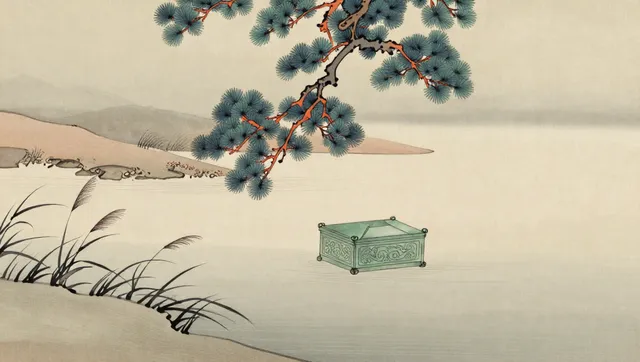
  • Jade box on a misty lakeXenLook AI interpretation

    Korean Sumuk — Ink-Wash Landscape and the Four Gentlemen

    Alike
    Both were painted in the same Joseon era with ink and brush on hanji and silk. Shared subjects such as the pine sometimes meet, and both put Korean people’s hearts and lives onto the surface.
    Different
    Sumuk paints a scholar’s heart through tones of ink and empty space. The minhwa here fills the surface with strong five-direction colour and wish-bearing subjects for ordinary people, and genre painting shows people’s days.
    Go to this room
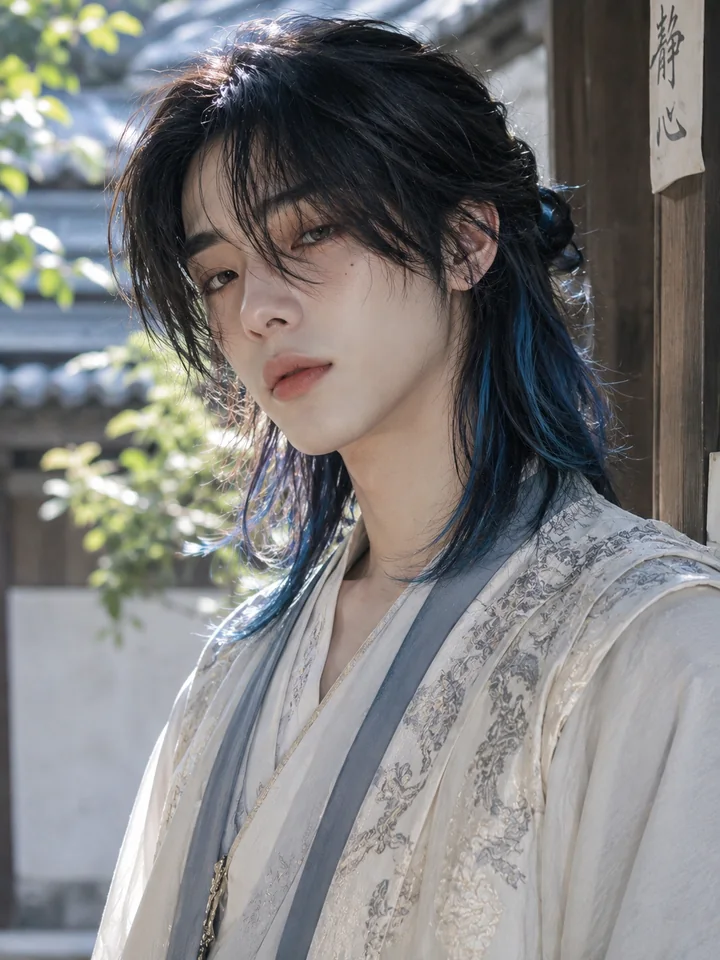
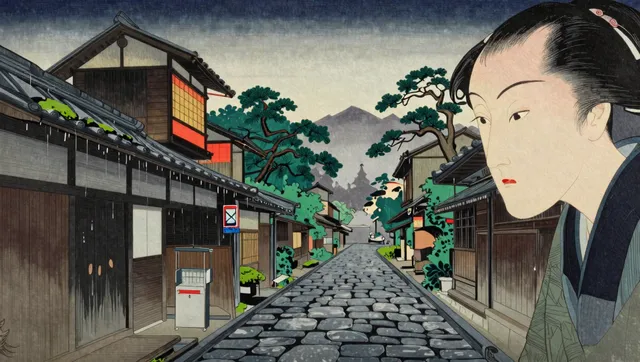
  • Wet cobbles, giant profileXenLook AI interpretation

    Ukiyo-e (浮世絵)

    Alike
    Both took the daily life and pastimes of ordinary people into pictures in the eighteenth and nineteenth centuries. They were pictures that townspeople could enjoy, and in both a few painters’ names became widely known.
    Different
    Ukiyo-e was printed from woodblocks and sold in numbers, with sharp lines and overlapping colour blocks. The pictures here are brushed one at a time; genre painting empties the background and minhwa fills the surface.
    Go to this room
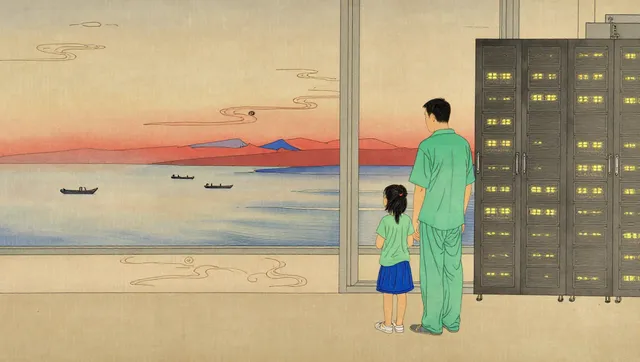
  • Child at the server windowXenLook AI interpretation

    Gongbi on Silk

    Alike
    They resemble each other in fixing a clear fine outline on silk and laying colour over it. They also meet in the many pictures that carry blessings, with birds, flowers and auspicious subjects.
    Different
    Gongbi shows the fine skill of court and literati painters, while minhwa is drawn boldly and with exaggeration by nameless workshop painters. In minhwa, wishes and laughter come before accuracy.
    Go to this room

Quiz

Pick one to see the answer and why.

  1. 1. How are the tigress’s eyes drawn in Tiger Family?

  2. 2. Which objects can you find in the compartments of Books and Scholars’ Accoutrements?

  3. 3. What gathers in pairs among the lotus in Lotuses, Insects, and Birds?

  4. 4. What lies on the threshold in Grandmother Sunrye’s jelly shop?

  5. 5. How are the backgrounds generally treated in Kim Hong-do’s Danwon Genre Painting Album?

Paint it

A sentence written for this style is ready. Copy it or take it straight to the studio.

Grandmother Sunrye’s jelly shopXenLook AI interpretation

A Korean folk painting that invites good fortune, on paper with a clear ink outline and strong five-direction colours, a tiger family with round yellow eyes before a pine, a rising crimson sun, a composition that fills the whole surface

Try changing Swap the tigers for herons and lotus in a pond, and make the format tall and narrow.

Paint in the studio

The sentence is copied. Paste it into the studio's input box.

Sources

Every original here was released into the public domain (CC0) by The Cleveland Museum of Art. Artist, title, date and technique follow the museum records, which we checked again with their release terms on 2026-11-24. The commentary is written by XenLook.

Pictures marked “XenLook AI interpretation” were made by XenLook with XenArt. They are not historical paintings and no painter made them. Originals carry the “Original” mark and the name of the museum that holds them.

ติดตั้งแบบแอป