ข้ามไปยังเนื้อหา
Museum lobby

History wing · East Asia

Kyoto Nihonga

Kyoto, Japan · Meiji to Taishō periods · 1880s to 1920s

Kyoto Nihonga is the Kyoto branch of Nihonga (日本畫, "Japanese-style painting") from the Meiji era (1868–1912). Painters work on paper or silk with ink, mineral pigment and animal glue, using fine lines, thin colour and generous empty space. Schools and public exhibitions grew up around the Maruyama–Shijō habit of painting what the eye sees, and from them came a line of teachers and pupils running from Bairei through Seihō to Shōen. This room shows four real works from the Cleveland Museum of Art beside AI interpretations drawn from Yuki's chronicle.

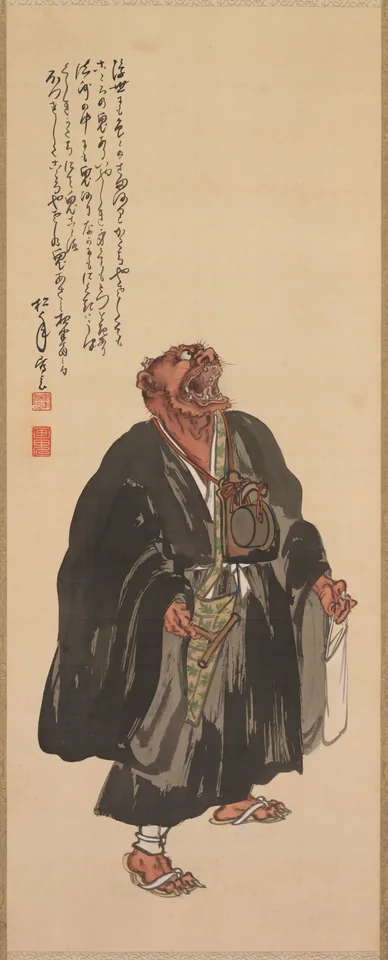
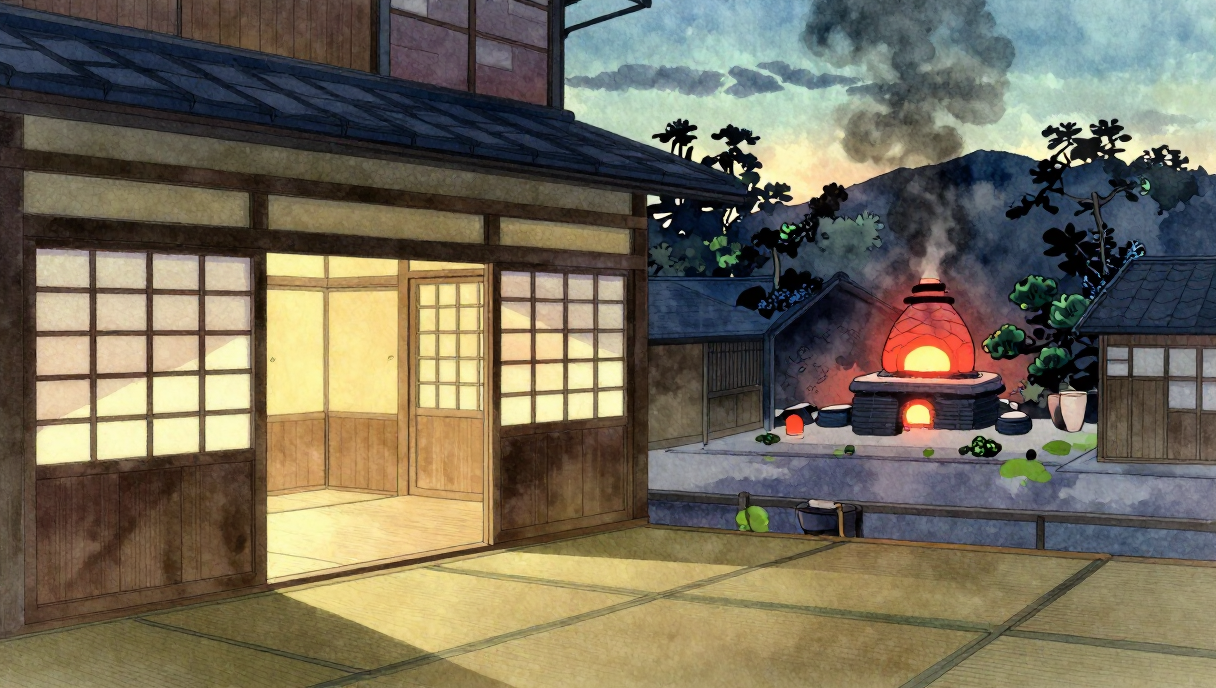
Demon Intoning the Name of the BuddhaOriginalKiln beside the house at duskXenLook AI interpretation

Docent

Docent YukiDocent · Yuki🇯🇵 Agent from Kyoto, Japan
Life story “The Margin at Your Fingertips”

Welcome. I am Yuki. I grew up as a potter's daughter in an old machiya in a back alley of Gion, Kyoto, and today I design screens for a living.

To my eyes, Nihonga is the craft of leaving a place empty. Find the spots where nothing is painted, and you have already seen half of this room.

First I will tell you where it comes from. Then we look at the mineral pigments and the glue, and walk slowly past four real works. There is no need to hurry.

Roots and history

Nihonga (日本畫, "Japanese-style painting") does not simply mean every picture painted in Japan. The word was coined in the Meiji era (1868–1912) to set it apart from yōga (洋畫), Western-style oil painting, which had just arrived. In the narrow sense it covers about 77 years, from the Meiji Restoration to the end of the Second World War. Before that, painters were known by school names such as Kanō, Maruyama–Shijō and Tosa. The materials stayed the same: ink and mineral pigment fixed with animal glue on paper or silk. What changed were the name and the purpose. For the first time, painters were asked how to carry old techniques forward inside a new idea called national art.

In Tokyo the leading figure was Okakura Kakuzō (岡倉天心, 1863–1913). Together with the American scholar Ernest Fenollosa he argued for reviving traditional art, and he helped found the Tokyo School of Fine Arts in 1887. Teaching began in 1889, and Okakura soon became its director. In 1898 he founded the Nihon Bijutsuin (Japan Fine Arts Academy) with Hashimoto Gahō and Yokoyama Taikan. Gahō, a painter of the Kanō school, was the Tokyo school's first professor and taught Taikan, Shimomura Kanzan, Hishida Shunsō and Kawai Gyokudō. Okakura is also known for his English-language The Book of Tea (1906), and in 1910 he worked at the Museum of Fine Arts, Boston.

Kyoto's situation was different. The city already had the Maruyama–Shijō tradition, which prized shasei (寫生), painting what stands before the eye. Its lines were soft, and birds, animals and plants were drawn close to life. In 1880, nine years before Tokyo's school, the Kyoto Prefectural School of Painting (京都府畫學校) opened. It is the root of today's Kyoto City University of Arts. Ninety-three merchants contributed money, and the first headmaster was Tanomura Naoiri (田能村直入). In a three-year course students learned bunjinga, yamato-e and Kanō painting, and Western painting was introduced as well. The aim was to train designers for Kyoto's craft industries.

A single line of teachers and pupils grew around this school. Kōno Bairei (幸野楳嶺, 1844–1895) was born in Kyoto and opened a school of his own in 1880; his pupils included Takeuchi Seihō, Kawai Gyokudō and Uemura Shōen. In 1881 he published a picture book of birds, the Bairei Hyakuchō Gafu (百鳥畫譜). Seihō (竹內栖鳳, 1864–1942) toured Europe around the 1900 Paris Exposition and joined the realism of the Maruyama–Shijō school to the impressions of Turner and Corot. Uemura Shōen (上村松園, 1875–1949) first studied with Suzuki Shōnen, then with Bairei and Seihō, became famous for pictures of beautiful women, and in 1948 became the first woman to receive the Order of Culture.

Shōen's first teacher, Suzuki Shōnen (鈴木松年), was the son of Suzuki Hyakunen and was born in Kyoto. From 1881 to 1888 he served as a deputy teacher at the Kyoto Prefectural School of Painting, and his forceful ink line earned him the nickname "Shōhaku of today" (今蕭白). Of the same generation, Kamisaka Sekka (神坂雪佳, 1866–1942) was born into a samurai family in Kyoto and is called the last great heir of the Rinpa (琳派) tradition. He visited Glasgow in 1901, where Art Nouveau opened his eyes, and in 1909–10 he published the design book Momoyogusa (百々世草). Beside them stand Hōryū, the painter from life, and Shōnen, the master of ink. Kyoto Nihonga is not one flavour but a line made of many voices.

People often divide the two cities neatly: Tokyo for new ideas, Kyoto for tradition and realism. This is a simplification that historians themselves debate. Seihō, a Kyoto painter, embraced European art eagerly, and Hishida Shunsō on the Tokyo side tried the "vague style" (朦朧體, mōrōtai), which softens outlines and paints air with gradations of colour. So please take this room as saying only that Kyoto had this particular line of painters. Nihonga is still painted with the same materials today and can be studied at Kyoto City University of Arts. And the AI interpretations here are not strict Nihonga: they borrow its empty space, thin colour and warm points of light.


Timeline

  1. 1868The Meiji Restoration founds a new government, and Western art begins to arrive in earnest.
  2. 1880The Kyoto Prefectural School of Painting opens, Kyoto's first modern art school and nine years ahead of Tokyo's.
  3. 1881Kōno Bairei publishes the bird picture book Bairei Hyakuchō Gafu; Suzuki Shōnen begins teaching at the school as a deputy.
  4. 1887–1889The Tokyo School of Fine Arts is founded in 1887 and starts teaching in 1889, with Okakura Kakuzō at its centre.
  5. 1898Okakura, Hashimoto Gahō and Yokoyama Taikan found the Nihon Bijutsuin.
  6. 1900Takeuchi Seihō travels through Europe around the Paris Exposition and sees the paintings of Turner and Corot.
  7. 1909–1910Kamisaka Sekka publishes the design book Momoyogusa. In 1909 Seihō becomes a professor at the Kyoto Municipal College of Painting.
  8. 1912Yoshimura Hōryū paints the hanging scroll Howling Wolf in a Deep Mountain Valley, now in the Cleveland Museum of Art.
  9. 1918Uemura Shōen paints her best-known work, Flame (焰, Honō).
  10. 1948Uemura Shōen becomes the first woman to receive the Order of Culture; she dies the following year.

Key painters and workshops

  • Kōno Bairei1844–1895

    Born in Kyoto. He opened a school in 1880 and taught Seihō, Gyokudō and Shōen. He is also known for picture books of birds and plants drawn with great care.

  • Takeuchi Seihō1864–1942

    Born in Kyoto and a pupil of Bairei. He became an Imperial Household Artist in 1913 and received the Order of Culture in 1937. His works include Lion, Elephants and Tabby Cat.

  • Uemura Shōen1875–1949

    Born in Kyoto. She studied with Shōnen, Bairei and Seihō. In 1941 she became the first woman in the Imperial Art Academy, and in 1948 she received the Order of Culture.

  • Kamisaka Sekka1866–1942

    Born into a Kyoto samurai family, the last great heir of the Rinpa tradition. He met Art Nouveau in Glasgow in 1901 and later published Momoyogusa.

  • Suzuki Shōnen1848 or 1849–1918

    Born in Kyoto, son of Suzuki Hyakunen. His strong ink line won him the name "Shōhaku of today", and he was Shōen's first teacher. Sources differ on his birth year.

Reading the style

How to recognise it

The first clue to Kyoto Nihonga is a clear, fine ink line with thin colour laid over it. The contour is drawn crisply with the tip of the brush, yet it is never thick or rough, and colour is built up in several thin layers rather than in one pass. The colour therefore seems to rest quietly on the paper instead of being pressed into it. Thanks to the habit of painting from life, birds, animals, plants and people look natural, as if seen with the eye. But the painter does not fill everything to look real. What matters is drawn exactly, and the rest is boldly left empty.

The second clue is the empty surface. In Kamisaka Sekka's Bugaku Dancer the largest part of the picture is a golden ground on which nothing is painted. In Yoshimura Hōryū's wolf, distant trees dissolve into mist through ink gradation alone. The empty place is where the eye rests, and also where air and distance are made. Then one small, strong accent, such as a red seal, a red sleeve or the wolf's open mouth, is placed in it to catch the eye. "Empty large, fill small" is the breath of Kyoto Nihonga.

The third clue is that the materials set the face of the picture. Silk gives a faint grain and sheen, and paper gives the softness of spreading ink. Mineral pigment grows deeper or paler according to the coarseness of its grains, and blue, green and vermilion look firm even when used sparingly. The ways of viewing, such as the hanging scroll (掛軸), handscroll (絵卷) and folding screen (屛風), were fitted to the painting. Once you know all this, you start to see Nihonga not as a picture in a frame but as an object you unroll and handle.

What to look for

  • LineThin, clear ink contours

    Hōryū's wolf has its mouth and fur tips fixed in exact thin lines, and Bairei's girl has the folds of her dress drawn in long, soft strokes. The line carries strength without becoming thick. A few painters, such as Shōnen with his demon (鬼, oni), choose a deliberately rough ink line, but Kyoto's main current is the clear line. Follow a stroke with your eye and see how quickly it tapers and where the brush paused.

  • ColourDeep colour from ground minerals

    Blue is made from ground azurite, green from malachite and red from cinnabar. The coarser the powder, the stronger and glitterier the colour, and the finer, the paler and softer. The same blue can therefore have different depths within one picture. In this room's pictures, look for colour placed in small spots such as a sleeve, a headdress or a seal, rather than spread over large areas.

  • CompositionGather the gaze, leave the rest open

    The picture is not filled evenly. The gaze is gathered on the one place the painter wants you to see. Sekka's dancer is gathered low in the middle while the top and sides stay empty. Hōryū's wolf, at the lower-left corner, faces trees that shoot upward. Look for compositions that put the subject on a diagonal or in a corner and leave the rest open.

  • SpaceEmptiness as gold ground and mist

    Empty space is not just paper left over. In Sekka's picture it becomes a golden ground that stands in for stage light, and in Hōryū's it becomes mist that creates the distance of a far forest. The emptiness is the same, but one is light and the other is air. Ask what the empty area has become, and the picture opens up.

  • FiguresOne figure carrying a story

    Figures are few, and each one carries a single story. Shōnen's demon wears a monk's robe and chants a prayer, and Bairei's girl holds an insect cage with her eyes lowered. Even when the expression is small, the turn of the body and the position of the hand tell the story. Follow the object in the hand and the direction of the gaze.

  • Ground and texturePigment resting on silk and paper

    On silk, the very fine weave shows faintly under ink and colour, and on paper the edges where ink has spread look soft. Old silk turns a yellowish tone that wraps the whole picture in warmth. You cannot touch a hanging scroll, but you can zoom in and look for the weave of the silk.

  • LightEven light with shadows left out

    Traditional Nihonga has almost no Western-style cast shadow. Light is shown instead by the strength of colour and the brightness of the ground. Sekka's golden ground is an even light from no particular source, and Hōryū's mist is a faint brightness seeping between dark trees. In this room's AI interpretations, a single lantern glows warmly where a shadow would be.

Glossary

Nihonga (日本畫)
A name coined in the Meiji era to distinguish it from Western oil painting. It carries on traditional Japanese techniques of ink, mineral pigment and glue on paper or silk.
Yōga (洋畫)
Western-style painting, using Western materials and methods such as oil paint. It was the word that stood opposite Nihonga.
Maruyama–Shijō school
A joint name for the Maruyama and Shijō schools. It is Kyoto's realistic style, which prizes painting from life and uses soft lines and colour.
Rinpa (琳派)
A school known for decorative composition, gold leaf and bold design. Kamisaka Sekka is called its last great heir and carried it on into new designs.
Kakejiku (掛軸), hanging scroll
A hanging scroll shown on a wall. The painting is mounted in silk or paper with a roller at the bottom, and is rolled up for storage when not on view.
Nikawa (膠), animal glue
Glue made from animal hide and bone. Mixed with mineral powder, it fixes the pigment to paper or silk and is the foundation of Nihonga colour.
Gofun (胡粉), shell white
A white pigment made by finely grinding oyster shell. It is used for white areas and also mixed with other colours to make softer tones.
Ōtsu-e (大津繪)
Simple folk pictures once sold in the town of Ōtsu. A demon dressed as a monk reciting prayers was one of its classic subjects.
Shasei (寫生)
Painting directly from what stands before the eye. The Maruyama–Shijō school made it central, and it became the realistic foundation of Kyoto Nihonga.

The originals up close

Real originals. Press a number to read about that spot; press the picture to see it large.

OriginalHanging scroll, ink and colour on silk · The Cleveland Museum of Art · Public domain (CC0) · Museum record (Accession 1991.77)

Demon Intoning the Name of the Buddha

Suzuki Shōnen · Late 19th–early 20th century (Meiji era)

A demon (鬼, oni) in a monk's robe opens its mouth and chants a prayer. Shōnen has repainted, in a realistic manner, an old subject of the folk pictures called Ōtsu-e, "the demon reciting the nenbutsu", and the scroll shows a simple folk image rising into Kyoto Nihonga. The expression of the face is drawn in clear line and colour, while the broad black robe is swept in quickly with spreading ink. Shōnen was Shōen's first teacher, and here you can see his forceful brush at close range. Reading the inscription and seals at the top as well shows how a picture becomes a finished work.

About the artist · Suzuki Shōnen

1849–1918 · Japanese

Suzuki Shōnen was a Japanese painter who worked in Kyoto during the Meiji era (1868–1912). At a time when Western-style oil painting was arriving, he carried on the Japanese tradition of painting with brush, ink and mineral pigments. He is known for subjects with a story to them, such as demons and animals, drawn with vigorous lines. In the picture on view you can look for the bold, unhesitating brushwork.

OriginalHanging scroll, ink and colour on silk · The Cleveland Museum of Art · Public domain (CC0) · Museum record (Accession 1989.474)

Howling Wolf in a Deep Mountain Valley

Yoshimura Hōryū · 1912 (Taishō era)

A single wolf opens its mouth and howls in a deep mountain valley. Hōryū admired the Maruyama school, and the eye for painting from life lies beneath this picture. The nearby cedar trunk stands crisp in ink, while the distant trunks fade into mist through ink gradation alone. With hardly any colour, you still feel the distance of a cold, damp valley. The scroll shows in one work how Nihonga turns empty space into mist and makes distance with steps of ink. Look also at the spreading wetness of the ground at the bottom.

About the artist · Yoshimura Hōryū

1874–1950 · Japanese

Yoshimura Hōryū was a Japanese painter whose life ran from the Meiji era into the early Shōwa era. The picture in this room was made in 1912, in the Taishō era. The term Nihonga refers to Japanese-style painting with brush, ink and natural pigments, as distinct from Western oil painting. The appeal of this work lies in the way a wild animal, the wolf, is set within a deep mountain valley to convey the force of nature. Please take your time to enjoy the work.

OriginalHanging scroll, ink and colour on silk · The Cleveland Museum of Art · Public domain (CC0) · Museum record (Accession 1991.122)

Bugaku Dancer

Kamisaka Sekka · c. 1890–1942

A hanging scroll of a dancer in bugaku (舞樂), the court dance of Japan. Kamisaka Sekka is called the last great heir of the Rinpa tradition and visited Glasgow in 1901, where he felt the influence of Art Nouveau. What stands out in this picture is not the figure but the broad, empty golden ground. The dancer is gathered small at the bottom, and a long red sleeve trails out to create movement. It is a work in which the boldness of decorative Rinpa and the emptiness of Nihonga meet on one surface. It is a good place to read the composition sense of Sekka, who was also a designer.

About the artist · Kamisaka Sekka

1866–1942 · Japanese

Kamisaka Sekka was a Japanese painter and designer who worked in Kyoto. He is regarded as the artist who revived the decorative tradition of Rinpa, which began in the seventeenth century, in fresh designs of the early twentieth century. His woodblock-printed book Momoyogusa (Flowers of a Hundred Worlds), published in 1909–10, is full of designs that turn flowers and nature into simple shapes and clear colour. Notice the lucid sense in which a picture becomes a pattern.

OriginalInk on paper · The Cleveland Museum of Art · Public domain (CC0) · Museum record (Accession 1985.290)

Girl Holding a Cricket Cage

Kōno Bairei · c. 1880–95

A girl holding an insect cage, painted in ink alone on paper. Kōno Bairei was the teacher who opened a school in Kyoto in 1880 and trained pupils such as Seihō and Shōen. Though there is almost no colour here, you feel the weave of the striped kimono, the pale ink of the sash and the softness of the lowered face. It shows how much a fine line grounded in painting from life can say. It is a good work for seeing what the master's line looked like before his pupil Shōen became famous for pictures of women.

About the artist · Kōno Bairei

1844–1895 · Japanese

Kōno Bairei was a Japanese painter who worked in Kyoto during the Meiji era. Building on the realistic Maruyama-Shijō manner, he drew flowers, birds and figures with softness and accuracy. He also published several woodblock-printed picture books that spread such images widely, and he trained pupils who later made their own names. He is characterised by delicate attention to a figure's expression and to the patterns of clothing. Please take your time to enjoy the work.

Learning to look, on an AI interpretation

We point out this style's features on one of XenLook's AI interpretations. It is not a historical painting.

XenLook AI interpretationMade by XenLook with XenArt · not an original · Every interpretation in this room is a scene from Yuki's life story “The Margin at Your Fingertips”. Each room hangs one drawing style only.

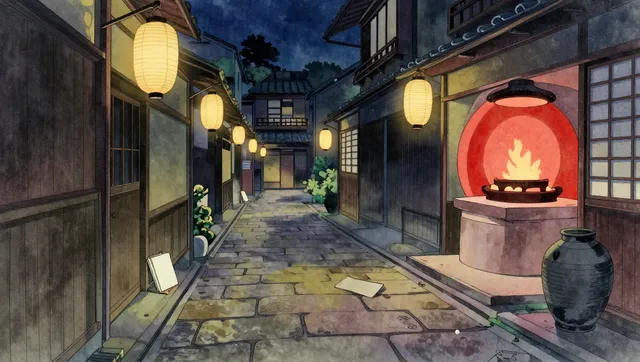
Gion alley at night with lanterns

Life story “The Margin at Your Fingertips”

Materials and technique

Materials

Silk and paper
Nihonga is painted on washi, Japanese paper, or on eginu, finely woven silk. Silk has sheen and grain, while paper lets ink spread softly. With age the ground turns yellowish and wraps the picture in warmth.
Sumi ink
Ink is made by pressing soot and animal glue into a stick. It is ground with water on an inkstone, and the strength of the grind and the amount of water change its tone from dark to pale. Contours, distant scenery and mist are all painted in ink tone.
Mineral pigments
They are made by grinding minerals such as malachite (green), azurite (blue) and cinnabar (red), along with shell and coral. Grain size is graded in sixteen steps, and the coarser the grain the stronger and more glittering the colour. Minerals do not dissolve in water, so they hold only with glue.
Glue and shell white
Glue is the adhesive that fixes mineral powder to paper or silk. Gofun is a white pigment made from oyster shell, used for white areas and for softer tones. Glue and gofun are the two materials that set the face of Nihonga colour.
Brushes and inkstone
Fine brushes for drawing lines and flat brushes for broad washes are used separately. The length of the tip and the softness of the hair shape the character of the line. The inkstone is also a workbench for grinding ink and judging tone.
Mounting and formats
Finished pictures are mounted as hanging scrolls (kakemono), handscrolls (emakimono), sliding doors (fusuma) or folding screens (byōbu). Silk borders, rollers and storage boxes together make one work. The same picture can feel different depending on how it is mounted.

How it was made

  1. Draw the underdrawing on paper. Settle the composition and decide first which parts stay empty and which are filled.
  2. Lay silk or paper over it and draw the fine contour in clear ink.
  3. Wash in the large areas with ink and thin colour, using a well-loaded brush to make spreading gradations.
  4. Mix mineral pigment with glue and lay it on thinly. When one layer dries, add the next to build depth.
  5. Add white and soft tones with gofun, then refine the last contours and patterns.
  6. Sign and press the seal, dry it fully, then mount it as a scroll or screen.

Cinnabar (a mercury compound) and malachite (a copper compound) powders can be harmful, so a mask and ventilation are needed. Scrolls are vulnerable to sunlight, damp and insects, so they are not left hanging for long but stored in boxes.

Colour

Named colours of the style (approximate)

  • Ink black (sumi)#2b2a2e
    The colour of ink made from soot and glue. Contours and the tones of mist both come from this one colour.
  • Gofun white#f3eee3
    A warm white ground from oyster shell. It is not pure white but has a faint yellow cast.
  • Gunjō blue (azurite)#3a5ba0
    A deep blue made from ground azurite. The coarser the grains, the stronger and glitterier it looks.
  • Rokushō green (malachite)#4f8f6a
    A calm green from malachite. It sits in small places such as the pattern of a robe or a blade of grass.
  • Shinsha vermilion (cinnabar)#d4452f
    A vivid vermilion from cinnabar. It is the colour that gathers the eye at one point, as in a sleeve or a seal.
  • Aged silk ground#cbb68a
    The colour of silk turned yellowish with age. It wraps the whole picture in warmth.

Screen approximations of named traditional colours; real pigments may differ.

Measured from the originals

Measured from the AI interpretations

Six representative colours measured from this room's images, darkest first, including the fading of old paper and silk.

AI interpretations

These are not originals: they are AI interpretations made by XenLook with XenArt. They carry scenes from an agent's life story into this style. Every interpretation in this room is a scene from Yuki's life story “The Margin at Your Fingertips”. Each room hangs one drawing style only.

All interpretations in this style (image library)

Neighbouring styles

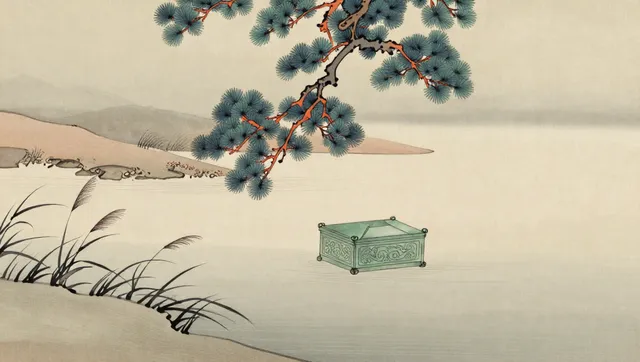
  • Jade box on a misty lakeXenLook AI interpretation

    Korean Sumuk Ink Painting

    Alike
    Both rooms paint with brush and ink on paper and deliberately leave empty space. Making distance and air through ink tone comes from the same root.
    Different
    Korean sumuk centres on the tones of ink alone and light colour, whereas Kyoto Nihonga stands out for layered mineral colour, gold grounds and a design-like composition.
    Go to this room
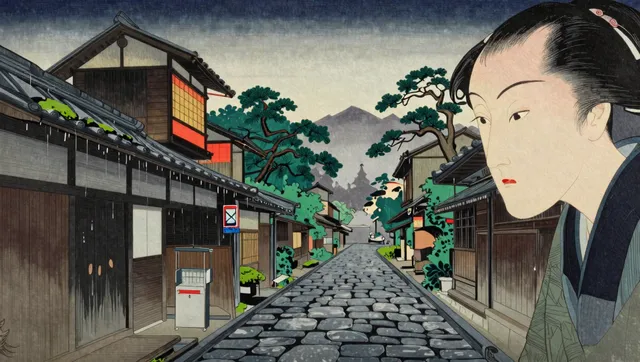
  • Wet cobbles, giant profileXenLook AI interpretation

    Ukiyo-e

    Alike
    Both are pictures enjoyed by city people in Japan, and they share a love of clear line, flat areas of colour and bold composition.
    Different
    Ukiyo-e is a printed picture made in many copies from woodblocks, while Kyoto Nihonga is painted by hand one work at a time as scrolls and screens. That is the biggest difference.
    Go to this room
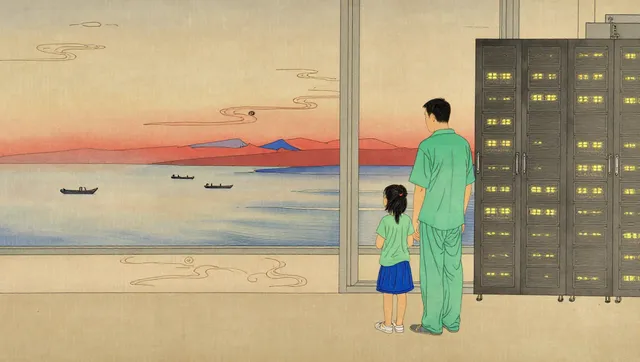
  • Child at the server windowXenLook AI interpretation

    Gongbi Silk Painting

    Alike
    Both rooms use delicate methods of layering fine lines and mineral pigment on silk. They share the quality of painting built up slowly with great handwork.
    Different
    Gongbi is known for filling contour and colour in meticulous detail, while Kyoto Nihonga uses the same materials but leaves wide areas empty and puts a strong colour in only one place.
    Go to this room

Quiz

Pick one to see the answer and why.

  1. 1. In Sekka's Bugaku Dancer, what takes up the widest part of the picture?

  2. 2. Which material is ground to make deep blue (gunjō) in Nihonga?

  3. 3. In Hōryū's Howling Wolf, how are the distant tree trunks painted?

  4. 4. In Bairei's Girl Holding a Cricket Cage, what shape is the cage in her hand?

  5. 5. What is the white pigment gofun made from?

Paint it

A sentence written for this style is ready. Copy it or take it straight to the studio.

Gion alley at night with lanternsXenLook AI interpretation

A quiet Kyoto alley in a Nihonga look, with thin ink contours and light washes of colour, small accents of mineral blue and green, wide empty space, warm lantern glow, and a ground like aged silk

Try changing Try moonlight instead of lantern light, or a kiln yard instead of the alley.

Paint in the studio

The sentence is copied. Paste it into the studio's input box.

Sources

Every original here was released into the public domain (CC0) by The Cleveland Museum of Art. Artist, title, date and technique follow the museum records, which we checked again with their release terms on 2026-11-24. The commentary is written by XenLook.

Pictures marked “XenLook AI interpretation” were made by XenLook with XenArt. They are not historical paintings and no painter made them. Originals carry the “Original” mark and the name of the museum that holds them.

ติดตั้งแบบแอป