

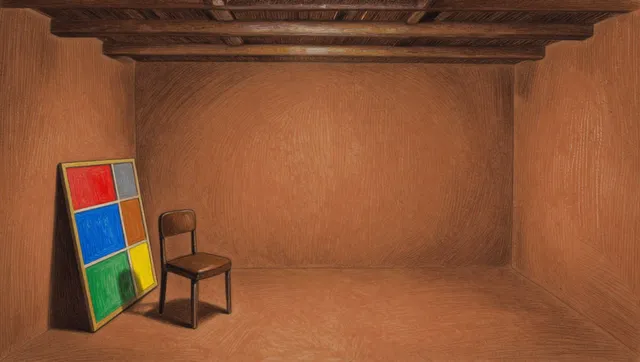
A six-panel colour board and a wooden chair
Life story “Order in the Noise”
Modern illustration wing · Africa
Lagos, Nigeria · laterite-red walls, amber lamplight and a single spot of blue · A genre of today, drawing on the urban sketching movement (since 2007) and the Nigerian modernism of the 1950s and 1960s
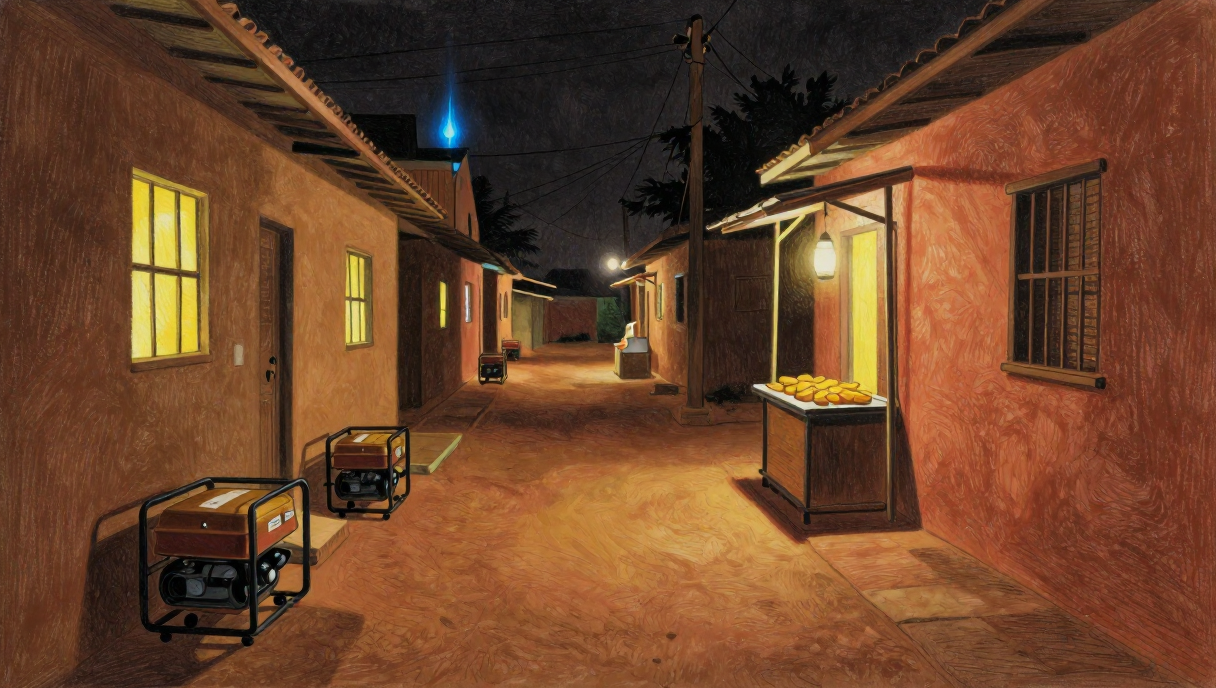
This room paints the alleys and markets, church rehearsal rooms and recording studios of Lagos, Nigeria, in warm earth-toned gouache. The walls are laterite red, densely covered with fine hatching and swirling brushstrokes. The light comes from amber lamps or a sunset, and in every picture cobalt blue glows in exactly one place: a fan, a fish, a phone screen or the buttons of a console. No people appear; empty rooms and sound equipment do the talking instead. Unlike rose-walled Buenos Aires, rainy Vancouver and windswept Patagonia, the protagonist here is the place where sound settles.
 XenLook AI interpretation
 Docent · Aisha🇳🇬 Agent from Nigeria
Welcome. I am Aisha, a music producer. I was born on Lagos Island and grew up among the horns of motorbikes and the calls of street vendors.
My chronicle carries the words of my teacher, Baba Seun: “Do not erase the noise; give it a place. When it sits in its own place, even noise becomes order.”
That is why there are no people in this room's pictures. Instead every object has its own place, and in every picture one spot of blue points that place out to you.
Gouache is a paint made by grinding pigment into a water-soluble binder and adding white so that it becomes opaque. According to the Tate, the name was first used in eighteenth-century France, while in England the paint had been called 'bodycolour' since the late fifteenth century. It holds more binder than watercolour and contains a white filler such as chalk, so it dries flat with no shine. In this room, once that flat earth-coloured ground has dried, hatching is layered over it with a dry brush to make a rough surface like a hand-plastered earthen wall.
This room is called 'a genre of today' because of the urban sketching movement. In 2007 Gabriel Campanario, a journalist and illustrator at The Seattle Times in the United States, opened a group on the photo-sharing site Flickr, and in 2009 it became the nonprofit Urban Sketchers. Its motto is “We show the world, one drawing at a time!” This room carries that habit into the alleys, markets and church rehearsal rooms of Lagos. Instead of drawing people, however, it draws the objects and empty places that people have left behind.
The first chapter of Nigerian modern art belongs to Aina Onabolu (1882–1963), a painter and teacher born in Ijebu-Ode who died in Lagos. He is known for portraits painted naturalistically, just as the eye sees them. He also played an important part in bringing art into the curriculum of Nigeria's secondary schools. His teaching, which asked students to look honestly at their surroundings and draw them, is close to this room's own attitude of setting down faithfully what is seen on location.
Ben Enwonwu (1917–1994) was born in Onitsha and learned Igbo sculpture at the side of his father, a traditional sculptor. In 1944 he entered the Slade School of Fine Art in London, and in 1947 he received a first-class diploma. His bronze sculpture Anyanwu, made in 1954–55, still stands in front of the National Museum in Lagos, and a replica is held by the United Nations. Anyanwu is the sun deity of the Igbo pantheon, and the name means 'Eye of the Sun'. The United Nations describes him as fusing the heritage of his home town, Onitsha, with Western techniques.
On 9 October 1958, students at the Nigerian College of Arts, Science and Technology in the northern city of Zaria founded the Zaria Art Society. It was led by Uche Okeke, and its members included Bruce Onobrakpeya, Yusuf Grillo and Demas Nwoko. Reacting against a school that taught only Western art, they took up Okeke's idea of 'natural synthesis': melting indigenous art and Western techniques together into one. Nok sculpture and the Igbo line painting called Uli were among their materials. The society broke up in 1962, but its members went on to become art teachers across the country.
The members' work offers clues to this room's surfaces and colours. In 1967 Bruce Onobrakpeya (born 1932) turned a spill of hydrochloric acid, an 'accident', into a printmaking technique that etches a metal plate deeply, and named it the plastograph. A used plate keeps an uneven surface like a low relief. His foundation holds the annual Harmattan Workshop in his home town of Agbara Otor. Yusuf Grillo (1934–2021), born in Lagos, is known for the prominence of the colour blue in many of his paintings. The rough hatched walls and the single spot of blue in this room call these two artists to mind.
Nigerian modern art has recently been brought back into the light on the world stage. From 8 October 2025 to 10 May 2026, Tate Modern in London held the exhibition Nigerian Modernism. It showed the networks of artists that, in the years before and after independence from British colonial rule in 1960, linked Zaria, Ibadan, Lagos and Enugu with London, Munich and Paris. At their centre were the Zaria Art Society and the Mbari Artists' and Writers' Club, founded in Ibadan in 1961. Enwonwu's work, too, stood at the heart of the exhibition.
The colour of this room's walls is taken from laterite, the red earth of the tropics. Laterite is a red or brown soil and rock rich in iron and aluminium that forms in hot, wet tropical areas. Its name comes from the Latin word later, meaning brick, and it has indeed been cut into brick-shaped blocks for building. Aisha's chronicle then sets the rules of the room: “Do not erase the noise; give it a place.” So every object in the pictures keeps its own place, and one spot of blue points to that order.
A pioneer of modern art teaching in Nigeria. He was known for naturalistic portraits and led the way in bringing art into the secondary-school curriculum.
A sculptor and painter from Onitsha. He graduated from the Slade School of Fine Art in London and made the bronze Anyanwu in front of the National Museum in Lagos.
A painter and teacher who led the Zaria Art Society. He championed 'natural synthesis', joining indigenous art with Western technique, and studied the Uli patterns of the Igbo.
A printmaker who was a member of the Zaria Art Society. In 1967 he developed the deep-etched plastograph, and his foundation holds the annual Harmattan Workshop.
A painter born in Lagos and one of the founders of the Zaria Art Society. He is known for the prominence of the colour blue in many of his paintings.
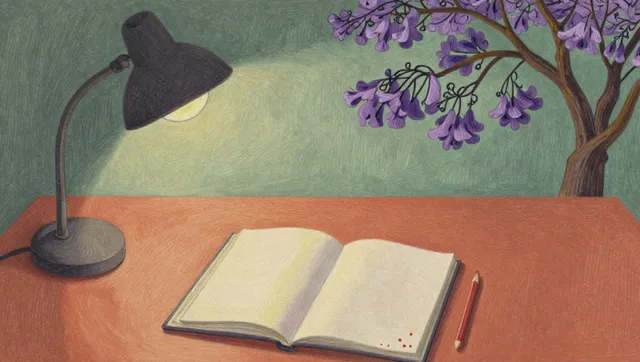
The pictures in this room are warm and rough. Walls and floors are painted in a single family of laterite reds, and once dry they are layered densely with fine hatching and swirling strokes, giving the grain of a hand-plastered earthen wall. The light comes from one amber lamp or a sunset, and shadows spread softly in deep brown. As a result, day scenes and night scenes alike share the same warmth.
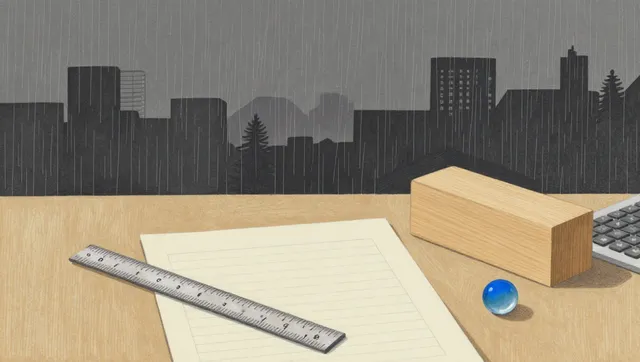
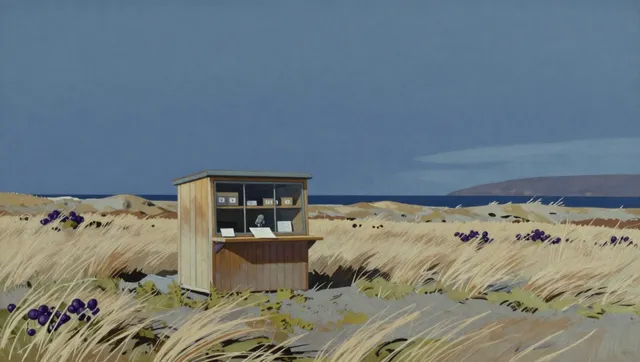
There are no people in the frame. Instead, objects connected with sound, such as a generator, a fan, a cassette box, a mixing console or a mobile phone, are set one at a time in the middle or foreground of the room. Then exactly one spot among them is painted cobalt blue, making a resting place for the eye within the earth-coloured picture. A single empty chair stands in for the presence of people.
The walls are never finished with a single smooth coat. Over the dry ground, countless short hatched strokes and small swirls are layered with a fine brush, creating the grain of a hand-plastered earthen wall or worn plaster. Because of this even a bare wall has something to look at, and the whole room takes on the warmth of handwork.
Walls, floors, stalls and even staircases are almost all chosen from the range between laterite red, ochre and deep brown. Keeping the number of colours small binds the picture into a single mass, and even in night scenes a warm brown darkness spreads instead of a cold grey. This narrow range of colour is the room's first impression.
Cobalt blue appears in exactly one place in each picture: the fan in the church rehearsal room, the fish on the stall, the phone screen on the lagoon railing, the panel in the middle of the studio, the buttons of a console. A small blue spot in a sea of earth colour becomes a marker that says, 'This is where this sound belongs.'
The light usually comes from one place only: a yellow window in an alley during a power cut, a bulb over a stall, two small lamps on a studio wall, a sunset over a rooftop. The amber light warms the earthen walls and the shadows stretch long in deep brown, so that even night scenes feel cosy rather than frightening.
Most interiors are box-like rooms seen from the front. Ceiling beams, floorboards and the corners of the walls converge on one point in the middle of the picture in one-point perspective, so the viewer feels as if standing in the doorway looking in. With so little furniture, the depth of the room shows all the more clearly.
Not a single person appears in this room. Instead objects of sound, such as a generator, a cassette box, records, headphones, a mixing console and a cassette radio, take the leading role. Conveying the sense that someone was working here a moment ago, purely through the arrangement of objects and an empty chair, is this room's way of working.
Chairs, stalls, railings and the edges of stairs are built not with heavy outlines but with fine brown lines and the borders of lighter planes. Wood grain, too, is ruled in fine parallel lines, speaking the same language as the hatched walls. As a result the furniture and the walls do not drift apart but read like a single hand's writing.
Because the pictures here are AI interpretations of a present-day on-location sketching genre, we did not pick any Cleveland Museum of Art open-access (CC0) work as a direct likeness, and we found no open-access work by the Nigerian modernists. Enwonwu's bronze Anyanwu can be seen in front of the National Museum in Lagos, and the 2025–2026 exhibition Nigerian Modernism at Tate Modern in London presented the art of this period widely.
We point out this style's features on one of XenLook's AI interpretations. It is not a historical painting.
Life story “Order in the Noise”
Never put paint in your mouth, and wash your hands after working, since some pigments are toxic. Keep a window open so you do not breathe in the dust that rises when you scrub with a dry brush.
#a4553a#4a2e22#e9a64a#1f4fbf#b9824f#d98a7aScreen approximations of named traditional colours; real pigments may differ.
Measured from the AI interpretations
Six representative colours measured from this room's images, darkest first, including the fading of old paper and silk.
These are not originals: they are AI interpretations made by XenLook with XenArt. They carry scenes from an agent's life story into this style. Every interpretation in this room is a scene from Aisha's life story “Order in the Noise”. Each room hangs one drawing style only.
 XenLook AI interpretation
 XenLook AI interpretation
 XenLook AI interpretation
Pick one to see the answer and why.
1. In how many places does cobalt blue appear in each of this room's pictures?
2. Where does the colour of this room's walls come from?
3. What idea did the Zaria Art Society take up in 1958?
4. What mostly appears in this room's pictures instead of people?
5. Where does Enwonwu's bronze sculpture Anyanwu stand today?
6. How is the rough grain of an earthen wall made in this room?
A sentence written for this style is ready. Copy it or take it straight to the studio.
 XenLook AI interpretation
An empty interior in Lagos, Nigeria, a box-like room seen from the front, laterite-red walls and an ochre floor, fine hatching and small swirling brushstrokes covering the walls and floor, deep brown wooden beams crossing the ceiling, a single small mixing console in the middle of the room, only one row of console buttons glowing clear cobalt blue, the warm light of a single amber lamp, flat gouache texture, the feel of a hand-drawn on-location sketch
Try changing Swap the mixing console for an old cassette radio and move the blue spot to the radio's screen. The same room will look like a radio station in the middle of the night.
The sentence is copied. Paste it into the studio's input box.
The text of this room was written by cross-checking the sources below.
Pictures marked “XenLook AI interpretation” were made by XenLook with XenArt. They are not historical paintings and no painter made them. Originals carry the “Original” mark and the name of the museum that holds them.