Mexican murals stand on a very old tradition. In Teotihuacan, a great city north-east of today’s Mexico City, the courtyard walls of wealthy apartment compounds were wrapped with paintings in the Classic period. The mural fragment of about 500–550 in this room keeps one man from a procession of identical figures who walked along such a courtyard wall. This way of painting, with clear outlines on a red ground filled with flat colour, was one the muralists looked back to some fourteen hundred years later, when they searched for the roots of their own country.
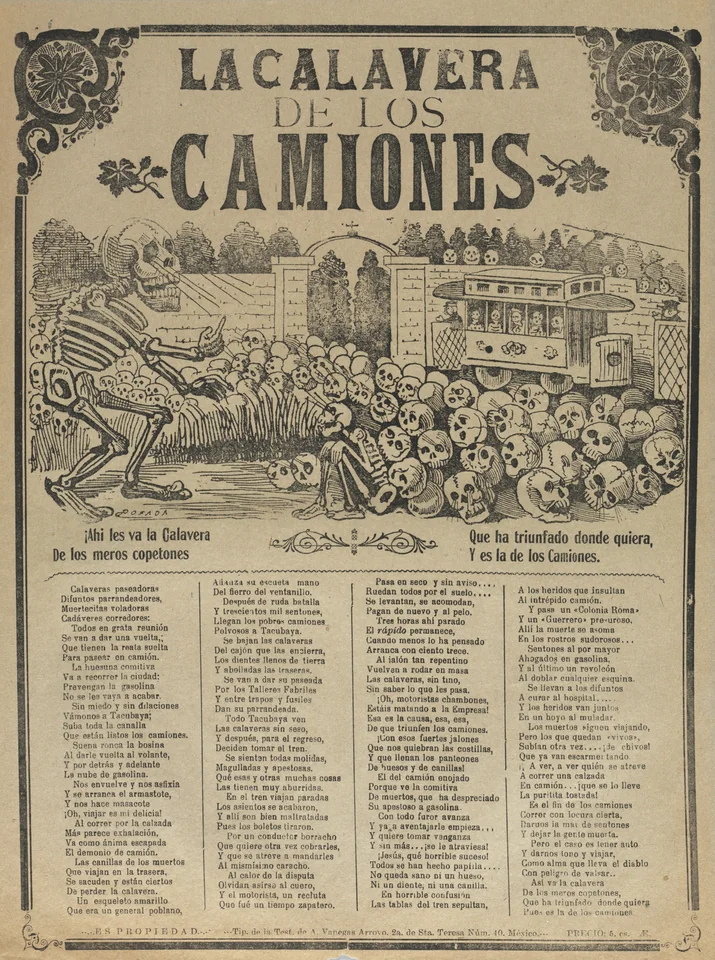
Another root lay in the print shop. José Guadalupe Posada, born in Aguascalientes in 1852, put pictures and words together on cheaply printed single sheets so that even workers who could not read could follow the news. He brought in skeletons, the calaveras, to poke fun at events and people, and his most famous picture is the skeleton lady “La Calavera Catrina”. Twentieth-century Mexican painters admired Posada for reaching a broad public, and Rivera and Orozco are said to have counted him as one of their starting points.
During the years of revolution, the man who led young painters was Gerardo Murillo, known as “Dr. Atl”. He painted murals himself and taught the next generation of painters, urging them to paint the land and people of Mexico instead of copying Europe. In 1921, when the government of Álvaro Obregón came to power and José Vasconcelos became minister of education, Vasconcelos entrusted the walls of schools and public buildings to painters. That same year Roberto Montenegro painted a mural in tempera, and Diego Rivera, who had long stayed in Europe, came home.
In January 1922 Rivera began his first mural, “Creation”, in the auditorium of the National Preparatory School, today the Antiguo Colegio de San Ildefonso, in encaustic, a technique of painting with melted wax. In September that year he began the murals of the Ministry of Education building and painted 124 frescoes there by 1928. The painters formed the Syndicate of Technical Workers, Painters and Sculptors and issued a manifesto, crying out that art was a matter of education, that it must be useful to everyone, and that beauty belonged not to a few but to all. Instead of small pictures on easels, the walls of buildings everyone walked through became their canvas.
José Clemente Orozco began murals at the same National Preparatory School in 1923, stopped for a while, and came back in 1926 to finish them. In pictures such as “The Trench”, “The Destruction of the Old Order”, “Maternity”, “The Strike”, “The Trinity” and “The Banquet of the Rich”, he painted the suffering left by war and poverty instead of heroic tales. From 1936 to 1939 he painted “Man of Fire” in the dome of the Hospicio Cabañas in Guadalajara, and the building became a UNESCO World Heritage Site in 1997. If Rivera’s walls were a bright epic, Orozco’s walls were a dark, fierce cry.
David Alfaro Siqueiros believed that murals, too, should be painted with the tools of a new age. Instead of the brush he used the latest paints, spray guns and airbrushes, and he transferred pictures to the wall with projectors and stencils. In Los Angeles he worked collectively with other painters, and when he opened an experimental workshop in New York in 1936, the young Jackson Pollock learned there too. Siqueiros taught ways of dripping and pouring paint, and these experiments are judged to have carried on into later American abstract painting. In this way muralism spread across borders.
Rivera painted walls in the United States as well. From 1932 to 1933, commissioned by Wilhelm Valentiner, director of the Detroit Institute of Arts, he completed 27 fresco panels showing car factories. But his mural “Man at the Crossroads” at Rockefeller Center in New York was covered in May 1933, taken off the wall in 1934 and replaced by another painter’s work, so today it survives only in black-and-white photographs. That same year Rivera painted it again at the Palacio de Bellas Artes in Mexico City as “Man, Controller of the Universe”. Meanwhile Rufino Tamayo, a painter of Zapotec heritage from Oaxaca, took his own path focused on colour and form rather than story, and in 1952 he painted “Birth of the Nationality” at Bellas Artes.