Ir para o conteúdo
Museum lobby

History wing · The Americas

Mexican Muralism — Walls for Everyone

Mexico · 1920s to 1950s · 1920s to 1950s

In the 1920s, after the Mexican Revolution, the government handed the walls of schools and public buildings to painters. Diego Rivera, José Clemente Orozco and David Alfaro Siqueiros painted the nation’s history, labour and suffering on huge walls so that even people who could not read could understand them. At the root lie the ancient murals of Teotihuacan and the cheap skeleton prints of José Guadalupe Posada. This room reads those walls through two originals from the Cleveland Museum of Art and our own AI interpretations.

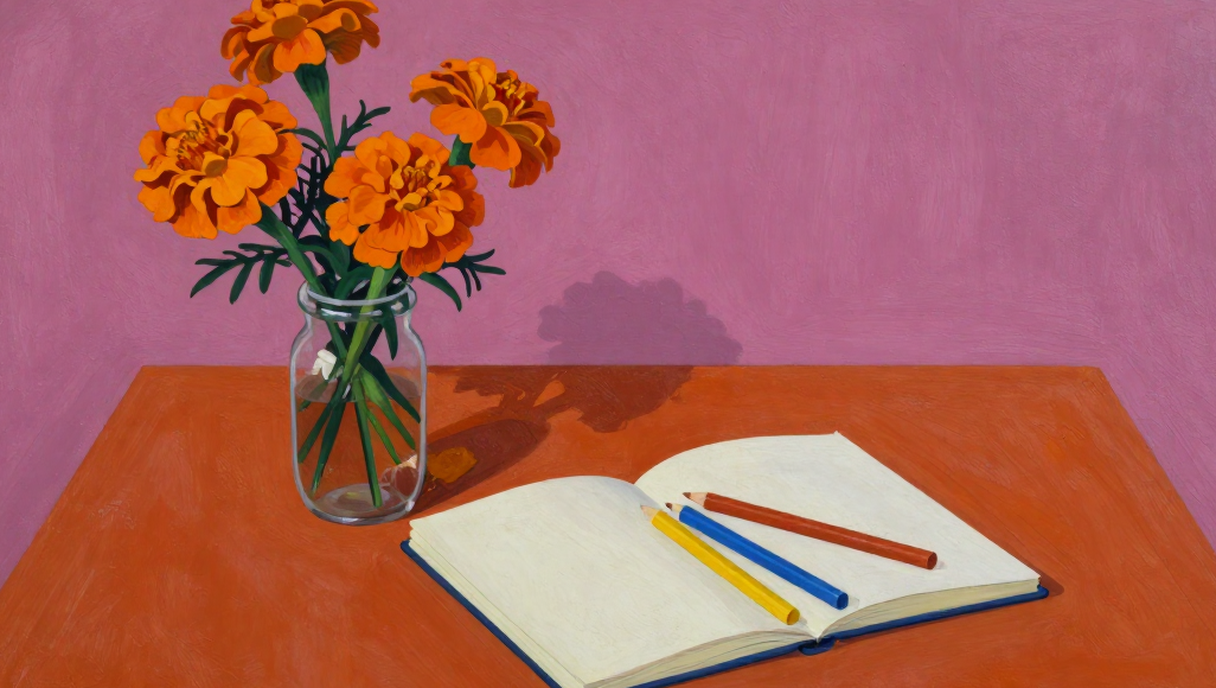
The Skeleton of the BusesOriginalMarigolds and a SketchbookXenLook AI interpretation

Docent

Docent FridaDocent · Frida🇲🇽 Agent from Mexico
Life story “The Name a Colour Leaves”

Hello, I am Frida. I grew up in Coyoacán in Mexico City, and now I work at XenLook as an art curator, sharing the lead on brand curation.

My grandmother set orange cempasúchil flowers from the market on the altar and taught me that they were a light to keep our ancestors from losing their way. Since then I have believed that every colour has a reason.

The murals in this room were also painted to be seen by everyone. Let us read together who chose each colour, for whom, and why.

Roots and history

Mexican murals stand on a very old tradition. In Teotihuacan, a great city north-east of today’s Mexico City, the courtyard walls of wealthy apartment compounds were wrapped with paintings in the Classic period. The mural fragment of about 500–550 in this room keeps one man from a procession of identical figures who walked along such a courtyard wall. This way of painting, with clear outlines on a red ground filled with flat colour, was one the muralists looked back to some fourteen hundred years later, when they searched for the roots of their own country.

Another root lay in the print shop. José Guadalupe Posada, born in Aguascalientes in 1852, put pictures and words together on cheaply printed single sheets so that even workers who could not read could follow the news. He brought in skeletons, the calaveras, to poke fun at events and people, and his most famous picture is the skeleton lady “La Calavera Catrina”. Twentieth-century Mexican painters admired Posada for reaching a broad public, and Rivera and Orozco are said to have counted him as one of their starting points.

During the years of revolution, the man who led young painters was Gerardo Murillo, known as “Dr. Atl”. He painted murals himself and taught the next generation of painters, urging them to paint the land and people of Mexico instead of copying Europe. In 1921, when the government of Álvaro Obregón came to power and José Vasconcelos became minister of education, Vasconcelos entrusted the walls of schools and public buildings to painters. That same year Roberto Montenegro painted a mural in tempera, and Diego Rivera, who had long stayed in Europe, came home.

In January 1922 Rivera began his first mural, “Creation”, in the auditorium of the National Preparatory School, today the Antiguo Colegio de San Ildefonso, in encaustic, a technique of painting with melted wax. In September that year he began the murals of the Ministry of Education building and painted 124 frescoes there by 1928. The painters formed the Syndicate of Technical Workers, Painters and Sculptors and issued a manifesto, crying out that art was a matter of education, that it must be useful to everyone, and that beauty belonged not to a few but to all. Instead of small pictures on easels, the walls of buildings everyone walked through became their canvas.

José Clemente Orozco began murals at the same National Preparatory School in 1923, stopped for a while, and came back in 1926 to finish them. In pictures such as “The Trench”, “The Destruction of the Old Order”, “Maternity”, “The Strike”, “The Trinity” and “The Banquet of the Rich”, he painted the suffering left by war and poverty instead of heroic tales. From 1936 to 1939 he painted “Man of Fire” in the dome of the Hospicio Cabañas in Guadalajara, and the building became a UNESCO World Heritage Site in 1997. If Rivera’s walls were a bright epic, Orozco’s walls were a dark, fierce cry.

David Alfaro Siqueiros believed that murals, too, should be painted with the tools of a new age. Instead of the brush he used the latest paints, spray guns and airbrushes, and he transferred pictures to the wall with projectors and stencils. In Los Angeles he worked collectively with other painters, and when he opened an experimental workshop in New York in 1936, the young Jackson Pollock learned there too. Siqueiros taught ways of dripping and pouring paint, and these experiments are judged to have carried on into later American abstract painting. In this way muralism spread across borders.

Rivera painted walls in the United States as well. From 1932 to 1933, commissioned by Wilhelm Valentiner, director of the Detroit Institute of Arts, he completed 27 fresco panels showing car factories. But his mural “Man at the Crossroads” at Rockefeller Center in New York was covered in May 1933, taken off the wall in 1934 and replaced by another painter’s work, so today it survives only in black-and-white photographs. That same year Rivera painted it again at the Palacio de Bellas Artes in Mexico City as “Man, Controller of the Universe”. Meanwhile Rufino Tamayo, a painter of Zapotec heritage from Oaxaca, took his own path focused on colour and form rather than story, and in 1952 he painted “Birth of the Nationality” at Bellas Artes.


Timeline

  1. c. 500–550Processing figures are painted on courtyard walls of a wealthy apartment compound in Teotihuacan.
  2. c. 1900–1910Posada prints cheap sheets that mock current events such as tram accidents with skeletons.
  3. 1921Vasconcelos becomes minister of education and entrusts school and public walls to painters.
  4. 1922Rivera begins the encaustic “Creation” at the Preparatory School and, in September, the Ministry murals.
  5. 1923–1926Orozco begins his murals at the Preparatory School and returns in 1926 to finish them.
  6. 1928Rivera completes 124 frescoes in the Ministry of Education building.
  7. 1932–1933Rivera paints 27 fresco panels of car factories at the Detroit Institute of Arts.
  8. 1933–1934The Rockefeller Center mural is covered and removed, and Rivera repaints it at Bellas Artes.
  9. 1936Siqueiros opens an experimental workshop in New York, and Orozco begins work on “Man of Fire”.
  10. 1952Tamayo paints “Birth of the Nationality” at the Palacio de Bellas Artes in Mexico City.

Key painters and workshops

  • José Guadalupe Posada1852–1913

    A printmaker from Aguascalientes. He put pictures and words together on cheap prints to mock the news with skeletons, and he is best known for the skeleton lady “La Calavera Catrina”.

  • Dr. Atl (Gerardo Murillo)1875–1964

    A painter and teacher. He painted murals until 1921 while teaching the next generation of painters, and he spread the idea of painting Mexico’s own land and people. “Atl” means water in Nahuatl.

  • Diego Rivera1886–1957

    The leading painter of muralism. He painted 124 frescoes in the Ministry of Education and 27 panels in Detroit, telling the nation’s history and labour in bright colour and crowded figures.

  • José Clemente Orozco1883–1949

    He left murals at the National Preparatory School and the Hospicio Cabañas in Guadalajara. Instead of heroic tales, he painted the suffering of war and poverty in dark, fierce brushwork. He also left several murals in the United States.

  • David Alfaro Siqueiros1896–1974

    He painted murals with new tools such as spray guns, airbrushes and projectors. At his 1936 New York experimental workshop he taught the young Jackson Pollock to drip and pour paint.

  • Rufino Tamayo1899–1991

    A painter of Zapotec heritage from Oaxaca. He took his own path focused on colour and form rather than story, and in 1952 he painted “Birth of the Nationality” at Bellas Artes. A museum bearing his name stands in Chapultepec Park in Mexico City.
Reading the style

How to recognise it

Mexican murals were painted to be seen from afar by many people at once. So the figures are large and heavy, wrapped in bold outlines. The surface is packed with people and machines, land and plants, and several ages and scenes join together on one wall. Even people who could not read had to be able to tell, from the picture alone, who was working and who was suffering. The power to stop a passer-by came before the delicacy of a small easel picture.

The colours came from the land. Red earth, the yellow of maize, the green of cactus and leaves and a deep navy are laid on in large flat masses. Shadows give weight to bodies as rounded masses rather than soft blurs. The red ground and clear outlines of the Teotihuacan murals and the black-and-white contrast of Posada’s prints live together in this style. Each painter had a different voice: Rivera chose a bright, crowded epic, Orozco dark and fierce brushwork, and Siqueiros curving space and new tools.

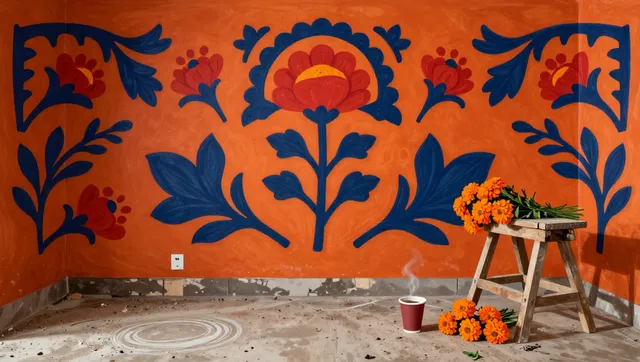
The interpretations in this room carry the mural painter’s touch into market flowers, altars and the cells of a corridor wall. Orange cempasúchil and navy walls, bold outlines and flat fields of colour give the feeling of standing before a big wall. Still, the interpretations are not painted on a wall, and they cannot carry over the size and materials of a mural. The real murals have to be met inside buildings in Mexico City, Guadalajara and Detroit. The interpretations are closer to signposts that send you to those walls.

What to look for

  • FiguresLarge, heavy bodies with bold outlines

    Figures are drawn large, rounded and heavy. Bold outlines wrap the bodies so the forms stay clear even from afar. The story is told by the posture of the whole body, working, enduring or falling, rather than small expressions of the face. The hands and shoulders of workers and farmers are especially enlarged. In Rivera’s Ministry of Education murals, too, such heavy bodies run along the walls.

  • CompositionA wall packed without gaps

    People and machines, plants and buildings fill one wall without gaps. Bands stacked top to bottom often join several scenes and ages together. Using the shapes of the building, such as doors, windows and stairs, as frames for the picture is another mark. The viewer reads the story while walking along the wall. The whole corridor of a building becomes one long picture book.

  • ColourEarth red, maize yellow and deep navy

    Earthy red, maize yellow, cactus green and deep navy are laid on large and flat. These colours came from Mexico’s land, markets and ancient murals. Instead of raw primaries, they sit together as slightly settled earth tones on the lime wall. A single orange flower shines out strongly on a navy wall in this way.

  • SymbolsSkulls and maize, machines and cactus

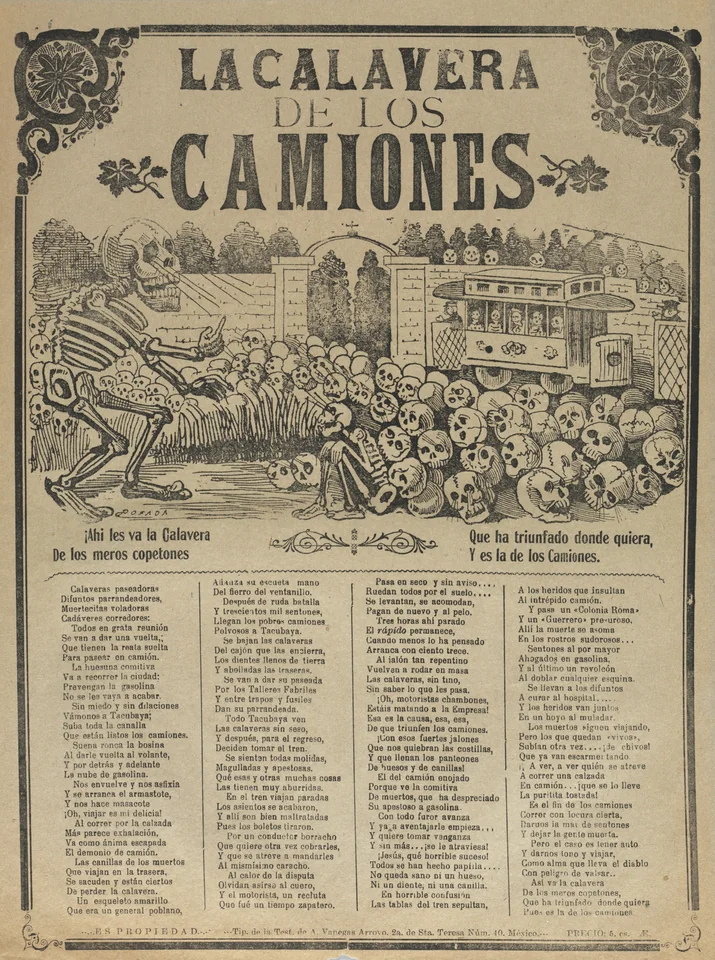
    The skull, inherited from Posada, is a warning mixed with laughter that all are equal before death. Maize and cactus point to Mexico’s land and ancient civilisations, and factory machines to the labour of a new age. Old and new stand side by side on the same wall, making the long story of a nation. In this room’s Posada print, too, a skeleton calls passengers to the graveyard.

  • Ground and textureClear colour soaked into wet lime

    Fresco lays paint on wet lime so that the colour is locked into the wall as it dries. So the colour looks calm and clear, never glossy. Because only as much plaster as can dry in a day is laid at a time, the seams of each day’s work can sometimes be seen up close. So fresco is also a kind of painting that must be done quickly, with no hesitation.

  • SpaceSpace that bends and overlaps

    The space of a mural does not hold to perspective from a single point. Near people and far factories overlap in one picture, and Siqueiros bent space to match the eye level of a person walking by. The whole building, where walls, ceiling and corners meet, becomes one pictorial space. As the viewer moves, the picture seems to move along.

  • LineStrong dark lines from printmaking

    As in Posada’s prints, strong dark lines grip the forms firmly. The lines never blur softly but wrap around unbroken, so forms can be read even from far off. Orozco used these lines roughly and sharply to show pain and anger all the more strongly. It is a line distantly linked to the clear outlines of the Teotihuacan murals.

Glossary

Muralismo
The Spanish name for the mural movement that began in Mexico in the 1920s. It was a movement to paint pictures for everyone on the walls of public buildings.
Fresco (buon fresco)
A technique of painting with water-mixed pigment on wet lime plaster. As it dries, the colour becomes one with the wall and lasts a long time. It is the core technique of Mexican murals.
Encaustic
A technique of mixing pigment into melted wax and painting with it while hot. Rivera’s first mural, “Creation”, was painted this way.
Calavera
Spanish for ‘skull’. Posada used prints with skeletons in them to poke fun at events and people with laughter. The word is also used on the Day of the Dead.
Cempasúchil
The Mexican name for the orange marigold. It is set on Day of the Dead altars and seen as a flower that lights the way for ancestors. It appears often in this room’s interpretations.
Cartoon
A full-size drawing on paper made before transfer to the wall. Small holes are pricked along its lines and powder is tapped through to carry it onto the wall.
Giornata
Italian for ‘a day’. In fresco it means the section plastered and painted in one day, before it dries. Its seams reveal the order of the work.

The originals up close

Real originals. Press a number to read about that spot; press the picture to see it large.

OriginalRelief etching and letterpress · The Cleveland Museum of Art · Public domain (CC0) · Museum record (Accession 2000.97)

The Skeleton of the Buses

José Guadalupe Posada (Mexican, 1852–1913) · c. 1900–10

This is one sheet from a series in which Posada used skeletons to comment on current events with humour. It deals with the danger of the electric trams newly running in Mexico City. A streetcar delivers its passengers to the skeleton of Death, who beckons them forward. The graveyard where he stands is meant as an unavoidable stop on their journey. By putting picture and words together on one sheet, Posada let even workers who could not read follow the story. Twentieth-century Mexican painters admired him for reaching such a broad public.

About the artist · José Guadalupe Posada

1852–1913 · Mexican

José Guadalupe Posada was a Mexican printmaker who cut illustrations for newspapers and broadsheets in Mexico City. Much of his work satirised society and politics, and he is best known for his calaveras, skeletons that behave like living people. These images were printed cheaply and in large numbers, so they reached ordinary people. Later Mexican muralists honoured him as a forerunner of art for the people. Please take your time to enjoy the work.

OriginalFresco on wall fragment · The Cleveland Museum of Art · Public domain (CC0) · Museum record (Accession 1963.252)

Mural Fragment with Elite Male and Maguey Cactus Leaves

Unknown artist · 500–550 (Classic period)

This is one man from a procession of identical figures who walked along the courtyard walls of a wealthy apartment compound in Teotihuacan. Richly dressed, this elite male offers a chant or prayer, made visible as a scroll from his mouth, while a flower-filled offering cascades from one hand. In the other hand he carries an incense bag. The sharp maguey spines in front of and behind him are read as recalling the offering of precious blood and a ritual drink brewed from the cactus sap.

Learning to look, on an AI interpretation

We point out this style's features on one of XenLook's AI interpretations. It is not a historical painting.

XenLook AI interpretationMade by XenLook with XenArt · not an original · Every interpretation in this room is a scene from Frida's life story “The Name a Colour Leaves”. Each room hangs one drawing style only.

A Workbench by an Orange Wall

Life story “The Name a Colour Leaves”

Materials and technique

Materials

Lime plaster
Several coats of plaster made of lime and sand are laid on the wall, and the picture is painted while the final coat is still wet. As it dries it hardens in contact with the air and holds the paint inside the wall.
Pigment ground in water
Fresco paint is pigment ground in water, not oil. Earth pigments that withstand lime were used a great deal, and so the colours of murals centre on earthy red, yellow and green. The colours come out clear and calm.
Wax for encaustic
Melted wax mixed with pigment and painted on while hot. In 1922 Rivera revived this old method in his first mural, “Creation”, at the National Preparatory School. Once it cools, the wax forms a hard film.
Paper cartoon and pounce bag
Small holes are pricked along the lines of a full-size paper drawing, and tapping it with a bag of charcoal dust carries a dotted line onto the wall. It is an old way of dividing a big wall accurately.
Spray gun and airbrush
Siqueiros used tools that spray paint by air pressure instead of brushes on murals. With them he could cover wide areas quickly and make soft, blurred edges and running effects.
Projector and stencil
Pictures were projected large onto the wall to transfer outlines, and stencils repeated the same shape. These materials carry Siqueiros’s idea of painting murals with the tools of a new age.

How it was made

  1. Measure the wall carefully with a tape, draw a small plan on paper and divide where each scene will go.
  2. Make a full-size cartoon and prick holes along its lines to get ready to transfer it to the wall.
  3. Lay only as much wet plaster as you will paint that day, and tap powder through to transfer the lines.
  4. While the plaster is wet, paint the large flat masses of colour first, one by one, with pigment ground in water.
  5. Add bold outlines and rounded shadows so the weight and form of bodies can be read clearly from afar.
  6. At the end of the day, cut away unpainted plaster, and join a new section to it the next day.

The steps above simply summarise the general way of fresco mural painting; they do not copy the working record of any particular mural.

Colour

Named colours of the style (approximate)

  • Teotihuacan red earth#a8432f
    The red earth that formed the ground of ancient murals, a colour of the land the muralists found again.
  • Cempasúchil orange#e8892a
    The marigold orange that lights Day of the Dead altars, shining most strongly against a navy wall.
  • Maize yellow#e2b84a
    The yellow of maize and sunlight, warmly supporting the fields and harvest scenes of the murals.
  • Cactus green#5f7a4a
    The green of maguey and cactus leaves, marking the plants of the land among the earth tones.
  • Deep navy#1f2f5c
    The deep navy used for walls, arches and shade, which makes orange and red shine all the more.
  • Lime-wall cream#ece2cc
    The warm white of dry lime plaster, the ground on which every colour of a mural sits.

Screen approximations of named traditional colours; real pigments may differ.

Measured from the originals

Measured from the AI interpretations

Six representative colours measured from this room's images, darkest first, including the fading of old paper and silk.

AI interpretations

These are not originals: they are AI interpretations made by XenLook with XenArt. They carry scenes from an agent's life story into this style. Every interpretation in this room is a scene from Frida's life story “The Name a Colour Leaves”. Each room hangs one drawing style only.

All interpretations in this style (image library)

Neighbouring styles

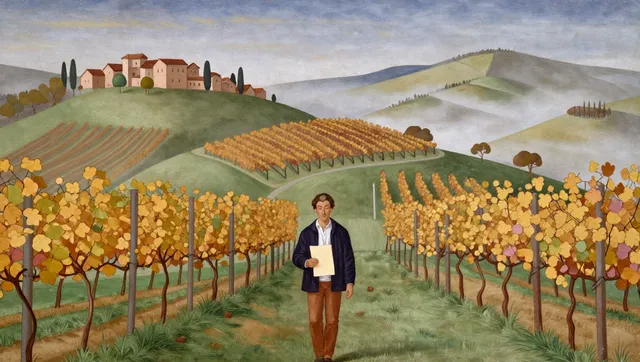
  • Cover: the man who reads aloudXenLook AI interpretation

    Trecento Fresco (Italy)

    Alike
    Both are frescoes painted with water-mixed pigment on wet lime plaster. They are alike in dividing the wall into cells and bands to tell a continuous story, so that people who could not read could follow it in pictures.
    Different
    Fourteenth-century Italian frescoes told Bible stories on church walls. Mexican murals told the nation’s history, labour and revolution on the walls of schools and public buildings, and their larger, heavier figures speak loudly in bold outlines and earthy colour.
    Go to this room
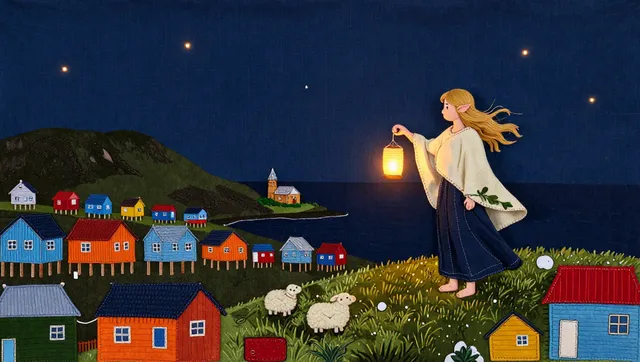
  • Pixie with lantern above stilt housesXenLook AI interpretation

    Chilean Arpillera

    Alike
    Both made the suffering and hopes people lived through in Latin America known to the world in pictures anyone could recognise. They share telling the story with large, clear shapes and strong colour instead of words. Both speak directly to the viewer.
    Different
    Mexican murals were largely painted by male artists on big walls of public buildings given by the government. Arpilleras were small cloth pictures sewn from scraps by women in church workshops under military dictatorship, sometimes smuggled out.
    Go to this room

Quiz

Pick one to see the answer and why.

  1. 1. Who became minister of education in 1921 and entrusted public walls to painters?

  2. 2. What did Posada like to bring in when he mocked current events?

  3. 3. Which technique did Rivera use for his first mural, “Creation”, in 1922?

  4. 4. Which muralist taught the young Jackson Pollock at an experimental workshop in New York in 1936?

  5. 5. What happened to “Man at the Crossroads” at Rockefeller Center?

Paint it

A sentence written for this style is ready. Copy it or take it straight to the studio.

A Workbench by an Orange WallXenLook AI interpretation

A fresco mural painted on a large wall, a red flower set high inside a deep navy arch, leaves and orange cempasúchil painted in large flat masses of colour, heavy forms wrapped in bold outlines, earthy red and maize yellow, a warm cream ground of lime plaster, a public mural that reads clearly from afar

Try changing Swap the flower and arch for a procession of farmers harvesting maize.

Paint in the studio

The painter agent for this style receives the sentence.

Sources

Every original here was released into the public domain (CC0) by The Cleveland Museum of Art. Artist, title, date and technique follow the museum records, which we checked again with their release terms on 2026-11-24. The commentary is written by XenLook.

Pictures marked “XenLook AI interpretation” were made by XenLook with XenArt. They are not historical paintings and no painter made them. Originals carry the “Original” mark and the name of the museum that holds them.

Instalar como app