Manga (漫画) is the word for narrative drawing made in Japan. According to Wikipedia, the twelfth- to thirteenth-century handscroll Chōjū-jinbutsu-giga (鳥獣人物戯画) is often named as an early root. It wittily depicts rabbits, frogs and monkeys playing like people, using ink lines alone. The tradition of unfolding a story through the flow of pictures has continued in this way for a long time. It is hard, however, to treat it as the same thing as today’s manga, and it is better understood as a distant ancestor connected from afar.
The word manga became widely known in the early nineteenth century. The picture books Hokusai Manga (北斎漫画) by the ukiyo-e painter Katsushika Hokusai (葛飾北斎) appeared in ten volumes from 1814 to 1819, followed by five more volumes up to 1878. They are collections of sketches drawn quickly with a brush, showing people, animals, customs and landscapes. Here manga meant something close to “pictures drawn as the mind wanders”. According to Wikipedia, the person who used the word in today’s sense of narrative comics was Kitazawa Rakuten (北沢楽天, 1876–1955).
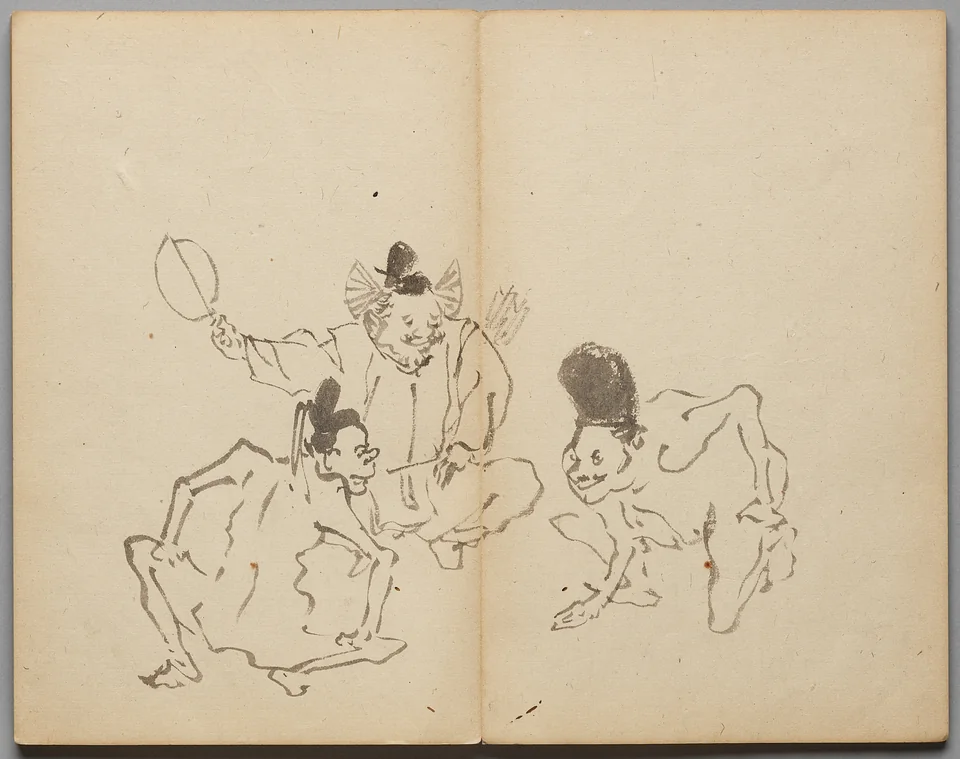
Kawanabe Kyōsai (河鍋暁斎), who drew the originals in this room, was born in 1831 and died in 1889. As a child he studied briefly with the ukiyo-e painter Utagawa Kuniyoshi, and then learned painting from Maemura Tōwa of the orthodox Kanō school (狩野派). It is said that his teacher called him, so absorbed in painting, “the painting demon” (画鬼). Kyōsai was a painter who combined the refined brushwork of the Kanō school with fearless satire. He made his name as a caricaturist in a time of political upheaval, and it is said he was arrested and imprisoned three times by the shogunate authorities. In his sketch albums you can see a quick brush that catches human movement in a single stroke of ink.
In 1874 Kyōsai published Eshinbun Nipponchi (絵新聞日本地) together with the writer Kanagaki Robun. Wikipedia describes this magazine as being considered Japan’s first manga magazine. At that time in Yokohama, the satirical magazine Japan Punch, begun in 1862 by the Englishman Charles Wirgman, was being published, and Kyōsai’s magazine was influenced by it. As Western satirical cartoons and Japanese brush sketches met in this way, a new medium that tells of the world in short pictures began to grow. This current later led to serial comics in newspapers and magazines.
Osamu Tezuka (手塚治虫, 1928–1989) is named as the person who opened the door to modern manga. New Treasure Island (新宝島), which he drew in 1947, won great popularity with staging that cut and joined scenes like a film. In 1957 Yoshihiro Tatsumi (辰巳ヨシヒロ, 1935–2015) named realistic, darker narrative manga for adults gekiga (劇画). Manga is usually serialised one chapter at a time in a magazine and then collected into volumes called tankōbon (単行本). The manga artist divides the backgrounds and finishing work with several assistants. Pages are read from top to bottom and from right to left.
The greys of black-and-white manga pages are made with screentone. According to Wikipedia, Zip-A-Tone appeared in the United States in 1937, followed by products such as Chart-Pak in 1949 and Letratone in 1966. When a transparent film evenly printed with tiny dots is cut with a knife and pasted onto the manuscript, many grades of grey appear between the ink and the white of the paper. According to the guide of a manga tool company, the tone is also rubbed with a sand eraser or scraped with a blade to make highlights and gradations. When two sheets overlap, a rippling pattern called moiré appears, so care is needed.
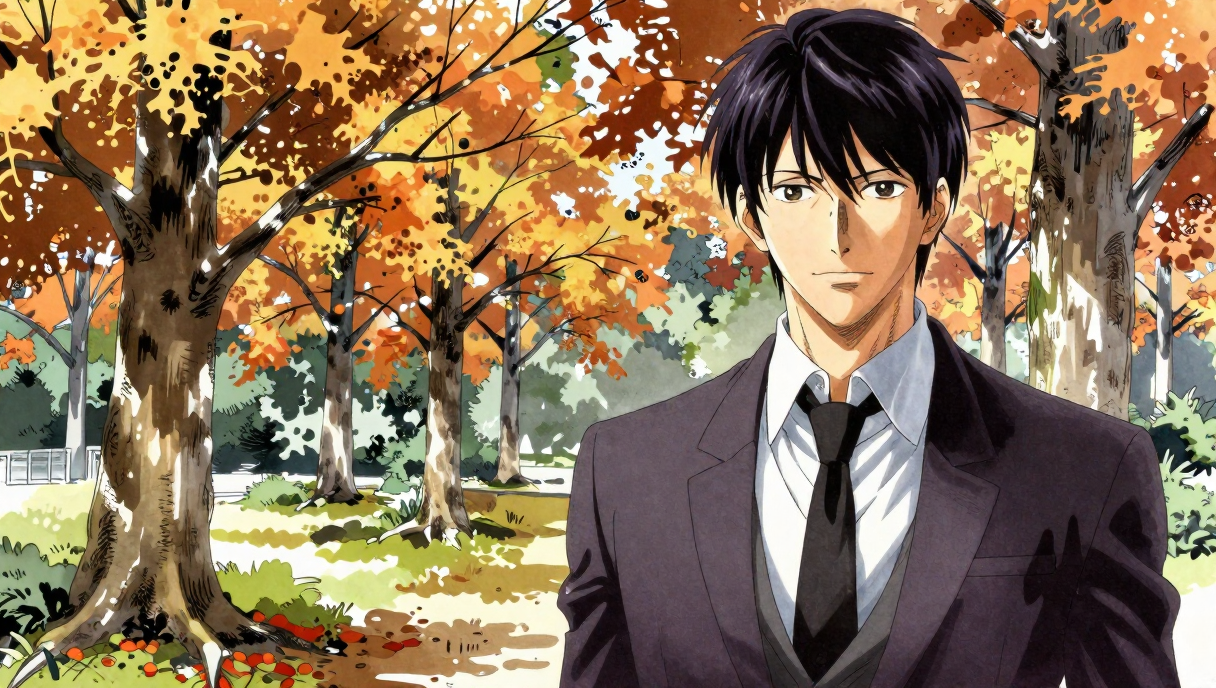
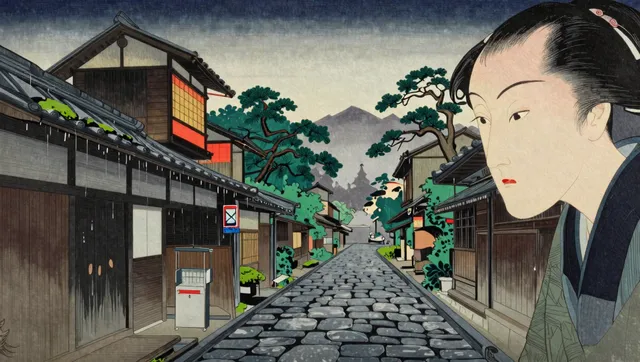
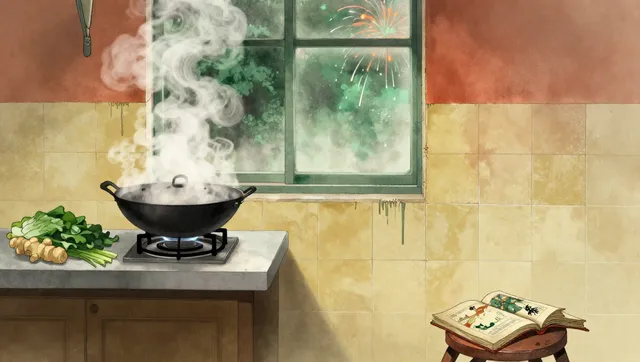
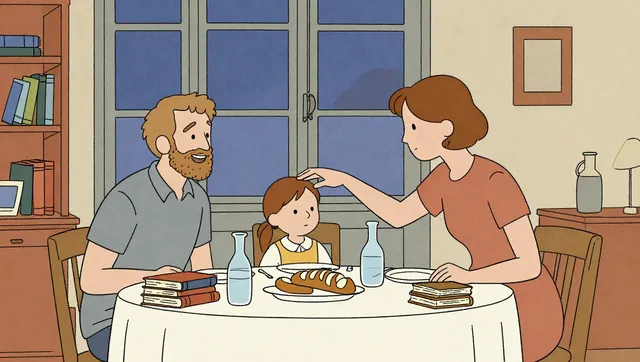
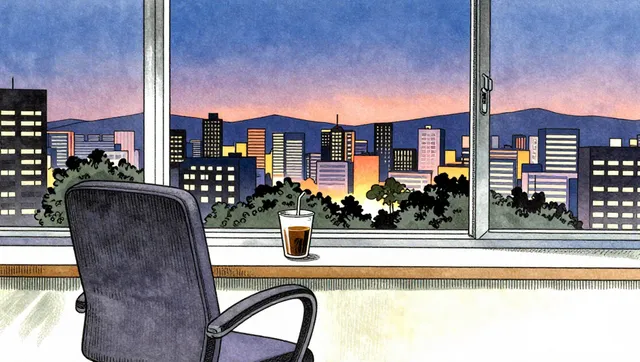
The pictures in this room interpret this lineage to fit Takeshi’s story, “The Structure of Naniwa”. The settings are a stifling July street in Seoul, a cool observatory, a desk piled with notebooks, a schedule crossed with red lines, a window at dusk and a sky garden. Our pictures are closer to the colour pages of a manga magazine than to black-and-white screentone pages. Crisp ink outlines and hatching are laid over backgrounds that bleed like watercolour, and shadows on faces are divided sharply as in cel animation. They carry into colour scenes the power of “telling stories with lines” that began with brush sketches. Every picture is an AI interpretation.