Jean-François Millet was born on 4 October 1814 as the eldest son of a farming family in the small village of Gruchy, in Gréville-Hague, near the Normandy coast. As the eldest he helped his father on the farm early on, and mowing, haymaking, binding sheaves, threshing, winnowing, spreading manure, ploughing and sowing all became familiar to his body. Each of these returned later in his pictures. Two village priests taught him Latin and the authors of his day, and in 1833 his father sent him to a portrait painter in Cherbourg. In 1837, on a stipend, he went to Paris and studied with Paul Delaroche at the École des Beaux-Arts.
His first years in Paris were not smooth. In 1839 the stipend ended and his first Salon submission was rejected by the jury. A portrait was accepted by the Salon of 1840, but he soon returned to Cherbourg to live by painting portraits, and he lost his first wife early to illness. Settled again in Paris in the mid-1840s, he befriended painters such as Constant Troyon, Narcisse Diaz, Charles Jacque and Théodore Rousseau, and he learned much from the figure drawing of the satirist Honoré Daumier. He also met an official named Alfred Sensier, who became a lifelong supporter and later his biographer. In 1847 he first tasted success at the Salon, and in 1848 the government bought his Winnower.
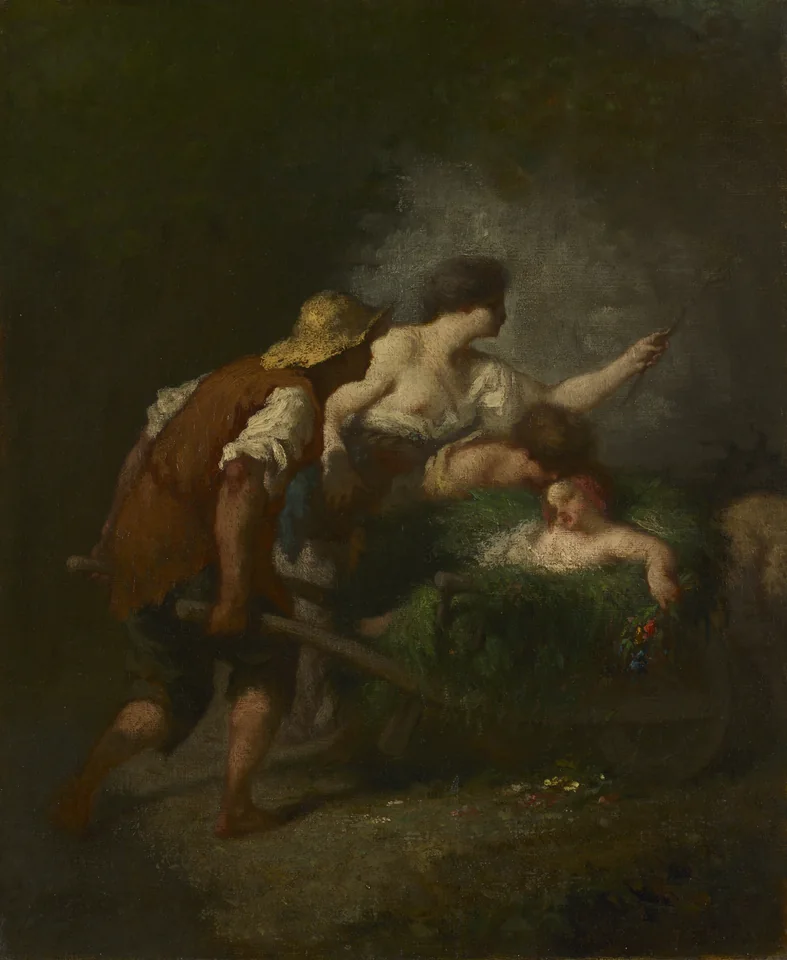
In June 1849 Millet settled with his wife Catherine and their children in Barbizon, a village at the edge of the forest south of Paris. The very small oil he showed at the Salon that year, Shepherdess Sitting at the Edge of the Forest, is described as a turn away from the idealised pastoral pictures of before toward a more realistic and personal approach. In 1850 he made an arrangement with Sensier, who supplied materials and money in return for drawings and paintings, while Millet remained free to sell to other buyers too. The Sower, which he showed at that year's Salon, is counted his first major masterpiece, the first of the famous trio with The Gleaners and The Angelus. Return from the Fields in this room is an early oil painted somewhat earlier, around 1846–47.
Gleaning was a centuries-old custom: the right of poor women and children to take the grain left in a field once the harvest was in. Walking the fields around Barbizon, Millet drew this subject again and again in pencil and brush over seven years, and around 1855–56 he also cut the etching in this room. That etching is described as directly foreshadowing the horizontal format of the later oil painting The Gleaners. In 1857 he submitted the large oil to the Salon, but the public's response was cold and at times hostile. The oil is now in the Musée d'Orsay in Paris. The Diggers, shown here beside the etching, was cut in the same years and puts the working body alone and large, without any event.
From the end of the 1850s Millet made many cheaper drawings alongside his large oils, because the market for drawings was much bigger. The black-crayon drawing The Sick Child of 1858 belongs to this period. In the 1860s he began to add pastel to black-chalk drawings, hoping colour would help them sell. In 1865 another patron, Emile Gavet, began commissioning pastels, in the end building a collection of ninety works. From 1865 to 1869 he used almost nothing but pastel and left more than a hundred works. First Steps in this room is a black-chalk-and-pastel drawing on beige paper from these years.
In the 1860s Millet's reputation kept growing despite mixed reviews at the Salon. At the Exposition Universelle of 1867 a major showing of his work took place, with The Gleaners, The Angelus and Potato Planters among the paintings exhibited. The next year he was named Chevalier of the Légion d'honneur, and in 1870 he was elected to the Salon jury. That year he fled the Franco-Prussian War with his family to Cherbourg and Gréville, and did not return to Barbizon until late in 1871. His last years brought financial success and growing official recognition, but poor health kept him from fulfilling government commissions. He died on 20 January 1875. The greatest afterlife of his work came from The Angelus.
The Angelus, commissioned by the American collector Thomas Gold Appleton, was completed in the summer of 1857 and was first titled Prayer for the Potato Crop. When the purchaser failed to take it in 1859, Millet added a steeple and changed the title. The painting passed through several hands and rose only modestly in value, but after Millet's death a bidding war between the United States and France ended, it is reported, at 800,000 gold francs. The gap between the painting's value and the poor estate of his surviving family is described as a major impetus for the droit de suite (追及權), the right to return a share to the artist or heirs when a work is resold. Van Gogh drew deep inspiration from Millet, and Monet and Seurat learned from his pictures too.