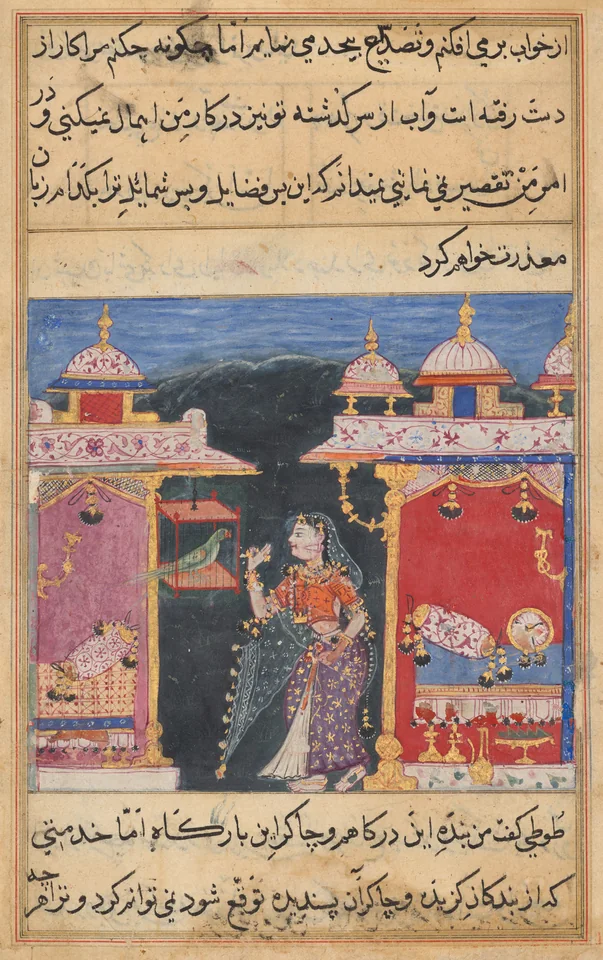
Mughal miniature painting (in Korean 細密畵, ‘small, finely worked picture’) grew up at the court of the Mughal dynasty, founded by Babur in 1526. The dynasty came into India carrying the culture of Central Asia and Persia, and painting was part of that culture. Persian miniature painting had developed as illustration for books of poetry and history. The second emperor, Humayun, had once lost his throne and stayed at the Persian court; when he came back to India he is said to have brought masters such as Abd al-Samad of Shiraz and Mir Sayyid Ali of Tabriz. What they brought was the fine line, the clear colour and a way of building a page like a stage. India already had its own painting traditions, carried in temples and manuscripts. The meeting of the two streams in one workshop is the beginning of Mughal miniature painting.
Painting grew large under the third emperor, Akbar (r. 1556–1605). Akbar is said to have learned painting from Abd al-Samad, and he enlarged the court workshop he inherited from his father. Records say more than a hundred painters were hired between 1570 and 1585, among them painters from many parts of India such as Basawan and Daswanth. The court chronicle, the A’in-i Akbari, tells that once a week the superintendents laid the artists' work before the emperor, who gave rewards and raised salaries according to excellence. Because of this, one picture came to be painted by several hands, and a single book became a great enterprise. The best known is the Hamzanama: a vast undertaking of about fifteen years, begun around 1562, with some 1,400 paintings on cloth, of which fewer than a tenth survive today.
Akbar also took painters' names seriously. Fortunately for modern scholars, the emperor is said to have liked the artists' names to be written beneath each miniature. A single picture was often shared between a designer and a colourist: one double-page composition in the Akbarnama is said to have been drawn by Basawan and coloured by Tara Kalan. In the later sixteenth century, European prints of Christian subjects, circulated by Jesuit missionaries, also reached the court. From them the painters learned how to make figures seem alive and how to put a feeling of air into a landscape. On top of the traditional flat colour, the haze of distance was added, and pictures grew more natural. Yet this was no imitation of European painting: the painters took only what they needed and digested it in their own way.
Under Jahangir (r. 1605–27) the pictures become calmer and more exact. The emperor enjoyed seeing the faces of people and the shapes of animals and plants exactly as they were, so portraits and studies from nature greatly increased. Mansur, a master of animal and plant painting who received the title Nadir al-Asr, ‘Wonder of the Age’, painted a zebra in 1621 that may be one of his last works. Bishandas was famed as a portraitist. The Cleveland Museum of Art's ‘Nur Jahan holding a portrait of Emperor Jahangir’ is his, dated around 1627, which was also the year of the emperor's death. The sitter in such portraits often stands in profile before a background of one clear colour. By clearing away the extras, the line of the face stands out.
Under Shah Jahan (r. 1628–58) painting became more refined and more splendid. At the court of this emperor, famed for his architecture, books such as the Padshahnama, the ‘Chronicle of the Emperor’, set out court ceremonies and battles in a golden glow. That book is now in the Royal Collection in Britain. Albums of this period were not mere piles of pictures: each picture was framed by a border of gold-decorated flowers and scrolling vines and joined with calligraphy by a master hand, making a jewel-box of an object. The Cleveland Museum of Art's ‘Prince and ascetics’ is a page from a late Shah Jahan album and the work of Govardhan; even the small ascetics around the picture are each drawn with a different face and posture. In all the splendour, the painters of this period never lost their eye for the individual.
Mughal paintings were not hung on a wall for many people to see. They were pictures that someone close to the emperor laid on the lap and turned page by page. So they could be small, and they had to be small. The emperor appeared at a window of the palace to show himself to his people in a ceremony called jharokha darshan, which made imperial authority visible. Paintings likewise carried a large share of the work of showing the power and taste of their patron, the emperor. Even so, the painters saw the world with their own eyes. The wrinkled face of an ascetic, the muscles of a horse, the direction of a leaf were not written in any order, but were drawn by painters from direct observation. The charm of Mughal painting is the small breath of life inside a splendid frame.
Under Aurangzeb (r. 1658–1707) in the later seventeenth century, court support for painting is said to have declined, and the emperor is also said to have given up jharokha darshan. When the empire weakened in the eighteenth century, painters scattered to the courts of regional rulers, where other branches such as Rajput and Pahari miniature painting flourished. After them came Company-style pictures commissioned by officials of the British East India Company. So the painting of the Mughal court did not end in one form but continued in many branches. Today Mughal miniatures are cherished in museums and libraries, and contemporary artists in India and Pakistan learn from this tradition to make new miniatures. It is a story of small pictures handed from hand to hand across several hundred years.