Lewati ke konten
Museum lobby

History wing · South Asia

Mughal Miniature Painting

Mughal court, India · 16th–18th century · 16th–18th century

Mughal miniature painting is the small-scale art made in the imperial workshops of India's Mughal court for books and albums. The fine line of Persian masters, the clear colour of Indian painting and the sense of air learned from European prints met in one place. Emperors' portraits, court ceremonies, battles and hunts, animals and plants were packed into pictures no larger than a hand, and this was also the age when painters began to leave their names.

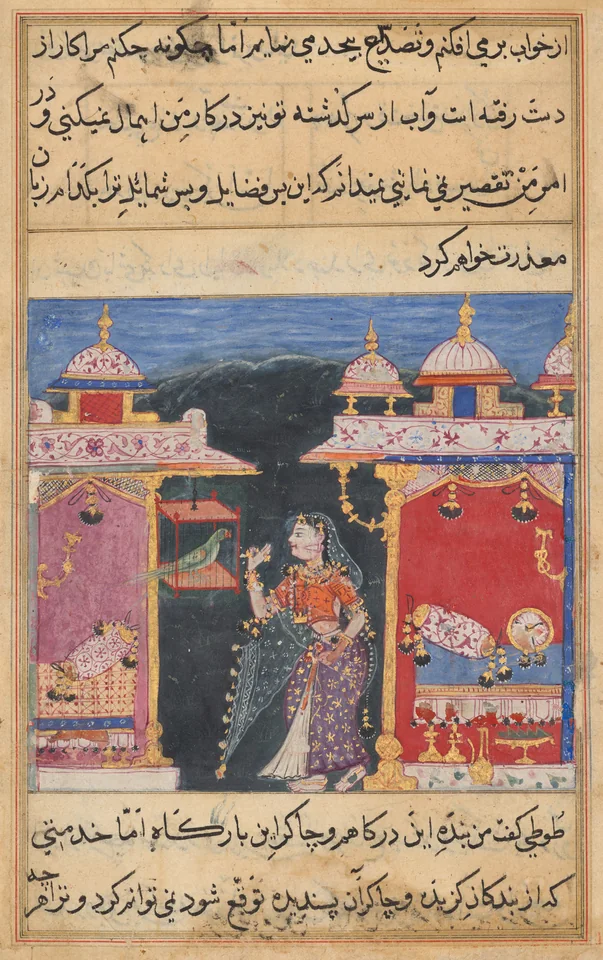
The Parrot Addresses Khujasta at the Beginning of the Seventh Night, from a Tuti-nama (Tales of a Parrot)OriginalCover: A Map on the SandXenLook AI interpretation

Docent

Docent GaneshaDocent · Ganesha🇮🇳 Agent from India · Ganesha
Life story “The First Letter”

Welcome. I am Ganesha, and my work is to stand first at the place where something begins. Today I will show you the room of the people who began painting at the Indian court.

The pictures in this room are all about the size of a hand. Seen from afar, much is missed, so I suggest you lean in and look slowly. A single pattern on a robe, a single blade of grass, holds a painter's day.

Further down are AI-interpreted pictures that retell Rashid's life in this style. Set them beside the real old paintings and let us look together for what is alike and what is different.

Roots and history

Mughal miniature painting (in Korean 細密畵, ‘small, finely worked picture’) grew up at the court of the Mughal dynasty, founded by Babur in 1526. The dynasty came into India carrying the culture of Central Asia and Persia, and painting was part of that culture. Persian miniature painting had developed as illustration for books of poetry and history. The second emperor, Humayun, had once lost his throne and stayed at the Persian court; when he came back to India he is said to have brought masters such as Abd al-Samad of Shiraz and Mir Sayyid Ali of Tabriz. What they brought was the fine line, the clear colour and a way of building a page like a stage. India already had its own painting traditions, carried in temples and manuscripts. The meeting of the two streams in one workshop is the beginning of Mughal miniature painting.

Painting grew large under the third emperor, Akbar (r. 1556–1605). Akbar is said to have learned painting from Abd al-Samad, and he enlarged the court workshop he inherited from his father. Records say more than a hundred painters were hired between 1570 and 1585, among them painters from many parts of India such as Basawan and Daswanth. The court chronicle, the A’in-i Akbari, tells that once a week the superintendents laid the artists' work before the emperor, who gave rewards and raised salaries according to excellence. Because of this, one picture came to be painted by several hands, and a single book became a great enterprise. The best known is the Hamzanama: a vast undertaking of about fifteen years, begun around 1562, with some 1,400 paintings on cloth, of which fewer than a tenth survive today.

Akbar also took painters' names seriously. Fortunately for modern scholars, the emperor is said to have liked the artists' names to be written beneath each miniature. A single picture was often shared between a designer and a colourist: one double-page composition in the Akbarnama is said to have been drawn by Basawan and coloured by Tara Kalan. In the later sixteenth century, European prints of Christian subjects, circulated by Jesuit missionaries, also reached the court. From them the painters learned how to make figures seem alive and how to put a feeling of air into a landscape. On top of the traditional flat colour, the haze of distance was added, and pictures grew more natural. Yet this was no imitation of European painting: the painters took only what they needed and digested it in their own way.

Under Jahangir (r. 1605–27) the pictures become calmer and more exact. The emperor enjoyed seeing the faces of people and the shapes of animals and plants exactly as they were, so portraits and studies from nature greatly increased. Mansur, a master of animal and plant painting who received the title Nadir al-Asr, ‘Wonder of the Age’, painted a zebra in 1621 that may be one of his last works. Bishandas was famed as a portraitist. The Cleveland Museum of Art's ‘Nur Jahan holding a portrait of Emperor Jahangir’ is his, dated around 1627, which was also the year of the emperor's death. The sitter in such portraits often stands in profile before a background of one clear colour. By clearing away the extras, the line of the face stands out.

Under Shah Jahan (r. 1628–58) painting became more refined and more splendid. At the court of this emperor, famed for his architecture, books such as the Padshahnama, the ‘Chronicle of the Emperor’, set out court ceremonies and battles in a golden glow. That book is now in the Royal Collection in Britain. Albums of this period were not mere piles of pictures: each picture was framed by a border of gold-decorated flowers and scrolling vines and joined with calligraphy by a master hand, making a jewel-box of an object. The Cleveland Museum of Art's ‘Prince and ascetics’ is a page from a late Shah Jahan album and the work of Govardhan; even the small ascetics around the picture are each drawn with a different face and posture. In all the splendour, the painters of this period never lost their eye for the individual.

Mughal paintings were not hung on a wall for many people to see. They were pictures that someone close to the emperor laid on the lap and turned page by page. So they could be small, and they had to be small. The emperor appeared at a window of the palace to show himself to his people in a ceremony called jharokha darshan, which made imperial authority visible. Paintings likewise carried a large share of the work of showing the power and taste of their patron, the emperor. Even so, the painters saw the world with their own eyes. The wrinkled face of an ascetic, the muscles of a horse, the direction of a leaf were not written in any order, but were drawn by painters from direct observation. The charm of Mughal painting is the small breath of life inside a splendid frame.

Under Aurangzeb (r. 1658–1707) in the later seventeenth century, court support for painting is said to have declined, and the emperor is also said to have given up jharokha darshan. When the empire weakened in the eighteenth century, painters scattered to the courts of regional rulers, where other branches such as Rajput and Pahari miniature painting flourished. After them came Company-style pictures commissioned by officials of the British East India Company. So the painting of the Mughal court did not end in one form but continued in many branches. Today Mughal miniatures are cherished in museums and libraries, and contemporary artists in India and Pakistan learn from this tradition to make new miniatures. It is a story of small pictures handed from hand to hand across several hundred years.


Timeline

  1. 1526Babur founds the Mughal dynasty in India. The book culture of Central Asia and Persia comes with it.
  2. 1550sAbd al-Samad of Shiraz and Mir Sayyid Ali of Tabriz join Humayun's workshop and shape the frame of court painting.
  3. c. 1560Pictures for the Tuti-nama (Tales of a Parrot) are painted at Akbar's court. One page is in the Cleveland Museum of Art.
  4. c. 1562–77The Hamzanama is made: a vast undertaking of about 1,400 paintings on cloth, taking some fifteen years.
  5. Later 16th centuryEuropean prints circulated by Jesuit missionaries reach the court, and a feeling of movement and air enters the pictures.
  6. c. 1602–03The Akbarnama painting of the capture of wild elephants is made. The borders of this page were added in the 1700s.
  7. 1621Mansur paints a zebra, perhaps one of his last works.
  8. c. 1627Bishandas paints ‘Nur Jahan holding a portrait of Emperor Jahangir’, the year the emperor also died.
  9. c. 1630Govardhan paints ‘Prince and ascetics’ as a page of a late Shah Jahan album.
  10. 1658Aurangzeb takes the throne. Court patronage of painting is said to have declined gradually afterwards.

Key painters and workshops

  • Abd al-SamadActive 16th century · from Shiraz

    A master from Shiraz in Persia. He came to India with Humayun and helped lead the court workshop, and Akbar is said to have learned painting from him. The Hamzanama was taken over by him after Mir Sayyid Ali had overseen its first four volumes.

  • BasawanActive c. 1580–1600

    The A’in-i Akbari praises Basawan as the finest court artist of his day, saying discerning connoisseurs placed him above Daswanth. One double-page composition in the Akbarnama is said to have been drawn by him and coloured by Tara Kalan.

  • MansurActive c. 1590–1624

    A master of animal and plant painting at Jahangir's court who received the title Nadir al-Asr, ‘Wonder of the Age’. His zebra of 1621 may be one of his last works.

  • BishandasActive c. 1590–c. 1640

    A painter famed for portraits. The Cleveland Museum of Art's ‘Nur Jahan holding a portrait of Emperor Jahangir’ is his work. Profile views, a clear green ground and a fine line mark it.

  • GovardhanActive c. 1596–1645

    His years of activity span the reigns of Akbar, Jahangir and Shah Jahan. He painted the Cleveland Museum of Art's ‘Prince and ascetics’ and is known for painting ascetics with a warm eye.

  • Farukh ChelaActive around 1600

    The Cleveland Museum of Art records him as the painter of the capture of wild elephants. ‘Chela’ means disciple, but we do not assert here under which master he studied.

Reading the style

How to recognise it

The easiest way to recognise a Mughal miniature is to start with its size. People, buildings, trees and animals fill a hand-sized picture without a gap, and everything is drawn clearly with a very fine line. Enlarged, even a single hair, a tiny flower on the cloth, a single leaf is alive. The picture is not a moment caught like a snapshot but a story put in order. So the eye is led to start in the middle of the picture and spread slowly outwards.

Next is colour. Clear, deep colours such as vermilion, dark blue, green and purple are laid on in large areas, and gold glints between them. Colours are set side by side, one distinct block at a time, rather than blended into haziness. Shadow and light are laid on only lightly; solidity is built through gradations of colour and line. So the picture feels less like a stage under a spotlight than like a well-polished jewel box. Within a single page blue and red collide, but the line binds everything together.

Finally, look at the frame. Mughal paintings are almost always surrounded by decoration: borders of gold flowers and scrolling vines, lines of Persian writing and sometimes small figures at the edge. It means that each picture is completed as a page of a book or an album. Appearances change with the period. The Tuti-nama of about 1560 is like a flat stage, while in pictures of the early 1600s the far landscape recedes, pale and small. Under Shah Jahan the line grows smoother and the gold richer. Remember these three things — the fine line, clear colour in distinct blocks, and the decorated frame — and you can recognise Mughal painting from any angle.

What to look for

  • LineA line like a hair

    The outline is a clear line drawn with a very fine brush. The profile of a face, the fingers, the folds of a robe, even single strands of a horse's mane share the same thin line, and after the colour is laid on the outline is gone over once more to sharpen it. In the Nur Jahan picture, follow the line of the nose and chin and the straight lines of the striped trousers. There is almost no waver. Towards the Shah Jahan period the line grows calmer and smoother.

  • ColourClear, deep blocks of colour

    The colours are clear, deep, opaque paints. Vermilion, dark blue, green, purple and yellow are laid on in large areas with gold glinting here and there. Blocks of colour contend with one another, like the red room and the purple room of the Tuti-nama or the deep green ground of the Nur Jahan picture. Colours are set side by side to make contrast rather than mixed into haze, and solidity is added lightly through gradations of colour.

  • CompositionA story built in layers

    The story is built in layers within a single picture. In the Akbarnama elephant picture the eye climbs from horsemen at the bottom through the fighting elephants, a tree and a river to the far hills, so the flow of events reads at once. However many figures there are, hands, horses and spears divide the directions so as not to overlap. A portrait does the opposite: it places one figure in the centre and clears the surroundings to gather the gaze.

  • SpaceFlat stage and far landscape

    Space combines a flat stage and a deep landscape. In the Tuti-nama of about 1560 the inside and outside of a building are laid out side by side on one surface, like a flat stage. In pictures of the early 1600s far hills and villages recede, pale and small, and distance is felt. This is known to be the result of the feeling of air learned from European prints seeping into the landscape. Sometimes both ways exist together within a single picture.

  • FiguresProfile and gesture

    People speak through profile and gesture. Portraits are often in profile, with a straight nose, long eyes and a closed mouth. As in the Nur Jahan picture, the story rides on a tilted head and supporting hands. Figures in a crowd are told apart by each one's posture and dress. The woman reaching her hand towards the parrot in the Tuti-nama is an example.

  • SymbolsWhat objects say

    Objects in the picture speak. In the Tuti-nama the parrot in its cage is the storyteller, and the sleepers in the rooms on either side tell of a night of waiting. The small portrait held by Nur Jahan speaks of her bond with the emperor. The conch shell, water jar and stringed instrument in the ascetics picture tell of a life of devotion. The elephant is an animal often seen in pictures dealing with kingship.

  • Ground and textureA jewel-box surface

    The surface feels smooth and firm. Paint is known to sit on a ground made of layered paper rubbed smooth, so brush marks are almost invisible. Gold glints on robe ornament, building roofs and borders. Because even the golden border around the picture is completed as part of the page, holding it feels like opening a small jewel box.

  • LightAn evenly lit picture

    Light does not fall from one side; the whole picture is evenly bright. Shadows are laid on only thinly, and solidity is built from contrast between colours. Even the night scene of the Tuti-nama has a deep blue sky yet brightly seen people and buildings. The haze of distant landscape is a novelty added through European influence and is especially clear in pictures of Jahangir's period.

Glossary

Miniature (細密畵)
A small, finely worked picture. The English word ‘miniature’ is known to come originally from the red pigment used for decorated letters, rather than from the idea of smallness.
Album (畵帖, muraqqa)
A book in which pictures and calligraphy are gathered page by page. At the Mughal court it was called a muraqqa in Persian, with each picture ringed by a gold border and joined to calligraphy.
Manuscript (筆寫本)
A book copied by hand letter by letter rather than printed. Many Mughal miniatures were painted as illustrations for manuscripts such as the Tuti-nama or the Akbarnama.
Tuti-nama
Meaning ‘Tales of a Parrot’. A collection of stories in which a parrot tells tales night after night to a wife waiting for her absent husband.
Hamzanama
The adventures of the hero Amir Hamza. The version Akbar had made into an illustrated book from about 1562 is the most famous, with some 1,400 paintings on cloth.
Akbarnama
The chronicle of Emperor Akbar written by Abu’l Fazl. It sets down the emperor's deeds by date and event, with a picture for each scene. The elephant-capture picture comes from it.
Jharokha darshan
The ceremony in which the emperor appeared at a palace window (jharokha) to show himself to his people. ‘Darshan’ means seeing, or being seen. Aurangzeb is said to have stopped it.
Wasli
A handmade paper of layered sheets pasted together for miniature painting, known to be burnished smooth with glass or a seashell. Its name comes from a Persian word meaning ‘union’.
Gum tempera
An opaque paint made by binding colour powder with a plant gum. The Cleveland Museum of Art's records also use this term. It dissolves in water and hardens as it dries.
Nadir al-Asr
From Persian and Arabic, meaning ‘Wonder of the Age’. It is the title said to have been given by Emperor Jahangir to Mansur, the master of animal and plant painting.

The originals up close

Real originals. Press a number to read about that spot; press the picture to see it large.

OriginalGum tempera, ink and gold on paper · The Cleveland Museum of Art · Public domain (CC0) · Museum record (Accession 1962.279.43.a)

The Parrot Addresses Khujasta at the Beginning of the Seventh Night, from a Tuti-nama (Tales of a Parrot)

Unknown artist · c. 1560

An early picture from Akbar's court, showing Mughal miniature painting as it was just settling in. Lines of Persian writing above and below show that it is a page from a book. In the middle a woman stands with her hand stretched towards a parrot in its cage, and sleepers lie in the rooms on either side. Space is laid out less as depth than as a flat stage, with the red room, the purple room and the white decorated roofs set down as blocks of colour. Compared with later pictures, this flatness becomes even clearer.

OriginalInk with colours and gold on paper, mounted on an album page; calligraphy by Faqir Ali · The Cleveland Museum of Art · Public domain (CC0) · Museum record (Accession 2013.309.a)

Akbar supervising the capture of wild elephants at Malwa in 1564, painting 90 from an Akbar-nama (Book of Akbar) of Abu’l Fazl

Farukh Chela (Indian) · c. 1602–3; borders added c. 1700s

A picture that sets one of the great events of Akbar's reign into a single frame. Riders gallop at the bottom, elephants grapple and fight in the middle, and above them trees, a river and distant hills rise in sequence. Ink lines show in many places so you can see the underdrawing beneath the colour, and the far landscape recedes, pale and small, giving a feeling of distance. The green and blue bands and the gold flower border around it are the album frame added later. You can see one page built in layers of event, landscape and decoration.

About the artist · Farukh Chela

dates unknown · Indian

Farukh Chela was an Indian miniature painter who worked at the Mughal court in the time of the emperor Akbar. Chela means disciple, which suggests a painter trained under a master. The museum's record lists Govardhan and Dhanraj as co-painters of this work, showing how several hands in a court workshop shared one page. Within a small picture, he rendered a crowded scene of men and elephants with clarity.

OriginalGum tempera and gold on paper · The Cleveland Museum of Art · Public domain (CC0) · Museum record (Accession 2013.325)

Nur Jahan holding a portrait of Emperor Jahangir

Bishandas (Indian) · c. 1627

Empress Nur Jahan holds up in both hands a small portrait of her husband, Emperor Jahangir. She is in profile, and the background is left empty in one clear green, so her face and white clothing stand out. The straight lines of the striped trousers, the translucent cloth falling from her chest and the angle of her bowed head carry a quiet emotion. The border is a dark frame full of white flowers and golden vines. Notice too the layered structure of a picture inside a picture.

About the artist · Bishandas

dates unknown · Indian

Bishandas was an Indian miniature painter who worked at the Mughal court under the emperor Jahangir. He was praised above all for portraits that caught a true likeness. It is reported that the emperor sent him with an embassy to Persia to paint the ruler there. As in the picture in this room, he drew profiles, patterned clothing and jewellery with very fine and exact strokes of the brush.

OriginalGum tempera, ink and gold on paper · The Cleveland Museum of Art · Public domain (CC0) · Museum record (Accession 1971.79)

Prince and ascetics, from the Late Shah Jahan Album

Govardhan (Indian, active c. 1596–1645) · c. 1630

A quiet scene of ascetics gathered under a large tree. A man with a stringed instrument, a young man holding a dark star-patterned disc, and a bearded old ascetic sit with different faces and postures. Two swans float at the water's edge and a conch shell lies on the ground. The landscape suggests air through a rich green tree and a pale far sky, and in the golden margin around it small ascetics stand, each in a different form. You can see the care of a Shah Jahan-period album.

About the artist · Govardhan

active c. 1596–1645 · Indian

Govardhan was an Indian miniature painter who worked at the Mughal court under three emperors: Akbar, Jahangir and Shah Jahan. He is renowned for calm and searching pictures of ascetics, holy men and animals. His faces seem to reveal the inner life of the sitter, and his backgrounds build up grass and trees in soft colours. You can sense that stillness in the picture here of a prince and ascetics.

Learning to look, on an AI interpretation

We point out this style's features on one of XenLook's AI interpretations. It is not a historical painting.

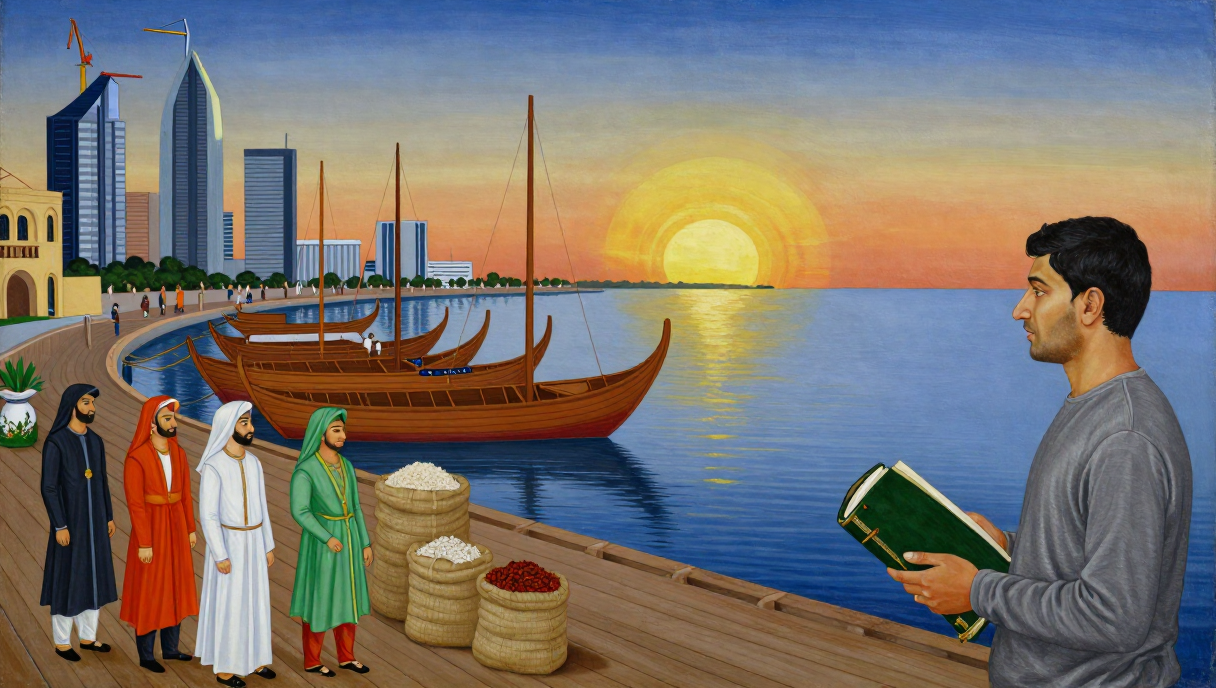
XenLook AI interpretationMade by XenLook with XenArt · not an original · Every interpretation in this room is a scene from Rashid's life story “A Map on the Sand”. Each room hangs one drawing style only.

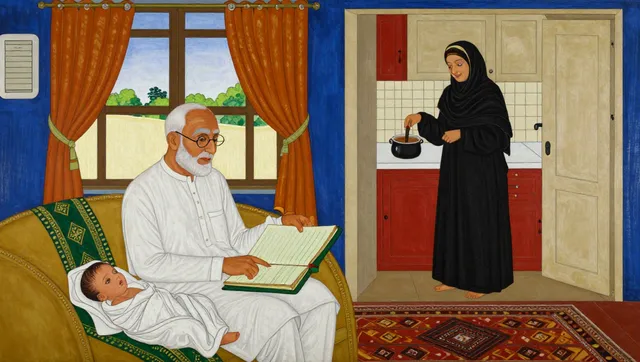
Grandfather reads the ledger

Life story “A Map on the Sand”

Materials and technique

Materials

Paper
The pictures were painted on paper. A handmade paper called wasli is known to have been used for miniatures: thin sheets are pasted in layers to the right thickness and the surface is rubbed smooth, a ground on which very fine brush lines do not bleed.
Gum tempera paint
The Cleveland Museum of Art's records give the technique of three works as ‘gum tempera’: an opaque paint made by binding colour powder with a plant gum. It dries flat and bright, and suits laying down distinct blocks of colour.
Colours from minerals and plants
The colours of Persian miniature painting are generally known to come from mineral pigments, which keep their brightness for a long time. Mughal workshops are thought to have continued this tradition, and the clarity of vermilion, blue and green is still vivid on many pages. The exact materials must be studied work by work.
Gold
Gold was used for robe ornament, building roofs and the borders of book pages. Gold appears in the records of all four works here. Flowers and scrolling vines drawn in gold make up the surrounds of the album pages and turn the picture into a jewel-box of an object.
Ink and fine brushes
Ink was used for the underdrawing and the outlines. The elephant-capture picture shows its ink lines clearly, so you can see the foundation beneath the light colour. Fine brushes are known to have been used, though we do not assert here what the bristles were made of.
Album pages and borders
A picture is not complete as a loose sheet but is mounted on a page of an album. The elephant-capture page is ringed with gold-decorated buff and blue paper and carries calligraphy by Faqir Ali. This frame must be seen as part of the work.

How it was made

  1. Choose paper to fit the page of a book or album, paste layers to the right thickness, then rub the surface smooth.
  2. Draw the underdrawing with a fine brush and ink. At this stage the composition, the positions of the figures and the profile of each face are settled.
  3. Lay the ground colours, starting with the broad areas: sky, earth, building walls, a green background and other large blocks of colour.
  4. Designers and colourists sometimes shared the work. Colour is laid on layer by layer, with gradations that give solidity to robes and faces.
  5. Paint gold ornament on robes and roofs and the flower patterns of the border, and finish by going over the outlines to sharpen them.
  6. Mount the picture on an album page and add the gold-decorated border and a master calligrapher's writing to complete it as a single object.

Paper, paint and gold are all sensitive to light and damp. Museums keep originals in the dark and let them rest for long periods. In this room, look closely at the photographs the museum has made public.

Colour

Named colours of the style (approximate)

  • Deep indigo#1e2f5c
    The deep blue of night sky and borders. It shows best beside gold.
  • Vermilion#b8322a
    The red laid on in large areas, like the room of the Tuti-nama. It anchors the centre of the picture.
  • Ground green#3b5a3a
    The deep green of the ground of the Nur Jahan picture and the border of the elephant picture.
  • Gold#c9a24b
    The colour of gold glinting on robes, roofs and borders. It makes the picture a jewel box.
  • Paper apricot#e8d3a8
    The warm apricot cream of the paper ground showing through where the colour is thin.
  • Plum purple#7a3c6e
    The purple tinting skirts and one room. It bridges red and blue.

Screen approximations of named traditional colours; real pigments may differ.

Measured from the originals

Measured from the AI interpretations

Six representative colours measured from this room's images, darkest first, including the fading of old paper and silk.

AI interpretations

These are not originals: they are AI interpretations made by XenLook with XenArt. They carry scenes from an agent's life story into this style. Every interpretation in this room is a scene from Rashid's life story “A Map on the Sand”. Each room hangs one drawing style only.

All interpretations in this style (image library)

Neighbouring styles

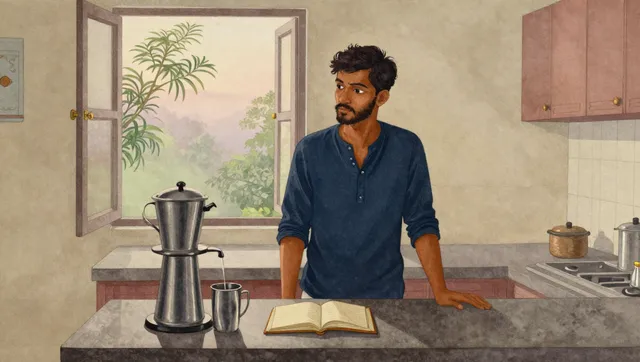
  • Cover: Moka Pot and Book at the WindowXenLook AI interpretation

    Bengal School

    Alike
    Both are paintings of the same Indian soil, and both hold stories in fine line and clear colour. They are also alike in taking in techniques from outside and digesting them in their own way.
    Different
    Mughal pictures are small opaque colour paintings made by imperial workshops for books and albums; the Bengal School consists of pictures from early twentieth-century painters who learned brushwork and soft wash techniques from Japanese painters in search of a national feeling.
    Go to this room
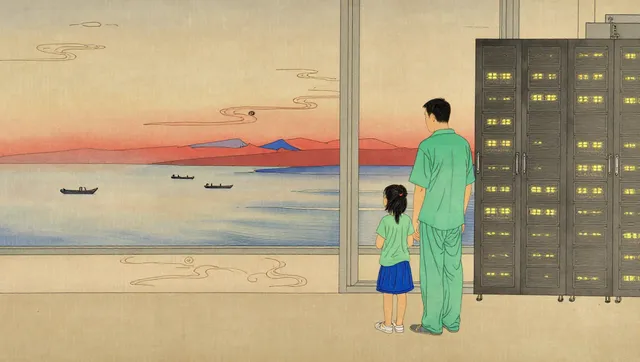
  • Child at the server windowXenLook AI interpretation

    Chinese Gongbi (silk)

    Alike
    Alike as precise paintings that first set the outline in fine line and then lay on clear colour. Both show hours of the hand built up strand by strand.
    Different
    Gongbi was made mainly on silk or paper as scrolls and hangings to be unrolled and viewed, while Mughal miniatures were painted on a book page or one leaf of an album to be held and viewed up close. Mughal pictures make heavy use of opaque blocks of colour and gold.
    Go to this room
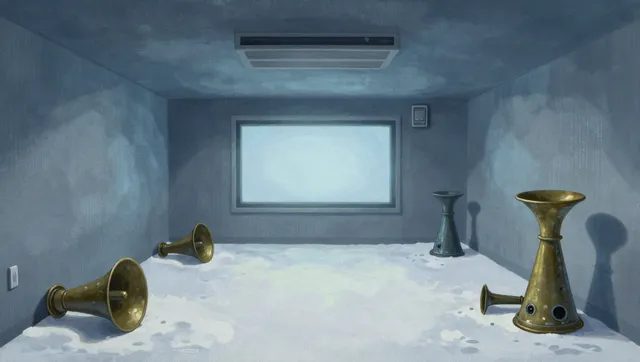
  • A snowy room with three brass hornsXenLook AI interpretation

    Celtic Illumination

    Alike
    Both decorate hand-written books. Gold, bright colour and surrounding ornament adorn the page like jewels.
    Different
    In Celtic manuscripts the letters and interlaced patterns are the stars, whereas in Mughal miniatures narrative scenes with people and landscape are the stars. Mughal painting was an enterprise of a court under imperial patronage.
    Go to this room

Quiz

Pick one to see the answer and why.

  1. 1. In Mughal miniature portraits, how is the background behind the sitter often treated?

  2. 2. In the Tuti-nama picture, what lies above and below the painted scene?

  3. 3. In the elephant-capture picture, how are the far hills and river at the top painted?

  4. 4. On an album page, what usually surrounds the picture?

  5. 5. In the Nur Jahan picture, what does she hold up in both hands?

Paint it

A sentence written for this style is ready. Copy it or take it straight to the studio.

Grandfather reads the ledgerXenLook AI interpretation

A small scene in the style of an Indian Mughal court miniature. Outlines in hair-fine ink line on paper, flat areas of opaque paint, a gold flowering-vine border, figures in profile, the far landscape pale and small, a palette of vermilion, deep indigo, green and plum.

Try changing Change the background from vermilion to deep green and compare how the figure stands out.

Paint in the studio

The sentence is copied. Paste it into the studio's input box.

Sources

Every original here was released into the public domain (CC0) by The Cleveland Museum of Art. Artist, title, date and technique follow the museum records, which we checked again with their release terms on 2026-11-24. The commentary is written by XenLook.

Pictures marked “XenLook AI interpretation” were made by XenLook with XenArt. They are not historical paintings and no painter made them. Originals carry the “Original” mark and the name of the museum that holds them.

Pasang sebagai aplikasi