Edvard Munch was born in 1863 in the village of Ådalsbruk in Løten, Norway. His father, Christian, was an army doctor, and the family soon moved to the capital, Christiania (today's Oslo). His mother died of tuberculosis in 1868, and in 1877 so did his sister Sophie, the one he was closest to. For the young Munch, illness and death were not words in books but things that happened inside the house. In 1881 he entered the Royal School of Art and Design, where he studied under the sculptor Julius Middelthun and the naturalist painter Christian Krohg.
In 1889 he won a state scholarship and went to Paris, studying in the studio of Léon Bonnat and making the rounds of museums and exhibitions. There he took close note of how Gauguin, Van Gogh and Toulouse-Lautrec used colour to carry feeling. His father died in December of that year, leaving the family in hard times. In 1892 he held a solo show at the invitation of the Association of Berlin Artists, but the paintings stirred such fierce controversy that it closed after a week. The episode is known as the Munch Affair. He is said to have been rather amused by the commotion.
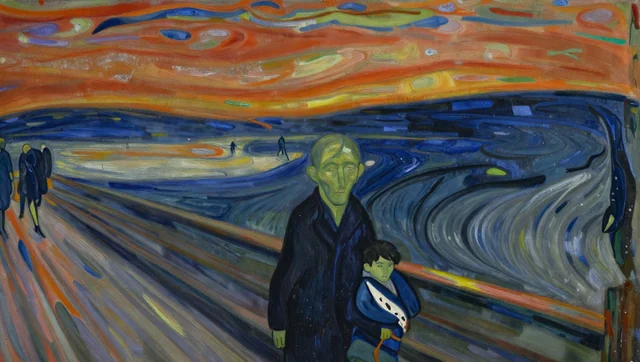
Around then Munch gathered themes such as love, anxiety, jealousy, betrayal and death into one great story he called the Frieze of Life (Livsfrisen). The Scream belongs to this series. After it first appeared in 1893 it survived as two pastels and two paintings, and from 1895 it was printed as lithographs too. Munch felt each painting was one part of a single expression and hated to sell it, so he is said to have made the same images again as prints, which also brought him an income. Printmaking gave him a way to take the same feeling out again in another form.
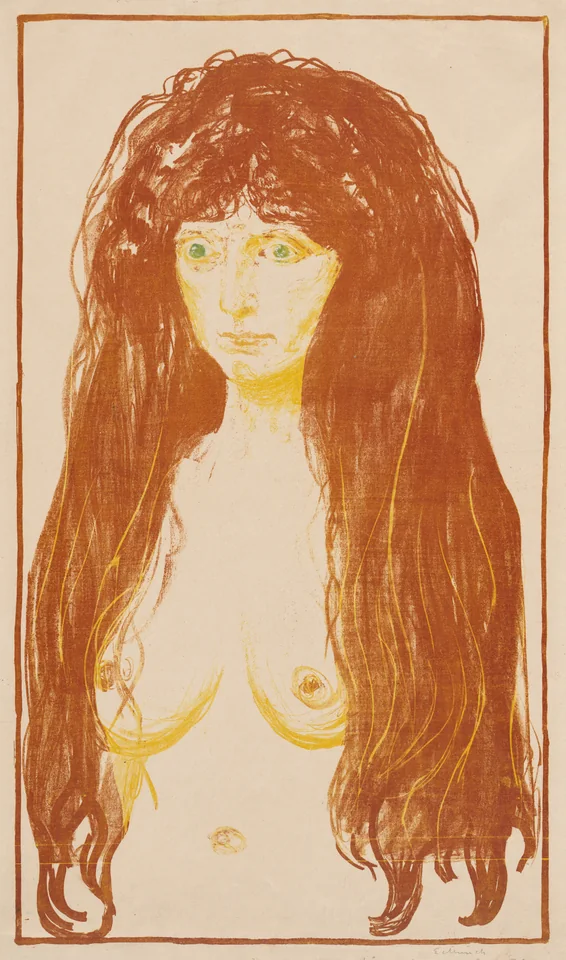
The influence of print artists such as Germany's Max Klinger is said to have opened his eyes to printmaking. From the mid-1890s Munch put his energy into lithographs and etchings, and in 1896 he cut his first woodcuts. He repeated the same scene while changing the medium and the state of the plate. In Summer Night (The Voice) he roughened a copper plate with sandpaper to win a misty grey, while The Sin was drawn on stone with crayon and printed one colour per stone. Change the medium and the same figure appears with a different warmth. For Munch the plate was not a mould for copying but a place to speak anew.
In autumn 1908 Munch suffered a breakdown and entered Daniel Jacobson's clinic in Copenhagen, where for about eight months he received dietary treatment and electrotherapy. After he returned to Norway in 1909, his paintings are judged to have grown brighter and less pessimistic. The lithograph series Alpha and Omega also dates from around this period. He was commissioned in 1914 to decorate the Aula of the University of Oslo and finished in 1916, a work of eleven paintings covering 223 square metres, counted among the great monumental paintings of Norway. For most of his last two decades he lived largely alone on his estate at Ekely near Oslo.
Munch died on 23 January 1944 at his house in Ekely, aged eighty. His remaining works were bequeathed to the city of Oslo, and in 1963 the Munch Museum opened at Tøyen in Oslo. His work was banned in Nazi-occupied Europe, but most of it came safely through the war. Today the several versions of The Scream are in Oslo, at the National Museum and the Munch Museum, while his prints are kept by museums around the world. His rough line and frank feeling also opened a broad road for the German Expressionist printmakers who followed.