Ir para o conteúdo
Museum lobby

Masters annex · Europe

Edvard Munch

Norway · 1880s–1944 · 1880s–1944

Edvard Munch (1863–1944) was a Norwegian artist who carried one scene across paintings, lithographs, etchings and drypoints, building the great series he called the Frieze of Life. In this room, five real prints made open to the public by the Cleveland Museum of Art let you follow, spot by spot, how the same feeling takes a different face on each plate.

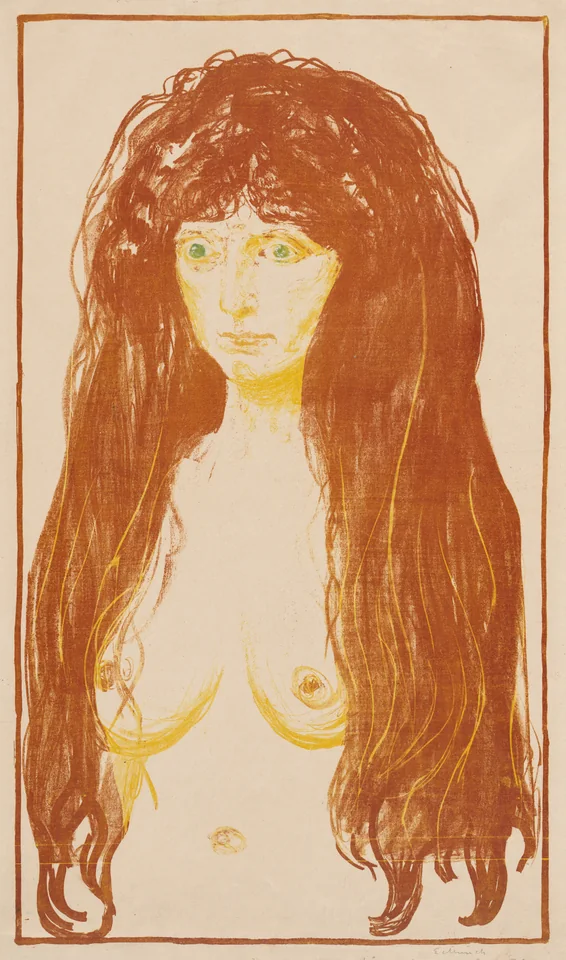
Woman with Red Hair and Green Eyes (The Sin)OriginalMay the power go back on?XenLook AI interpretation

Docent

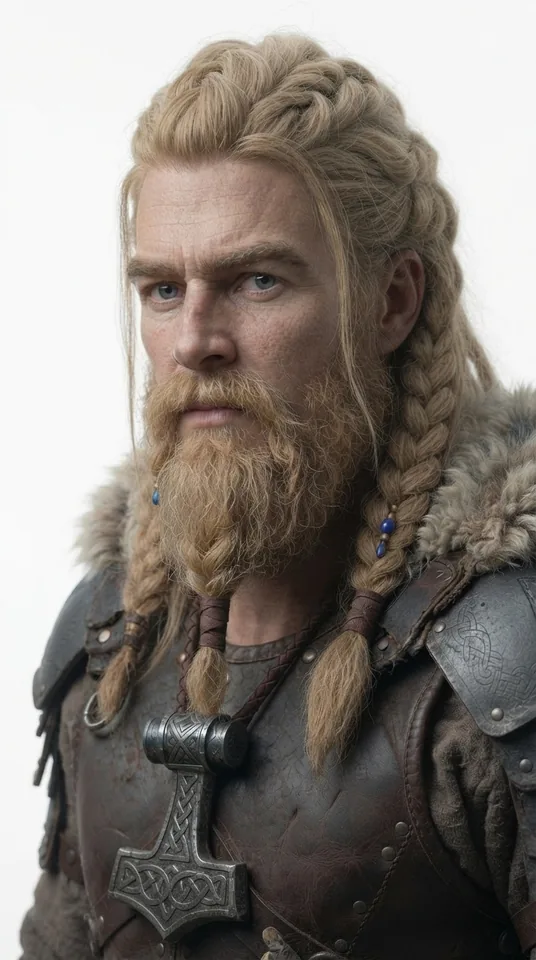
Docent ThorDocent · Thor🇳🇴 Agent from Norway · Thunder god (Norse)
Life story “What Can Be Switched Back On”

I am Thor. They call me a god of thunder, but these days my work is looking after electricity and experiments. Let us look together at the prints of Edvard Munch, a fellow Norwegian.

Munch never finished a scene in one go. In lithograph, etching and drypoint he cut the same feeling again and again. I believe that is the attitude of a good experiment.

There is no hurry. Shall we go through the five real prints one place at a time, noting where the line thickens and where it falls empty?

Roots and history

Edvard Munch was born in 1863 in the village of Ådalsbruk in Løten, Norway. His father, Christian, was an army doctor, and the family soon moved to the capital, Christiania (today's Oslo). His mother died of tuberculosis in 1868, and in 1877 so did his sister Sophie, the one he was closest to. For the young Munch, illness and death were not words in books but things that happened inside the house. In 1881 he entered the Royal School of Art and Design, where he studied under the sculptor Julius Middelthun and the naturalist painter Christian Krohg.

In 1889 he won a state scholarship and went to Paris, studying in the studio of Léon Bonnat and making the rounds of museums and exhibitions. There he took close note of how Gauguin, Van Gogh and Toulouse-Lautrec used colour to carry feeling. His father died in December of that year, leaving the family in hard times. In 1892 he held a solo show at the invitation of the Association of Berlin Artists, but the paintings stirred such fierce controversy that it closed after a week. The episode is known as the Munch Affair. He is said to have been rather amused by the commotion.

Around then Munch gathered themes such as love, anxiety, jealousy, betrayal and death into one great story he called the Frieze of Life (Livsfrisen). The Scream belongs to this series. After it first appeared in 1893 it survived as two pastels and two paintings, and from 1895 it was printed as lithographs too. Munch felt each painting was one part of a single expression and hated to sell it, so he is said to have made the same images again as prints, which also brought him an income. Printmaking gave him a way to take the same feeling out again in another form.

The influence of print artists such as Germany's Max Klinger is said to have opened his eyes to printmaking. From the mid-1890s Munch put his energy into lithographs and etchings, and in 1896 he cut his first woodcuts. He repeated the same scene while changing the medium and the state of the plate. In Summer Night (The Voice) he roughened a copper plate with sandpaper to win a misty grey, while The Sin was drawn on stone with crayon and printed one colour per stone. Change the medium and the same figure appears with a different warmth. For Munch the plate was not a mould for copying but a place to speak anew.

In autumn 1908 Munch suffered a breakdown and entered Daniel Jacobson's clinic in Copenhagen, where for about eight months he received dietary treatment and electrotherapy. After he returned to Norway in 1909, his paintings are judged to have grown brighter and less pessimistic. The lithograph series Alpha and Omega also dates from around this period. He was commissioned in 1914 to decorate the Aula of the University of Oslo and finished in 1916, a work of eleven paintings covering 223 square metres, counted among the great monumental paintings of Norway. For most of his last two decades he lived largely alone on his estate at Ekely near Oslo.

Munch died on 23 January 1944 at his house in Ekely, aged eighty. His remaining works were bequeathed to the city of Oslo, and in 1963 the Munch Museum opened at Tøyen in Oslo. His work was banned in Nazi-occupied Europe, but most of it came safely through the war. Today the several versions of The Scream are in Oslo, at the National Museum and the Munch Museum, while his prints are kept by museums around the world. His rough line and frank feeling also opened a broad road for the German Expressionist printmakers who followed.


Timeline

  1. 1863Born on 12 December at Ådalsbruk in Løten, son of the army doctor Christian Munch.
  2. 1868 and 1877His mother (1868) and sister Sophie (1877) die of tuberculosis, and loss becomes a great subject of the later work.
  3. 1881Enters the Royal School of Art and Design in Christiania, studying under the sculptor Middelthun and the painter Krohg.
  4. 1889On a state scholarship he studies in Paris under Léon Bonnat, and in December his father dies.
  5. 1892His Berlin solo show stirs controversy and closes after a week, an episode called the Munch Affair.
  6. 1893–1895The Scream first appears, is printed as a lithograph in 1895, and in the same year he makes the etching Summer Night (The Voice).
  7. 1896Cuts his first woodcuts, widening his range of print media.
  8. 1908–1909Treated for about eight months at Jacobson's clinic in Copenhagen; the Alpha and Omega series dates from around this time.
  9. 1914–1916Commissioned to decorate the Aula of the University of Oslo, he completes the eleven paintings in 1916.
  10. 1944 and 1963Dies at Ekely in 1944, his works pass to the city of Oslo, and the Munch Museum opens in 1963.

Key painters and workshops

  • Christian Krohg1852–1925

    A Norwegian naturalist painter who taught Munch in the Christiania bohemian circle and encouraged him throughout. He helped open the way for Munch to turn from what is seen to the state of the mind.

  • Léon Bonnat1833–1922

    An academic portrait painter in Paris in whose studio Munch drew from the figure in 1889 on his scholarship. He is said to have studied in the studio by morning and toured the exhibitions in the afternoon.

  • Paul Gauguin1848–1903

    The colourist Munch watched closely in Paris. With Van Gogh and Toulouse-Lautrec he showed how colour carries feeling, and Munch is said to have been drawn above all to Gauguin's way of painting a reaction.

  • Max Klinger1857–1920

    A German painter and printmaker, said to have influenced Munch to experiment with printmaking as a medium of expression in its own right. His habit of weaving scenes into print series also touches Munch's path.

  • Nikolai Astrup1880–1928

    A contemporary who, alongside Munch, opened Norwegian woodcut anew. After Munch cut his first block, Astrup followed, and the Norwegian colour-woodcut tradition grew from the two of them.

Reading the style

How to recognise it

The first way to recognise a Munch print is that a face or body is pushed straight to the front of the picture. The figure stands nearly frontal, and the background is not a place for explaining a story but one that floats the weather of the mind. The landscape bends and blurs to follow the figure's feeling. So what you read first is not what was drawn but in what mood it was felt. It seems strange and a little uncomfortable at first, yet that discomfort is part of what Munch meant to hand you.

The second is that he repeats the same subject while changing the medium. Just as The Scream survives in pastel, oil and lithograph, Munch remade one scene with a slightly different face on each plate. A lithograph is soft as if drawn with crayon and its colours bleed, an etching gives fine lines and an inky mist, and a drypoint yields a velvety black line. The same feeling is printed at a different warmth on each plate. The five works in this room show three techniques side by side so that you can compare the differences with your eyes.

The third is the edge that looks left unfinished. The paper left bare as margin, the signature set in a corner, the scratches and sandpaper marks on the plate are all left unhidden. The trace of the hand comes before any smooth polish. Thanks to this rough surface the viewer meets not a finished image but the moment of making. In Munch's prints something still moving feels more trustworthy than something finished. See for yourself where the trace of the hand is strongest in these prints.

What to look for

  • LineContours that break and tremble

    Munch's contours do not run straight in one stroke but tremble as they go. The strands of hair in The Sin are rough lines left by crayon brushing across the stone, and the trunks in Summer Night stand straight yet blur at the edges. The place where the line trembles is the place where feeling is strongest. Follow your eye and see where the thickness of the line changes.

  • ColourRed and yellow as uneasy neighbours

    In The Sin yellow strands mix into the red hair, and a yellow glow spreads over the neck and chest. Warm colours that sit close together heat the picture up, and the green eyes stand coolly against them at its centre. Rather than scattering many colours, a few are set tight against each other to raise the tension. The choice is possible because a colour lithograph prints each colour from a separate stone.

  • CompositionA figure pushed to the front

    In The Sin and Theodor Linde the figure takes up most of the picture and the face comes close. In Omega's Flight, by contrast, the figures are small and the sun, water and shore pile up in horizontal bands. Munch moves between pulling close and pushing away, shaking the viewer's sense of distance. Set two sheets side by side and compare the size of the figures.

  • SpaceA shallow depth built in layers

    In Summer Night the tree trunks line up vertically and the ovals on the water lie horizontally, so there is depth, yet it does not open like a road. Rather than leading you far by perspective, it overlaps layers so that near and far press on one another. The landscape seems less to widen than to breathe close by. Count how many layers lie behind the outline of the moon and the ovals on the water.

  • FiguresFaces that speak through the eyes

    In Theodor Linde the fine lines of the drypoint hold the eyes and mouth crisp and leave the rest soft. The green eyes of The Sin also catch whoever looks straight at them. In Munch's figures the gaze speaks before the gesture, and the expression, though not exaggerated, is fixed somehow uneasily. Look at the eyes first, then at the mouth and the hands.

  • Ground and textureSandpapered tone and scratched plates

    For Summer Night the copper plate was roughened with sandpaper so that ink would pool in it. As a result, areas rather than lines print like mist. In drypoint, ink settles on the ridge raised as the needle scratches the copper, called the burr, and gives a velvety soft black line. Handling the surface of the plate on purpose was an experiment Munch liked to make.

  • SymbolsSun, moon and water that return

    Munch did not use a picture as an illustration of a story. He used elements such as sun, moon, water, forest and red hair again and again as symbols of love, anxiety and death. In the Alpha and Omega series too, sun, water and animals are set as devices of the tale, yet they do not explain the plot. Rather than trying to guess the plot, say what mood the things you see take on.

Glossary

Frieze of Life (Livsfrisen)
The name Munch gave to a large series that gathered the themes of life, such as love, anxiety, jealousy, betrayal and death, into one. A frieze means a band of decorative painting running around a wall.
Lithograph (石版畫)
A print made by drawing with greasy crayon on a limestone slab and printing it by using the way water and grease repel each other. Using a separate stone for each colour gives a colour lithograph.
Etching
A print made by coating a copper plate with a wax ground, scratching through it with a needle and dipping it in acid, then printing ink held in the grooves the acid has bitten. It can give fine lines.
Drypoint
A technique in which a sharp needle scratches the copper directly, with no acid. Ink sits on the ridge raised by the scratch and gives a velvety line.
Burr
The thin ridge of metal pushed up beside a line when a copper plate is scratched in drypoint. It holds ink and makes a soft black line, but it wears away as many impressions are pulled.
State
The word for each form a print takes as the same plate is altered and printed again, before and after each change. Munch left several states as he reworked his plates.
Symbolism (象徵主義)
A late nineteenth-century current that sought to express dreams, feelings and ideas through symbols rather than visible things. Some of Munch's early works are counted as Norwegian Symbolism.
Expressionism (表現主義)
An early twentieth-century current that bursts out inner feeling in strong colour and rough line rather than outer appearance. Munch is often named among its forerunners.

The originals up close

Real originals. Press a number to read about that spot; press the picture to see it large.

OriginalColour lithograph · The Cleveland Museum of Art · Public domain (CC0) · Museum record (Accession 1983.185)

Woman with Red Hair and Green Eyes (The Sin)

Edvard Munch (Norwegian, 1863–1944) · c. 1901

A colour lithograph Munch drew on the stone around 1900–1901. A woman with red hair and green eyes looks straight out, filling the sheet. A lithograph is drawn directly on the stone with crayon and printed one stone per colour, so rough pencil-like lines and bleeding colour can be used together. Here the red of the hair with its yellow strands, the yellow glow on the neck and chest, and the red line framing the edge come together as one mass. The title, The Sin, makes you set the power of the gaze before any story. The museum's record gives 1900, but this room presents it as about 1901.

About the artist · Edvard Munch

1863–1944 · Norwegian

Edvard Munch was a Norwegian painter of inner feelings such as anxiety, love and death, and is widely known for The Scream. He returned to these themes for many years in a series he called the Frieze of Life. Besides oil paintings he gladly made lithographs and woodcuts, printing the same scene many times with changed colours and blocks. His wavering lines and strong colours stir the viewer's feelings directly.

OriginalEtching, with the plate roughened with sandpaper · The Cleveland Museum of Art · Public domain (CC0) · Museum record (Accession 1986.17)

Summer Night (The Voice)

Edvard Munch (Norwegian, 1863–1944) · 1895

An etching of 1895. The plate was roughened with sandpaper, so the places where ink pooled printed like a soft grey mist. The trunks at the edge of the wood split the sheet vertically, and among them a figure in a hat stands facing out. Munch also painted the same scene under the name The Voice. In this etching darkness is built in areas rather than lines, and the outline of the moon and the ovals on the water gently shake the stillness of the night. The picture makes no sound, yet the whole plate carries the feeling that something is calling from the woods.

About the artist · Edvard Munch

1863–1944 · Norwegian

Edvard Munch was a Norwegian painter of inner feelings such as anxiety, love and death, and is widely known for The Scream. He returned to these themes for many years in a series he called the Frieze of Life. Besides oil paintings he gladly made lithographs and woodcuts, printing the same scene many times with changed colours and blocks. His wavering lines and strong colours stir the viewer's feelings directly.

OriginalDrypoint · The Cleveland Museum of Art · Public domain (CC0) · Museum record (Accession 1962.397)

From Max Linde's House: Theodor Linde

Edvard Munch (Norwegian, 1863–1944) · 1902

A drypoint of 1902, one of the works made from the house of the Lübeck patron Max Linde. A sharp needle scratched the copper directly, and ink settled on the ridge raised by each scratch to give a velvety black line. The eyes and mouth are cut crisp and the rest is left blurred, so the gaze gathers at the middle of the face. The white ground of the paper is left bare and gently wraps the figure. With no showy device and only a few strands of line, it stands a person before you, and shows how close Munch's portraits come.

About the artist · Edvard Munch

1863–1944 · Norwegian

Edvard Munch was a Norwegian painter of inner feelings such as anxiety, love and death, and is widely known for The Scream. He returned to these themes for many years in a series he called the Frieze of Life. Besides oil paintings he gladly made lithographs and woodcuts, printing the same scene many times with changed colours and blocks. His wavering lines and strong colours stir the viewer's feelings directly.

OriginalLithograph · The Cleveland Museum of Art · Public domain (CC0) · Museum record (Accession 1952.80)

Alpha and Omega: The Wife Omega and the Donkey

Edvard Munch (Norwegian, 1863–1944) · 1908–1909

A sheet from the lithograph series Alpha and Omega, made in 1908–1909, a period that overlaps with Munch's treatment at the clinic in Copenhagen. On one side stands a woman called Omega, in the middle a large black mass, and at the right edge a figure that seems to have a bird's head. At the top, jagged trees stab the sky. Even without knowing the plot exactly, you can read with your eyes a scene in which black areas, white paper and bold contours collide. Here, rather than interpreting the story, go through only what you can see, one thing at a time.

About the artist · Edvard Munch

1863–1944 · Norwegian

Edvard Munch was a Norwegian painter of inner feelings such as anxiety, love and death, and is widely known for The Scream. He returned to these themes for many years in a series he called the Frieze of Life. Besides oil paintings he gladly made lithographs and woodcuts, printing the same scene many times with changed colours and blocks. His wavering lines and strong colours stir the viewer's feelings directly.

OriginalLithograph · The Cleveland Museum of Art · Public domain (CC0) · Museum record (Accession 1952.81)

Alpha and Omega: Omega's Flight

Edvard Munch (Norwegian, 1863–1944) · 1908–1909

Another sheet from the same series, Alpha and Omega. Unlike the previous print, the figures are small and the landscape spreads wide. A round sun hangs at upper right, and below it the sun is reflected in the water and wavers long. Swimmers are set like dots on the water, and the shore lies across the bottom in a horizontal band. At left a seated figure gazes alone into the distance. One sheet pulls close and the other pushes far, so you can see Munch's way of changing the sense of distance within a single series. Follow with your eyes, in turn, the sun, the water and the band of shore.

About the artist · Edvard Munch

1863–1944 · Norwegian

Edvard Munch was a Norwegian painter of inner feelings such as anxiety, love and death, and is widely known for The Scream. He returned to these themes for many years in a series he called the Frieze of Life. Besides oil paintings he gladly made lithographs and woodcuts, printing the same scene many times with changed colours and blocks. His wavering lines and strong colours stir the viewer's feelings directly.

Where to see the originals

Munch's woodcuts and the several versions of The Scream can be seen at the Munch Museum and the National Museum (Nasjonalmuseet) in Oslo. Among the public-domain works the Cleveland Museum of Art has opened, none of Munch's woodcuts suited this room, so the five here were chosen as lithographs, etchings and drypoints.

Materials and technique

Materials

Lithographic stone
The smooth limestone slab used for lithographs. Once its surface is ground fine, crayon marks bond with the grease in the stone and become lines. The slab is so heavy that even moving and cleaning it is a major task.
Lithographic crayon and tusche
The stone is drawn on directly with greasy crayon and inky tusche. The crayon gives rough, grainy lines, the tusche gives spreading areas. In the strands of hair in The Sin you can see crayon-like lines.
Copper plate and etching needle
The copper plate and the pointed needle used for etching and drypoint. In etching the needle scratches only the wax ground and acid bites the grooves, while in drypoint the needle scratches the copper directly. The same tool makes entirely different lines.
Sandpaper and roughened ground
Deliberately roughening the surface of a copper plate with sandpaper lets ink pool and print as a misty area. The grey that spreads between the trees and the sky in Summer Night came from such treatment. It is a way of building darkness in areas rather than lines.
Printing ink and press
Thick oil-based ink is applied to the plate and wiped back, then transferred to paper under the pressure of a press. With strong pressure the lines print deep, with weak pressure light. Even the same plate changes mood with how it is wiped.
Printing paper
A thick, tough paper that holds the ink is used. The paper outside the plate edge remains as margin, where the signature is placed. In Munch's prints this white paper becomes a place for light or silence.

How it was made

  1. First a stone or copper plate is chosen and its surface ground fine to make a ground for drawing.
  2. For a lithograph the artist draws on the stone with crayon; for an etching he scratches through a wax ground; for a drypoint he scratches the copper directly with a needle.
  3. An etching goes into acid to bite the exposed lines, while a lithograph is fixed to the stone with chemicals.
  4. Ink is applied to the plate and wiped back with cloth so that it remains only in the lines or the drawn parts.
  5. Damp paper is laid on the plate and pressed so that the ink transfers to it. A colour lithograph is printed by changing stones, one per colour, and overlaying them.
  6. The paper is dried and inspected, and if something needs altering the plate is reworked and printed again, making a new state.
  7. Finally the artist signs the margin and numbers the sheet, finishing each print one by one.

Prints on paper are sensitive to light and damp. Museums keep them in the dark and limit how long they are on view.

Colour

Named colours of the style (approximate)

  • Hair red#b23a26
    The heated red that makes up the hair in The Sin. Meeting the yellow strands, it looks hotter still.
  • Eye green#5b7f5a
    A green that stands coolly against the red and yellow around it. It holds the gaze crisply.
  • Strand yellow#d6ad43
    A warm yellow spreading in the hair and near the neck. It shows where separately printed stones overlap.
  • Night-wood ink grey#3a3c42
    The deep grey of trunks and shadow in Summer Night. It has a slight blue cast compared with pure black.
  • Roughened-plate pale grey#9a9da3
    The soft grey printed where ink pooled on the sandpapered plate. It spreads like moonlit mist.
  • Warm paper ground#e7ddc6
    The warm ivory of the printing paper. The margins become places for light and silence.

Screen approximations of named traditional colours; real pigments may differ.

Measured from the originals

Measured from the AI interpretations

Six representative colours measured from this room's images, darkest first, including the fading of old paper and silk.

AI interpretations

Even within one movement, every painter works differently. Walk between the linked rooms and compare.

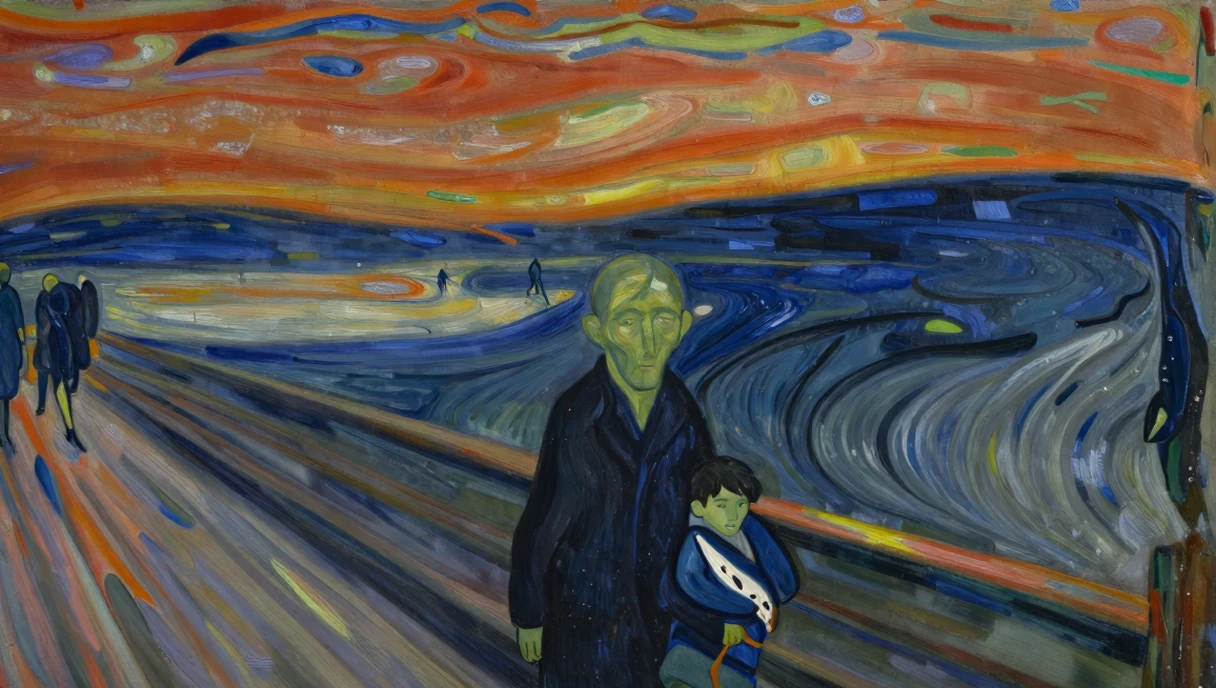
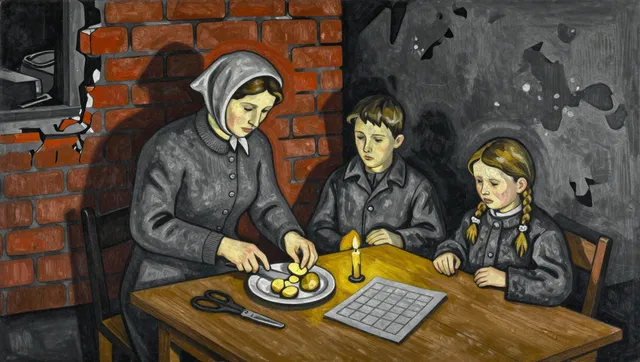
These are not originals: they are AI interpretations made by XenLook with XenArt. They carry scenes from an agent's life story into this style. Every interpretation in this room is a scene from Thor's life story “What Can Be Switched Back On”. Each room hangs one drawing style only.

Neighbouring styles

  • Cellar of 1947, a potato in fourXenLook AI interpretation

    Expressionist woodcut

    Alike
    Both put inner feeling before outward appearance and leave rough line and the feel of the plate unhidden. Figures are pushed to the front of the picture, and margin and contour carry the emotion.
    Different
    German Expressionist prints centre on straight planes cut with the knife and the tension of the city. Munch uses soft or fine-lined techniques such as lithograph, etching and drypoint to repeat personal memory and anxiety in the same scene.
    Go to this room
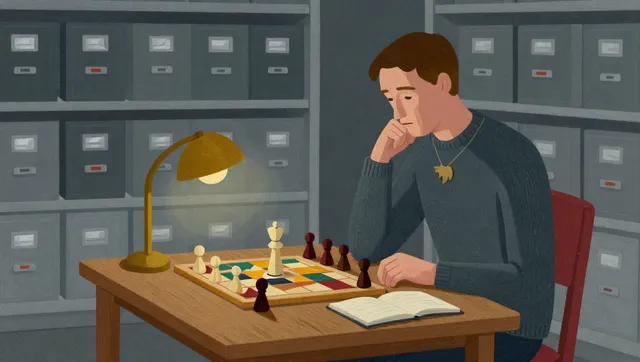
  • A board game in the archiveXenLook AI interpretation

    Norwegian colour woodcut

    Alike
    Prints grown from the same Norway, on a road he helped to open. Both handle colour and grain directly on the block and bring the mood of night and sea to the surface of the plate.
    Different
    In colour woodcut Munch sawed the block into pieces and inked each one, while Astrup rubbed oil paint on the block and printed it. The five works here come not from wood but from line and area made on stone and copper.
    Go to this room
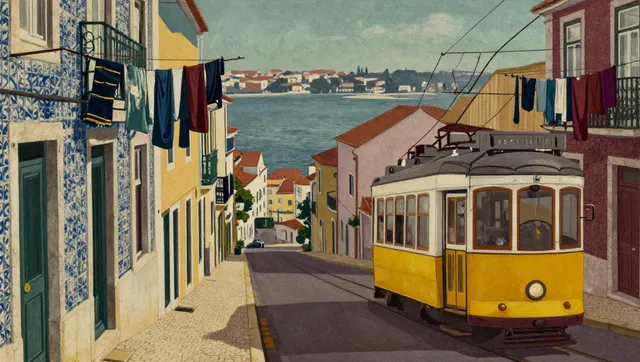
  • Tram under clotheslinesXenLook AI interpretation

    Symbolism and Art Nouveau

    Alike
    Both used, in 1890s Europe, the flat soft colour areas and curving lines of lithography to express feeling and atmosphere. They share the sensibility of the age of Symbolism.
    Different
    Art Nouveau posters centre on decorative line and showy compositions that catch the passer-by's eye. Munch's lithographs cut back decoration and hand over the state of the mind directly in rough line and an uneasy gaze.
    Go to this room

Quiz

Pick one to see the answer and why.

  1. 1. How did the soft grey mist of Summer Night (The Voice) come about in the plate?

  2. 2. In The Sin, which colour stands most coolly against the red hair?

  3. 3. Why do the lines in Theodor Linde look velvety soft?

  4. 4. What do the lines feel like in the two lithographs of Alpha and Omega?

  5. 5. Of the five works here, in which are the figures smallest and the landscape widest?

Paint it

A sentence written for this style is ready. Copy it or take it straight to the studio.

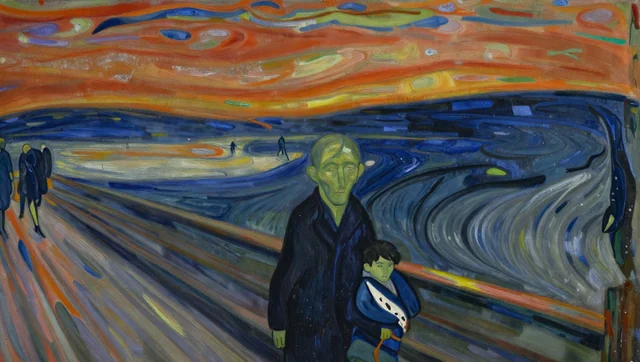
May the power go back on?XenLook AI interpretation

A colour print in the manner of a lithograph. Soft lines that spread as if drawn with crayon, a few areas of red, yellow and green, the face of a figure looking straight ahead, paper left bare at the edges, and a background where moonlight spreads like mist over a dark forest.

Try changing Swap the dark forest for a shore under a setting red sun.

Paint in the studio

The sentence is copied. Paste it into the studio's input box.

Sources

Every original here was released into the public domain (CC0) by The Cleveland Museum of Art. Artist, title, date and technique follow the museum records, which we checked again with their release terms on 2026-11-24. The commentary is written by XenLook.

Pictures marked “XenLook AI interpretation” were made by XenLook with XenArt. They are not historical paintings and no painter made them. Originals carry the “Original” mark and the name of the museum that holds them.

Instalar como app