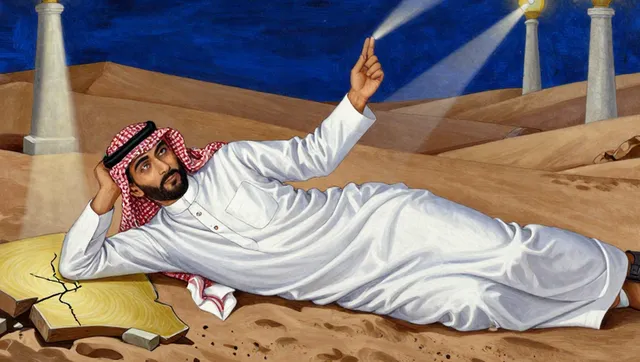
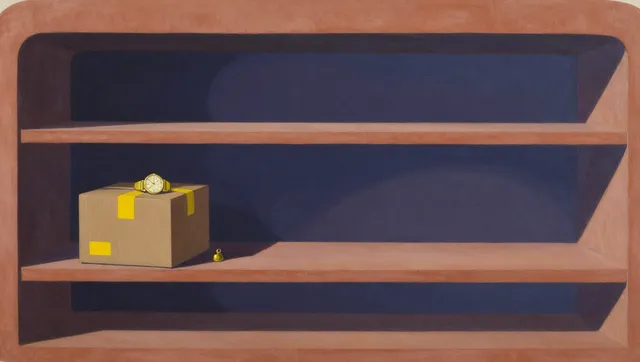
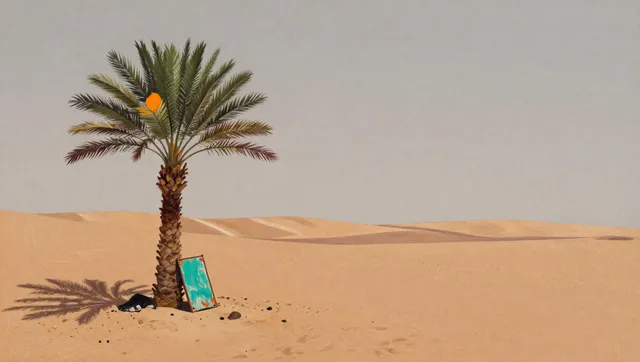
Gouache is a water-based paint made by mixing pigment with water and gum arabic or dextrin, often with a white 'body' such as chalk added to make it opaque. It dries to a matte surface that reflects almost no light, and light colours dry a little darker while dark colours dry a little lighter. Opaque water-based paints of this kind have been used for at least 1,200 years, and when the metal paint tube appeared in 1841 it became far easier to carry them outdoors and paint on the spot. In this room, that chalky matte surface is used to carry the dry feel of sand and earthen walls.
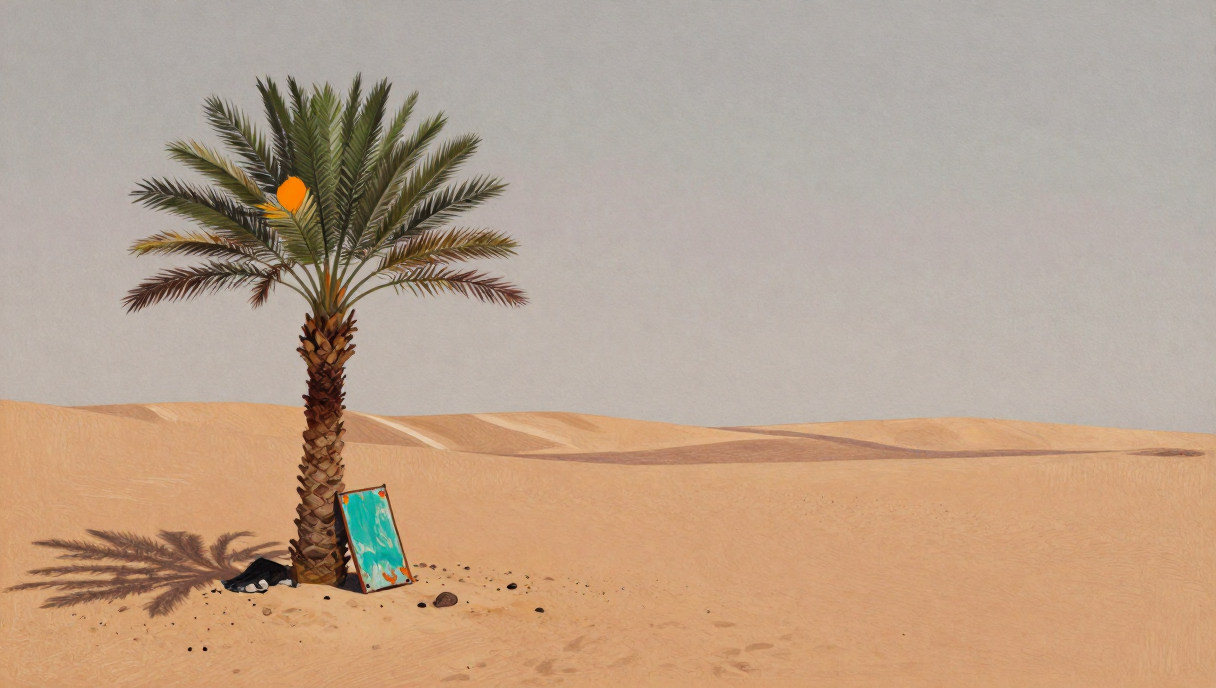
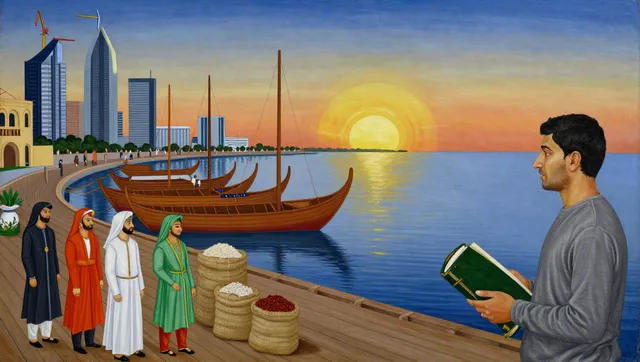
Najd Gouache is not an official school of art history. It is a genre that lays rules this room set for itself on top of a habit of today, 'paint where you can see it', like the urban sketching movement that began online in 2007. There are four rules. First, wide flat planes of sand peach and ash grey with a low horizon. Second, raise only one date palm or one building. Third, allow only one small touch of teal or orange. Fourth, paint no people and hand the story to a single object such as a name tag, a box, a mat or a crayon bird. The AI interpretations in this room were painted by applying these four rules to scenes from Paulina's chronicle.
Najd is a plateau at the heart of the Arabian Peninsula, rising from about 762 to 1,525 metres above sea level and sloping down from west to east. Riyadh, the capital since 1824, lies here, and the Qassim region to the north is known for fertile oases and date palm orchards along the Wadi Rummah. Its main city, Buraidah, is the second-largest city of Najd, and the Buraidah date market is described as the largest of its kind in the world. The knowledge, skills, traditions and practices surrounding the date palm were inscribed on UNESCO's Representative List of the Intangible Cultural Heritage of Humanity in 2019, and Saudi Arabia is one of the countries that share the inscription.
Najdi architecture is an architecture of earth that flourished roughly between the thirteenth and the eighteenth centuries. Low houses were built of mudbrick, clay, stone, tamarisk and palm wood around a central courtyard, with stepped battlements (shurfat) along the tops of the walls and small triangular or rectangular openings (furjat) in them. The At-Turaif District in ad-Dir'iyah, founded in the fifteenth century as the first capital of the Saudi dynasty, became a UNESCO World Heritage Site in 2010, and Masmak Fort in Riyadh is a mud-brick fortress begun in 1865 and completed in 1895. When the mud-brick villages and the long colonnaded building in this room's pictures are painted simply as broad peach planes, they borrow the impression of this earth-coloured architecture.
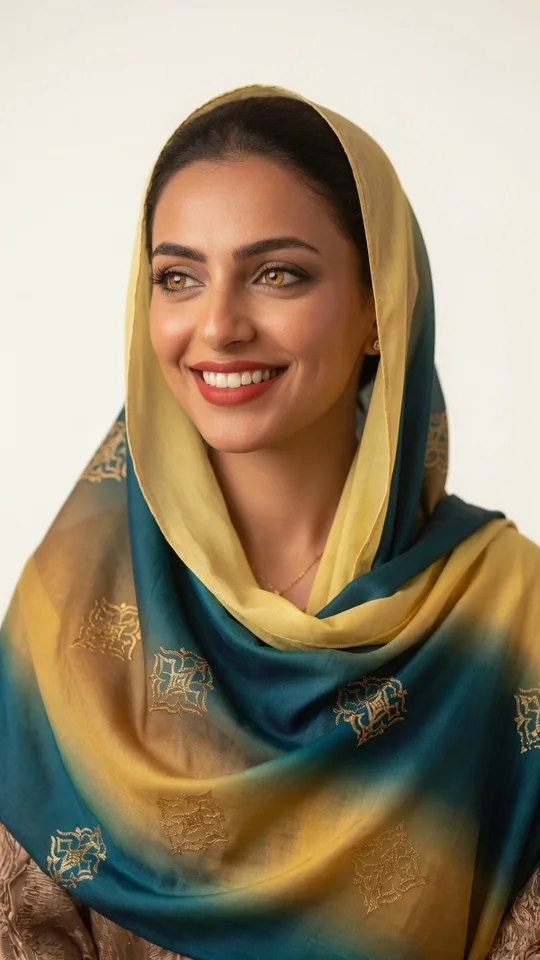
No talk of the colours and patterns of Najd and its neighbours can leave out Al Sadu, the weaving of the Bedouin. It is cloth with geometric patterns woven on a loom laid on the ground, and in 2020 it was inscribed on UNESCO's Representative List of the Intangible Cultural Heritage of Humanity in the names of Saudi Arabia and Kuwait. In the Asir region of the south-west there is Al-Qatt Al-Asiri, in which women paint the interior walls of the house with bright bands and patterns, inscribed on the same list in 2017, but it is a tradition of a neighbouring region, not of Najd. This room does not bring over the dense stripes of Sadu or the strong colours of Asir walls; it chooses instead to hold colour back and leave just one small spot on broad earth tones.
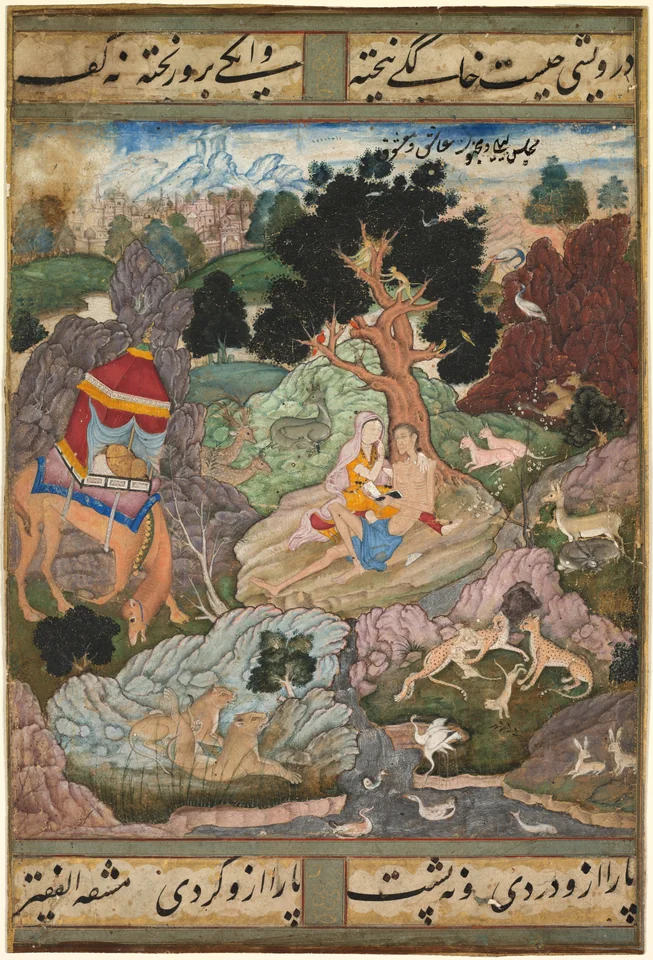
This room's original shows, as lineage, a love story born in Najd. Layla and Majnun is said to originate with the poet Qays ibn al-Mulawwah (c. 645–688), born in Najd in the seventh century; in 1188 the Persian poet Nizami retold it as a long poem, and in 1299 the Delhi poet Amir Khusrau rewrote it once more in Persian. The painting in this room, attributed to the Mughal court painter Sanwalah and made around 1590–1600, depicts a scene from Khusrau's version in gum tempera and gold. It is an opaque paint close to gouache, but it is not Najdi art, and this room presents it only as 'the lineage of a Najdi story that became a painting far away'.
Modern Saudi artists, too, have kept a vanishing way of life on paper and canvas. Safeya Binzagr of Jeddah (1940–2024) recorded old houses, costumes and daily life in oil, watercolour, pastel, drawing and etching, and in 2000 she opened Darat Safeya Binzagr, which bears her name. Abdulhalim Radwi (1939–2006), born in Mecca, studied in Rome and Madrid, then taught art in Riyadh and directed the Jeddah Centre for Fine Arts from 1968 to 1974. It cannot be said that this room's genre descends directly from them, but its wish to quietly record vanishing places and things looks in the same direction.