‘Northern Renaissance’ is the name given to the art of the fifteenth and sixteenth centuries north of the Alps, in what are now the Netherlands, Belgium and Germany. Keep in mind first that it is less one unified style than a loose label for the traditions of different cities. Commercial cities such as Bruges, Ghent and Antwerp, and princely courts such as Saxony, were the patrons; the printing press spread books and printed pictures widely, and the movement was closely tied to the Reformation. So this room does not give one answer; it sets the different choices of several cities side by side.
Early Netherlandish painting is described as running from Robert Campin and Jan van Eyck in the 1420s to about the death of Gerard David in 1523. Van Eyck is often called the ‘inventor of oil painting’, but that is an oversimplification; it is more accurate to say that he achieved astonishing detail in oil. His Arnolfini Portrait (1434) is the best-known work. Slow-drying oil paint allowed thin layers to be added again and again, giving jewel-like colour and the glint of light. In Van Eyck’s time many patrons prized such detail like a jewel and ordered it.
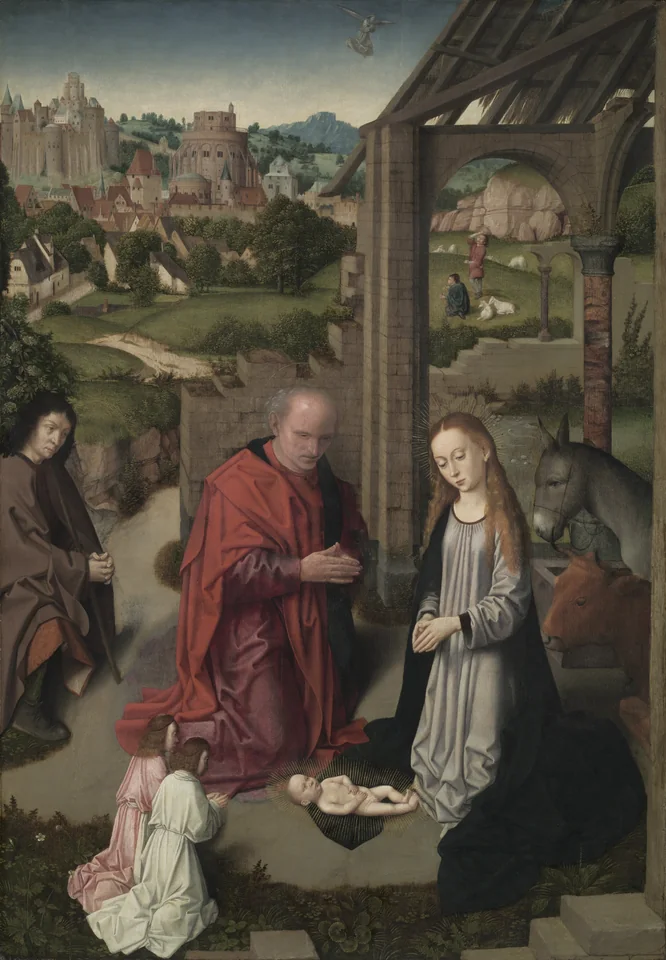
Gerard David was born around 1460 in Oudewater, moved to Bruges in 1483, joined the painters’ guild of Saint Luke the next year, and died there in 1523. He was also a manuscript illuminator. The Cleveland Nativity is a small panel from his hand in the later 1480s that sets the Bible scene before a northern, medieval-looking city, so that an event from the distant past looked to the patron’s eye like something happening close to his own town. It is intriguing that even one small panel carried the patron’s faith and the city’s pride together.
Prints are the other central axis of the age. Lucas van Leyden, born in Leiden in 1494 and dead there in 1533, handled the copper plate with great skill at a very young age and met Albrecht Dürer in 1521, each influencing the other. Because one plate could print the same picture many times, an artist could share his designs with people beyond his own city, and that share soon became the price of a sheet of paper moving through the market. These prints were pictures on paper that were talked about as widely as a single painting hung in a museum today.
The Reformation changed who ordered pictures and what they showed. Lucas Cranach was born around 1472 in Kronach, entered the court of Frederick the Wise, Elector of Saxony, in 1504 and worked in Wittenberg, where he was a close friend of Martin Luther. He ran a large workshop, so several versions of one design circulated, and the 1540 Hunting near Hartenfels Castle is a hunting picture made for Protestant princes. He died in Weimar in 1553. In an age when religion, power and pictures were entwined, not even a single picture moved lightly.
Hans Holbein was born around 1497 in Augsburg, worked mostly in Basel as a young artist, and made his name with portraits of Erasmus. With Erasmus’s recommendation he went to England in 1526 and joined the humanist circle of Thomas More, returned to Basel for four years, went back to England in 1532, and by 1535 was King’s Painter to Henry VIII. He died in London in 1543. The small panel of Erasmus’s emblem holds that friendship and intellectual climate in a single picture. Erasmus, born around 1466 and dead in 1536, was a humanist scholar who corresponded with scholars across Europe. Holbein had early on drawn witty marginal sketches in his Praise of Folly.