The woodcut is the oldest kind of print: the maker leaves only the part to be drawn standing on a block of wood, cuts the rest away, inks the remaining surface and presses it onto paper. For a long time in Europe it was a technique for printing illustrations in books and newspapers, and it was common for a professional carver to transfer a painter’s drawing onto the block. Such block-cutting made for reproduction was called xylography. Then, in the 1880s, a movement began in Paris to revive the woodcut as the artist’s own work, and the block turned from a tool of copying into a tool of expression.
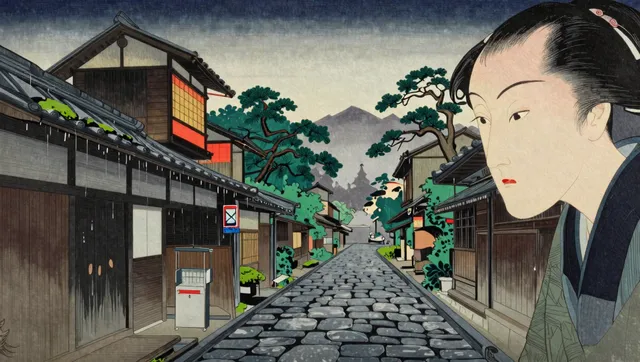
At about the same time European painters opened their eyes to Japanese prints. In Japan the colour print called ukiyo-e (浮世絵) spread widely from the second half of the 17th century, with a separate block for each colour, rubbed onto the paper with a round tool called a baren. The great fashion for Japanese art that swept Europe from the middle of the 19th century on is called Japonisme. Flat planes of colour, decorative line and boldly cropped compositions became a new model for Norwegian painters too. Astrup studied Japanese woodcuts on a study tour to Paris in 1901, and the influence of Hokusai and Hiroshige is seen in his prints.
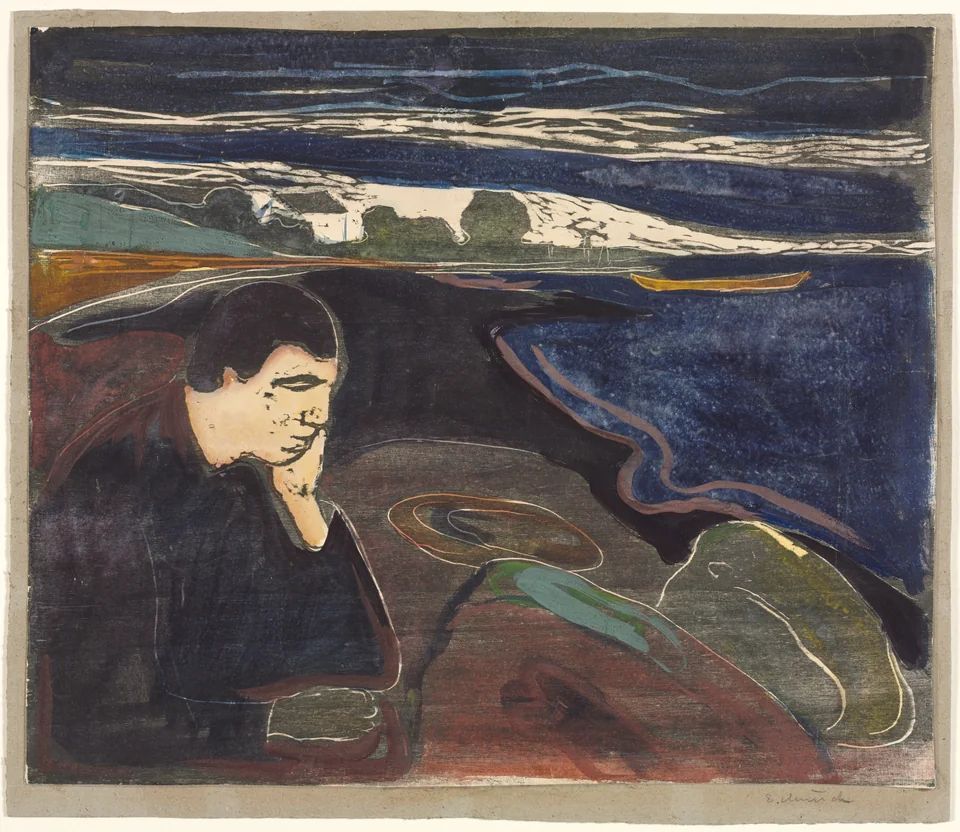
Edvard Munch made his first woodcuts in 1896. In 「Evening, Melancholy I」 of that year he deliberately chose blocks with a coarse grain and cut them roughly. Soon Munch found a method of his own: he sawed the carved block into pieces like a jigsaw puzzle, inked each piece separately, fitted them together again and printed. It is commonly called the jigsaw method. Colour could now be divided within a single block, and the same block could yield a different scene with every printing. Munch received professional help in Paris, in Berlin and in Norway, and later he equipped himself with a press of his own.
「Evening, Melancholy I」 shows the shore of Åsgårdstrand, a small town on the Oslofjord. Munch bought a house there in 1898. According to the Cleveland Museum of Art, the figure in the picture is the art critic Jappe Nilssen, who had been jilted in love. The print shown in this room was pulled from the block in its first state, before it was cut in two, and only two such impressions are known. 「Encounter in Space」 of about 1898–99 is a small colour woodcut, 19 centimetres high and 25.4 centimetres wide, now in the National Museum in Oslo.
Nikolai Astrup was born on 30 August 1880 in Kalvåg and grew up in Ålhus in Jølster. He made his first woodcuts in the autumn of 1904, applying oil paint directly to the blocks and printing it in several layers. He usually used four blocks, wrote of five or six in a letter of 1910, and used six for 「Milling Weather」. With neither a press nor a printer, he rubbed the paper with his hand, a cotton reel and a piece of wood wrapped in rag, and sometimes the pressure tore the paper. After printing he added colour with a brush and dried the sheets over the stove.
Astrup’s prints were sold by Isabella Høst, who acted as his agent from 1911 to 1924, and Per Kramer, an engraver in Bergen and a friend, worked to make them known. Munch bought three of his black-and-white prints. In 1918 an exhibition of prints alone was held in Kristiania, today’s Oslo. In a letter of about 1917 Astrup counted Munch and himself among the few who had tried the modern woodcut, and in a letter of 1910 he wrote that his prints were more paintings than woodcuts. He died on 21 January 1928, at the age of forty-seven.