Pompeii was a Roman city on the Bay of Naples in southern Italy. When Mount Vesuvius erupted in AD 79, the whole town was buried in volcanic ash. Because of that, the wall paintings inside its houses survived almost as they were. Ancient paintings vanish far more easily than stone or bronze sculpture, and Pompeii is one of the rare places that shows about two centuries of wall painting without a break. The person who gave that sequence its names was the German archaeologist August Mau (1840 to 1909). In a book of 1882 he sorted the paintings of Pompeii into four styles. We still use his labels today, from the First Style to the Fourth Style.
The First Style is traditionally dated from about 200 BC to about 80 BC, although earlier examples are reported outside Pompeii. It is also called the masonry style. The plaster of the wall was modelled in relief and painted to look like a stack of costly marble slabs. It let a family who could not buy marble make the house look rich. The fashion first spread through the cities of the Greek world and reached Italy as Rome took control of Greece. The First Style did not vanish. It lived on in the lower parts of walls, where it was less noticed, and was combined with the later styles.
The Second Style first appears in Pompeii around 80 BC. It is also called the architectural style: columns, cornices and doors were painted so that the flat wall seemed to open. This trick of the eye is called trompe-l'oeil. Distant things were painted hazily to create depth, a method known as atmospheric perspective. The best-known work is in Room 5 of the Villa of the Mysteries outside the city. The most widespread reading is that it shows a woman being initiated into the secret rites of the god Dionysus, and it is dated to about 70 to 60 BC. Landscapes and story pictures also enter the wall in these years. The frescoes of the villa at Boscoreale, from about the same time, are also famous.
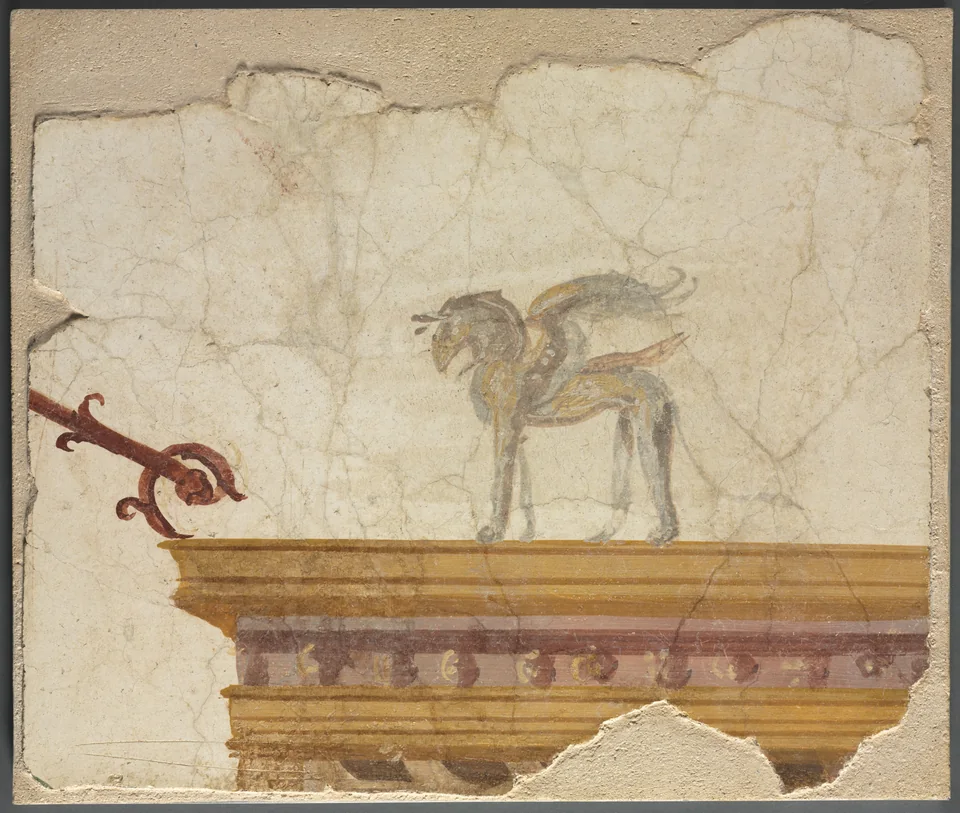
The Third Style spread in the age of the emperor Augustus. It is thought to have been fashionable around 20 to 10 BC, though sources differ slightly on the dates. It is described as a reaction against the grand architectural illusions before it. The wall becomes flat again, and slender candelabra and vine ornaments line up on black or red grounds. Pictures shrink to small scenes at the centre of the wall. The contemporary architect Vitruvius complained about this fashion in Book 7 of his Ten Books on Architecture: reeds painted in place of columns, and monsters painted that exist nowhere in nature. His complaint is, in fact, a witness to what was fashionable.
The Fourth Style runs from about the AD 50s or 60s until 79. Mau called it the Intricate Style. Its mark is that it draws on all three earlier styles and mixes them on one wall. Theatre-like architectural ornament returns, along with large pictures of myths and wide landscapes. The paintings of Nero's Golden House in Rome (the Domus Aurea, about AD 64 to 68) are counted among the leading examples of the age. The Roman naturalist Pliny the Elder reports that the painter Famulus, who worked there, came for only a few hours a day, when the light was right. It is one of the few cases where a painter's name has survived.
Almost no painters' names survive. Most Pompeian wall paintings are the work of anonymous workshops. The house owners were wealthy merchants, officials and landowners, and the paintings were given the most care in the dining rooms and bedrooms where guests were received. A wall was the face that showed the owner's taste and wealth. Pliny wrote that in the age of Augustus Spurius Tadius (called Ludius or Studius in other manuscripts) made landscapes of villas and harbours fashionable on walls. Yet no surviving work has been confirmed as his. So it is more honest to ask in what kind of house and for what use a painting was made than who painted it.
The buried city was forgotten for a long time. Nearby Herculaneum was found in 1738 and excavations began there; Pompeii came to light in 1748, and in 1763 the site was identified as Pompeii. The red walls of Pompeii also shaped European taste, which is why the colour name Pompeian red survives today. The Villa of the Mysteries was uncovered between 1909 and 1910. Today the greatest task is to keep the paintings safely in place, because light, damp and the breath of visitors dim the colour. That is why restorers mark honestly what has been newly filled in, so that it stays visible.