Saltar al contenido
Museum lobby

History wing · Europe

Pompeian Wall Painting

Pompeii, Italy · 2nd century BC to AD 79 · c. 200 BC to AD 79

From the 2nd century BC to AD 79, the people of Pompeii opened up the walls of their homes with paint. Four fashions followed one another: walls painted like marble blocks, walls that open through columns onto distant landscapes, walls of thread-fine ornament, and crowded walls that mix architecture with stories. All were done in buon fresco, with pigment sinking into wet plaster. Ash from Vesuvius sealed the city and kept the colours alive to this day. In this room you learn to tell the four styles apart, and also the restorer's honesty of filling what is lost without erasing the truth.

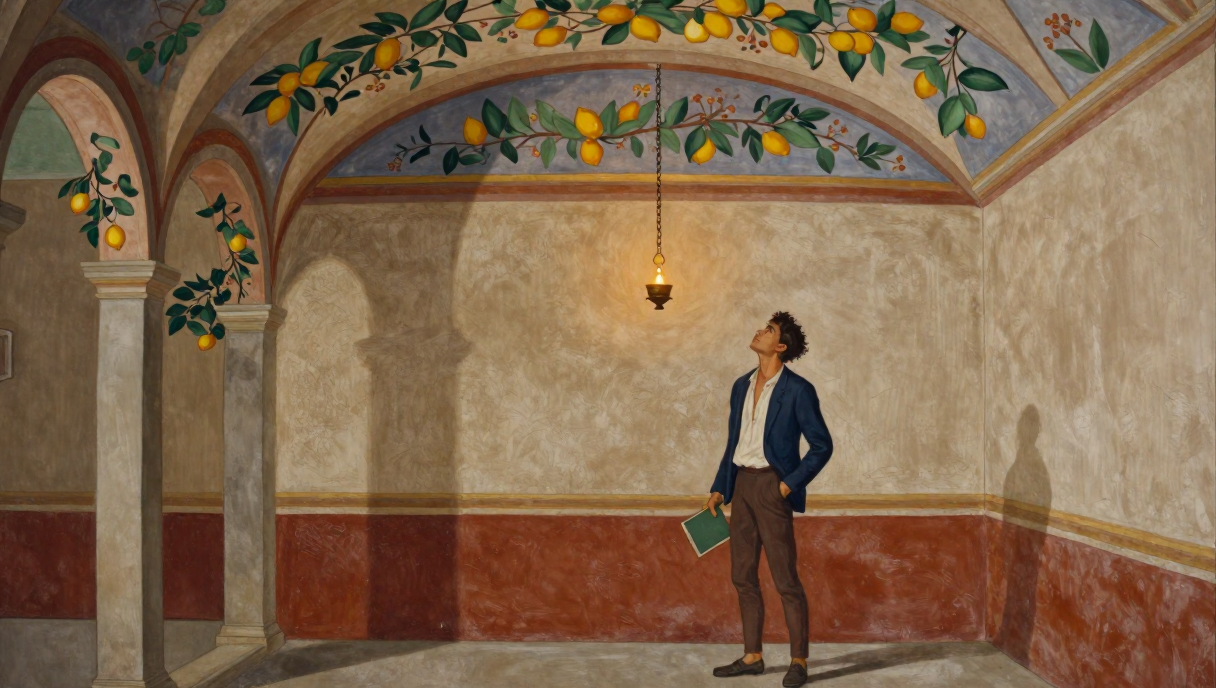
Griffin Atop EntablatureOriginalA man looking up at a lemon-vault muralXenLook AI interpretation

Docent

Docent GeniusDocent · Genius🇮🇹 Agent from Italy
Life story “Tratteggio”

Hello, I am Genius. I grew up in Trastevere in Rome and now work as a love counsellor. In this room we will look at how a wall speaks to the people who live with it.

I learned tratteggio where my mother Chiara restored wall paintings. It fills a lost patch with fine vertical lines: up close you can see what is new, and from afar the picture reads as one.

Walk slowly past the four kinds of Pompeian wall. Find the red lower band, the open window and the slender candelabrum, and your eyes will tell you which era a room belongs to.

Roots and history

Pompeii was a Roman city on the Bay of Naples in southern Italy. When Mount Vesuvius erupted in AD 79, the whole town was buried in volcanic ash. Because of that, the wall paintings inside its houses survived almost as they were. Ancient paintings vanish far more easily than stone or bronze sculpture, and Pompeii is one of the rare places that shows about two centuries of wall painting without a break. The person who gave that sequence its names was the German archaeologist August Mau (1840 to 1909). In a book of 1882 he sorted the paintings of Pompeii into four styles. We still use his labels today, from the First Style to the Fourth Style.

The First Style is traditionally dated from about 200 BC to about 80 BC, although earlier examples are reported outside Pompeii. It is also called the masonry style. The plaster of the wall was modelled in relief and painted to look like a stack of costly marble slabs. It let a family who could not buy marble make the house look rich. The fashion first spread through the cities of the Greek world and reached Italy as Rome took control of Greece. The First Style did not vanish. It lived on in the lower parts of walls, where it was less noticed, and was combined with the later styles.

The Second Style first appears in Pompeii around 80 BC. It is also called the architectural style: columns, cornices and doors were painted so that the flat wall seemed to open. This trick of the eye is called trompe-l'oeil. Distant things were painted hazily to create depth, a method known as atmospheric perspective. The best-known work is in Room 5 of the Villa of the Mysteries outside the city. The most widespread reading is that it shows a woman being initiated into the secret rites of the god Dionysus, and it is dated to about 70 to 60 BC. Landscapes and story pictures also enter the wall in these years. The frescoes of the villa at Boscoreale, from about the same time, are also famous.

The Third Style spread in the age of the emperor Augustus. It is thought to have been fashionable around 20 to 10 BC, though sources differ slightly on the dates. It is described as a reaction against the grand architectural illusions before it. The wall becomes flat again, and slender candelabra and vine ornaments line up on black or red grounds. Pictures shrink to small scenes at the centre of the wall. The contemporary architect Vitruvius complained about this fashion in Book 7 of his Ten Books on Architecture: reeds painted in place of columns, and monsters painted that exist nowhere in nature. His complaint is, in fact, a witness to what was fashionable.

The Fourth Style runs from about the AD 50s or 60s until 79. Mau called it the Intricate Style. Its mark is that it draws on all three earlier styles and mixes them on one wall. Theatre-like architectural ornament returns, along with large pictures of myths and wide landscapes. The paintings of Nero's Golden House in Rome (the Domus Aurea, about AD 64 to 68) are counted among the leading examples of the age. The Roman naturalist Pliny the Elder reports that the painter Famulus, who worked there, came for only a few hours a day, when the light was right. It is one of the few cases where a painter's name has survived.

Almost no painters' names survive. Most Pompeian wall paintings are the work of anonymous workshops. The house owners were wealthy merchants, officials and landowners, and the paintings were given the most care in the dining rooms and bedrooms where guests were received. A wall was the face that showed the owner's taste and wealth. Pliny wrote that in the age of Augustus Spurius Tadius (called Ludius or Studius in other manuscripts) made landscapes of villas and harbours fashionable on walls. Yet no surviving work has been confirmed as his. So it is more honest to ask in what kind of house and for what use a painting was made than who painted it.

The buried city was forgotten for a long time. Nearby Herculaneum was found in 1738 and excavations began there; Pompeii came to light in 1748, and in 1763 the site was identified as Pompeii. The red walls of Pompeii also shaped European taste, which is why the colour name Pompeian red survives today. The Villa of the Mysteries was uncovered between 1909 and 1910. Today the greatest task is to keep the paintings safely in place, because light, damp and the breath of visitors dim the colour. That is why restorers mark honestly what has been newly filled in, so that it stays visible.


Timeline

  1. c. 200 to c. 80 BCFirst Style: plaster modelled in relief and painted to look like a wall of marble blocks.
  2. c. 80 BCSecond Style appears at Pompeii: painted columns and cornices make the wall seem to open.
  3. c. 70 to 60 BCThe frescoes of Room 5 in the Villa of the Mysteries are painted, a leading work of the Second Style.
  4. c. 20 to 10 BCThird Style becomes fashionable: flat, refined walls with slender candelabra and vines.
  5. c. AD 50s to 60sFourth Style spreads: intricate, theatrical walls that mix the three earlier styles.
  6. c. AD 64 to 68Nero's Golden House is built, and the painter Famulus and his workshop cover its walls.
  7. AD 79Vesuvius erupts and buries Pompeii and Herculaneum under ash.
  8. 1738 and 1748Regular excavation begins at Herculaneum; Pompeii is uncovered ten years later and identified as Pompeii in 1763.
  9. 1882August Mau publishes his book dividing Pompeian wall painting into four styles.
  10. 1909 to 1910The Villa of the Mysteries is excavated, and the paintings of Room 5 remain in place today.

Key painters and workshops

  • Anonymous Pompeian workshops2nd century BC to AD 79

    They painted most of what survives at Pompeii. Their names are lost, but they are thought to have worked as teams who shared out plastering, underdrawing, ground colours and fine detail.

  • Spurius Tadius (Ludius, Studius)age of Augustus (27 BC to AD 14)

    Pliny names him as the painter who brought landscapes of villas and harbours to the walls of Rome. His life dates are unknown, and no surviving work is confirmed as his.

  • Famulus (Fabullus, Amulius)1st century AD, age of Nero

    A fresco painter famous for his work in Nero's Golden House. The spelling of his name varies between manuscripts. He is known from Pliny's note that he worked only in the hours when the light was good.

  • August Mau1840 to 1909

    A German archaeologist who worked at the German Archaeological Institute in Rome. He was a scholar, not a painter, but his sorting of the four Pompeian styles gave us the framework we still study with.

Reading the style

How to recognise it

The easiest way to recognise a Pompeian wall is to divide the whole wall into horizontal layers. It usually splits into a lower band, a broad central field and a slender strip above. The lower band is often red or black, with marble-like patterns. The central field is a large block of yellow, red or black, carrying architecture or pictures. Once you find these three layers, the eye relaxes. In the AI interpretations of this room, too, a yellow-ochre wall standing on a red lower band returns again and again.

Next, ask whether the wall is closed or open. A closed wall is First or Third Style. If you see blocks modelled in relief, it is the First; if slender candelabra stand on a black ground, it is the Third. An open wall is Second or Fourth Style. If landscape runs far away between columns and the shadows are deep, it is the Second. If many elements are packed together and large myth pictures hang on theatre-like buildings, it is the Fourth. This one question sorts most walls.

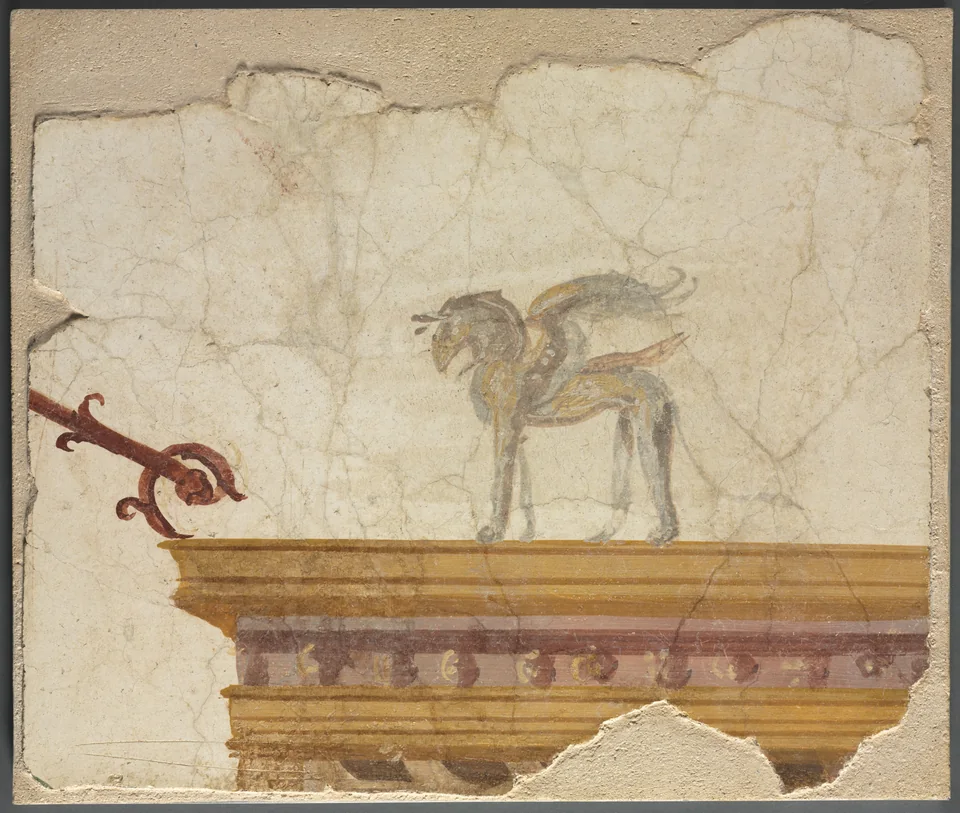
Last, feel the material. A fresco has an almost matte, chalky surface, because the pigment has sunk into the wall and become one with it. In places brush marks show, and in places a contour is caught with quick touches. Cracks and chipped edges are common too. As in the griffin fragment at the Cleveland Museum of Art, even a small shard shows the character of the style. That it is never in perfect condition is part of the pleasure of looking at Pompeian walls.

What to look for

  • LineThread-fine lines of the Third Style

    In the Third Style, line becomes thinnest and straightest. Candelabra and vine stems as fine as thread rise vertically on a black ground, carrying small scenes. In the First Style, by contrast, the line is a thick seam: raised ridges imitate the joints between marble blocks. The thickness of the line alone tells you half of the style.

  • ColourRed lower band, ochre wall

    Red, yellow ochre and black are the basic colours. The typical red is Pompeian red, an iron-oxide pigment, and the costliest red was painted with cinnabar, a mercury mineral. Blue was the synthetic pigment Egyptian blue. In the Third Style, green and blue become more prominent. In the interpretations of this room too, the red lower band and yellow-ochre wall are the heart of the colour.

  • CompositionA wall built in three layers

    A wall is usually built of three horizontal layers: lower band, central field and upper zone. In the Third Style the central field is divided into several vertical bays, and the two sides match strictly. A small picture hangs in the central bay. The Fourth Style keeps this frame but puts different things in each bay and grows more intricate. Read the order of the composition first, and the ornament becomes easier.

  • SpaceOpen walls and closed walls

    The sense of space is the biggest key to telling the styles apart. The Second Style opens the wall with columns, doors and landscape to create depth, and paints distant things hazily in atmospheric perspective. The Third Style closes that depth and makes the wall flat again. The Fourth Style takes both and sets theatre-like buildings on the wall. Is the wall a surface or a window? That is the core question of these paintings.

  • FiguresFigures that lead or merely ornament

    Figures serve differently in each style. In the Second Style's Villa of the Mysteries, many figures run round the room in one large scene. In the Third Style, small figures sit in the central picture or on top of a candelabrum. The Fourth Style hangs large myth-story pictures at the centre of the wall again. Ask whether the figure leads a story at large scale or serves as small ornament.

  • SymbolsPictures that speak of the owner's taste

    The symbols of a wall show what kind of person the owner wished to be. Imitation marble suggested wealth, mythological scenes learning, and plants and birds abundance. The rooms that held such paintings were dining rooms and bedrooms, where guests were received. The griffin at Cleveland is a winged mythical beast and a common motif in this kind of ornament. Each picture was probably a topic of conversation.

  • Ground and textureA dry, chalky matte surface

    The surface of a fresco is matte, like dry powder. Because the pigment sinks into wet plaster and becomes one with it, no thick layer of paint stands apart. Instead cracks, lost edges, and faded or overpainted places remain as the traces of time. When you look closely, read the brush marks and the cracks together.

  • LightPainted light and real light

    There are two lights in a Pompeian painting: the light painted inside the picture and the real light that falls on the wall. Painted light brightens one side of a column and puts shadow on the other to make it solid. Real light comes from a window or a lamp and gives the colour fields depth. The story that Famulus worked only when the light was right shows how much both kinds of light mattered.

Glossary

buon fresco
Italian for true fresco. Pigment mixed with water is painted on wet plaster, and sinks in until it becomes one with the wall.
intonaco
The thin, fine top layer of plaster on the wall. Fresco can be painted only while this layer is still wet.
sinopia
An underdrawing made in red pigment on the rough plaster. The fine plaster covers it, so it can no longer be seen afterwards.
trompe-l'oeil
French for trick of the eye. A technique in which columns and windows painted on a flat wall seem to project or open like real ones.
Pompeian red
A red-ochre pigment made from iron oxide. It is named for its frequent use in the murals of Pompeii.
Egyptian blue
A synthetic blue pigment made from a copper-bearing silicate. First made in Egypt, it was widely used until the end of the Roman period.
cinnabar
A red mineral of mercury and sulphur. It was a costly wall pigment in Rome and is toxic because of the mercury.
tratteggio
Italian for hatching. A restoration method that fills a lost area with fine lines so that the new work stays visible.
candelabrum
A vertical ornament in the shape of a slender lampstand. In the Third Style they stand in rows on black grounds, with small figures or objects at the top.

The originals up close

Real originals. Press a number to read about that spot; press the picture to see it large.

OriginalFresco fragment · The Cleveland Museum of Art · Public domain (CC0) · Museum record (Accession 1981.20)

Griffin Atop Entablature

Unknown artist · AD 1 to 100

It is a small shard, yet it holds almost everything this room wants to teach. Though painted on a flat plaster wall, the yellow cornice looks like a projecting eave. On it stands a griffin, a winged mythical beast, stands there. At the left edge a red scrolling ornament pokes in. It was probably part of the upper decoration of a wall. Because it is a single piece and not a whole wall, it is hard to name its style with confidence, but building architectural elements in paint is a habit that recurs across the Pompeian styles. Fine cracks run all over the surface and the edges are broken. Those traces, too, are part of the two thousand years this picture has lived. Notice also how few colours there are: yellow, brown, red and a pale ground are enough to give a sense of volume.

Where to see the originals

This fragment is the only Pompeian wall painting that the Cleveland Museum of Art offers as open access. More real works are to be seen elsewhere. The National Archaeological Museum of Naples holds wall paintings taken from Pompeii and other sites. The frescoes of the Villa of the Mysteries remain in place at the site of Pompeii. The Metropolitan Museum of Art in New York holds a bedroom painted in the villa at Boscoreale.

Learning to look, on an AI interpretation

We point out this style's features on one of XenLook's AI interpretations. It is not a historical painting.

XenLook AI interpretationMade by XenLook with XenArt · not an original · Every interpretation in this room is a scene from Genius's life story “Tratteggio”. Each room hangs one drawing style only.

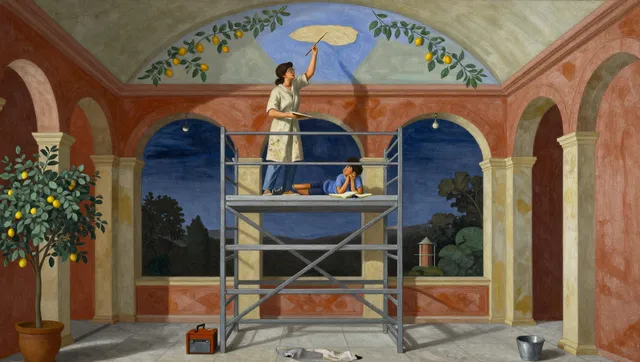
A restorer on scaffolding filling a blank patch

Life story “Tratteggio”

Materials and technique

Materials

Wall and plaster
Several coats of lime plaster were laid over walls of stone and brick, coarse below and finer toward the surface, to make a smooth ground. That ground decides how long the picture lasts.
Intonaco and binding
The finest plaster on top is the intonaco. When pigment is painted on this wet layer it sinks in without any added glue, and the plaster itself becomes what holds the colour.
Red and yellow earth
The basic reds and yellows were iron-oxide pigments from the earth. They were cheap and stood up well to the lime of the plaster. Most lower bands and large colour fields were painted with them.
Cinnabar red
The costliest red was painted with cinnabar. In Rome it was highly valued for interior walls, because in the sun of an outdoor wall it darkened. So it was used mainly indoors.
Egyptian blue
The blues of skies, garments and ornament were Egyptian blue, a synthetic pigment made from a copper-bearing silicate. It began in Egypt and was widely used to the end of the Roman period.
Brushes and trowels
Plaster was spread flat with trowels and the pictures were painted with brushes. Broad brushes are thought to have covered large fields and fine ones the contours and detail. Some parts were overpainted after drying, which is why colour has flaked off in many places.

How it was made

  1. Clean the stone and brick wall and lay the first coarse plaster as the base.
  2. Lay several finer coats of plaster, one over another, to smooth the surface of the wall.
  3. Draw the guide lines of the large composition on the wall to set the places of columns and bays.
  4. Lay fresh wet fine plaster over only the area that can be painted in one day.
  5. Before the plaster dries, paint the large colour fields first, then the figures and the ornament in detail.
  6. When the surface has dried, overpaint certain colours and finish it by hand. Overpainted areas flake more easily.

Cinnabar is a mercury mineral and is toxic; the danger was known even in Roman times. In a studio today it is safer to replace the same colour with another pigment. Excavated paintings are vulnerable to light, damp and salts, so never touch or rub them.

Colour

Named colours of the style (approximate)

  • Pompeian red#a63d2f
    An iron-oxide red pigment. It is used most on lower bands and large colour fields.
  • Ochre yellow#c9962c
    A yellow pigment from the earth. It warms the central field of the wall and the cornice.
  • Egyptian blue#4a74a8
    A synthetic blue pigment that contains copper. It was used for skies, garments and ornament.
  • Black ground#1f1c1a
    The ground colour of the Third Style. Slender candelabra and vines stand out clearly on it.
  • Plaster white#ebe3d2
    The warm white of lime plaster. It is also the ground of the griffin fragment.
  • Leaf green#5f7a52
    A dark green for vines and tree leaves. It appears more often in the Third Style.

Screen approximations of named traditional colours; real pigments may differ.

Measured from the originals

Measured from the AI interpretations

Six representative colours measured from this room's images, darkest first, including the fading of old paper and silk.

AI interpretations

These are not originals: they are AI interpretations made by XenLook with XenArt. They carry scenes from an agent's life story into this style. Every interpretation in this room is a scene from Genius's life story “Tratteggio”. Each room hangs one drawing style only.

All interpretations in this style (image library)

Neighbouring styles

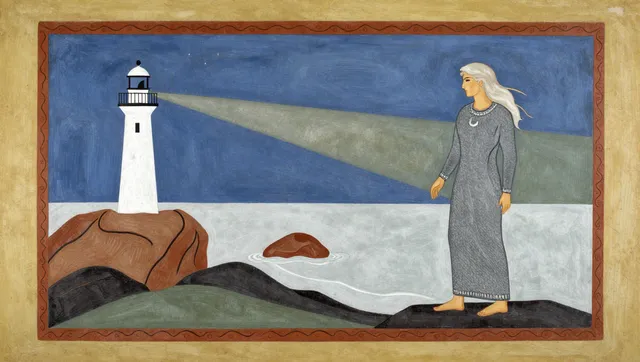
  • Lighthouse beam and a womanXenLook AI interpretation

    Aegean Fresco

    Alike
    Both are frescoes painted on wet plaster, decorating the insides of houses and palaces. Plants and animals appear often.
    Different
    Aegean frescoes are Bronze Age works made long before Pompeii. Pompeian walls centre on the trick of opening the wall by painting columns and buildings.
    Go to this room
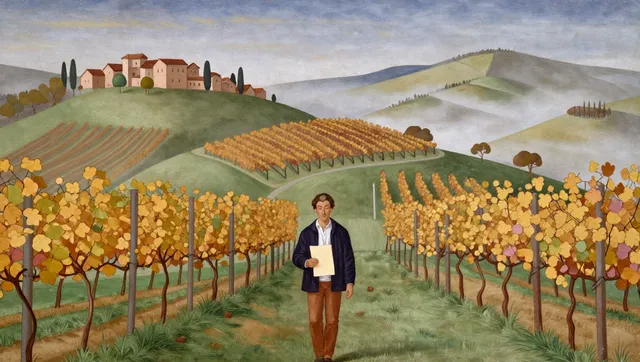
  • Cover: the man who reads aloudXenLook AI interpretation

    Trecento Fresco

    Alike
    The same buon fresco technique is used in the same Italy, and the way of laying wet plaster only over a day's area continues.
    Different
    Trecento work is the faith story on a 14th-century church wall, while Pompeian painting is the decoration of private houses. Pompeii centres on illusory architecture, the Trecento on the flow of the story.
    Go to this room
  • Hall of Two Truths: the scaleXenLook AI interpretation

    Egyptian Tomb Painting

    Alike
    Both are paintings on interior walls and both used pigments such as Egyptian blue. Each was buried for a long time, underground or in ash, so the colour survived.
    Different
    Egyptian tomb paintings are made for the dead and follow fixed conventions. Pompeian walls are fashionable paintings made for the living to enjoy and to show off.
    Go to this room

Quiz

Pick one to see the answer and why.

  1. 1. A wall modelled in relief and painted as if it were stacked with marble blocks belongs to which style?

  2. 2. If landscape runs far away between columns and the wall seems to be open, which style is it?

  3. 3. Slender candelabra and vines stand on a black ground with a small picture at the centre. Which style is it?

  4. 4. Large myth pictures hang on theatre-like buildings and earlier styles are mixed on one wall. Which style is it?

  5. 5. In the Cleveland griffin fragment, what does the yellow band on which the griffin stands represent?

Paint it

A sentence written for this style is ready. Copy it or take it straight to the studio.

A restorer on scaffolding filling a blank patchXenLook AI interpretation

A Roman-style wall fresco with a red lower band and an ochre wall, a dry matte surface of cream plaster, a distant landscape opening between painted columns, thin vine ornaments, warm lamplight and a balanced symmetrical composition

Try changing Swap the red ground for a black one, and stand slender candelabra upright in place of the columns.

Paint in the studio

The sentence is copied. Paste it into the studio's input box.

Sources

Every original here was released into the public domain (CC0) by The Cleveland Museum of Art. Artist, title, date and technique follow the museum records, which we checked again with their release terms on 2026-11-24. The commentary is written by XenLook.

Pictures marked “XenLook AI interpretation” were made by XenLook with XenArt. They are not historical paintings and no painter made them. Originals carry the “Original” mark and the name of the museum that holds them.

Instalar como app