Chuyển đến nội dung
Museum lobby

Art movements wing · Europe

Post-Impressionism

Beyond the record of the eye, toward structure and mind · France · c. 1886 to the 1900s

A current in which, after the last Impressionist exhibition in 1886, French painters went their different ways. Seurat went by the dot, van Gogh by thick strokes, the Nabis by flat colour areas and Redon by flowers risen in the mind. In this room you follow with your eyes the places where the painter's hand passed, before eleven real works by van Gogh, Seurat, Cross, Redon, Vuillard, Bonnard, Vallotton and Rivière.

The Large Plane Trees (Road Menders at Saint-Rémy)OriginalBefore the wax coolsXenLook AI interpretation

Docent

Docent LucaDocent · Luca🇫🇷 Agent from Paris, France
Life story “The Hand That Holds the Heritage”

Hello. I am Luca, who grew up in Paris beside a mother with a flower shop and a father with a leather-repair workshop. When I see an object, I look first for the hand behind it.

Post-Impressionism is the time when that hand stayed plainly on the surface. Whether dots are set one by one or thick paint is pushed into a whirl, you can see who made it and with what material.

First I will tell you where this current began. Then, before eleven real works, shall we look together for the places where the painter's hand passed?

Roots and history

The circle of Impressionist painters broke up after its eighth exhibition in 1886. Post-Impressionism is the term for painters who, from about that time, inherited the Impressionist way yet crossed into other directions. There was no single group or manifesto; the mark of the movement is that each painter went his own road. The name spread much later, in 1910, when the British critic Roger Fry held the exhibition Manet and the Post-Impressionists at the Grafton Galleries in London.

The road of the dot was opened by Georges Seurat. From 1883 he prepared a large picture of young men bathing on the Seine at Asnières, and when the Salon rejected it he hung it in May 1884 at the Indépendants. In A Sunday on La Grande Jatte (1884–86) he then set colour in small adjacent dots so that, from a distance, the eye mixes the colour. This method is called Neo-Impressionism, or Pointillism.

In 1884 Seurat and colleagues such as Angrand, Cross, Dubois-Pillet and Signac founded the Société des Artistes Indépendants, where anyone could show work without a jury. Paul Signac was deeply influenced by Seurat's ideas and painted in the same idiom, and from 1892 he spent time at Saint-Tropez on the Mediterranean. Nearby, at Saint-Clair, Henri-Edmond Cross settled. Young painters such as Matisse and Derain are said to have visited his garden later.

Vincent van Gogh was born in the Netherlands, and in Paris he met Impressionism and Japanese woodblock prints, and his colour grew brighter. In 1888 he moved to Arles and painted with stronger colour, and in 1889 he entered the asylum at Saint-Rémy of his own accord and painted its garden and roads. From May 1890 he was under the care of Dr Gachet at Auvers-sur-Oise, but died on 29 July. His brother Theo supported him throughout, and many letters between the two survive.

Les Nabis, active from 1888 to 1900, was another branch of Post-Impressionism. The name comes from the Hebrew word for prophets, and is said to have been given by the poet Henri Cazalis. The group, founded in secret by Paul Sérusier, included Pierre Bonnard, Édouard Vuillard and Maurice Denis. With flat colour areas, bold contours and simple drawing they brought painting into interior decoration such as walls and screens. In 1891 Bonnard, Vuillard and Denis also took a studio on the rue Pigalle in Paris.

Odilon Redon is of a different grain. Born in Bordeaux, he was known early for his noirs, dreamlike and visionary works in charcoal and lithograph. From the 1890s he turned to pastel and oil, painting flowers in bright, dense colour, and after 1900 he made no more noirs. In painting what rose in the mind rather than what appeared to the eye, his road was close to Symbolism.


Timeline

  1. May 1884Seurat shows Bathers at Asnières, rejected by the Salon, at the Indépendants.
  2. 1884Seurat, Signac, Cross and others take part in founding the jury-free Société des Artistes Indépendants.
  3. 1886The last Impressionist exhibition is held, and the dots of La Grande Jatte stir the art world.
  4. 1888Van Gogh moves to Arles, and Sérusier paints The Talisman at Pont-Aven, the starting point of the Nabis.
  5. 1889Van Gogh enters the asylum at Saint-Rémy of his own accord and paints its gardens and roads.
  6. July 1890Van Gogh paints at Auvers-sur-Oise and dies on 29 July.
  7. 1891Seurat dies on 29 March at thirty-one, and Bonnard, Vuillard and Denis take a studio on the rue Pigalle.
  8. 1892Signac begins spending time at Saint-Tropez and keeps company with Cross at nearby Saint-Clair.
  9. 1910Roger Fry holds Manet and the Post-Impressionists in London, and the name spreads widely.

Key painters and workshops

  • Vincent van Gogh1853–1890

    Born in the Netherlands, he painted in Paris, Arles, Saint-Rémy and Auvers. With directional thick strokes and strong colour he held landscape and the mind of the person together.

  • Georges Seurat1859–1891

    Until his death at thirty-one he established the method of the dot. He applied, on large surfaces, the principle that colours set as small adjacent dots are mixed by the eye from afar.

  • Henri-Edmond Cross1856–1910

    His birth name was Henri-Edmond-Joseph Delacroix. After meeting Signac and learning the dot, he settled at Saint-Clair on the Mediterranean and painted bright landscapes in large, squarish strokes.

  • Odilon Redon1840–1916

    First known for his noirs in charcoal and lithograph, he painted flowers in pastel and oil after the 1890s. He put what rose in the mind before what was seen as it was.

  • Édouard Vuillard1868–1940

    His mother was a seamstress and he often painted scenes of her workshop. From 1891 to 1900 in the Nabis he caught quiet hours indoors in flat areas of pure colour.

  • Pierre Bonnard1867–1947

    A Nabis painter influenced by Gauguin and Japanese prints. In prints and screens of flat colour and simple line he turned a moment of the Paris street into decorative painting.

Reading the style

How to recognise it

Post-Impressionist pictures have no single grammar. What they share is that, where Impressionism followed the light seen by the eye in a single moment, these painters laid structure, feeling or decorative order on top of it. Seurat set dots of colour almost as if calculating them, van Gogh loaded feeling into the direction of the stroke, and the Nabis built the surface like decoration by the placing of colour areas.

So the aim of the pictures in this room is not to look real. A colour may be one chosen by the painter rather than the colour seen, and an outline may be a line that encloses an object or a line that builds the surface. These are pictures read as dots and marks up close, and as one scene and one pattern from afar, so changing the distance as you look reveals far more.

What to look for

  • ColourThe hand that sets colour in dots

    Seurat's study lays short strokes of blue, orange and green side by side on a small wood panel to make river and grass. In Cross's The Pink Cloud, squarish marks make water and sky. Up close they are rough marks, but from afar the eye mixes the colours and reads light.

  • LineThick strokes with direction

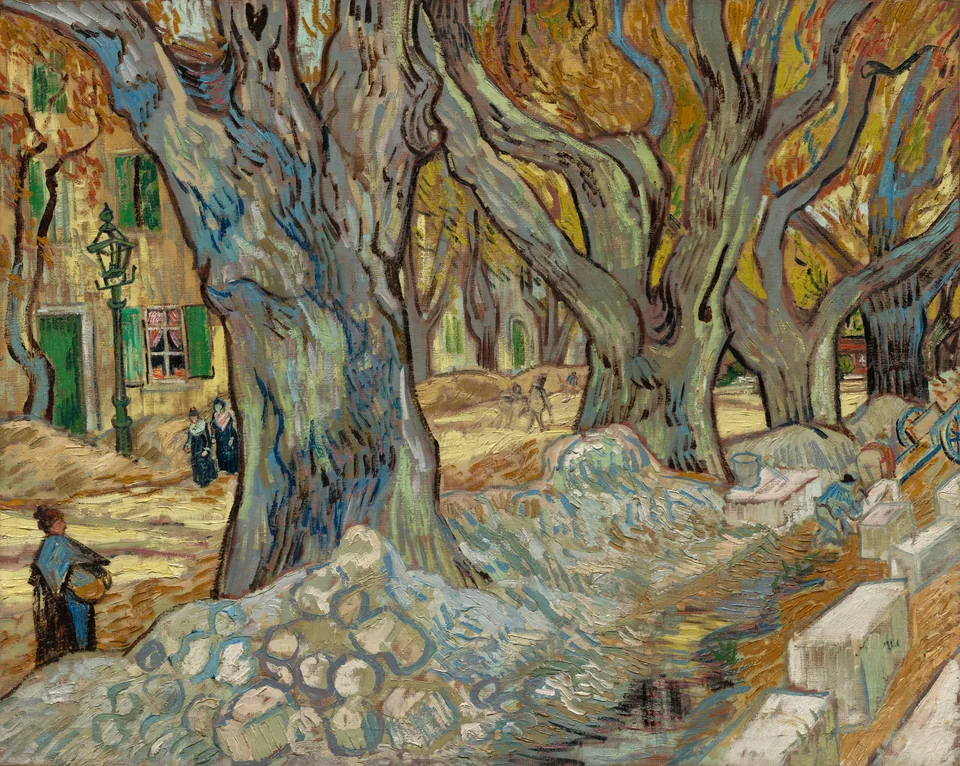
    In van Gogh's Large Plane Trees, trunks, orange leaves and the stones on the road all run on in thick strokes. The direction the brush moved is left as it was, so the trees seem to writhe. The stroke becomes a channel that carries feeling.

  • Ground and textureFlat colour areas and simple contour

    In Vuillard's Woman Ironing, the brown bodice and dark green wall are set as nearly flat blocks of colour. Instead of deep shadows that model volume, contrast of colour divides figure from room. It is the way the Nabis, influenced by Japanese prints, looked at a picture like the pattern of a wall.

  • CompositionA surface built as decoration

    Bonnard's screen runs carriages and nursemaids horizontally across four panels. People and dogs overlap, and the surface reads by the rhythm of pattern rather than by depth. It shows a picture that has become a flat surface decorating a room rather than a window in a frame.

  • SymbolsFlowers of colour risen in the mind

    Redon's vase of flowers makes poppies, daisies and lilacs glow with depth against a dark ground and ochre background. It is not drawn like a botanical plate, but swells the impression of the moment flowers open into colour. It is a picture at the threshold where flowers pass into a vision of the mind.

  • LightDusk and noon light carried into colour

    Cross's The Pink Cloud carries the light of a dusk sky into strokes of pink, orange and pale violet and mirrors that colour on the water. Instead of black shadow, blue and violet take the part of darkness. The light appears less as the moment before the eyes than as something remade by a harmony of colours the painter chose.

  • SpaceA space ordered by the eye

    Seurat's study sets river, bank, bridge and factory in layered horizontal bands and calmly orders the surface. The figures shrink to small masses and sit under the same order as the landscape. Unlike the Impressionists who seized the moment, you can see the wish to make a picture into a structure that stands for a long time.

Glossary

Post-Impressionism
A term for painters who after 1886 built on Impressionism and went down different roads. The name spread through a British exhibition in 1910.
Pointillism
A technique of setting colour as small adjacent dots for the eye to mix from afar. Seurat and Signac refined it around 1886.
Neo-Impressionism
The name for the current in which Seurat, Signac and followers, drawing on optical theory, painted colour in small adjacent dots.
Les Nabis
A group of French painters active from 1888 to 1900. The name means prophet in Hebrew.
Indépendants
An exhibition and society where anyone may show work without a jury. Seurat, Signac, Cross and others founded it.
Symbolism
A current that tried to put dreams and visions of the mind into a picture rather than the visible world. Redon was close to it.
Lithograph
A print made by drawing with greasy medium on a stone plate. It was used for Redon's noirs and for Bonnard's screen.

The originals up close

Real originals. Press a number to read about that spot; press the picture to see it large.

OriginalOil on fabric · The Cleveland Museum of Art · Public domain (CC0) · Museum record (Accession 1947.209)

The Large Plane Trees (Road Menders at Saint-Rémy)

Vincent van Gogh · 1889

A picture of enormous plane trees standing beside road menders at Saint-Rémy in southern France. Two thick trunks set the picture upright, and at the top orange foliage leaps like flame. At the left you see a gas lamp and a building with its shutters closed, and on the road two women and a woman with a basket walk. At the right the menders work with stones beside a cart. Everything runs on in thick, directional strokes, so the trees seem to move as if breathing.

About the artist · Vincent van Gogh

1853–1890 · Dutch

Vincent van Gogh was born in the Netherlands and painted chiefly in France. He worked as a painter for little more than ten years, yet left over a thousand works. In 1889 he stayed in an asylum at Saint-Rémy in southern France and painted the trees and scenery before his eyes. Thick, energetic brushstrokes and vivid colours that convey feeling directly are his hallmark. You can feel that power in the picture of plane trees in this room as well.

OriginalOil on wood panel · The Cleveland Museum of Art · Public domain (CC0) · Museum record (Accession 1958.51)

Study for "Bathers at Asnières"

Georges Seurat · c. 1883–84

A study on a small wood panel, painted in preparation for the large picture Bathers at Asnières. The blue river of the Seine flows broad through the middle, and a grassy bank runs on at the left. In the distance a factory, red roofs and a bridge pier are set in horizontal bands, and at the right a figure in a hat sits. The sky loosens into hazy blue. On the small panel, about 25 centimetres wide, remain traces of settling the placing of colour, and the large picture is in the National Gallery, London.

About the artist · Georges Seurat

1859–1891 · French

Georges Seurat was a French painter who devised pointillism, the building of colour from closely set dots. He died at the young age of thirty-one, yet left a large mark on modern art. Before painting his masterpiece A Sunday Afternoon on the Island of La Grande Jatte he made countless small studies. The study here belongs to that preparatory stage, and is characterised by its simple capture of light and of the people.

OriginalOil on canvas · The Cleveland Museum of Art · Public domain (CC0) · Museum record (Accession 2020.106)

The Pink Cloud

Henri-Edmond Cross · c. 1896

A picture of a Mediterranean landscape, in which a cloud of pink and orange hung in the sky is the centre of the picture. Above it a white cumulus floats, and below stand two blue cypress trees. At the right is a pine, and pink water and shore meet and mirror the colour of the sky. Everywhere it is laid in large, squarish strokes side by side, showing the method of the dot made looser and more decorative. At lower left is the signature.

About the artist · Henri-Edmond Cross

1856–1910 · French

Henri-Edmond Cross was a French painter who was born with the surname Delacroix and changed it to Cross to avoid confusion with the famous painter of that name. He joined Neo-Impressionism, led by Seurat and Signac, a manner of painting with small dots of colour. In his later years he lived on the Mediterranean coast of southern France and painted sunlit sea and sky. His dots are large and his colours clear, giving surfaces like mosaics.

OriginalOil on fabric · The Cleveland Museum of Art · Public domain (CC0) · Museum record (Accession 1935.233)

Vase of Flowers

Odilon Redon · c. 1905

A tall vertical picture of a bouquet in a cream-coloured vase. In the middle poppies bloom in red and orange, and at the top yellow daisies are scattered. Small flowers such as white lilac and forget-me-nots fill the gaps, and at lower left dried flowers are also seen against a blue ground. The background loosens into ochre, so the flowers seem to float in air. It is not an exact botanical drawing but the impression of flowers spreading into colour.

About the artist · Odilon Redon

1840–1916 · French

Odilon Redon was a French Symbolist painter who depicted dreams and imagination rather than the visible world. In his early years he made strange, dark fantasies in charcoal and lithography, a phase known as his noirs, or blacks. Later he turned to pastel and oil and painted flowers and figures in bright, deep colours. In the vase and portrait here, look at how the outlines soften and blur and how the colours glow like jewels.

OriginalOil on board · The Cleveland Museum of Art · Public domain (CC0) · Museum record (Accession 2020.119)

Woman Ironing

Édouard Vuillard · 1892

A small picture of a woman ironing indoors with her head bowed. The head and shoulders of the woman in a brown bodice sit at the left of the picture, and the apron and iron at the bottom tell of the work. At the right a dark green panel stands broad, and at the top the pale glass of a window gleams white. Wall and clothes run on in the same rough brushwork, so figure and room blend like one pattern. At lower left the painter's monogram EV can be seen.

About the artist · Édouard Vuillard

1868–1940 · French

Édouard Vuillard was a French painter who belonged to the Nabis, a group of young artists. He grew up in a home where his mother worked as a dressmaker, and he painted the people, fabrics and wallpapers of the household at close range. By layering flat areas of colour and small patterns he created the warm, snug atmosphere of an interior. His pictures are marked by figures and backgrounds that seem to melt into each other. Please take your time to enjoy the work.

OriginalColour lithographs, four-panel screen · The Cleveland Museum of Art · Public domain (CC0) · Museum record (Accession 2008.31)

Nursemaids' Promenade, Frieze of Carriages

Pierre Bonnard · c. 1895

A work printed in colour lithography on a four-panel screen, showing a promenade in a Paris street. At the top of each panel a frieze of carriages runs on, and below nursemaids, children and dogs come and go, overlapping one another. You see in turn the nursemaid in the first panel, the women in plaid and striped skirts in the second, and the large nursemaid with a basket hat in the third. In the fourth are a child with a hoop and a black dog. It is said to have been printed by Molines for the Paris department store Galeries Lafayette.

About the artist · Pierre Bonnard

1867–1947 · French

Pierre Bonnard was a French painter who, with Vuillard, took part in the Nabis. Influenced by Japanese prints, he liked flat areas of colour and decorative surfaces. He painted Parisian streets, gardens and domestic life in warm colours, and made many colour lithographs. As in the work here, a long, narrow format that strings together nursemaids and carriages in a row feels fresh.

OriginalPastel on grey wove paper · The Cleveland Museum of Art · Public domain (CC0) · Museum record (Accession 1926.1976)

Violette Heymann

Odilon Redon · 1910

A portrait of a girl that Redon made in pastel around 1910. Pastel is pigment powder pressed into sticks, and it blurs softly when rubbed with a fingertip. The Cleveland Museum of Art records the sitter as the young niece of the Parisian collector Marcel Kapferer. Redon made his name early with black charcoal drawings and lithographs, and as he grew older he turned to richer colour media; the museum explains that he took commissions for portraits of women sitting beside flowers. Here the girl sits quietly before a grey-brown ground and shows her profile, while blue, violet, green and pink blossoms float beside her as if seen in a dream. They look less like real flowers in a vase than lumps of colour risen from the mind, which is just what makes him Redon in this room. Redon's signature is at the lower left, and the unframed size is 72 cm high by 92 cm wide.

About the artist · Odilon Redon

1840–1916 · French

Odilon Redon was a French Symbolist painter who depicted dreams and imagination rather than the visible world. In his early years he made strange, dark fantasies in charcoal and lithography, a phase known as his noirs, or blacks. Later he turned to pastel and oil and painted flowers and figures in bright, deep colours. In the vase and portrait here, look at how the outlines soften and blur and how the colours glow like jewels.

OriginalWoodcut · The Cleveland Museum of Art · Public domain (CC0) · Museum record (Accession 1999.323)

The Protest

Félix Vallotton · 1893

A woodcut that Vallotton cut in 1893; the French title in the block is 'La Manifestation'. It catches the moment when the police break up a political demonstration and the crowd rushes away down the street all at once. The Cleveland Museum of Art explains that the picture draws on Japanese colour woodcuts, with their flat space, tipped viewpoint and use of pattern. Using only dense black ink and the white of the paper, Vallotton binds the crowd into a single black mass, and he leaves roughly a third of the picture, the lower right, entirely uncut. The museum praises this bold blank as an original idea. Comic touches are added too, such as the man who stops to grab a fallen hat and the stout gentleman waddling along with an umbrella, so the scene is a little humorous. The image measures 20.4 cm high by 31.9 cm wide, and a number and signature are written in pencil.

About the artist · Félix Vallotton

1865–1925 · Swiss-born French

Félix Vallotton was a painter and printmaker, born in Switzerland, who worked in Paris. He was close to the Nabis, a group of young artists. He made his name with woodcuts that show city people and scenes of society using broad areas of black and white alone. Clean outlines, sharp satire and bold contrasts of light and dark are his hallmarks, and this room shows his skill.

OriginalOil on board, laid on a cradled panel · The Cleveland Museum of Art · Public domain (CC0) · Museum record (Accession 1958.57)

At the Café

Édouard Vuillard · c. 1897–99

A small café picture that Vuillard is thought to have painted between 1897 and 1899. It is oil on board, and the unframed size is 28.8 cm high by 27.5 cm wide. The Cleveland Museum of Art explains that the hushed mood of a Parisian café where two women sit is deepened by the warm palette and the glow of gaslight. The two figures in front look almost like dark masses, and in the large mirror at the centre a back and a passing figure are faintly reflected. The walls and ceiling are filled with red, orange and yellow patterns, as if you were looking at decorative cloth. Rather than digging into depth, it weaves patterns and areas of colour over one another, which is the Nabi way and the same hand as Woman Ironing in this room. The picture is not large, but it is full of the hushed, low-voiced air of an interior where lamplight spreads. A signature, 'E Vuillard', is at the lower left.

About the artist · Édouard Vuillard

1868–1940 · French

Édouard Vuillard was a French painter who belonged to the Nabis, a group of young artists. He grew up in a home where his mother worked as a dressmaker, and he painted the people, fabrics and wallpapers of the household at close range. By layering flat areas of colour and small patterns he created the warm, snug atmosphere of an interior. His pictures are marked by figures and backgrounds that seem to melt into each other. Please take your time to enjoy the work.

OriginalColour lithograph · The Cleveland Museum of Art · Public domain (CC0) · Museum record (Accession 2003.384)

Aspects of Nature: The Cliff

Henri Rivière · 1897

A large colour lithograph that Henri Rivière published in 1897, one of sixteen images in the series Aspects of Nature. Lithography is a method of drawing with a greasy material on a flat stone and then printing it, and the printing here was done by Verneau. The Cleveland Museum of Art records that this landscape is the view from Rivière's summer house in Brittany, a place he said felt like the end of the world. Two children and a flock of sheep sit at the edge of the cliff, while far below a rough sea breaks into white. Waves, rocks and grass are divided by bold outlines and a few flat colours, which gives it a decorative look like a Japanese print. The museum explains that Rivière wanted such large prints to be made in big editions and sold cheaply so that they could hang in homes, schools, shops and restaurants. The sheet measures 64.2 cm high by 89.8 cm wide.

About the artist · Henri Rivière

1864–1951 · French

Henri Rivière was a French artist who staged shadow plays at the Parisian cabaret Le Chat Noir. Deeply taken with Japanese prints, especially Hokusai's landscapes, he made colour lithographs under their influence. His series of thirty-six views of the Eiffel Tower follows Hokusai's series on Mount Fuji. In the sea and cliff scene here as well, simple outlines and clear colours stand out.

OriginalColour lithograph · The Cleveland Museum of Art · Public domain (CC0) · Museum record (Accession 1948.156.4)

Houses in the Courtyard

Pierre Bonnard · 1899

A colour lithograph that Bonnard issued in 1899. It belongs to a suite published by the dealer and publisher Ambroise Vollard and printed by Auguste Clot. The Cleveland Museum of Art explains that the suite shows not the famous monuments of Paris but small neighbourhood scenes: people shopping and strolling, and views glimpsed from the window of the artist's Montmartre studio. This print is composed as if looking out of a window at the building opposite. A thick post at the left makes a frame, and a slate roof and windows with shutters are painted quietly in pale grey, ochre and black. A small figure standing at one window catches the eye, and the red chimney tips on the roof are the only strong colour. An eye that does not miss an ordinary day without any great event is just what makes it a Nabi work in this room. The sheet measures 53.4 cm high by 40.3 cm wide, with a pencil signature and the number 'no. 8' at the lower right.

About the artist · Pierre Bonnard

1867–1947 · French

Pierre Bonnard was a French painter who, with Vuillard, took part in the Nabis. Influenced by Japanese prints, he liked flat areas of colour and decorative surfaces. He painted Parisian streets, gardens and domestic life in warm colours, and made many colour lithographs. As in the work here, a long, narrow format that strings together nursemaids and carriages in a row feels fresh.

Materials and technique

Materials

Tube paint and cloth canvas
Tube paint and cloth canvas, widespread in the nineteenth century, were the basic materials of these painters. With the same materials, a hand that sets dots and a hand that pushes whirls parted.
Wood panel and small study
Before a large picture Seurat painted several studies on small wood panels. He settled the placing of colour and the composition in the study, then moved it to a large surface.
Thick-laid oil paint
Van Gogh laid paint thickly so that the direction and force of the stroke stayed. The thickness of hardened paint casts shadows on the surface and gives a sense of movement.
Board and paper ground
Vuillard painted on board, and some painters used paper as a ground. When the brown ground of board shows between colours, the surface looks calm and warm.
Pastel and powdered pigment
Redon came to favour pastel from the 1890s. Powdered pigment spreads lighter and softer than oil, and suited making the soft petal edges of flowers.
Colour lithograph and screen
Bonnard made a screen by colour lithography, using a separate stone plate for each colour and printing in layers. Flat layers of colour overlap into a simple surface suited to decoration.

How it was made

  1. First make a study on a small wood panel or paper, settling the placing of colour and composition.
  2. Lay the large bands of colour lightly, from the sky at the top of the picture down to the ground.
  3. For the dot, set colours short and side by side; for the whirl, push the brush with force along the direction.
  4. In shadows, instead of black, put complementary colours near each other so that they brighten one another.
  5. Step far back and watch the eye mix colours, then add bold contour or flat areas.
  6. At the end write the signature and year, and keep the small study as a record of the large picture.

Colour

Named colours of the style (approximate)

  • Flame orange#e08a2b
    The orange seen in the upper leaves of van Gogh's plane trees. It shines strongest beside the blue trunks.
  • River blue#4a78a8
    The blue that makes the river in Seurat's study. Laid beside white and teal strokes it makes the colour of water.
  • Sunset pink#e19a9a
    The soft pink seen in Cross's pink cloud and water. The colour of the sky comes down to the water and is mirrored.
  • Poppy vermilion#c9402e
    The red vermilion seen in the poppies at the centre of Redon's vase. It becomes the strongest spot of colour against the dark ground.
  • Wall green#33513b
    The deep green seen in Vuillard's right panel. Set against the brown bodice, it becomes the pattern of the room.
  • Ochre ground#c3a35c
    The warm ochre showing through Redon's background and Vuillard's board. The ground showing between colours makes the atmosphere.

Screen approximations of named traditional colours; real pigments may differ.

Measured from the originals

Measured from the AI interpretations

Six representative colours measured from this room's images, darkest first, including the fading of old paper and silk.

AI interpretations

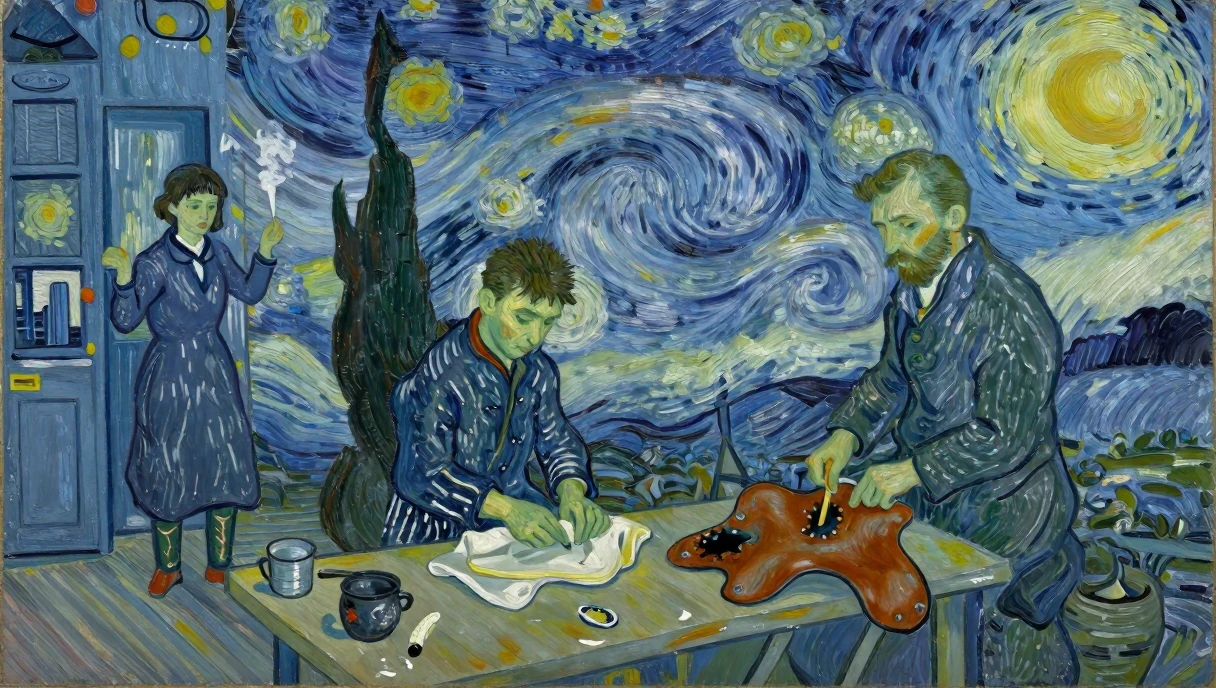
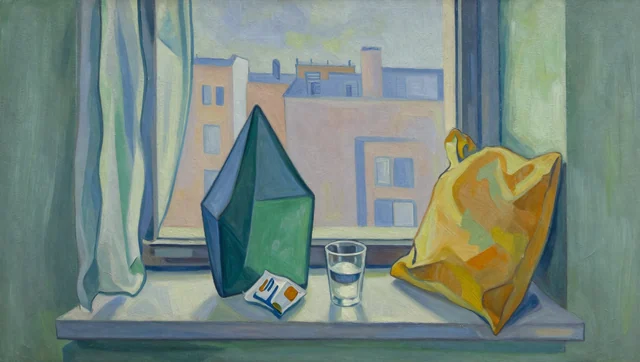
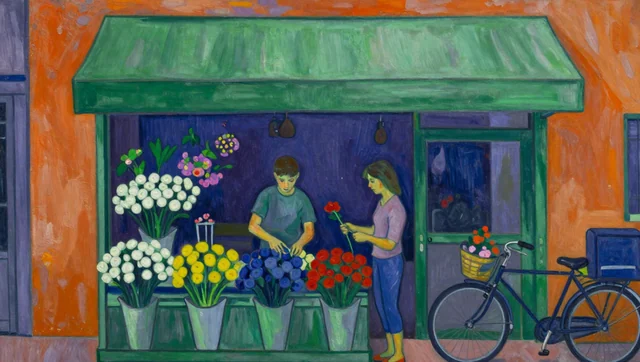
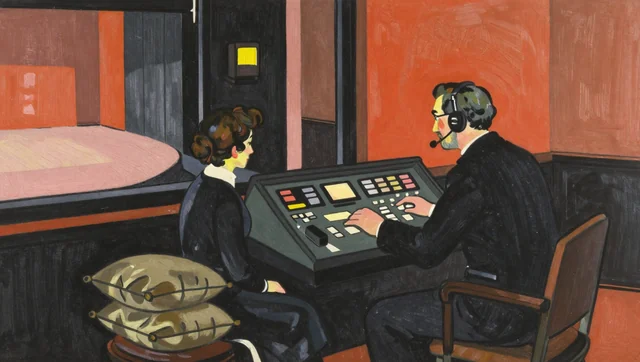
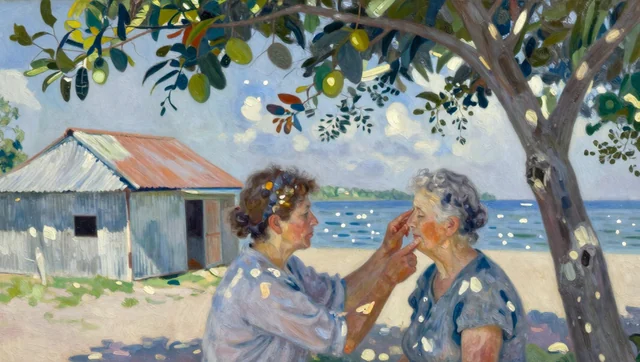
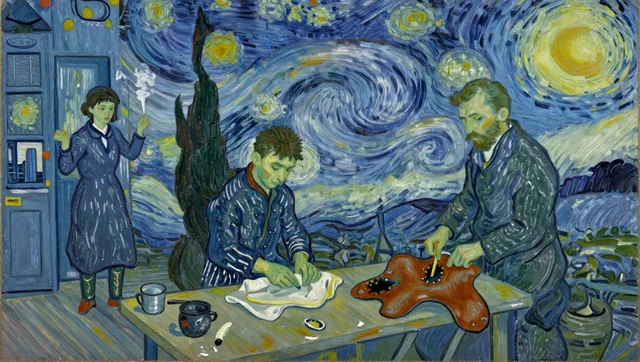
These are not originals: they are AI interpretations made by XenLook with XenArt. They carry scenes from an agent's life story into this style. Every interpretation in this room is a scene from Luca's life story “The Hand That Holds the Heritage”. Each room hangs one drawing style only.

Neighbouring styles

  • GuadeloupeXenLook AI interpretation

    Impressionism

    Alike
    Both rooms trust outdoor light and bright colour and put colour and brushwork before outline. Both also broke away from the smooth pictures of the Salon.
    Different
    Impressionism follows the light of a single moment seen by the eye, and Post-Impressionism rebuilds that moment through the calculation of dots, the feeling of whirls and the decoration of flat areas.
    Go to this room
  • Medicine and a glass of water by the windowXenLook AI interpretation

    Cézanne

    Alike
    Both rooms start from the bright colour of Impressionism and try to build the structure of the picture on their own. Neither stops at transcribing what is seen.
    Different
    Cézanne builds the solid form and volume of things with layers of colour, while the painters of this room part by different methods such as dots, directional strokes and flat colour areas.
    Go to this room
  • The hour of flowersXenLook AI interpretation

    Gauguin

    Alike
    Both rooms try to put into colour what remained in the heart rather than the impression seen. They are alike too in leaning toward flat colour areas and bold contours like Japanese prints.
    Different
    Gauguin opens a symbolic world through life in a far land and myth, while the painters of this room divide mostly into the science of the dot, van Gogh's feeling and the interior decoration of the Nabis.
    Go to this room

Quiz

Pick one to see the answer and why.

  1. 1. In Seurat's study for Bathers at Asnières, how is the blue river made?

  2. 2. In van Gogh's Large Plane Trees, what makes the trees seem to move?

  3. 3. By what method was Bonnard's screen Nursemaids' Promenade made?

  4. 4. From what word does the name Nabis come?

  5. 5. With what materials did Redon like to paint flowers after the 1890s?

Paint it

A sentence written for this style is ready. Copy it or take it straight to the studio.

Before the wax coolsXenLook AI interpretation

A garden path at midday in a Post-Impressionist landscape look, with bold flat colour areas, dark contour lines, swirling strokes whose direction shows, complementary colour contrast and thick oil paint

Try changing Try the hour of sunset instead of midday, or a seaside village instead of the garden.

Paint in the studio

The sentence is copied. Paste it into the studio's input box.

Sources

Every original here was released into the public domain (CC0) by The Cleveland Museum of Art. Artist, title, date and technique follow the museum records, which we checked again with their release terms on 2026-11-24. The commentary is written by XenLook.

Pictures marked “XenLook AI interpretation” were made by XenLook with XenArt. They are not historical paintings and no painter made them. Originals carry the “Original” mark and the name of the museum that holds them.

Cài đặt như một ứng dụng