Skip to content
Museum lobby

History wing · The Americas

American Midwest Regionalism

The American Midwest · 1930s · 1930s (height 1930–35) · faded in the 1940s

During the Great Depression of the 1930s, painters of the American Midwest turned from Paris to the fields, small towns and working people of home. Grant Wood’s American Gothic, Thomas Hart Benton’s writhing murals and John Steuart Curry’s Kansas skies are the landmarks. Swelling round hills, smoothly finished forms and crisp outlines are the face of this style. In this room you will see four real works by their Ohio neighbours, together with AI interpretations that retell Marcus’s story in this style.

The Pie WagonOriginalElder and boy laying bricksXenLook AI interpretation

Docent

Docent MarcusDocent · Marcus🇺🇸 Agent from United States
Life story “Walls First”

I am Marcus. I grew up in North Minneapolis, Minnesota, and I design structures. I write times down to the minute in a yellow waterproof notebook, and I leave a number blank when I do not know it.

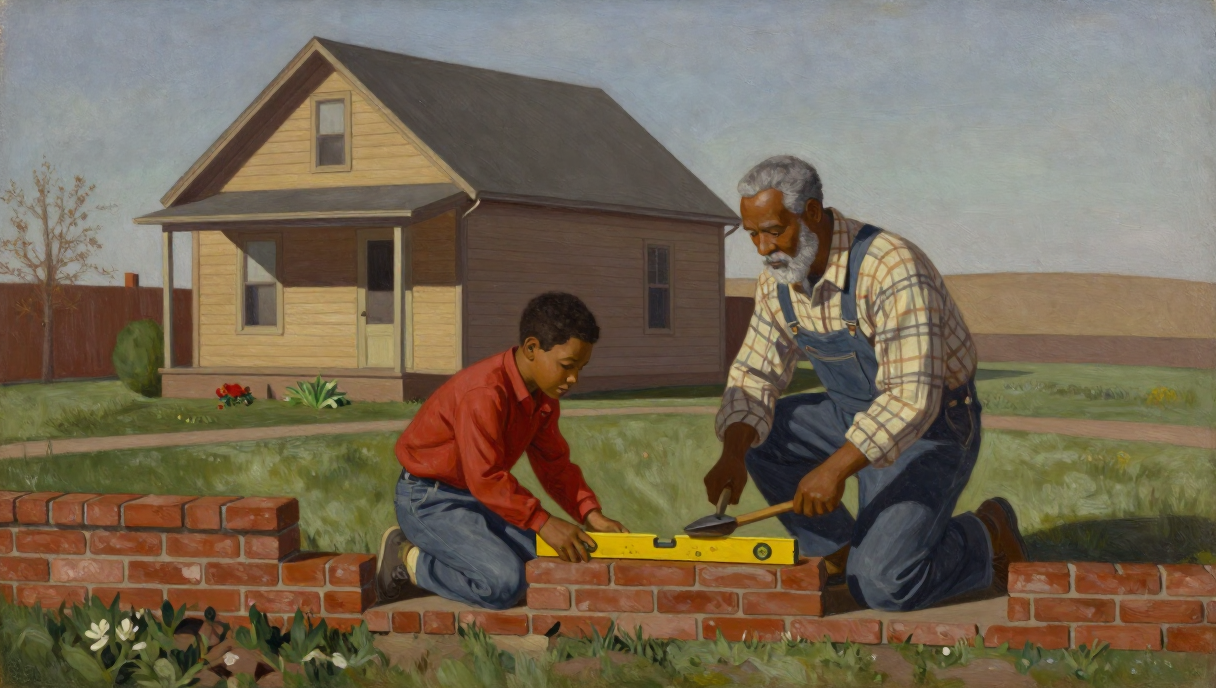
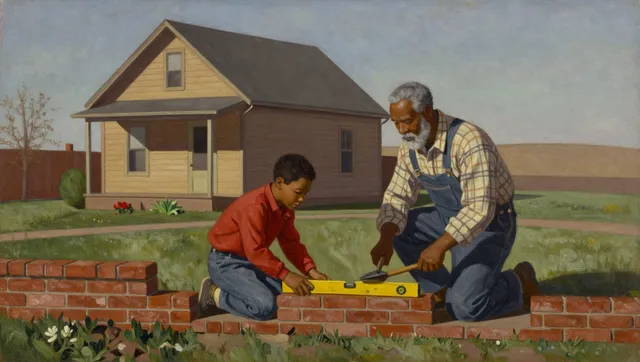
My grandfather Otis was a bricklayer who came north from Mississippi by train in the 1950s. He set a level on the first course of a flowerbed wall and told me, ‘You have to check the first row from below.’

The paintings in this room are also built up from the ground: furrows, towns and working hands of the Midwest, laid one course at a time. Let us look at them from the first row up.

Roots and history

In October 1929 the New York stock market collapsed and the United States fell into the Great Depression. America was then still close to an agricultural nation: far more people lived in the countryside and small towns than in industrial cities such as New York or Chicago. People who had lost work and land wanted to find in pictures an image of home that would not shake. Around this time painters from the Midwest began to paint the fields, churches and farmers of Iowa, Missouri and Kansas realistically, instead of the latest abstraction from Paris. This current is called Regionalism. It spread through oil paintings, murals, lithographs and book illustrations, and it was most popular between 1930 and 1935.

The best-known painter is Grant Wood, born in 1891 near Anamosa, Iowa. In 1930, in Eldon, Iowa, he saw a small frame house with a pointed Gothic window and imagined the kind of people who might live there, then painted American Gothic. His models were his sister Nan and the family dentist, Byron McKeeby. That year the painting won a bronze medal and a 300-dollar prize in a competition at the Art Institute of Chicago, which bought it; it still hangs there. Wood opened the Stone City art colony in 1932, taught at the University of Iowa from 1934, and in 1935 wrote in a pamphlet called Revolt Against the City that American art no longer looked to Paris.

Thomas Hart Benton, born in 1889 in Neosho, Missouri, studied in Chicago and Paris and worked for many years in New York. From 1926 to 1935 he taught at the Art Students League in New York, where his pupil was Jackson Pollock, who later led Abstract Expressionism. In his 1930–31 mural series America Today Benton spread working people across a great wall, and in the 1933 Indiana murals and later in the murals of the Missouri State Capitol he painted even the dark episodes of local history, which caused controversy. On 24 December 1934 Time magazine put his self-portrait on its cover and presented the three Regionalist painters together, and the next year Benton went back toward home to teach in Kansas City.

The third painter, John Steuart Curry, was born in 1897 on a farm in Dunavant, Kansas. He grew up in a devout family, worked as an illustrator for Western story magazines, and studied further in Paris. In August 1928 he painted Baptism in Kansas, showing country people being baptised in a livestock water tank; it was hung at the Corcoran Gallery in Washington and drew wide attention, and in 1931 Gertrude Vanderbilt Whitney bought it. He went on to paint Tornado over Kansas, and in 1936 became the first artist-in-residence at the College of Agriculture of the University of Wisconsin. His murals for the Kansas State Capitol met fierce opposition, and he left them unsigned; the state legislature formally apologised only in 1992.

The man who launched the three as a group was the critic Thomas Craven. He championed Regionalism as a truly American art that would drive back the abstraction arriving from Europe. On the other side stood the abstract painters gathered in New York and the critics who backed them, along with the photographer Alfred Stieglitz. The current that painted city streets and labour problems in the same years was called Social Realism, and the two together are known as American Scene painting. A similar wind blew in Ohio. Among the watercolourists trained by Henry Keller at the Cleveland School of Art, the so-called Cleveland School, Charles Burchfield and Carl Gaertner painted the days of small towns and factory cities. The four real works in this room belong to these neighbours.

There are reasons why Regionalist forms are round and smooth. Wood admired the careful finish of the old Northern European masters he saw on his travels in Europe, so he painted smoothly, as if erasing the brushstroke, and trimmed hills and trees into simple masses like toys. Benton made figures and land writhe in S-curves so that a whole mural seemed to move, and Curry set people dramatically before the great forces of nature, such as sky and wind. All three used crisp outlines that anyone could recognise at a glance, because they wanted pictures that still read when printed in newspapers and magazines: pictures that reach many people.

When the Second World War ended, Regionalism quickly lost its standing in the art world. Wood died in February 1942 and Curry in 1946. It is one of history’s ironies that the man who led Abstract Expressionism, the movement that took their place, was Benton’s pupil Pollock. Benton died in 1975 while painting a mural for the Country Music Hall of Fame in Nashville. Today American Gothic is one of the most parodied paintings in the world. In 1942 the photographer Gordon Parks posed Ella Watson, a Black cleaning woman in Washington, in the same stance, asking who was missing from the ‘America’ the painting showed.


Timeline

  1. January 1917Charles Burchfield paints snowy backyards and a discarded Christmas tree in watercolour in Salem, Ohio.
  2. 1926Carl Gaertner paints The Pie Wagon beneath Cleveland’s factories, and Edwin Kaufman makes the drypoint Loading Hay.
  3. August 1928John Steuart Curry paints Baptism in Kansas and makes his name when it is shown at the Corcoran Gallery in Washington.
  4. 1930Grant Wood’s American Gothic wins a bronze medal and a 300-dollar prize at the Art Institute of Chicago, which buys it.
  5. 1932Wood and his colleagues open the Stone City art colony in Iowa to paint and teach together through the summer.
  6. 24 December 1934Time puts Benton’s self-portrait on its cover and presents Wood, Benton and Curry together as painters of the American scene.
  7. 1935Wood publishes the pamphlet Revolt Against the City, and Benton leaves New York for the Kansas City Art Institute.
  8. 1936Curry becomes the first artist-in-residence at the University of Wisconsin’s College of Agriculture and travels the state’s farms promoting art.
  9. 1942Wood dies in February, and in the same year Gordon Parks photographs Ella Watson in the pose of American Gothic.
  10. 1992The Kansas legislature formally apologises for its treatment of Curry and buys his drawings for the Capitol murals.

Key painters and workshops

  • Grant Wood1891–1942

    Born near Anamosa, Iowa. He made his name with American Gothic in 1930, opened the Stone City art colony and taught at the University of Iowa. Smooth finish and hills trimmed like balls are his marks.

  • Thomas Hart Benton1889–1975

    Born in Neosho, Missouri. He painted great murals of figures and land that writhe in S-curves, and taught Jackson Pollock in New York. He moved to Kansas City in 1935 and died in 1975 while at work on his last mural.

  • John Steuart Curry1897–1946

    Born on a farm in Dunavant, Kansas. In works such as Baptism in Kansas and Tornado over Kansas he set people dramatically before sky and wind, and in 1936 became the first artist-in-residence at the University of Wisconsin.

  • Charles Burchfield1893–1967

    Born in Ashtabula, Ohio, he grew up in Salem and trained at the Cleveland School of Art. He painted nature and small towns in passionate watercolours, and his townscapes from the 1920s on are counted as American Scene painting.

  • Carl Gaertner1898–1952

    The Cleveland Museum of Art presents him as one of the most widely exhibited Cleveland artists. He painted the factories and workers of Cleveland steadily through the city’s industrial heyday.

Reading the style

How to recognise it

The easiest way to recognise a Regionalist picture is to look at the land. Hills swell like bread dough, furrows draw stripes along the curve of the hills, and trees are round as if trimmed with shears. There are nearly always farmers, labourers or townspeople in the landscape. Ordinary people, not famous heroes, are the main characters, and the setting is not a Paris café but the farms, small towns and factory cities of the Midwest.

The second sign is surface and outline. Wood’s paintings are so smooth that the brushstroke almost disappears, Benton’s figures writhe with muscles and folds in S-curves, and Curry’s skies are full of dramatic clouds. All three organised forms into simple masses wrapped in crisp outlines, so that even a small printed copy reads at once. The AI interpretations in this room follow the same rule, ordering even underground corridors and pump rooms into true lines and smooth planes.

What to look for

  • CompositionSwelling hills striped with furrows

    In Regionalist landscapes the land does not lie flat but swells into round forms. Furrows and roads curve along the hills and lead the eye into the picture. Follow the bending road in Rural Ohio: a single road carries the eye from the foreground to the house at the right.

  • LineCrisp outlines that survive print

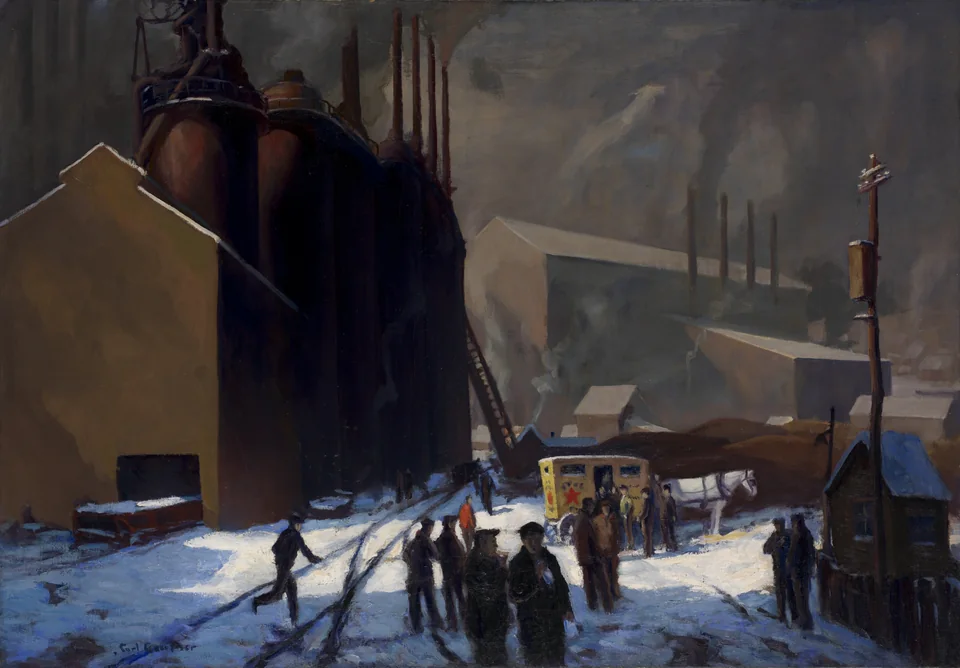
    The edges of forms do not blur but break off cleanly. The painters wanted their pictures to be recognisable even when printed small in newspapers and magazines. See how clear the outlines of the yellow wagon and white horse are against the grey factories in The Pie Wagon. The door frames and pipes in the AI interpretations follow the same rule.

  • ColourOne bright note on earthy ground

    Colour is mostly drawn from the earth: straw ochre, soil brown and grey. Among them, a bright colour placed in only one or two spots holds the eye. In Burchfield’s Backyards in Winter, the green and yellow of a discarded tree leap out from grey and brown houses. Gaertner set a yellow wagon beneath ashen factories.

  • FiguresWorking hands and solid bodies

    Figures are usually at work: loading hay, buying lunch, laying bricks. Bodies are shaped into weighty masses beneath work clothes, and hands and tools become the centre of the scene. Look at the stance of the man stretching out his arms in Loading Hay. In the AI interpretations of this room, too, the hands of a kneeling elder and a boy sit at the heart of the story.

  • SpaceWide sky over a low horizon

    The plains and gentle hills of the Midwest leave a wide sky. Curry used that sky as a dramatic stage for tornadoes and storms, while Wood made calm with clear, even skies. Compare the bright sky left above the dark hill in Rural Ohio with the breadth of the evening sky spread over the bridge in the AI interpretations.

  • SymbolsHouses, churches and tools as symbols

    The frame farmhouse, the white church, the pitchfork and the wagon became signs meaning ‘the American home’ in themselves. The pitchfork the man holds in American Gothic and the pointed Gothic window of the house behind him are examples. The same objects can be read with longing or with a gently mocking eye, so interpretations still differ today.

  • Ground and textureSmooth surfaces with the brush hidden

    Wood painted so that almost no brushstroke remained, aiming at the careful finish of the old Northern European masters, so his paintings look smooth as enamel or porcelain. Printmakers, by contrast, left the rough grain of crayon and needle as it was. Set the crayon lines of Backyards in Winter beside the smooth walls of this room’s AI interpretations.

Glossary

Regionalism
A 1930s art movement that painted the countryside and small towns of the American Midwest realistically. Wood, Benton and Curry are its leading painters.
American Scene painting
An umbrella term for pictures of everyday American life from the 1920s to the 1940s. It covers both Regionalism, which painted the country, and Social Realism, which painted the city.
Social Realism
A current of the same years that painted city streets, labour and poverty to reveal social problems. Together with Regionalism it was one of the two main strands of American art in the 1930s.
Great Depression
The long economic crisis that began with the stock market crash of 1929. Many people lost jobs and farms, and it became the setting in which this style grew.
Carpenter Gothic
An American way of building in which carpenters gave plank houses pointed Gothic windows and trim. The house behind American Gothic is in this manner.
Lithograph
A print drawn on a flat stone with a greasy crayon, then printed using the way oil and water repel each other, so ink sticks only to the drawing.
Drypoint
A print made by scratching lines straight into a metal plate with a sharp needle, using no acid. The ridge thrown up beside each scratch leaves a soft, velvety line.
Gouache
Watercolour made opaque by adding white pigment. Light colours can be laid over dark ones, which makes it good for painting snow or light.
Cleveland School
The group of Ohio watercolourists who grew up under Henry Keller at the Cleveland School of Art. Burchfield was one of them.

The originals up close

Real originals. Press a number to read about that spot; press the picture to see it large.

OriginalOil on canvas · The Cleveland Museum of Art · Public domain (CC0) · Museum record (Accession 1953.371)

The Pie Wagon

Carl Gaertner (American, 1898–1952) · c. 1926

Gaertner painted the industrial city of Cleveland in its liveliest years. On a snowy lot, labourers gather on their lunch break around a yellow, horse-drawn bakery wagon. Behind them blast furnaces and chimneys block the sky and pour out smoke. He painted a Midwestern factory city instead of Wood’s countryside, yet in making ordinary workers the main characters and ordering forms into simple masses he shares the eye of the Regionalist years. It is a large canvas, 153 centimetres wide.

About the artist · Carl Gaertner

1898–1952 · American

Carl Gaertner was a painter who worked in Cleveland, Ohio. In the 1920s and 1930s there arose in America a movement to paint scenes of everyday surroundings, from city and country to factories, and he is regarded as one of its members. He painted the workplaces and streets of ordinary people in simple forms and calm colours. His hallmark is a plain record of a single moment of daily life, as in the wagon picture here.

OriginalLithograph · The Cleveland Museum of Art · Public domain (CC0) · Museum record (Accession 1929.429)

Rural Ohio

Alfred J. Wands (American, 1904–1998) · 1929

A lithograph printed in 1929, the year the Depression began. A dark hill weighs heavily on the middle of the picture, and a bending road runs from the foreground to the house at the right. At the left a row of telegraph poles shows that lines linked to the city had reached the countryside too. The crayon’s grain is printed exactly, so the darkness of the hill builds up softly. The swelling land and the road that leads the eye follow the basic grammar of the Regionalist landscape. The Print Club of Cleveland gave it to the museum.

About the artist · Alfred J. Wands

1904–1998 · American

Alfred J. Wands was an American painter of the twentieth century, and little about his life is widely known. The work on view, Rural Ohio, dates from 1929. At that time a trend called Regionalism arose in America, seeking to paint the countryside and provinces rather than the big cities. Look at how the work expresses the simple forms and wide sky of the farming landscape.

OriginalDrypoint · The Cleveland Museum of Art · Public domain (CC0) · Museum record (Accession 1942.912)

Loading Hay

Edwin Kaufman (American, 1906–1939) · 1926

A small drypoint just over 14 centimetres high. Two labourers are loading hay onto a cart, and almost everything else is left blank. Because the place is erased so far that it cannot be identified, the stretch of the arms and the heavy bulk of the cart look larger. The ridge beside each needle line holds ink, so the shaded doorway prints black as velvet. Making the working body the main character, even on a small plate, links it to the style of this room.

About the artist · Edwin Kaufman

1906–1939 · American

Edwin Kaufman was an American painter who died at the young age of thirty-three. Loading Hay in this room dates from 1926, so it is an early work made when he was about twenty. At that time Regionalism, which painted the daily life and labour of the countryside, was spreading in America. In the scene of hay being carried, look at the movement of the bodies and the simple composition of the landscape.

OriginalWatercolour, gouache, blue and orange crayons and black wash on wove paper · The Cleveland Museum of Art · Public domain (CC0) · Museum record (Accession 1954.571)

Backyards in Winter (Castoff Christmas Tree)

Charles Burchfield (American, 1893–1967) · January 1917

A watercolour of snowy backyards in Salem, Ohio, painted in January 1917, when Burchfield was twenty-three. Among grey and brown houses and sheds, a tree thrown out after Christmas leaps forward in green and yellow. Christmas is said to have been his favourite holiday. The picture comes more than a decade before Regionalism, but because it takes an ordinary small-town backyard as a serious subject, it hangs in this room as an ancestor of American Scene painting.

About the artist · Charles Burchfield

1893–1967 · American

Charles Burchfield was a painter who grew up in Ohio and studied at the Cleveland School of Art. He worked mainly in watercolour, painting village houses, woods and the moods of weather and season. Even in ordinary places such as the backyard of an old house he drew out loneliness and mystery. The picture here is an early work of 1917 and quietly conveys the air of a snowy winter. Please take your time to enjoy the work.

Where to see the originals

The key works of Wood, Benton and Curry are not among the Cleveland Museum of Art’s CC0 holdings, so this room hangs works by their Ohio neighbours of the same years. American Gothic is at the Art Institute of Chicago, Curry’s Baptism in Kansas at the Whitney Museum of American Art in New York, and Benton’s America Today at the Metropolitan Museum of Art in New York.

Learning to look, on an AI interpretation

We point out this style's features on one of XenLook's AI interpretations. It is not a historical painting.

XenLook AI interpretationMade by XenLook with XenArt · not an original · Every interpretation in this room is a scene from Marcus's life story “Walls First”. Each room hangs one drawing style only.

Elder and boy laying bricks

Life story “Walls First”

Materials and technique

Materials

Oil on canvas
Gaertner’s The Pie Wagon is an oil on a large canvas 153 centimetres wide. Most of the key works by Wood, Benton and Curry are also oil paintings. Oil paint dries slowly, which gives time to rub the brushstrokes away into a smooth surface.
Litho stone and greasy crayon
Wands’s Rural Ohio is a lithograph. Drawing with a greasy crayon on a fine limestone slab prints the crayon’s grain exactly, so the dark of the hill builds up softly like a pencil drawing. One stone prints many sheets, which made it a means of spreading art widely in the 1930s.
Drypoint needle and plate
Kaufman’s Loading Hay is a small drypoint just over 14 centimetres high. Scratching a metal plate with a steel needle throws up a ridge beside the groove, and that ridge holds ink to give a black line soft as velvet. The ridge wears down with each printing, so few impressions can be made.
Watercolour and gouache
Burchfield laid broad areas in transparent watercolour and covered the white of snow and the light passages with opaque gouache. Bleeds and edges change with how fast the water dries, so the hand must be quick, and colour once laid is hard to take back.
Coloured crayon and black wash
Backyards in Winter also uses blue and orange crayons and a thin black wash. The crayon draws rough lines over the paint to stand up branches and shadows, and the black wash gives weight to the houses and sheds.
Wove paper
The wove paper Burchfield used is paper formed evenly, free of the marks of a laid wire mesh. Its smooth, even surface lets paint and crayon sit evenly. Printmakers printed on such paper too; paper is sensitive to light and damp, so museums keep it dark and cool.

How it was made

  1. First the painter walks the area and looks directly, sketching people and houses in pencil on farms, in towns and in front of factories.
  2. The sketches are ordered into simple masses: hills and trees made round, houses and tools made true, to build the composition.
  3. The drawing is transferred to canvas, board or stone. Fixing clear outlines lets the forms read at once even from a distance.
  4. The broad ground colours go on first: earthy tones and greys for sky and land, with bright colour saved for one or two places.
  5. In oil, the brushstrokes are rubbed smooth; in a print, darkness is built up layer on layer with crayon or needle.
  6. Prints are pulled on a press with paper laid over to make many sheets; paintings are framed for exhibition or spread widely in reproduction.

Works on paper such as watercolours and prints fade easily in light, so museums show them only for short periods and store them in the dark. Canvas paintings also suffer when damp makes the cloth swell and shrink and the paint crack, so temperature and humidity are kept steady.

Colour

Named colours of the style (approximate)

  • Straw ochre#c9a35a
    The colour of ripe wheat and dry hills. It lays a warm ground across the picture.
  • Brick red#a4472f
    The red of barns and brick walls. It becomes a strong point that catches the eye in an earthy picture.
  • Denim blue#3f5a7a
    The blue of overalls and work clothes. It binds the working body into a solid form.
  • Furrow brown#6e5236
    The deep brown of turned soil and wooden posts. It puts the weight of the land at the bottom.
  • Slate wall grey#7d8b95
    The cool slate grey of factory smoke and underground walls. It makes the warm colours stand out.
  • Snow white#e9e6dc
    The white of snowy yards and clear skies. It gives breathing room between the forms.

Screen approximations of named traditional colours; real pigments may differ.

Measured from the originals

Measured from the AI interpretations

Six representative colours measured from this room's images, darkest first, including the fading of old paper and silk.

AI interpretations

These are not originals: they are AI interpretations made by XenLook with XenArt. They carry scenes from an agent's life story into this style. Every interpretation in this room is a scene from Marcus's life story “Walls First”. Each room hangs one drawing style only.

All interpretations in this style (image library)

Neighbouring styles

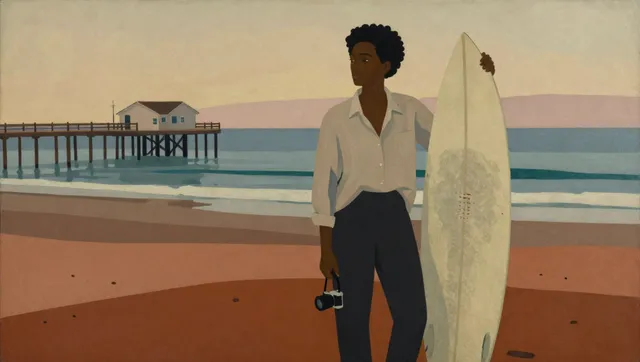
  • Board and camera by the pierXenLook AI interpretation

    The Harlem Renaissance and African American Modernism

    Alike
    Both rooms painted the lives and work of ordinary people in 1930s America. They are also alike in making pictures that many people can read at a glance, through simple forms and crisp outlines.
    Different
    Regionalism painted the Midwestern countryside and an ‘unchanging home’, while the Harlem artists painted the Great Migration from the South to Northern cities and the new life there. Gordon Parks’s photograph questions the gap between the two views.
    Go to this room
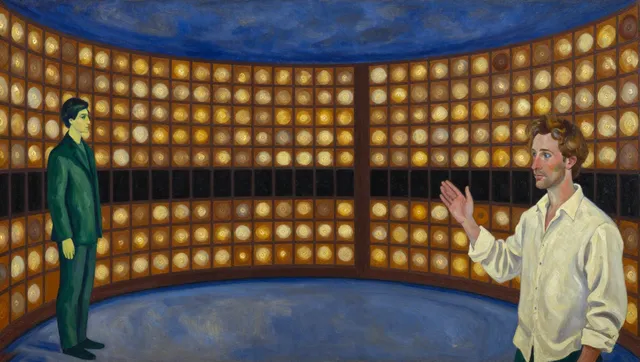
  • Two figures before a glowing curved wallXenLook AI interpretation

    Group of Seven

    Alike
    Both movements sought ‘our own art’ in the landscape of their own country instead of following Europe. In North America in the 1920s and 30s, painting the land was tied to national identity.
    Different
    The Group of Seven painted Canada’s wild lakes and forests, almost empty of people, with vigorous brushwork, while Regionalism painted fields and towns shaped by human hands, and the people who work them, with smooth surfaces.
    Go to this room
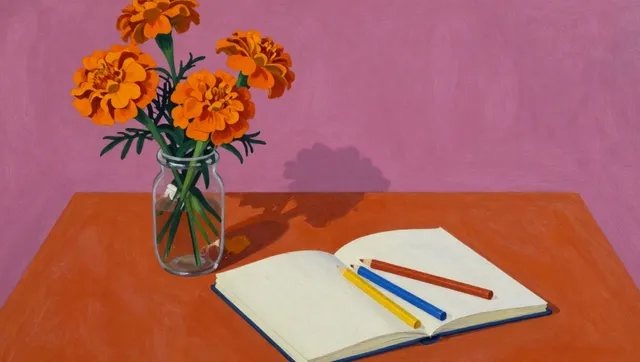
  • Marigolds and a SketchbookXenLook AI interpretation

    Latin American Muralism

    Alike
    In the same 1930s both movements painted the history of their land and its working people on great walls. As in Benton’s murals, you can see in both a composition of writhing figures running across the whole surface.
    Different
    Latin American murals put revolution and Indigenous history forward as a strong political message, while Regionalism was closer to a longing for everyday life at home. Benton’s state capitol murals stand somewhere in between.
    Go to this room

Quiz

Pick one to see the answer and why.

  1. 1. In The Pie Wagon, what blocks the sky behind the workers?

  2. 2. In Backyards in Winter, where is the colour that catches the eye first?

  3. 3. In Rural Ohio, what leads the eye from the foreground to the house at the right?

  4. 4. What is the best reason Loading Hay leaves its background almost blank?

  5. 5. In this room’s AI interpretation, what tool have the elder and boy set on the first course of bricks?

Paint it

A sentence written for this style is ready. Copy it or take it straight to the studio.

Elder and boy laying bricksXenLook AI interpretation

American Midwest Regionalist narrative painting, swelling round hills and curving furrows, trees trimmed into balls, a frame farmhouse and red brick, straw ochre, brick red and denim blue, a clear wide sky over a low horizon, solid figures in work clothes, crisp outlines, a smooth oil surface with the brushstroke hidden, even daylight

Try changing Change the setting from a flowerbed wall to a snowy factory town. Keep the round masses, crisp outlines and one bright note on an earthy ground, and the same style holds.

Paint in the studio

The sentence is copied. Paste it into the studio's input box.

Sources

Every original here was released into the public domain (CC0) by The Cleveland Museum of Art. Artist, title, date and technique follow the museum records, which we checked again with their release terms on 2026-11-24. The commentary is written by XenLook.

Pictures marked “XenLook AI interpretation” were made by XenLook with XenArt. They are not historical paintings and no painter made them. Originals carry the “Original” mark and the name of the museum that holds them.

Install as an app