Pierre-Auguste Renoir was born on 25 February 1841 in Limoges, a city in central France. His father Léonard was a tailor, and the family moved to Paris in 1844. The boy had a good voice and sang in a church choir, and is said to have been taught singing by the composer Gounod. Family circumstances, however, made him an apprentice in a porcelain factory at thirteen, painting plates and vases. The painting hand was thus trained first in a factory. It is a surprising start when you think that the poor tailor's son would later paint portraits of the Parisian upper class.
Around 1858 methods of mechanically reproducing pictures spread and the work vanished. Renoir earned a living painting fans and wall hangings, and copied old paintings at the Louvre in his spare time. Around 1862 he entered the studio of Charles Gleyre, where he met Alfred Sisley, Frédéric Bazille and Monet. These young friends would later become Impressionism. Renoir showed at the Salon for the first time in 1864 and had a success in 1868 with Lise with a Parasol. In 1869 he sat beside Monet and painted the riverside bathing spot La Grenouillère, studying the shimmering water together.
He took part in the first Impressionist exhibition in 1874, and in 1876 painted the midday dancing of Parisians in Dance at Le Moulin de la Galette. In 1878 he painted a portrait of a publisher's wife and her children, shown at the Salon of the following year, and from then on the Parisian upper class vied to commission portraits. Luncheon of the Boating Party was painted in 1880–81. He began as one of the Impressionists, but because Renoir could also paint pictures that sold at the Salon he moved between both worlds. One reason his pictures are warm may be that they hold the joy of such patrons.
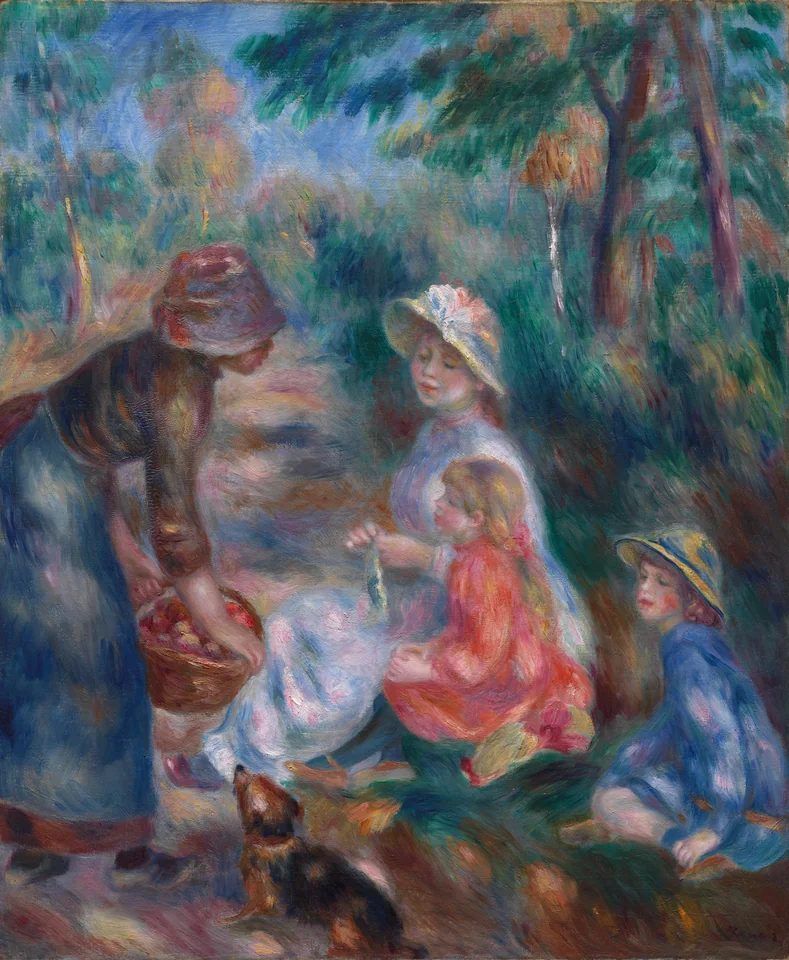
In 1881 he travelled to Algeria, Madrid and Italy and saw the paintings of Raphael and Titian. After the journey he is said to have felt that he had gone as far as he could with Impressionism. For several years he went through a period of firm outlines and painted Large Bathers from 1884 to 1887. This is often called the Ingres period, drawing on lessons from Ingres's contours. After 1890, however, he returned to soft, thinly laid colour. The Apple Seller, Roses in a Vase and Bathers Playing with a Crab in this room all come out of this later softness.
In 1890 Renoir married Aline Charigot, a seamstress. His son Pierre was born in 1885, Jean in 1894 and a third son in 1901. Gabrielle Renard, nurse to the children and a model, appears often in his paintings. The laundress and child in this room is a pastel with Aline and Pierre as models, and the museum says the person receiving the apples in The Apple Seller is also Aline. For him the family was not an outside subject but the everyday before his eyes. So the mothers and children in his pictures resemble not a distant ideal but the faces one meets every day.
From around 1892 rheumatoid arthritis began and his hands and body gradually stiffened. In 1907 he moved to Les Collettes in warm Cagnes in the south of France. Here one legend must be weighed. The tale that he painted with the brush strapped to his fingers is called erroneous by Wikipedia. He could hold a brush but needed an assistant to place it in his hand, and the bandages were to protect his skin. I think such distinctions are the reading of footnotes. It is courtesy to the sick not to dramatise their story but to tell only as much as was.
In the later 1890s Renoir worked with the art dealer Ambroise Vollard and also turned his hand to lithography. Pinning the Hat in this room is one of these, with Renoir drawing the design on the stone and the printer Auguste Clot printing each colour separately. Renoir died at Cagnes-sur-Mer on 3 December 1919, and is said to have visited the Louvre shortly before his death to look at the old paintings. The Barnes Foundation in Philadelphia holds 181 Renoirs, the largest collection in the world. The works in this room are opened to all as public domain by the Cleveland Museum of Art, also in the United States.