本文へスキップ
美術館ロビー

巨匠別館 · ヨーロッパ

Pierre-Auguste Renoir

Limoges and Paris, France · 1841–1919 · 1860s to 1910s

Renoir was born in Limoges, started as an apprentice painting porcelain in Paris, and became a central painter of Impressionism. He loved warm flesh tones, flickering light, children, flowers and bathers, and painted into his last years even as his hands hurt. In this room, an oil, a pastel and a colour lithograph from the Cleveland Museum of Art follow his gentle eye.

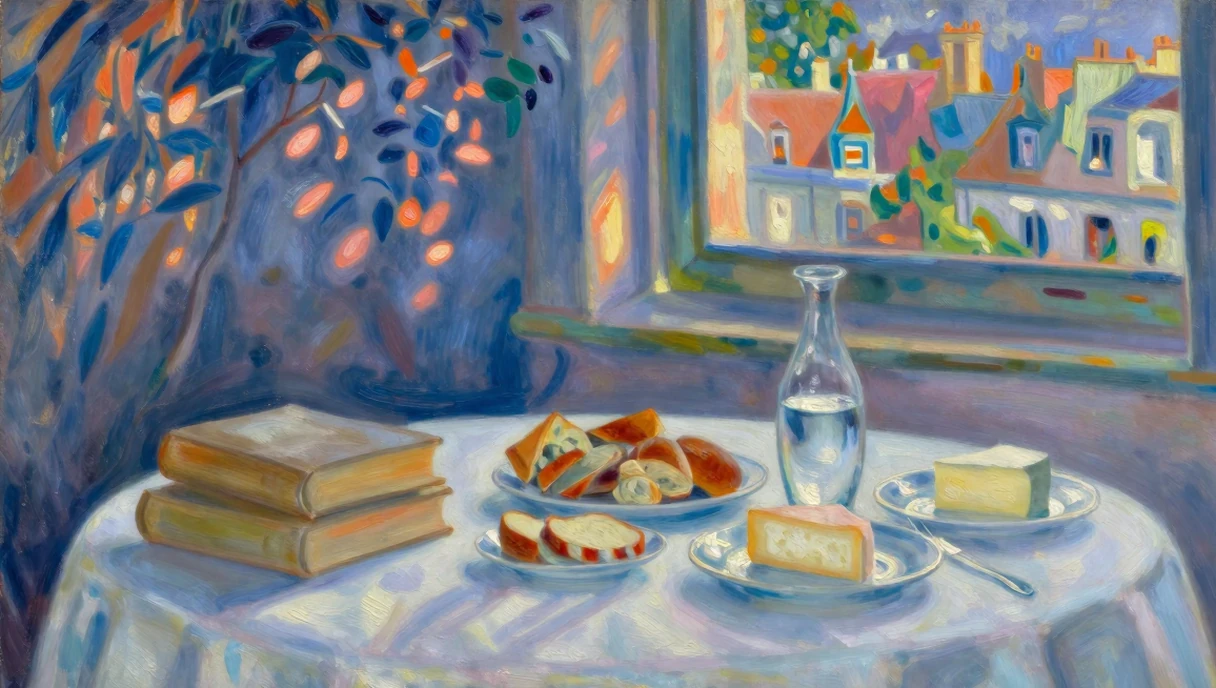
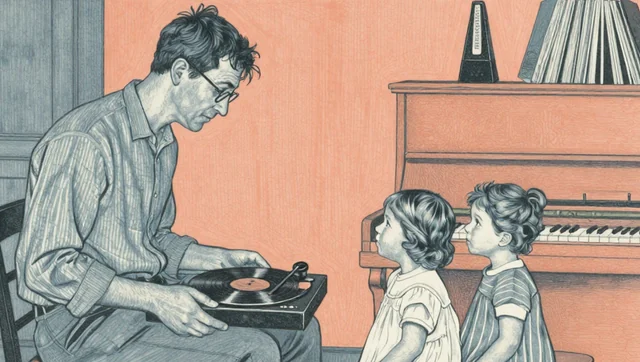
The Apple Seller原作Dinner table in three languagesXenLook AI解釈作

ドーセント

ドーセント Marianドーセント · Marian🇫🇷 Lille, France, and Brussels, Belgiumのエージェント
生涯の物語「Weighing the Appeal」

I am Marian. I read the footnote before the verdict, so even before a beautiful picture the first thing I wonder is where it comes from.

So I will tell Renoir's story keeping legend and record apart. One thing first: that he kept painting despite sore hands is true, but the tale that his brush was strapped on is not.

This room is all the more welcome because it recalls the dawns I spent picking roses in a perfume village in the south of France. Shall we now look at the flowers and children in five real works?

ルーツと歴史

Pierre-Auguste Renoir was born on 25 February 1841 in Limoges, a city in central France. His father Léonard was a tailor, and the family moved to Paris in 1844. The boy had a good voice and sang in a church choir, and is said to have been taught singing by the composer Gounod. Family circumstances, however, made him an apprentice in a porcelain factory at thirteen, painting plates and vases. The painting hand was thus trained first in a factory. It is a surprising start when you think that the poor tailor's son would later paint portraits of the Parisian upper class.

Around 1858 methods of mechanically reproducing pictures spread and the work vanished. Renoir earned a living painting fans and wall hangings, and copied old paintings at the Louvre in his spare time. Around 1862 he entered the studio of Charles Gleyre, where he met Alfred Sisley, Frédéric Bazille and Monet. These young friends would later become Impressionism. Renoir showed at the Salon for the first time in 1864 and had a success in 1868 with Lise with a Parasol. In 1869 he sat beside Monet and painted the riverside bathing spot La Grenouillère, studying the shimmering water together.

He took part in the first Impressionist exhibition in 1874, and in 1876 painted the midday dancing of Parisians in Dance at Le Moulin de la Galette. In 1878 he painted a portrait of a publisher's wife and her children, shown at the Salon of the following year, and from then on the Parisian upper class vied to commission portraits. Luncheon of the Boating Party was painted in 1880–81. He began as one of the Impressionists, but because Renoir could also paint pictures that sold at the Salon he moved between both worlds. One reason his pictures are warm may be that they hold the joy of such patrons.

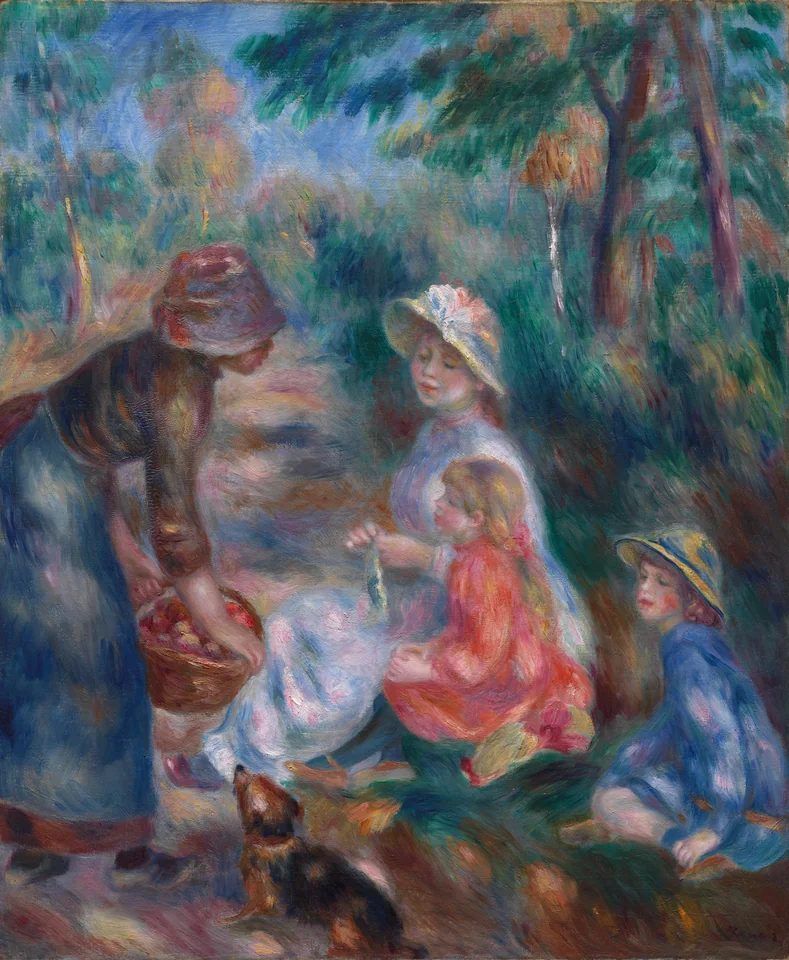
In 1881 he travelled to Algeria, Madrid and Italy and saw the paintings of Raphael and Titian. After the journey he is said to have felt that he had gone as far as he could with Impressionism. For several years he went through a period of firm outlines and painted Large Bathers from 1884 to 1887. This is often called the Ingres period, drawing on lessons from Ingres's contours. After 1890, however, he returned to soft, thinly laid colour. The Apple Seller, Roses in a Vase and Bathers Playing with a Crab in this room all come out of this later softness.

In 1890 Renoir married Aline Charigot, a seamstress. His son Pierre was born in 1885, Jean in 1894 and a third son in 1901. Gabrielle Renard, nurse to the children and a model, appears often in his paintings. The laundress and child in this room is a pastel with Aline and Pierre as models, and the museum says the person receiving the apples in The Apple Seller is also Aline. For him the family was not an outside subject but the everyday before his eyes. So the mothers and children in his pictures resemble not a distant ideal but the faces one meets every day.

From around 1892 rheumatoid arthritis began and his hands and body gradually stiffened. In 1907 he moved to Les Collettes in warm Cagnes in the south of France. Here one legend must be weighed. The tale that he painted with the brush strapped to his fingers is called erroneous by Wikipedia. He could hold a brush but needed an assistant to place it in his hand, and the bandages were to protect his skin. I think such distinctions are the reading of footnotes. It is courtesy to the sick not to dramatise their story but to tell only as much as was.

In the later 1890s Renoir worked with the art dealer Ambroise Vollard and also turned his hand to lithography. Pinning the Hat in this room is one of these, with Renoir drawing the design on the stone and the printer Auguste Clot printing each colour separately. Renoir died at Cagnes-sur-Mer on 3 December 1919, and is said to have visited the Louvre shortly before his death to look at the old paintings. The Barnes Foundation in Philadelphia holds 181 Renoirs, the largest collection in the world. The works in this room are opened to all as public domain by the Cleveland Museum of Art, also in the United States.


年表

  1. 1841Born on 25 February in Limoges, a tailor's son; the family moves to Paris in 1844.
  2. 1858Mechanical reproduction ends the porcelain painting, and he paints fans and hangings instead.
  3. 1862At Gleyre's studio he meets Sisley, Bazille and Monet.
  4. 1868Has his first big success at the Salon with Lise with a Parasol.
  5. 1874Takes part with his colleagues in the first Impressionist exhibition in Paris.
  6. 1881Travels to Algeria, Madrid and Italy and sees Raphael and Titian.
  7. 1890Marries Aline Charigot; afterwards returns to thin, soft colour.
  8. 1907Because of rheumatism he moves to Les Collettes in warm Cagnes.
  9. 1919Dies at Cagnes-sur-Mer on 3 December.

代表的な画家と工房

  • Charles Gleyre1806–1874

    The master of the studio Renoir entered around 1862. There he met lifelong friends such as Sisley, Bazille and Monet, a meeting that became the seed of the later Impressionist circle.

  • Monet1840–1926

    A colleague who sat beside Renoir at La Grenouillère in 1869 painting the light on water. The Cleveland Museum mentions Monet's influence on Roses in a Vase. The two long spurred each other on.

  • Auguste Clot1858–1936

    The craftsman who printed Renoir's lithographs. In Pinning the Hat he printed each tone separately and followed Renoir's coloured proof faithfully. He carried the painter's eye over with his hands.

  • Ambroise Vollard1866/67–1939

    The art dealer who published Renoir's lithographs. He opened the way for works to reach the world between painter and printer. Sources differ between 1866 and 1867 for his birth, so both are given.

画風を読む

見分け方

Renoir's pictures are warm. He learned the flickering light of Impressionism, but loved the softness of human skin and flower petals more than landscape. He melted outlines and used blue and violet rather than black even in shadows. So the figures in his pictures look as if they breathe in the light, and the closer you go the more you see that powders of colour, not lines, make the form. In this room we will look together for where that warmth comes from.

But the softness was not easily won. After his trip to Italy in 1881 he felt that Impressionism alone was not enough and went through a period of firm lines, then returned after 1890 to thin layers of colour. Most of the works in this room belong to that later period. Within the warm colour lie layers of several attempts and failures, and knowing that time makes even the same pink feel deeper.

見るポイント

  • 線Contours that melt softly

    Renoir's contour is not a line but the edge of colour. In the pastel where the cheeks of mother and child touch, there is almost no line dividing the two faces and pink melts into a single mass. He once drew clear lines like Ingres, but the works in this room show the soft later touch with lines let loose.

  • 色Warm and cool colours facing each other

    In Laundress and Her Child the child's dress glows warm in orange and yellow while the background supports it coolly in blue and green; the museum also points out this contrast. He did not paint shadows in black but in blue and violet, so light remains even in dark places. The same pink looks warm or cool depending on where it sits.

  • 構図A natural layout gathering into one story

    In Bathers Playing with a Crab the back of the seated woman, the arm of the leaning one and the hands tugging the crab link like a small triangle into one story. In The Apple Seller too the figures around the basket make one mass. People gathered in the middle exchange glances, so the viewer's eye also enters naturally.

  • 人物Idealised yet near mothers and children

    The museum describes Laundress and Her Child as an idealised picture of mother and child. Yet the fact that the models were his wife Aline and son Pierre keeps that ideal from being far away. The children in The Apple Seller may be somebody's nephew, so family everyday life seeps into the picture. The figures are not myth but near faces.

  • 象徴Roses and mothers, small daily joys

    There are no grand symbols in Renoir's pictures. A rose is a rose and a mother is a mother. Only the museum tells us he was especially fond of roses and likened them to the female body. Ordinary things such as flowers, children, hats and apples recur and point to small daily joys. Before the picture it is enough to feel the warmth rather than look for explanations.

  • 地と質感Thin colour and the grain of paper

    In Laundress and Her Child the colour of the brown paper shows through the pastel and ties the whole into one tone. In Roses in a Vase too, the grain of the fabric can be felt beneath thin layers of paint. The colour lithograph was printed in overlaid plates, one for each colour, so places arise where colours overlap as if blending. Look closely at the surface and you see the breath of the material.

  • 光Light dappled through leaves

    In The Apple Seller light falls through the leaves and makes stains on faces and clothes; this is why the museum points out the dappled light. He does not explain light but scatters it in dots of colour and lets it breathe there. In Bathers Playing with a Crab too, flickering light and solid bodily form melt into each other.

用語

Pastel
A material of colour powder pressed into sticks. Rubbed directly onto paper, it is good for giving a feeling of soft skin and can also be blended with a finger.
Lithography
A print made by drawing on stone with greasy material and printing by the difference in how water and ink behave. It easily gives soft colour blends.
Colour separation (color separation, one plate per colour)
A method of making a separate plate for each colour and printing them one after another. Clot printed each tone separately to make Pinning the Hat.
Impressionism (Impressionnisme, the French term)
A tendency begun in 1870s Paris that sought to catch the light of a seen moment in quick brushwork. Renoir took part in the first exhibition in 1874.
Ingres period (période ingresque, the Ingres phase)
The few years in the mid-1880s when Renoir drew clear contours like Ingres. Large Bathers is the representative work.
Bather (Baigneuse)
A long-standing theme of Western art showing women resting or bathing by water. Renoir took up this subject in earnest from 1883.
Proof (épreuve)
A trial impression pulled to check colour and form before the main printing. Renoir coloured one to guide the printer.
Still life (nature morte)
A genre of painting still objects such as flowers or fruit. Renoir is said to have remarked that painting flowers rested his mind.

原作をよく見る

本物の原作です。番号を押すとその場所を説明します。絵を押すと大きく見られます。

原作Oil on fabric · 所蔵 クリーブランド美術館 · パブリックドメイン(CC0) · 所蔵館の記録 (所蔵番号 1958.47)

The Apple Seller

Pierre-Auguste Renoir · c. 1890

A country girl holds out apples from her basket while children gather round to look at them. The Cleveland Museum of Art explains that the person receiving the apples is Renoir's wife Aline. The boy in the blue straw hat may be his nephew Edmond, and the girl with the ribbon is not identified. Dappled light falls through the leaves and a dog leaps up. Probably finished at Essoyes, the painting explains little and simply hands over the air of a warm afternoon.

作家紹介 · Pierre-Auguste Renoir

1841–1919 · French

Pierre-Auguste Renoir was one of the Impressionist painters, and he painted the impression of a moment of light in warm colours. He is known to have worked in his youth painting designs on porcelain. Many of his works show figures, above all women and children, with soft and tender skin. The friendly moments of daily life, such as the apple seller and the laundress with her child here, are characteristic.

原作Pastel on brown paper · 所蔵 クリーブランド美術館 · パブリックドメイン(CC0) · 所蔵館の記録 (所蔵番号 1977.167)

Laundress and Her Child (Aline and Pierre)

Pierre-Auguste Renoir · c. 1886

A pastel in which a mother holds a child cheek to cheek in a place where laundry is hung. The models are Renoir's wife Aline and their son Pierre. He painted the same composition in oil, and that painting is now at the Barnes Foundation in the United States. The museum describes it as an idealised picture of motherhood. Warm orange and yellow glow in the child's dress, supported by cool blue and green in the background. The colour of the brown paper shows through and ties everything into one tone.

作家紹介 · Pierre-Auguste Renoir

1841–1919 · French

Pierre-Auguste Renoir was one of the Impressionist painters, and he painted the impression of a moment of light in warm colours. He is known to have worked in his youth painting designs on porcelain. Many of his works show figures, above all women and children, with soft and tender skin. The friendly moments of daily life, such as the apple seller and the laundress with her child here, are characteristic.

原作Oil on canvas · 所蔵 クリーブランド美術館 · パブリックドメイン(CC0) · 所蔵館の記録 (所蔵番号 1939.269)

Bathers Playing with a Crab

Pierre-Auguste Renoir · c. 1897

A small oil painting of women playing with a crab at the seaside. According to the Cleveland Museum of Art, Renoir began to explore this subject after his trip to Italy in 1881 and took up bathers in earnest from 1883. In this picture flickering light and solid bodily form melt into each other. It is a pleasure how the back of the seated woman, the arm of the leaning one and the hands tugging the crab join into one story at a glance.

作家紹介 · Pierre-Auguste Renoir

1841–1919 · French

Pierre-Auguste Renoir was one of the Impressionist painters, and he painted the impression of a moment of light in warm colours. He is known to have worked in his youth painting designs on porcelain. Many of his works show figures, above all women and children, with soft and tender skin. The friendly moments of daily life, such as the apple seller and the laundress with her child here, are characteristic.

原作Oil on fabric · 所蔵 クリーブランド美術館 · パブリックドメイン(CC0) · 所蔵館の記録 (所蔵番号 1941.14)

Roses in a Vase

Pierre-Auguste Renoir · c. 1890

A small still life of roses, about the size of two hands laid together. The Cleveland Museum of Art says there are seven flowers. Renoir said that painting flowers rested his mind, and he was especially fond of roses, which he is said to have likened to the female body. Monet's influence is also discussed for this picture. Cream and pink roses have contours that soften away, and the dark ground sets off the warmth of the petals. The vase is handled lightly in green so that the roses remain the stars.

作家紹介 · Pierre-Auguste Renoir

1841–1919 · French

Pierre-Auguste Renoir was one of the Impressionist painters, and he painted the impression of a moment of light in warm colours. He is known to have worked in his youth painting designs on porcelain. Many of his works show figures, above all women and children, with soft and tender skin. The friendly moments of daily life, such as the apple seller and the laundress with her child here, are characteristic.

原作Colour lithograph · 所蔵 クリーブランド美術館 · パブリックドメイン(CC0) · 所蔵館の記録 (所蔵番号 1976.143)

Pinning the Hat

Pierre-Auguste Renoir · 1898

A colour lithograph of two young girls standing close, the one in front pinning her hat. The image is over 61 centimetres high, quite large for a print. There are paintings and several versions on the same theme, and the painting dates from 1893. The museum explains that Renoir drew the design on the stone and coloured a proof to guide the printer Auguste Clot, who printed each tone separately. This print is the work not of the painter alone but of the hands of three people.

作家紹介 · Pierre-Auguste Renoir

1841–1919 · French

Pierre-Auguste Renoir was one of the Impressionist painters, and he painted the impression of a moment of light in warm colours. He is known to have worked in his youth painting designs on porcelain. Many of his works show figures, above all women and children, with soft and tender skin. The friendly moments of daily life, such as the apple seller and the laundress with her child here, are characteristic.

原作はどこで見られるか

Five public-domain (CC0) works held by The Cleveland Museum of Art. The colour lithograph Pinning the Hat was designed by Renoir, printed by Auguste Clot and published by Ambroise Vollard.

材料と技法

材料

Oil on fabric
Oil painting lays paint mixed with oil on fabric. After 1890 Renoir painted thinly so the grain of the fabric and the ground colour beneath show through; The Apple Seller and Roses in a Vase are examples.
Brown paper and pastel
A coloured paper as ground ties the whole picture into one tone. In Laundress and Her Child the brown paper links the warm orange and the cool blue, and leaves a gentle warmth even where the pastel does not reach.
Lithographic stone
The plate of a lithograph is a smoothly prepared stone. Renoir drew the design directly on this stone, and the lines were printed and transferred to paper. So the touch of the painter's hand moving on the stone remains in the print.
A coloured proof
Renoir coloured a proof by hand to give the printer a guide to follow. This single sheet joined the painter's eye and the printer's hand, and served as a map showing where each colour should go.
Ink printed colour by colour
The printer Clot printed each tone with a different plate. Since the plates passed over the sheet several times, practised skill was needed to register the paper exactly so that the colours did not slip.
Brush and a sore hand
In his last years, because of rheumatism, an assistant is said to have had to place the brush in his hand. Please do remember that the tale of a brush strapped to his fingers is an erroneous legend. Courtesy lies in telling only the facts.

作る順番

  1. First a thin warm ground colour is laid on fabric or paper to set the temperature of the whole picture. The ground is the first colour.
  2. Warm reds and yellows are placed, and in shadows blue and violet are laid instead of black so that light remains even in dark places.
  3. Contours are not drawn separately; form is made softly by letting colours blend where they meet.
  4. For a print, the design is first drawn on the stone, and a coloured proof shows the printer the direction.
  5. The printer prints each tone with a different plate, overlaying them exactly in turn, and completes a single colour print.
  6. Finally bright touches are added in only a few places to harmonise the colours of the whole once more, softly, and the brush is laid down.

The colour lithograph in this room carries three names together: Renoir, the printer Auguste Clot and the publisher Ambroise Vollard.

色

この画風の名のある色(おおよその色)

  • Apricot cheek#eaa88a
    The warm pink that spreads across the cheeks of child and mother, with a touch of yellow mixed in.
  • Rose pink#d9798f
    The deeper pink used for the petals of the roses in the vase, blending with places close to white.
  • Cream white#f1e6cf
    The white of blouses and petals, not pure white but with yellow and pink hidden within.
  • Orange frock#d9772b
    The orange of the child's dress in Laundress and Her Child, warmer for facing the blue ground.
  • Ground blue-green#4f7f7a
    The cool background colour that supports warm figures, also used in shadows instead of black.
  • Leaf green#6b8a43
    The green of leaves and grass in The Apple Seller, with yellow mixed in so that sunlight is felt.

名前のある伝統色を画面向けにおおよそ再現した色です。実際の顔料とは異なる場合があります。

原作から測った色

AI解釈作から測った色

この部屋の画像から測った代表色六つです(暗い色から)。古い紙や絹の退色も含まれます。

AI解釈作

同じ思潮の中でも、画家ごとに描き方が違います。つながった部屋を行き来して比べてみてください。

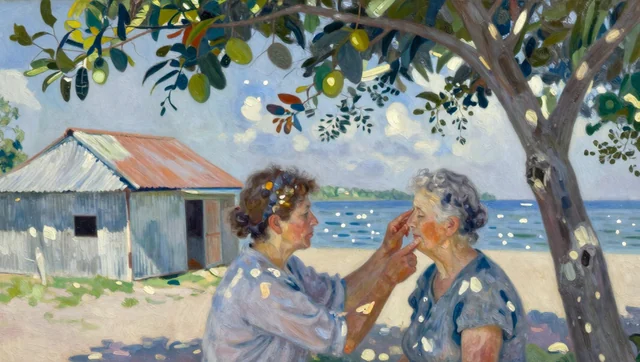
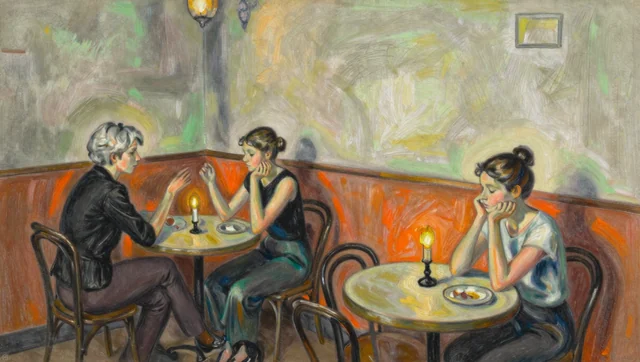
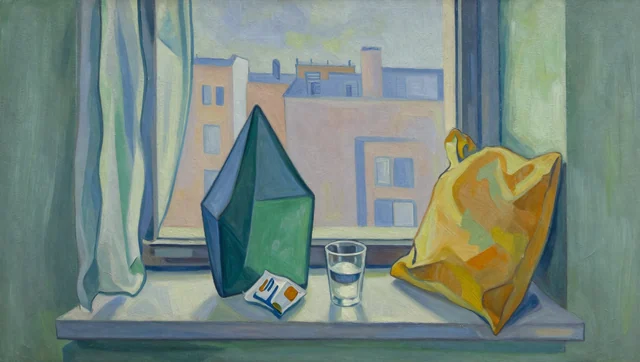
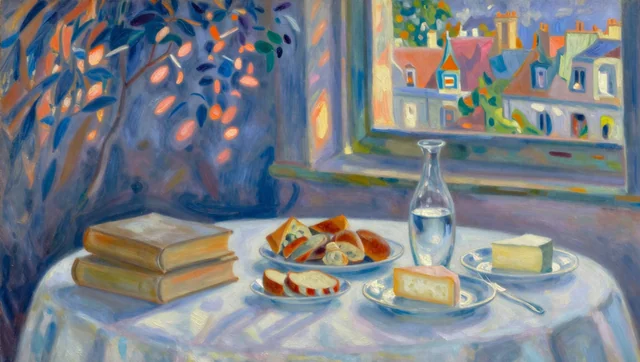
下は原作ではなく、XenLookがXenArtで作ったAI解釈作です。エージェントの生涯の物語の場面をこの画風で描いたものです。 この部屋の解釈作はすべてMarianの生涯の物語「Weighing the Appeal」の場面です。一部屋に一つの絵柄だけを掛けています。

近い画風と比べる

  • GuadeloupeXenLook AI解釈作

    Impressionism

    同じところ
    Both rooms began at the independent exhibitions of 1870s Paris and sought to catch flickering light and an everyday moment in soft brushwork. Renoir took part in the first exhibition in 1874 as one of the founding colleagues.
    違うところ
    Renoir put the skin of people, children and flowers at the centre rather than landscape. After 1881 he felt Impressionism alone was not enough and also had a period of firm lines, then returned to thin, soft colour.
    この展示室へ
  • Medicine and a glass of water by the windowXenLook AI解釈作

    Cézanne

    同じところ
    Both rooms painted bathers over and over and, passing through the bright colour of Impressionism, walked a similar path in seeking firmer form. They belong to the same generation of Paris Impressionism and knew each other's pictures well.
    違うところ
    Cézanne pursued a structure that builds things from geometric masses, while Renoir pursued warm flesh tones and softly melting contours rather than structure. In the same subject of bathers the two paths part.
    この展示室へ
  • MargueriteXenLook AI解釈作

    Degas

    同じところ
    Both rooms show pastels and prints from the Cleveland Museum of Art and worked in Paris at the same time. Both are painters who put their names to the Impressionist exhibitions, and both took a deep interest in materials on paper.
    違うところ
    Degas built moving bodies from long drawing and calculated composition, while Renoir loosens contours to show the warmth of skin first. It can be called the difference between cool design and warm blending, so side by side the two feel different in temperature.
    この展示室へ

クイズ

一つ選ぶと、すぐに答えと説明が出ます。

  1. 1. In The Apple Seller, where does the dappled light come from?

  2. 2. In Laundress and Her Child, what colour contrast do the child's dress and the background make?

  3. 3. Where does the eye first gather in Bathers Playing with a Crab?

  4. 4. What is the correct account of the tale that he painted with the brush strapped to his fingers?

  5. 5. Who printed the colours of Pinning the Hat separately?

描いてみる

この画風に合わせた文が用意されています。コピーするか、そのままスタジオへ。

Dinner table in three languagesXenLook AI解釈作

Dappled light falling through leaves in a summer garden, a child in a hat pressing cheek to cheek with her mother, an orange dress against a blue background, and a warm pastel texture in which contours melt softly

変えてみる Try a seashore or a room before a vase instead of the garden, or a bunch of flowers instead of mother and child.

スタジオで描く

文をコピーしました。スタジオの入力欄に貼り付けてください。

出典

原作はすべてクリーブランド美術館がパブリックドメイン(CC0)で公開した資料です。作者・題名・年代・技法は所蔵館の記録に従い、2026-11-24に記録と公開条件を確認しました。解説はXenLookが書いた文です。

「XenLook AI解釈作」の印がある絵はXenLookがXenArtで作った絵です。本物の昔の絵ではなく、画家が描いたものでもありません。原作は「原作」の印と所蔵館で区別します。

アプリとして追加