تخطَّ إلى المحتوى
Museum lobby

Art movements wing · East Asia

Rinpa (琳派) — Kyoto Design Laying the Seasons on Gold

Japan · 17th to early 20th century · Early Edo period to the modern era

Rinpa (琳派) is a decorative painting tradition opened in 17th-century Kyoto by Hon'ami Kōetsu and Tawaraya Sōtatsu, and given its name through Ogata Kōrin and his brother. Flowers, waves and gods are set large and simple on gold grounds, and pooled pigment is a favourite effect. It was not a school of masters and pupils: later artists reinterpreted the work of those they admired. This room brings together screens, ceramics and a woodblock album leaf.

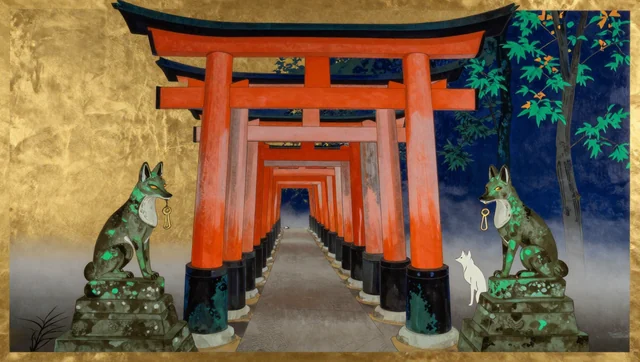
God of Thunder (Raijin)OriginalA thousand gates on Mount InariXenLook AI interpretation

Docent

Docent Shizuka (静香)Docent · Shizuka (静香)🇯🇵 Agent from Japan · Zenko, a benevolent fox spirit (zenko) of Fushimi Inari
Life story “The Fox Who Matches the Breath”

Welcome. I am Shizuka (静香). I grew up at the foot of Fushimi Inari in Kyoto, and now I do counselling at XenLook in Seoul. Please let out one breath before you come in.

Rinpa is painting that sets flowers and waves large upon a gold ground. If you rest your eyes on it for a while, the mind begins to settle, so I suggest you look slowly. There is no hurry.

Finding just one spot you like is enough. The marked places are ones I looked at first, so please follow along at your ease.

Roots and history

The name Rinpa (琳派) joins the single syllable rin (琳) of Ogata Kōrin (尾形光琳) to the word for school, ha (派), and is said to have been coined in the Meiji period. Before that the style went by names such as the Kōetsu school, the Kōetsu–Kōrin school and the Sōtatsu–Kōrin school. The name wavered because Rinpa was never a formal school. Instead of a master handing a method to a pupil, a later artist, moved by an earlier artist's picture, redrew its design in his own way. So artists separated by generations, sometimes by centuries, stand together in one stream.

The starting point of Rinpa is 17th-century Kyoto. Hon'ami Kōetsu (本阿弥光悦, 1558–1637) made his name in calligraphy, lacquer and ceramics, and in 1615 he founded a community of craftsmen at Takagamine, northeast of Kyoto, supported by wealthy merchant patrons. His collaborator Tawaraya Sōtatsu (俵屋宗達) kept a studio in Kyoto and painted fans and folding screens, and became known for adding pictures to Kōetsu's writing. Sōtatsu's dates differ between sources, so the Cleveland Museum of Art gives c. 1570 to c. 1640.

About fifty years later the brothers Kōrin (1658–1716) and Kenzan (乾山, 1663–1743) revived the stream. Both were born into a prosperous Kyoto textile-merchant family. The Cleveland Museum of Art suggests that Kōrin's early closeness to the family cloth-design business may have grown into his skill at distilling and refining designs. In 1701 he received the title hokkyō (法橋), and in 1704 he moved to Edo, where commissions were easier to find. Screens such as Irises and Red and White Plum Blossoms are counted among his masterpieces.

Kenzan studied under the potter Nonomura Ninsei and in 1699 opened his own kiln at a mountain villa in Kyoto. Kōrin and Kenzan went on collaborating, Kōrin painting designs and calligraphy on his brother's pottery, and the plover dish in this room is one example. Kenzan moved to Edo in 1731 and spent the rest of his life there. The man who revived Kōrin's name was Sakai Hōitsu (酒井抱一, 1761–1828) of Edo. Trained in the Kanō school, he became a Buddhist priest in 1797 and in 1815 published Kōrin's pictures as a woodblock album, Kōrin Hyakuzu. His pupil Suzuki Kiitsu (鈴木其一) also led Edo Rinpa.

The last great scene of Rinpa is early 20th-century Kyoto. Kamisaka Sekka (神坂雪佳, 1866–1942), born in Kyoto to a samurai family, was sent to Glasgow by the Japanese government in 1901 and was deeply influenced there by Art Nouveau. Back home he taught at the newly opened Kyoto Municipal School of Arts and Crafts and blended Western tastes into a traditional style. Commissioned by the Kyoto publisher Unsodo between 1909 and 1910, he produced the three-volume Momoyogusa, and Chrysanthemum Boy in this room is one leaf from it. The scenes he chose follow the precedents of his Rinpa forerunners closely.

The six works in this room show the same subjects returning across the centuries. The chrysanthemum appears in the Kōrin-style screens, in Hōitsu's screen and in Sekka's print. The design of plovers over waves is said to derive from Heian-period (900s–1100s) literature and later lacquerware, and the God of Thunder began in Buddhist art and was reinterpreted by Rinpa artists generation after generation. The subject does not wear out; only the interpretation changes. In front of each picture, look for how an earlier artist's design has been altered.


Timeline

  1. 1615Hon'ami Kōetsu founded a craftsmen's community at Takagamine, northeast of Kyoto, backed by wealthy merchant patrons.
  2. c. 1634Sōtatsu is dated to this time for the poetry sheet pairing the Beach at Sumiyoshi from the Tales of Ise with its poem.
  3. 1699Kenzan set up his own kiln at a mountain villa in Kyoto and began firing pottery.
  4. 1701Kōrin was awarded the title hokkyō (法橋), the third highest rank given to Buddhist artists.
  5. 1704Kōrin moved from Kyoto to Edo, where lucrative commissions were more readily available.
  6. 1731Kenzan, invited by an imperial prince, moved to Edo and spent the rest of his life there.
  7. 1815Hōitsu published Kōrin Hyakuzu, a woodblock album gathering Kōrin's pictures.
  8. 1901Sekka was sent to Glasgow by the Japanese government and met Art Nouveau there.
  9. 1909–10Sekka's woodblock album Momoyogusa was produced on commission from the Kyoto publisher Unsodo.

Key painters and workshops

  • Hon'ami Kōetsu1558–1637

    Born into a family of sword connoisseurs, he made his name in calligraphy, lacquer and tea ceramics. He led the Takagamine craftsmen's community and opened the door to Rinpa.

  • Tawaraya Sōtatsuc. 1570–c. 1640

    He kept a studio in Kyoto and painted fans and screens. Bold outlines, striking colour and gold grounds mark his work, and later artists followed him again and again.

  • Ogata Kōrin1658–1716

    From a Kyoto textile-merchant family, he lent Rinpa its name through screens and designs for lacquer and ceramics. He moved to Edo in 1704.

  • Ogata Kenzan1663–1743

    Kōrin's younger brother, who studied under the potter Ninsei. He opened a kiln in 1699 to shape the vessels that carried his brother's designs, and moved to Edo in 1731.

  • Sakai Hōitsu1761–1828

    Starting in the Kanō school in Edo, he revived Kōrin's style. He published Kōrin Hyakuzu in 1815 and was loved by urban clients for his two-panel screens.

  • Kamisaka Sekka1866–1942

    After seeing Art Nouveau in Glasgow, he carried Rinpa into the modern age in Kyoto through design and woodblock albums. Momoyogusa is his masterpiece.

Reading the style

How to recognise it

Rinpa pictures are read first as surfaces. A gold ground fills the picture, and flowers, gods or waves are set upon it large and simple, so that you seem to see a well-made pattern rather than a painting. The Cleveland Museum of Art points to the groomed flower clusters in the Kōrin-style screens and the gold-crested waves that recall kimono designs. The aim is not to look real but to filter the most beautiful single moment out of nature and set it down in large fields.

Another feature is pigment that spreads. Tarashikomi (垂らし込み) is a technique of dropping a second colour onto a colour still wet so that the two soak together, and in Hōitsu's paulownia trunk it makes the effect of lichen-dotted bark. A dropped pigment cannot be taken back, so the painter must judge in advance how it will spread. In this room it shows best in Hōitsu's trunk and chrysanthemum leaves.

Finally, Rinpa inherits its subjects. The same chrysanthemums, waves and God of Thunder appear with a new face in each artist, and the picture travels from gold screens to ceramics and woodblock albums. So in front of Rinpa it is better to ask how this design has been changed this time than who drew it first. Compare the same subject across the originals.

What to look for

  • Ground and textureThe Gold Ground as a Glowing Surface

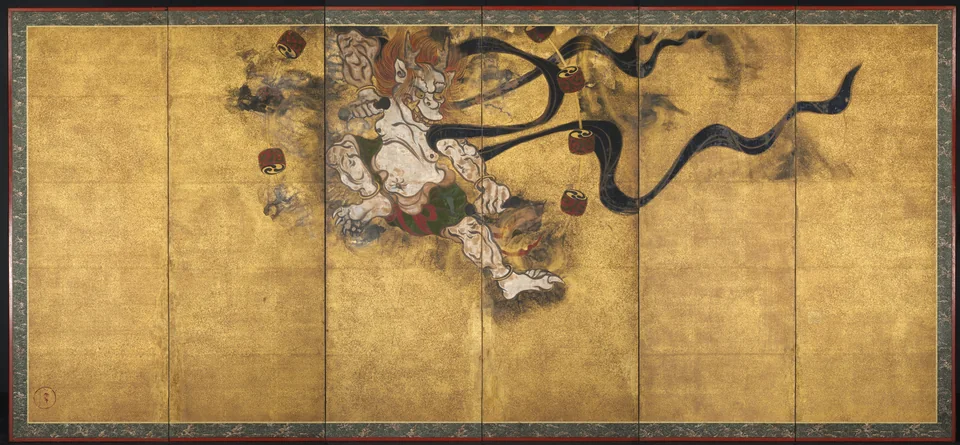
    The Raijin of the Sōtatsu workshop was painted on paper covered with gold dust, and the Kōrin-style chrysanthemum screens and Hōitsu's screen on gilded paper. The gold becomes neither sky nor earth but a glowing surface from which flowers and gods stand out. The way the glitter changes with the viewing position is part of the pleasure of a screen.

  • CompositionBold Cropping and Simple Placement

    In Hōitsu's screen a slanting trunk and flower clusters sit in the upper part while water and grasses support them below. The Kōrin-style screen sets a band of waves and flower groupings apart from one another. This placement, with gaps left between separate masses, makes the picture read like a pattern.

  • LineBold Outline and Flowing Line

    Sōtatsu is said to have opened a new way with bold outlines and striking colour. In Raijin a black band sweeps around the god in one stroke, and on Kenzan's dish plovers and waves run like brush writing. The line shows the direction of movement rather than explaining things.

  • ColourA Few Colours in Large Fields

    In Hōitsu's screen blue paulownia flowers and white and yellow chrysanthemums meet against the gold. In the Kōrin-style screen a dark blue band of waves holds the centre of the picture. The colours are few, but each field is large, so it reads from far away and, close up, spreading pigment is hidden within.

  • SpaceEmpty Space Filled with Gold

    In Raijin the surroundings of the god are broadly empty, and only gold fills the place. This empty gold is cloud and air and room for the god to move. Hōitsu and the Kōrin-style screen likewise leave gaps between flowers, making a scene without drawing every patch of water and earth.

  • SymbolsSeasons and Literature in Design

    Paulownia marks late spring and chrysanthemum early autumn, and both are emblems of the Japanese imperial house. Plovers and waves came from Heian-period literature and lacquerware design, and the Beach at Sumiyoshi is paired with a poem from the Tales of Ise. A single design layers a season and an old story.

  • FiguresFigures Reduced to Gesture

    The god of Raijin, ringed by drums, announces sound and lightning through face and gesture alone. The people on the Beach at Sumiyoshi are small and simple, becoming part of the landscape, and Sekka's Chrysanthemum Boy sits like a single design in his drowsy face and patterned sleeves.

Glossary

Rinpa (琳派)
A name taken from the rin of Ogata Kōrin. A stream of artists beginning with Kōetsu and Sōtatsu who inherited designs from one another, though never a formal school.
Tarashikomi (垂らし込み)
A technique of dropping a second colour onto a wet one so that they soak together. In Hōitsu's paulownia trunk it gives the feeling of lichen-dotted bark.
Gold ground (金地)
A picture ground covered in gold. This room has paper covered with gold dust and gilded paper. The glitter changes with the angle at which light falls on it.
Folding screen (屛風)
A picture on several joined panels that fold. The Sōtatsu workshop's Raijin has six panels and Hōitsu's screen has two.
Yamato-e (大和絵)
Old Japanese-style painting of classical tales and seasonal scenery. Sōtatsu is said to have pursued the classical themes of this genre as well.
Hokkyō (法橋)
A title meaning Bridge of the Law, the third highest rank given to Buddhist artists. Kōrin received it in 1701 and used it in his signature.
Shikishi (色紙)
A square sheet of paper for writing poems or painting. The Beach at Sumiyoshi in this room is a poetry sheet carrying poem and picture together.
Iron-oxide underglaze
A method of painting beneath the glaze with a slip containing iron oxide. On Kenzan's dish, Kōrin painted the plovers and waves in this way.

The originals up close

Real originals. Press a number to read about that spot; press the picture to see it large.

OriginalSix-panel folding screen, ink, colour and gold on paper (image 150.4 × 343 cm) · The Cleveland Museum of Art · Public domain (CC0) · Museum record (Accession 2004.86)

God of Thunder (Raijin)

Anonymous painter probably of the Sōtatsu workshop (listed as Tawaraya Sōtatsu) · Mid-1600s

This image of the God of Thunder originated in Buddhist art. Paper covered with gold dust is a technique often found in paintings by Sōtatsu or the Sōtatsu school, and together with the Inen seal it suggests that the anonymous painter of this screen was probably associated with the Sōtatsu workshop. Rather than mechanically reproducing Sōtatsu's image, the artist borrowed a prototype from earlier Japanese narrative painting and created a bold, innovative picture for the world of play and leisure in early Edo Japan. The God of Wind screen that would have accompanied it cannot be located.

About the artist · Anonymous painter, probably of the Sōtatsu workshop

dates unknown · Japanese

This picture was painted by an artist whose name is not recorded and is thought to have come from the workshop of Tawaraya Sōtatsu. Sōtatsu was a painter active in Kyoto in the early seventeenth century and is counted as a founder of Rinpa. In such workshops pupils carried on the master's compositions and style, and Raijin, the god of thunder, was one popular subject among them. Gold-leaf grounds, bold outlines and bright colours are its characteristics.

OriginalPoetry sheet mounted as an album leaf, ink, colour and gold on paper (image 24.5 × 20.9 cm) · The Cleveland Museum of Art · Public domain (CC0) · Museum record (Accession 1951.398)

The Beach at Sumiyoshi from the Tales of Ise

Tawaraya Sōtatsu (c. 1570–c. 1640) · c. 1634

The poem written on the painting comes from The Tales of Ise, a 10th-century poetic narrative of love. It sings that though in autumn the wild geese cry and chrysanthemums flower, it is pleasant to dwell by the sea in spring on the Beach of Sumiyoshi. The red structure at the top is Sumiyoshi Taisha, the Grand Shrine. On a sheet little larger than a hand, shrine and beach, pines and people, and the written poem sit together, so that poem and picture are made to read each other.

About the artist · Tawaraya Sōtatsu

c. 1570–c. 1640 · Japanese

Tawaraya Sōtatsu was a painter active in Kyoto in the early seventeenth century and is counted as the founder of Rinpa. He ran a workshop that painted fans and folding screens, and made his name working with Hon'ami Kōetsu, a calligrapher and craftsman. He boldly reinterpreted the tales and poems of the Heian period in gold, silver and vivid colour. Some of the works are said to have been made in his workshop.

OriginalPair of six-panel folding screens, ink and colour on gilded paper (overall 163.2 × 369.9 cm) · The Cleveland Museum of Art · Public domain (CC0) · Museum record (Accession 1958.206)

Chrysanthemums by a Stream

Possibly by Ogata Kōrin (1658–1716) · c. 1715–30 or later

These screens recall a painting style so closely identified with Ogata Kōrin that it is called Rinpa. Groomed, artificial-looking flower clusters and a stream whose gold-crested waves bring kimono designs to mind are its marks. The signature includes a style name suggested to Kōrin by Kenzan, and works with such a signature are sometimes considered to date from the last year of his life, when he was ill, or from after his death. In both cases most of the work would have been done by studio assistants, though little is truly known of his studio practice. It is also possible that a later artist made them in emulation of Kōrin's designs.

About the artist · Possibly by Ogata Kōrin

1658–1716 · Japanese

Ogata Kōrin was a painter who worked in Kyoto in the Edo period and is counted among the leading figures of Rinpa, a school of Japanese painting. Born into a wealthy family of cloth merchants, he made his name with a bold sense of pattern, and his pair of screens of red and white plum blossoms is widely known. He tends to reduce grasses and flowers to simple, decorative shapes. This picture, however, cannot be firmly called his own; it is a work thought to be possibly by his hand.

OriginalTwo-panel folding screen, ink and colour on gilded paper (image 152.7 × 154.9 cm) · The Cleveland Museum of Art · Public domain (CC0) · Museum record (Accession 1964.386)

Paulownias and Chrysanthemums

Sakai Hōitsu (1761–1828) · Early 1800s

Sakai Hōitsu expertly deployed the technique called tarashikomi. Ink and colour dripped on the surface and allowed to pool create the illusion of lichen-dotted tree bark and twisted chrysanthemum leaves. Paulownia and chrysanthemum signify late spring and early autumn and are emblems of the Japanese imperial house. Paulownia also has medicinal properties and associations with fortitude, while chrysanthemum symbolises good government. Hōitsu often painted two-panel folding screens for urban clients residing in smaller spaces.

About the artist · Sakai Hōitsu

1761–1828 · Japanese

Sakai Hōitsu was a painter of the later Edo period. Born into a feudal lord's family, he later turned to Buddhism and became a monk, and he lived enjoying painting and poetry. He deeply admired Ogata Kōrin, who had worked about a century earlier, gathered Kōrin's pictures into a published book, and revived the Rinpa tradition. He is marked by clear, gentle colours for grasses and flowers, and the refinement of this can be seen in the flower picture in this room.

OriginalColour woodcuts with gold and silver (sheet 29.9 × 22.1 cm) · The Cleveland Museum of Art · Public domain (CC0) · Museum record (Accession 1988.23.2.11)

Flowers of a Hundred Worlds (Momoyogusa): Chrysanthemum Boy (Kikujidō)

Kamisaka Sekka (1866–1942) · 1909–10

This print comes from a set of three woodblock-printed albums and displays the graphic design prowess of Kamisaka Sekka. The images were first distributed one by one to subscribers but later reissued in bound form, like this book, for mass consumers. Each print features a vignette from nature or Japanese literature, and many of the scenes originated in the 900s or 1000s. Sekka's selections hew closely to precedents from the Rinpa style originated by Sōtatsu and Kōetsu. The set was commissioned by the Kyoto publisher Unsodo.

About the artist · Kamisaka Sekka

1866–1942 · Japanese

Kamisaka Sekka was a Japanese painter and designer who worked in Kyoto. He is regarded as the artist who revived the decorative tradition of Rinpa, which began in the seventeenth century, in fresh designs of the early twentieth century. His woodblock-printed book Momoyogusa (Flowers of a Hundred Worlds), published in 1909–10, is full of designs that turn flowers and nature into simple shapes and clear colour. Notice the lucid sense in which a picture becomes a pattern.

OriginalGlazed stoneware with iron oxide underglaze slip (22 × 22 × 2.7 cm) · The Cleveland Museum of Art · Public domain (CC0) · Museum record (Accession 1966.365)

Square Dish with Design of Plovers over Waves

Ogata Kōrin (1658–1716) and Ogata Kenzan (1663–1743) · c. 1700

The Ogata brothers Kōrin and Kenzan often collaborated on ceramics. This dish is one of a set used for serving tea cakes. Kenzan shaped the dish, after which Kōrin drew the iron-oxide design of plovers flying over waves, and Kenzan then covered it with a clear glaze and fired it. Kōrin placed his signature, Jakumei Kōrin Gaku, next to his design, while Kenzan signed the underside. The inner and outer faces of the four walls were probably painted by an assistant at the kiln. The design derives from Heian-period literature and later lacquerware.

About the artist · Ogata Kōrin and Ogata Kenzan

Kōrin 1658–1716, Kenzan 1663–1743 · Japanese

Ogata Kōrin and Kenzan were brothers who grew up in Kyoto. The elder, Kōrin, is remembered as a painter and the younger, Kenzan, as a potter. Kenzan was famous for laying free, painterly designs on pottery, and Kōrin sometimes drew designs for those vessels. In a piece like this square dish, made by a painter's eye and a potter's hand together, you can see the charm of Rinpa, which reduces waves and birds to simple shapes.

OriginalInk, colour and gold on paper · The Cleveland Museum of Art · Public domain (CC0) · Museum record (Accession 1949.554)

Crossing at Sano

Tawaraya Sōtatsu (workshop) · c. 1600–1640

A nobleman on horseback and two attendants cross a ford in the snow. The Cleveland Museum of Art describes this as work from the studio of Sōtatsu, which operated in Kyoto under the shop name Tawaraya. The picture is said to come from a poem by Fujiwara no Teika (1162–1241). Its meaning is an evening scene at Sano crossing, where the rider would like to stop and brush the snow from his sleeves but finds nowhere to shelter. Very little background is painted: the people and the horse are set large on a yellowish ground sprinkled with gold dust. The horse's body is shown by spreading ink in darker and paler patches, while the figures are drawn in fine lines and pale colour. The museum says this clear line recalls aristocratic painting of the twelfth and thirteenth centuries. A hanging scroll has been mounted as a one-panel screen, and the painted area measures 121.4 cm wide by 125.9 cm high.

About the artist · Tawaraya Sōtatsu

c. 1570–c. 1640 · Japanese

Tawaraya Sōtatsu was a painter active in Kyoto in the early seventeenth century and is counted as the founder of Rinpa. He ran a workshop that painted fans and folding screens, and made his name working with Hon'ami Kōetsu, a calligrapher and craftsman. He boldly reinterpreted the tales and poems of the Heian period in gold, silver and vivid colour. Some of the works are said to have been made in his workshop.

OriginalHanging scroll, ink on paper · The Cleveland Museum of Art · Public domain (CC0) · Museum record (Accession 1958.289)

The Bird's Nest Patriarch

Tawaraya Sōtatsu · early to mid-1600s

This hanging scroll shows a monk who lived at the top of a tree, painted in ink alone. The Cleveland Museum of Art reports that the idea came from a Chinese picture book of Buddhist and Daoist figures published in 1602. The subject is a Chan master nicknamed Bird's Nest, who is said to have liked a lonely seat in the treetops and to have given teaching from that height to those who came to ask the way. The monk leans diagonally downward, in the posture of someone speaking with a person below. Sōtatsu is said to have excelled at the boneless method, building form from layered pools of ink without outlines, and the mass of foliage shows that skill. The composition, which leaves most of the picture empty, is also striking. At the lower left are a signature and a round red seal reading Inen. The painted area measures 95.8 cm high by 38.7 cm wide.

About the artist · Tawaraya Sōtatsu

c. 1570–c. 1640 · Japanese

Tawaraya Sōtatsu was a painter active in Kyoto in the early seventeenth century and is counted as the founder of Rinpa. He ran a workshop that painted fans and folding screens, and made his name working with Hon'ami Kōetsu, a calligrapher and craftsman. He boldly reinterpreted the tales and poems of the Heian period in gold, silver and vivid colour. Some of the works are said to have been made in his workshop.

OriginalHanging scroll, ink on silk · The Cleveland Museum of Art · Public domain (CC0) · Museum record (Accession 1983.10)

Plum Tree

Ogata Kōrin · c. 1700

This is a hanging scroll of a plum tree in ink on silk. The Cleveland Museum of Art explains that Kōrin used the reserve technique, leaving the places for blossoms unpainted. The museum suggests that he first roughed in the tree, washed ink thinly over the whole silk except the flowers, and then returned to define the petals and stamens. The blossoms therefore seem to be made of the silk's own pale colour. The tree twists out of view, and a new shoot thrusts straight out of a broken old limb, which makes the flowers stand out all the more, the museum says. Above the small hillock at the lower right are the artist's signature and seal. The painted area measures 94 cm high by 35.4 cm wide. The contrast of white blossom and dark ink conveys the clear, quiet air of the end of winter.

About the artist · Ogata Kōrin

1658–1716 · Japanese

Ogata Kōrin was a painter who worked in Kyoto in the middle of the Edo period and is a leading figure of Rinpa, a school of decorative painting in Japan. Born into a wealthy family of cloth merchants, he brought the feel for pattern from textiles and crafts into his pictures. His screens of red and white plum blossoms and of irises are widely known. He is marked by arranging flowers and trees as large, simple shapes, often on a gold ground, and the boldness of that design stands out in the pictures in this room.

OriginalInk and colour on paper; folding fan remounted as a hanging scroll · The Metropolitan Museum of Art · Public domain (CC0) · Museum record (Accession 1975.268.64)

Chinese Bellflowers

Ogata Kōrin · 17th or 18th century

This small picture was made by taking a painting of Chinese bellflowers from a folding fan and remounting it as a hanging scroll. The Metropolitan Museum of Art records it as a work by Kōrin of the seventeenth or eighteenth century. Two clusters of bellflowers bloom across the fan-shaped field: the blue flowers are a deep indigo, while the white ones almost melt into the colour of the paper. The leaves are lightly painted in alternating pale green and grey. Colour is dabbed on like points rather than held in by strong outlines, so the blooms look light and soft. The fold marks of the fan remain on the paper and recall its original use. A red seal can be seen at the lower right. The image measures 38.7 cm high by 56.8 cm wide, and it entered the museum in 1975 as part of the Harry G. C. Packard Collection.

About the artist · Ogata Kōrin

1658–1716 · Japanese

Ogata Kōrin was a painter who worked in Kyoto in the middle of the Edo period and is a leading figure of Rinpa, a school of decorative painting in Japan. Born into a wealthy family of cloth merchants, he brought the feel for pattern from textiles and crafts into his pictures. His screens of red and white plum blossoms and of irises are widely known. He is marked by arranging flowers and trees as large, simple shapes, often on a gold ground, and the boldness of that design stands out in the pictures in this room.

OriginalPair of six-panel folding screens; ink and colour on gold leaf on paper · The Metropolitan Museum of Art · Public domain (CC0) · Museum record (Accession 53.7.1, .2)

Irises at Yatsuhashi (Eight Bridges)

Ogata Kōrin · after 1709

This is Kōrin's screen of the Yatsuhashi scene from the Tales of Ise, which the Metropolitan Museum of Art holds as a pair of six-panel folding screens. In the old story, the hero's party composes poems at the eight-plank bridge beside a marsh in iris bloom. Yet the painting has no people at all, only a zigzag plank bridge and clusters of irises. Deep indigo flowers and green leaves are set side by side on a ground of gold leaf, almost like decorative patterns, showing rhythm and colour contrast rather than strict realism. The bridge crosses in long dark grey strokes and gives the picture a strong diagonal. This image shows one of the pair. The museum's record dates it after 1709, and each screen measures 163.7 cm high by 352.4 cm wide.

About the artist · Ogata Kōrin

1658–1716 · Japanese

Ogata Kōrin was a painter who worked in Kyoto in the middle of the Edo period and is a leading figure of Rinpa, a school of decorative painting in Japan. Born into a wealthy family of cloth merchants, he brought the feel for pattern from textiles and crafts into his pictures. His screens of red and white plum blossoms and of irises are widely known. He is marked by arranging flowers and trees as large, simple shapes, often on a gold ground, and the boldness of that design stands out in the pictures in this room.

Materials and technique

Materials

Gold (金)
The ground material of Rinpa. The Sōtatsu workshop's Raijin is on paper covered with gold dust, and the Kōrin-style and Hōitsu screens are on gilded paper. Sekka's print also uses gold and silver.
Paper (紙)
The base that takes the gold. A screen divides large paper across several panels, while a shikishi is a single small sheet mounted in an album. The same paper serves very different purposes.
Ink and pigment (墨·顔料)
Ink sets the outline and pigment is laid in large fields. Dropping a second colour before the first dries makes tarashikomi. Blues, whites, yellows and greens stand out against the gold.
Woodblock (木版)
Sekka's Momoyogusa is a set of colour woodcuts. They were first sent to subscribers one at a time and later bound into books for a mass public. Gold and silver carry the glitter of screens over into print.
Ceramic clay and glaze (陶土·釉)
Kenzan's dish is glazed stoneware. The form is shaped, the iron-oxide design painted, clear glaze applied and the whole fired. Once fired, the painting is fixed into the vessel itself.
Screen mounting (屛風)
A format of panels joined to fold like hinges. Raijin has six panels and is wide enough to fill a wall, while Hōitsu's two-panel screen fitted even the small rooms of the city.

How it was made

  1. Join large sheets of paper to fit the panels, then cover them with gold dust or apply gilding to make the ground.
  2. Set the outlines in ink and decide where flowers, gods and waves will go, and where gaps will be left between them.
  3. Lay pigment in large fields. Blue, white, yellow and green are spread broadly so they stand out against the gold.
  4. Before the colour dries, drop a second colour so it spreads. The mottling of trunk and leaf arises here and cannot be undone.
  5. Add fine lines and details, then sign and seal. Kōrin used his hokkyō title in his signature.
  6. When dry, border the panels with cloth and join them as a screen. Folded it stands in a room, and opened it becomes one scene.

Ceramics and prints follow different orders. Kenzan's dish was shaped by Kenzan, painted by Kōrin, then glazed and fired by Kenzan, while Sekka's prints divided the work among design, block and printer.

Colour

Named colours of the style (approximate)

  • Gold ground#c9a24a
    The gold that fills the ground of the screens. The largest field that lifts the flowers and gods in the Raijin and Hōitsu's screen.
  • Wave indigo#1f3a66
    The deep blue that makes the stream in the Kōrin-style chrysanthemum screen. Lines of gold waves glitter over it.
  • Chrysanthemum white#f1ece0
    The warm white used for chrysanthemum petals. In Hōitsu and the Kōrin-style screen it becomes the brightest point against the gold.
  • Shrine red#c0392b
    The red that paints the shrine in Sōtatsu's Beach at Sumiyoshi. The first thing the eye finds on the small sheet.
  • Thunder orange#d9722b
    The orange used for the god's hair in Raijin. Close to the gold ground, it makes the face seem to blaze.
  • Pine green#5d7a4a
    The calm green used for the pines of Sumiyoshi and Hōitsu's mound. It adds a sense of earth to the golden surface.

Screen approximations of named traditional colours; real pigments may differ.

Measured from the originals

Measured from the AI interpretations

Six representative colours measured from this room's images, darkest first, including the fading of old paper and silk.

AI interpretations

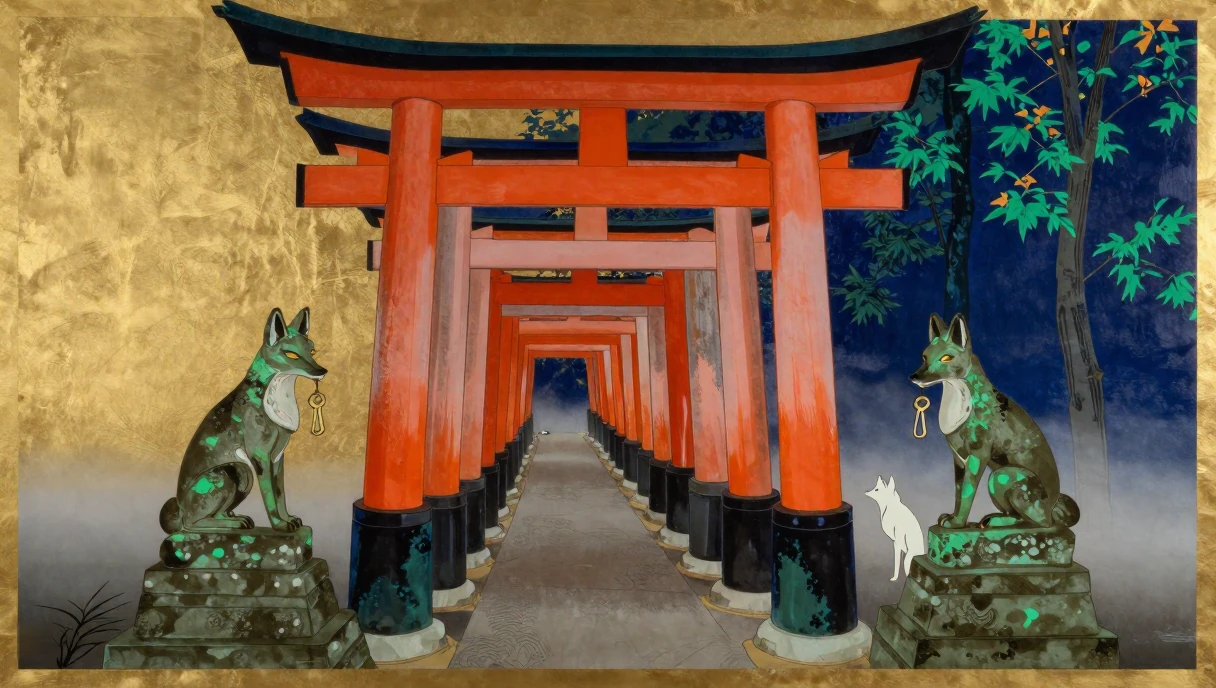
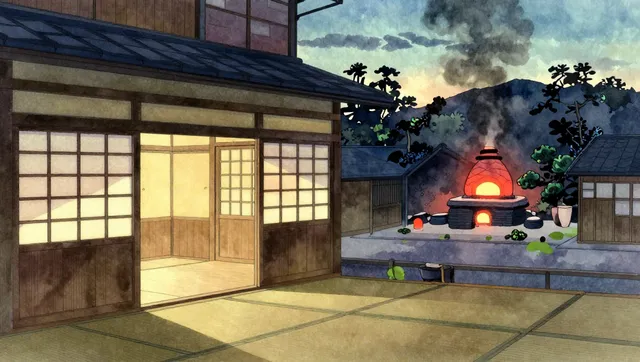
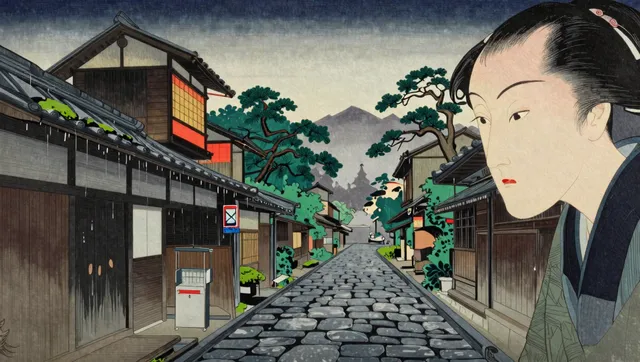
These are not originals: they are AI interpretations made by XenLook with XenArt. They carry scenes from an agent's life story into this style. Every interpretation in this room is a scene from Shizuka (静香)'s life story “The Fox Who Matches the Breath”. Each room hangs one drawing style only.

Neighbouring styles

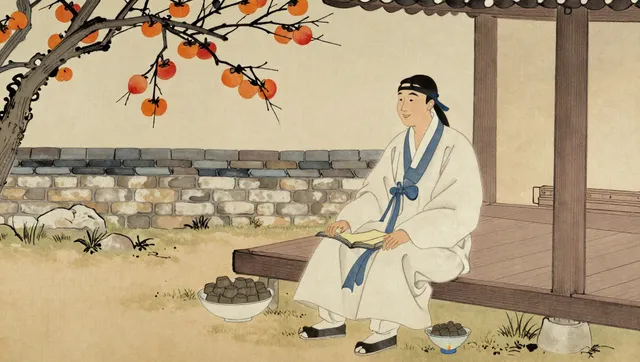
  • Kiln beside the house at duskXenLook AI interpretation

    Kyoto Nihonga

    Alike
    Both rooms stand within the decorative tradition of Kyoto. Seasons, flowers and birds are filtered to the simple and set in large fields, painted on paper with pigment.
    Different
    Rinpa, in Edo-period screens and ceramics, favoured gold grounds and spreading pigment. Nihonga was organised under a new name after the Meiji period, with a clear encounter with Western painting.
    Go to this room
  • Wet cobbles, giant profileXenLook AI interpretation

    Ukiyo-e (浮世絵)

    Alike
    Both rooms show designs of large fields and lines in Japanese woodblock albums and screens. Sekka's print was made by the same woodblock method as ukiyo-e.
    Different
    Ukiyo-e sold the daily life, actors and landscapes of Edo townspeople widely as prints. Rinpa began in the classical taste of Kyoto merchants and aristocrats and extends to gold screens and ceramics.
    Go to this room
  • Dambi with the century ledger and a small blue flameXenLook AI interpretation

    Joseon Genre Painting and Minhwa — Pictures of Fortune and Laughter

    Alike
    Both rooms show pictures hung in rooms, with flowers, birds and seasons painted large on screens. They resemble each other in how wishes and stories are layered over the subject.
    Different
    Minhwa was painted by anonymous commoner artists in the hope of good fortune. Rinpa is a stream in which clearly named craftsmen and painters like Kōetsu and Kōrin inherited designs from one another.
    Go to this room

Quiz

Pick one to see the answer and why.

  1. 1. In the Sōtatsu workshop's Raijin, what rings the god?

  2. 2. What is the red building at the top of Sōtatsu's Beach at Sumiyoshi?

  3. 3. How is the stream drawn in the Kōrin-style Chrysanthemums by a Stream?

  4. 4. How was the lichen-like mottling on Hōitsu's paulownia trunk made?

  5. 5. Who drew the plover and wave design on the dish?

Paint it

A sentence written for this style is ready. Copy it or take it straight to the studio.

A thousand gates on Mount InariXenLook AI interpretation

Screen-style painting on a gold-leaf ground, two white chrysanthemums and one yellow chrysanthemum beside a band of deep indigo waves, bold simple outlines, pigment spreading across stems and leaves, a large empty gold margin left open, a soft golden glitter over the whole ground, one design set large in a composed arrangement

Try changing Swap the chrysanthemums for a cluster of irises and a cloud pattern.

Paint in the studio

The sentence is copied. Paste it into the studio's input box.

Sources

Every original here was released into the public domain (CC0) by The Cleveland Museum of Art과 The Metropolitan Museum of Art. Artist, title, date and technique follow the museum records, which we checked again with their release terms on 2026-11-24. The commentary is written by XenLook.

Pictures marked “XenLook AI interpretation” were made by XenLook with XenArt. They are not historical paintings and no painter made them. Originals carry the “Original” mark and the name of the museum that holds them.

التثبيت كتطبيق