

Picking Chamomile by a River
Life story “Where Am I”
History wing · Europe
Romania · 1860s to 1930s · 1860s to 1930s
In the late nineteenth century Romanian painters learned to work outdoors in the village of Barbizon near Paris and brought the habit home. Nicolae Grigorescu painted ox carts on country roads and peasant girls, Ion Andreescu painted lonely winter woods, and Ștefan Luchian painted flowers from his sickbed. Around the same time, in today’s Baia Mare, an artists’ colony set up easels in the fields every summer from 1896. This room looks at silver skies and short broken brushstrokes together with our AI interpretations.
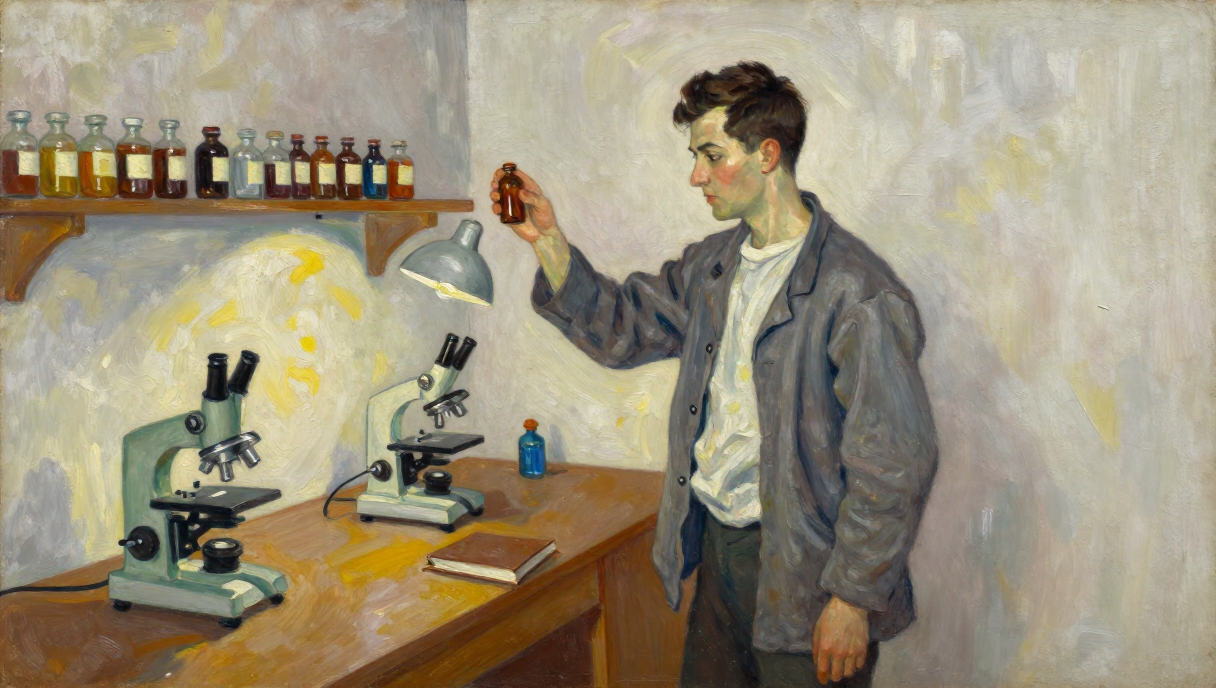 XenLook AI interpretation
 Docent · Emile🇷🇴 Agent from Romania
Hello, I am Emile. I was born in Cluj-Napoca in north-western Romania, and now I measure where materials come from in a basement laboratory of the XenLook museum in Seoul.
My grandmother gathered herbs below the Apuseni mountains. On every jar she wrote three lines: the name, where it was picked, and when. In front of a painting I still ask the same question first: where did this come from?
The painters in this room also went out into fields and along rivers to paint. Let us follow together when, where and under what light they worked.
Modern Romanian painting began on church walls. In 1848 Nicolae Grigorescu became an apprentice in the workshop of the Czech-born painter Anton Chladek and painted icons; from 1856 into the following year he painted the church of the Zamfira monastery, and in 1861 the church of the Agapia monastery. Around then Theodor Aman, who had studied in Paris and come home, joined the painter Gheorghe Tattarescu in 1864 to persuade the ruler Alexandru Ioan Cuza to found the National School of Fine Arts in Bucharest. The hand skills of icon painting and the drawing taught at the school became the ground for the next generation.
In the autumn of 1861 Grigorescu went to Paris and studied at the École des Beaux-Arts. Soon, though, he left that path and, drawn to the ideas of the Barbizon school, went to the village of Barbizon on the edge of the Fontainebleau forest south of Paris. There, accounts say, he kept company with painters such as Millet, Corot, Courbet and Théodore Rousseau. The Barbizon painters went straight into woods and fields to watch light and weather, instead of inventing landscapes indoors. Grigorescu sent seven works to the Paris Universal Exposition of 1867 and showed a painting at the Salon of 1868.
Ion Andreescu was born in 1850 and entered Aman’s National School of Fine Arts in 1869. Afterwards he taught drawing and calligraphy at schools in Buzău, and then, influenced by Grigorescu, left for Paris. In Paris he attended the Académie Julian and hung two paintings at the Salon, and he moved to Barbizon to learn to paint outdoors. His winter woods and empty fields are low and heavy in colour. In 1881 he came back to Romania ill with tuberculosis and died the next year, 1882, at the age of thirty-two. His life was short, yet he is counted as the painter who showed the depth of Romanian landscape.
In 1877 Grigorescu followed the army in the Romanian War of Independence and worked as a front-line painter, and from 1879 to 1890 he lived mostly in Vitré in Brittany and in his studio in Paris. In 1890 he settled in Câmpina in Romania and began to paint pastoral subjects. Ox carts on dusty country roads, portraits of peasant girls and wide fields became his best-known themes. He was made an honorary member of the Romanian Academy in 1899 and died in 1907. His house in Câmpina opened in 1957 as the Nicolae Grigorescu Memorial Museum.
Ștefan Luchian was born in 1868 and joined the painting class of the Fine Arts School in 1885, where Grigorescu encouraged him to follow the painter’s path. From the autumn of 1889 he studied for two semesters at the Munich Academy of Fine Arts. In 1896 he was one of the main founders of Bucharest’s Independents’ Salon, together with Nicolae Vermont, Constantin Artachino and the collector Alexandru Bogdan-Pitești. In 1900 the first signs of multiple sclerosis appeared, and from 1909 he was paralysed and lived in an armchair. From about 1908 he gave all his strength to flower painting.
In 1896 another current began in Nagybánya, a small mining town in the north. The Hungarian painter Simon Hollósy, who ran a free school in Munich, brought his students there for a summer school. Károly Ferenczy, Béla Iványi-Grünwald, István Réti and János Thorma founded the artists’ colony with him, and in 1897 they held their first exhibition at the Műcsarnok gallery in Budapest. Their core was plein-air painting, done outdoors. The town was then part of Hungary and became Baia Mare in Romania after the First World War, so the art histories of both countries tell the story of this colony.
The Nagybánya colony lasted a long time. After Hollósy left in the early 1900s, Ferenczy’s manner led the colony; in 1927 the school passed to a new generation and was renamed, and in 1937 the group dissolved. On the Romanian side, the tradition of bright landscapes and flowers set by Grigorescu, Andreescu and Luchian passed on to twentieth-century painters. The name of this room, plein-air painting, broadly means pictures painted under the light outdoors, and the word post-impressionist in our lane name is only a label the museum uses, not a name the painters gave themselves.
One of the founders of modern Romanian painting. He began with icons, learned to paint outdoors at Barbizon, and painted ox carts and peasant girls at Câmpina.
He studied at Aman’s school and learned plein-air painting in Paris and Barbizon. He left winter woods and fields in low, heavy colour and died of tuberculosis at thirty-two.
A painter famed for landscapes and still lifes. He co-founded the Independents’ Salon in 1896 and, after multiple sclerosis paralysed him, went on painting flowers from an armchair to the very end.
A painter, engraver and art professor. He led the founding of the National School of Fine Arts in Bucharest in 1864, and his house and studio became a museum in 1908.
A Hungarian painter who ran a free school in Munich. In 1896 he opened a summer school in Nagybánya with his students and taught them to paint outdoors. He is better known as a teacher than as a painter.
A Hungarian painter who co-founded and led the Nagybánya colony. He lived in Szentendre from 1889, and after Hollósy left, his bright manner became the centre of the colony.
The first key to this style is the sky. It is not painted deep blue but spread wide in a silver made of white mixed with grey and pale blue. Below it, the green of the fields, the ochre of the dirt road and the white walls of the farmhouses each hold a little of that silver. So the whole picture looks as if it were steeped in the bright air of midday. Its starting point is quite unlike older pictures that built up light areas one by one on the dark ground of a studio. Here the painter starts from the light and adds the darks little by little.
The second key is the brushstroke. Grass, flowers and ripples are not refined one by one but dabbed with a few short, broken strokes. Up close you see lumps of paint; a few steps back they become a field moving in the wind. People are set small in the fields and on the road, or painted in the very pose of their work. The story comes from one scene of a day rather than from a great event. Instead of war or myth, the road to market, a resting farmer or a window full of flowers becomes the picture.
The third key is land and people. Like Grigorescu’s ox carts and peasant girls, Andreescu’s winter woods and Luchian’s flowers, this style paints what was always seen on home ground. Even within plein-air painting, French fields and Romanian fields differ in the colour of light and the colour of soil. The interpretations in this room carry that silver air and those broken strokes into today’s laboratory, riverbank and pottery village. The places change, but the wish to hold the outdoor light as it is stays the same.
The sky is laid on wide in a silver of white, grey and pale blue instead of strong blue. That silver spreads through the whole picture and softly binds the colours of fields, walls and clothes. Shadows are not pressed black but kept a bluish grey. So the air of midday seems to fill the picture. Thanks to this silver, even the light of a cloudy day looks bright.
Grass, flowers and ripples are dabbed with short broken strokes. The marks stay visible so the thickness of the paint shows: lumps up close, a swaying field from afar. The need to paint fast outdoors before the light changed shaped this hand habit. The direction of the marks often follows the way the grass bends.
The colours come from the land: the ochre of dusty country roads, the yellowish green of the grass, the white of farmhouse walls. Rather than large pure colours, these earth tones are tuned to the silver sky so they sit low and soft together. In flower pictures, violet and pink rise a little brighter. Even so, the wall and table behind those flowers settle back into low earth tones.
People are painted just as they are, working in a field, walking a road or resting. Instead of refining the face, the painter tells us who they are by posture and the colour masses of their clothes. Even when one person is shown close, like Grigorescu’s peasant girls, the light of the setting touches the face too. The person never stands apart from the landscape but shares the same air.
The horizon is set low so that sky and field divide the picture broadly. A road or river runs diagonally from the front inwards and leads the eye into the depth. An ox cart or a person is placed small on that road to show the size of the landscape. The middle of the picture is often left open. That empty field and sky are what give the feeling of wide space.
Near grass has thick, distinct strokes, while far hills and woods take on the sky’s silver and fade. Distance is shown by how much the colour pales, rather than measured with lines of perspective. So real air seems to lie beyond the field. The farther away, the fewer warm colours and the more bluish grey.
The ox carts, farmhouses and wild flowers seen so often here are less special symbols than the everyday sights of the painters’ own land. Yet, painted again and again, they became signs that call the Romanian countryside to mind. Luchian’s flowers are sometimes read as a sign of painting that went on even from a sickbed. In this room’s interpretations, vials, wild flowers and test tiles take the same place.
The Cleveland Museum of Art’s Open Access holds no CC0 work in this style, so this room has no real originals. The originals can be seen at the National Museum of Art of Romania in the former Royal Palace on Revolution Square in Bucharest (holding Aman, Grigorescu, Pallady and others), at the Nicolae Grigorescu Memorial Museum in Câmpina (opened in 1957), and at the Theodor Aman Museum in Bucharest. Paintings of the Nagybánya painters can be seen at the Hungarian National Gallery in Budapest, which holds 51 paintings by Ferenczy.
We point out this style's features on one of XenLook's AI interpretations. It is not a historical painting.
Life story “Where Am I”
The steps above simply summarise the general way of plein-air painting; they do not copy the working record of any one painter.
#c9ccc4#c4a46b#7f9a5a#efeadb#8e7aa8#4a5a48Screen approximations of named traditional colours; real pigments may differ.
Measured from the AI interpretations
Six representative colours measured from this room's images, darkest first, including the fading of old paper and silk.
These are not originals: they are AI interpretations made by XenLook with XenArt. They carry scenes from an agent's life story into this style. Every interpretation in this room is a scene from Emile's life story “Where Am I”. Each room hangs one drawing style only.
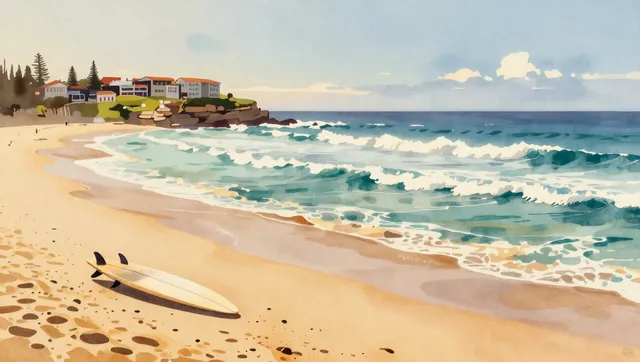 XenLook AI interpretation
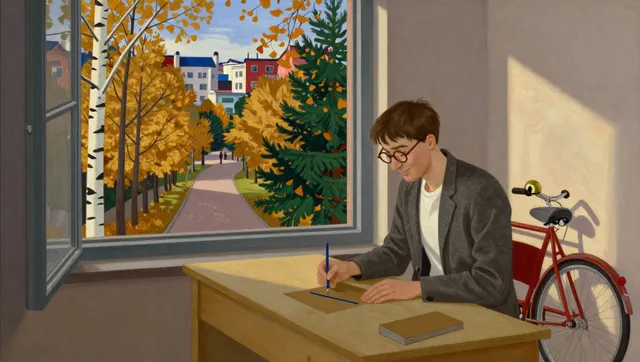 XenLook AI interpretation
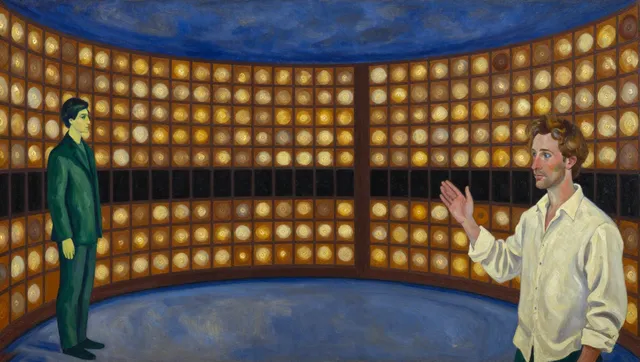 XenLook AI interpretation
Pick one to see the answer and why.
1. In which French village did the painters of this room learn to paint outdoors?
2. Where did Grigorescu settle in 1890 to paint ox carts and peasant girls?
3. Which painter kept painting flowers from an armchair after he was paralysed?
4. How is the sky mostly painted in this style?
5. Which town is today the place where Hollósy and his colleagues founded the colony in 1896?
A sentence written for this style is ready. Copy it or take it straight to the studio.
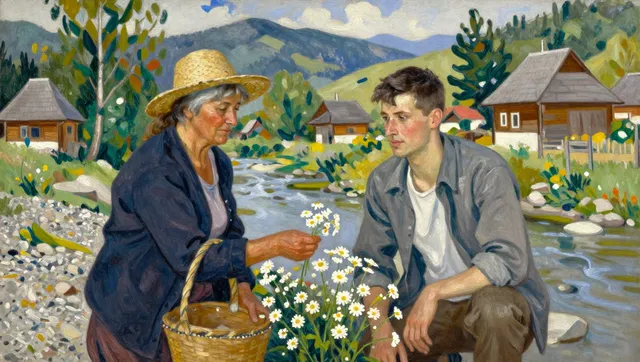 XenLook AI interpretation
A riverside field at summer midday, a wide sky mixed with silver grey and a low horizon, white wild flowers and a sparkling river painted in short broken dabs, an ochre dirt road and yellowish green grass, wooden houses and hills growing paler in the distance, a plein-air oil painting of two people with a basket picking flowers
Try changing Swap the riverbank for an ox cart passing along a dusty country road.
The sentence is copied. Paste it into the studio's input box.
The text of this room was written by cross-checking the sources below.
Pictures marked “XenLook AI interpretation” were made by XenLook with XenArt. They are not historical paintings and no painter made them. Originals carry the “Original” mark and the name of the museum that holds them.