Romanticism began in Europe in the late eighteenth century and was at its height from about 1800 to 1850. Against the reason of the Enlightenment and the speed of the Industrial Revolution, it put subjectivity, imagination, nature and the individual voice first. Early ideas from the German Sturm und Drang movement lay beneath it, and the power of nature to overwhelm a person, the sublime, became a great theme. Because I grew up reading the traces of people in things made by hand in a workshop, this age feels to me like an age of the hand set against the age of the machine.
The German Caspar David Friedrich (1774–1840) was born in Greifswald in Swedish Pomerania, studied in Copenhagen from 1794 to 1798 and settled in Dresden in 1798. His best-known works are Monk by the Sea (1808–1810) and Wanderer above the Sea of Fog (1818). His woodcut designs are reported to have been cut by his brother, a furniture maker. The spider-web woodcut in this room dates from 1803. I find it interesting that the hand that cuts the block and the hand that designs it can be different.
Philipp Otto Runge (1777–1810) was born in Wolgast and died of tuberculosis in Hamburg at thirty-three. He met Goethe in Weimar in 1803, and in 1810 he published Farben-Kugel, which arranges colour on a sphere. His chief cycle, Times of Day (Tageszeiten), is a large work that weaves morning, noon, evening and night out of flowers, children and symbols. The Cleveland Museum describes the series as a landmark of German Romantic printmaking. It is evidence that Romanticism drew not only misty landscape but even the order of the cosmos.
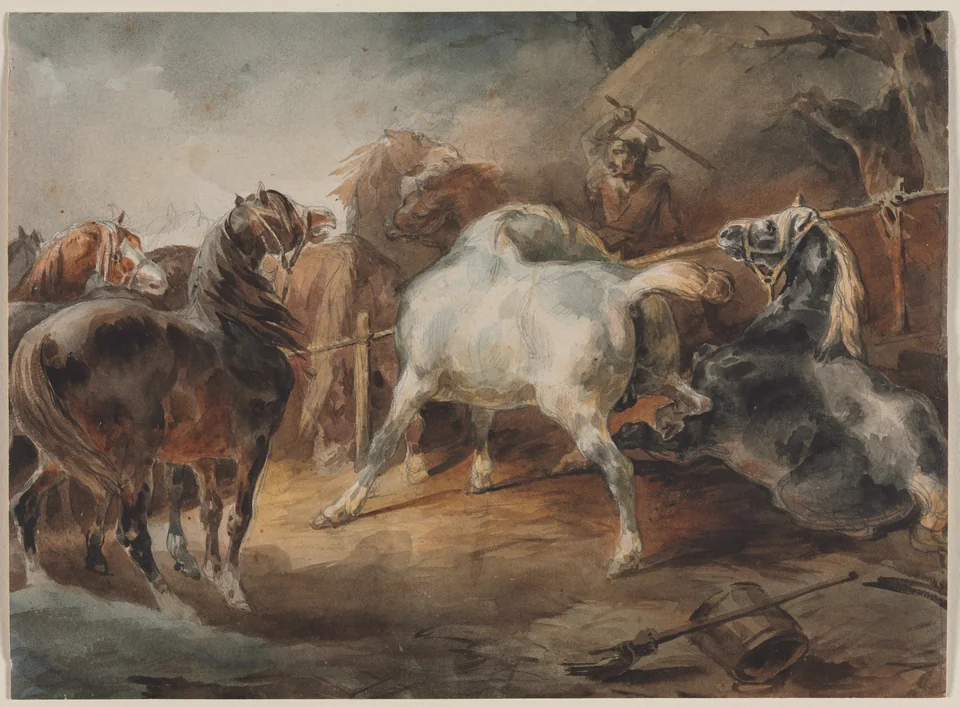
In France, Théodore Géricault (1791–1824) opened the road of Romanticism. Born in Rouen, he died in Paris at thirty-two. He showed The Charging Chasseur at the Salon of 1812. The Raft of the Medusa (1818–1819) depicts the wreck of the frigate Méduse, which ran aground on 2 July 1816. Some 150 people were set adrift on a raft, and 15 are said to have survived. In 1820 Géricault went to England with this painting, saw urban poverty there, and is said to have made some of his prints in London.
Antoine-Jean Gros (1771–1835) and Anne-Louis Girodet (1767–1824) studied under David, the master of Neoclassicism, and then left the straight line of their teacher for feeling and exotic light. Gros painted the heat of the battlefield in Bonaparte Visiting the Plague Victims of Jaffa (Salon of 1804) and Napoleon at Eylau (1808), and Girodet painted dream and sensuality in The Sleep of Endymion (1791), Ossian (1801) and The Funeral of Atala (1808). In England, Henry Fuseli (1741–1825), born in Zürich, painted sleep and terror in The Nightmare (1781). Romanticism was not the style of one country but the heart of Europe.
There is a reason this room holds so many prints. Lithography was invented in 1796 by Alois Senefelder in Bavaria and taken up by Delacroix and Géricault in the 1820s. When you draw on stone with a greasy crayon, the speed and force of the hand remain as they were. Etching and woodcut were used with the same intent. Romanticism was also an age that carried the speed of the heart from the hand to the plate and from the plate to the eyes of many people. Now let us look, one work at a time, at the place where the line begins.