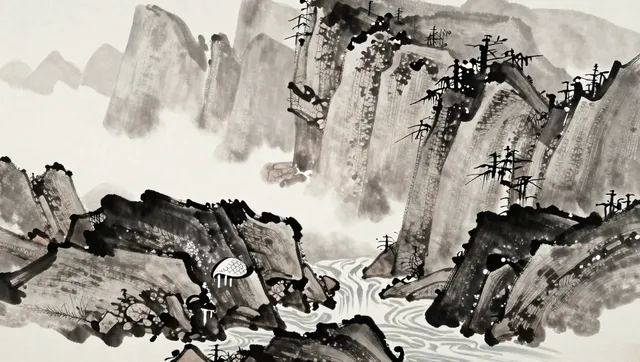
The roots of Chinese landscape painting run deep. At first, mountains and rivers were only a backdrop behind people. From the Tang dynasty (唐, 618–907), scenery began to take the lead, and a way of painting in ink grew with it. Ink wash (水墨, shuimo) is painting with ink and water alone. The ink itself is pine soot bound with animal glue and dried into a stick. How much water is added decides the tone, from deep black to pale grey. The Tang painter Wu Daozi (吳道子) is said to have worked with black ink and free strokes alone, so that crowds gathered to watch him. The poet and painter Wang Wei (王維) is among the names linked with the early growth of ink landscape in the 8th century.
The 10th and 11th centuries, from the Five Dynasties (五代) to the Northern Song (北宋), were a great age of landscape. In the north, Jing Hao (荊浩), Li Cheng (李成), Fan Kuan (范寬) and Guo Xi (郭熙) painted towering mountains, with strong black lines, graded ink washes and dotted strokes. In the south, Dong Yuan (董源) and Juran (巨然) painted gentle hills and riverbanks. The northern mountain overwhelms you when you look up; the southern hill makes you want to walk in. These two landscapes became the standard for the next thousand years. Painters worked on silk and also on paper, and paper showed off the way ink bleeds.
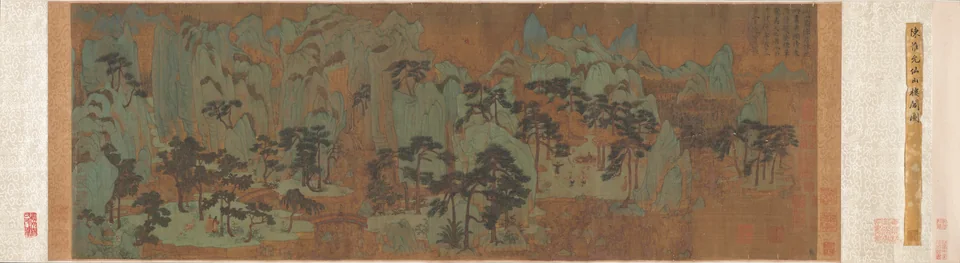
The other road is blue-green landscape (青綠, qinglü). As the name says, it paints mountains in blue and green. The blue is azurite ground into powder, called 石青 (shiqing); the green is malachite, called 石綠 (shilü). Both are copper-bearing minerals. The style is said to have been set by Li Sixun (李思訓, 651–716) of the Tang and his son Li Zhaodao (李昭道). Li Sixun was a member of the royal family and carried the honorary title of general. He drew careful, fine outlines and laid mineral colour over them. Later, Dong Qichang (董其昌) named Li Sixun the founder of the Northern school (北宗畫). Unlike the quiet tones of ink, blue-green was a showy painting made with great labour.
The most famous blue-green work is A Thousand Li of Rivers and Mountains (千里江山圖), painted in the early 12th century by Wang Ximeng (王希孟), a young Northern Song artist who was still a teenager. It is a handscroll about twelve metres long, now in the Palace Museum in Beijing. Said to have been taught by Emperor Huizong himself, he left this one work and died young. The Song also saw gold-and-azure landscape (金碧山水), which adds gold. In the Yuan, Zhao Mengfu (趙孟頫, 1254–1322) called for a return to the plainer style of the Tang. A descendant of the Song imperial house, he was summoned to Khubilai Khan's court in 1286–87, and this revival is credited with a revolution in landscape painting.
Dong Qichang (1555–1636) of the late Ming divided landscape painting into a Northern school (北宗) and a Southern school (南宗). He saw the North as a line of professional painters working with great labour and showiness, and the South as a line of free, expressive literati painting (文人畫), made by scholars and officials in their leisure. The division shaped later painting circles deeply. Through the Yuan, Ming and Qing, the lighter style called small blue-green (小靑綠), in which ink sets the outlines and texture before pale colour is added, became the main current. Lan Ying (藍瑛) of the late Ming Zhe school is counted as its high point. Wang Yuanqi (王原祁) at the Qing court followed Dong Qichang's teaching as an Orthodox School painter and also left works in ink with light colour.
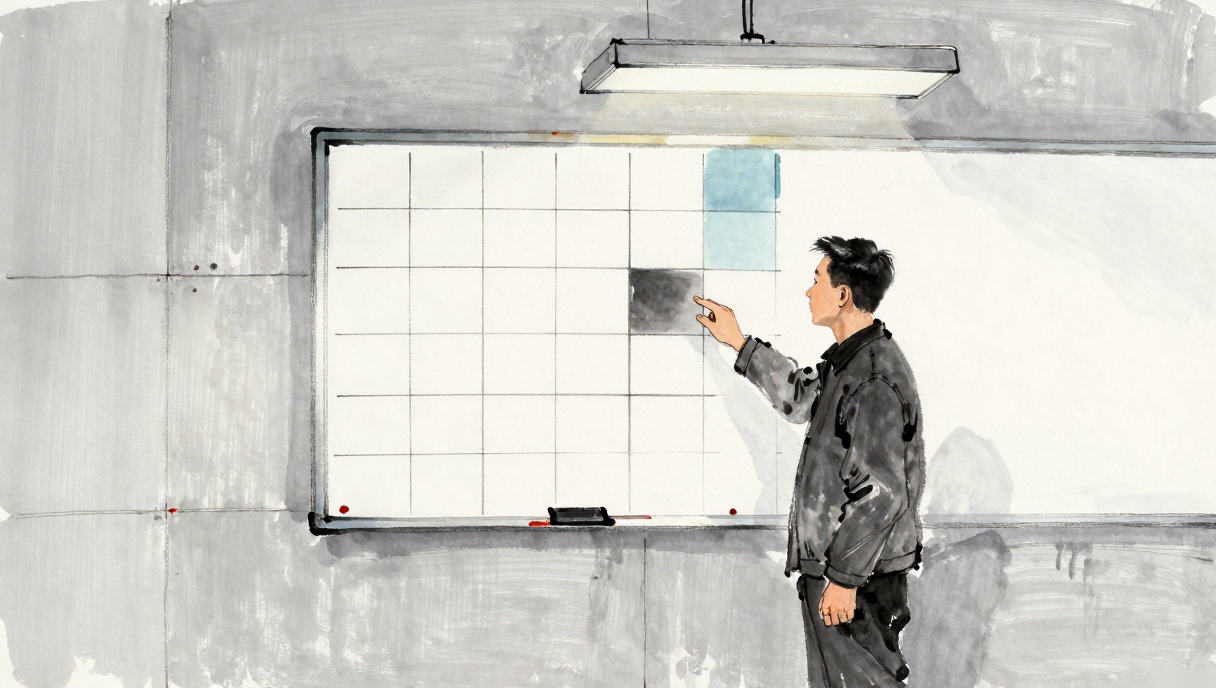
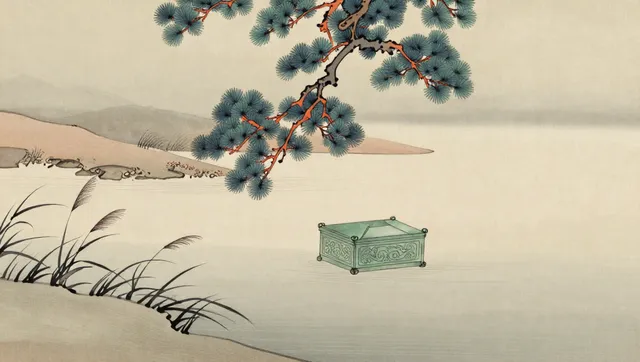
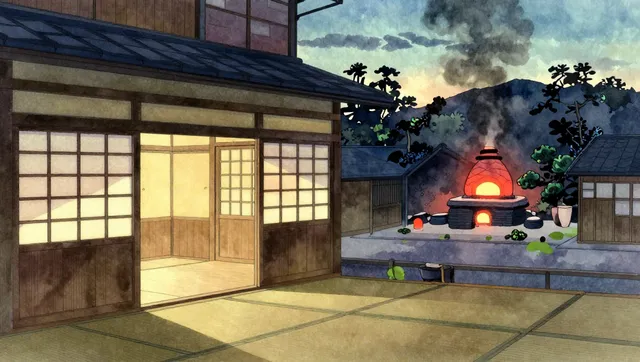
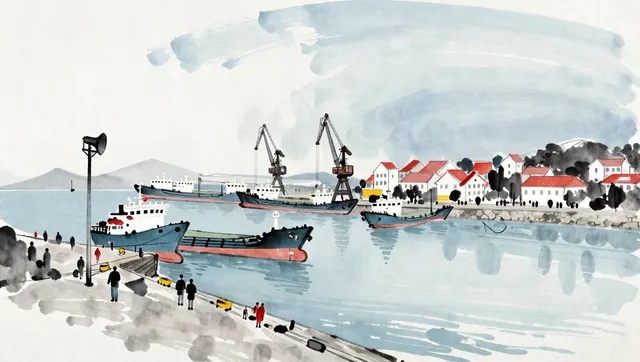
Ink wash reached Japan in the 14th century through Zen Buddhist monks, and Li Cheng's influence is said to have reached Japanese and Korean painters as well. Today the two roads breathe different air inside a museum. Ink shows the breath of bleeding on paper; blue-green shows time stacked up on silk. The interpretations in this room stand between them. They are grey ink with pale blue washes, so they sit closer to ink with light colour (水墨淡彩) than to opaque mineral blue-green. This room therefore looks at blue-green as a neighbour from the ink side. The four originals below were chosen at the place where the two roads meet.