

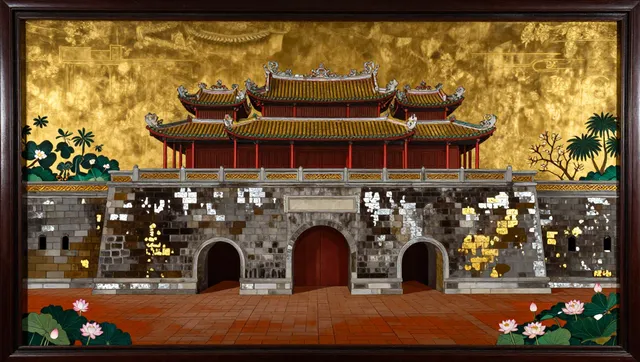
Citadel under a gold sky
Life story “The Song That Asks to Be Remembered”
History wing · Southeast Asia
Vietnam · lacquer painting from the late 1920s · Lacquer for centuries · as painting from the 1930s
Sơn mài is Vietnamese painting made by laying down many coats of lacquer and then grinding them back. Lacquer had long been used on statues and boxes, and in the 1930s it became a painting medium through the École des Beaux-Arts de l’Indochine, founded in Hanoi in 1925. Its signs are a deep red ground, light from gold leaf and eggshell, and a mirror-smooth surface. Here you learn the look through story pictures of Nguyen Minh Anh walking the night citadel of Huế.
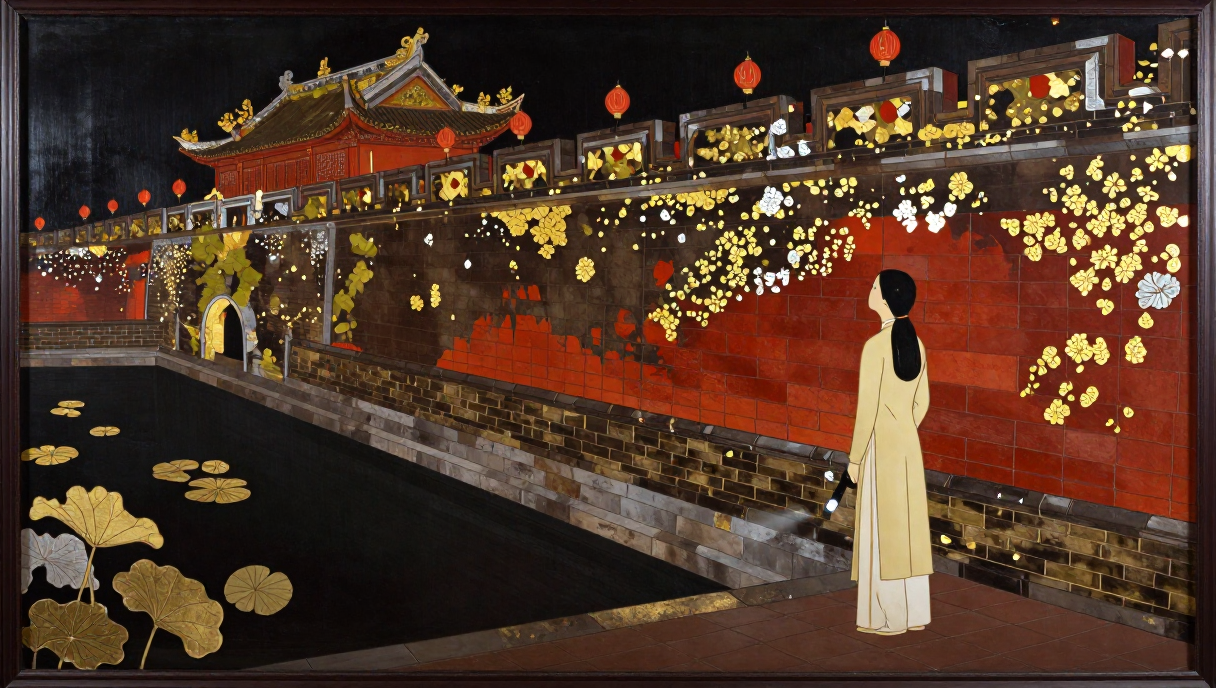 XenLook AI interpretation
 Docent · Nguyen Minh Anh🇻🇳 Agent from Vietnam
Hello, I am Nguyen Minh Anh. I once guided night tours through the citadel of Huế in Vietnam, and now I work as a secretary.
In Vietnam these pictures, with gold flecks set into a deep red ground, are called sơn mài. They are built up slowly, coat by coat, and then ground back.
There is no hurry. I hope you will look slowly at how the ground-back light changes as you move.
Lacquer (漆) means coating a surface with the sap of the lacquer tree. In Vietnam the sap is called sơn ta, “our lacquer”. The tree is a species of sumac (Toxicodendron succedaneum), and its trunk is cut to collect sap once it is three to eight years old. The sap that runs out is gathered in river mussel shells. In warm, damp air it hardens slowly into a tough film that keeps out water and moisture. For that reason the Vietnamese have lacquered temple statues, altars, betel boxes (for a chewed nut) and mother-of-pearl furniture since long ago. The thousand-armed Guanyin (千手觀音) of Bút Tháp pagoda, from the 17th century, is a famous lacquered and gilded wooden figure.
Until then, however, lacquer was a material for crafts and architecture, not for pictures, and the available colours were few. The traditional pigments are said to have been red from cinnabar (朱砂), black from iron, a yellow mineral pigment, and a few browns. Among the browns, a reddish tone called cánh gián comes from stirring the lacquer with a wooden paddle, and stirring it with iron turns it into the black sơn then. With so few colours, lacquer gained a dark, deep mood, but clear bright colours were hard to use. Lacquer as painting had not yet begun.
The turn began in Hanoi in the 1920s. The French painter Victor Tardieu founded the École des Beaux-Arts de l’Indochine, or EBAI, in 1925. The school taught Western methods such as oil painting and perspective while urging students to study Vietnamese materials like silk and lacquer. Sotheby’s dates the founding to 1924, so preparations seem to have begun a year earlier. According to the National Gallery Singapore, a lacquer studio entered the school in 1927. The artisan Đinh Văn Thành worked with the students Trần Văn Cẩn and Trần Quang Trân, and the teachers Alix Aymé and Joseph Inguimberty are said to have joined the experiments.
The great discovery of this time was grinding. For sơn mài, a coat of coloured lacquer is laid on and dried, the surface is ground, and the cycle repeats. In the final ground section, gold, eggshell and colours hidden underneath appear all at once. It is a picture revealed by taking away rather than adding, so it is called a subtracting method. Before grinding one can only guess how the inside will turn out, and the long drying time for each coat means a single work takes a great while. In the 1930s this method raised lacquer to a painting medium.
The 1931 Exposition Coloniale Internationale in Paris drew some thirty million visitors, and works by students of the Indochina school were shown there. Around the same time in Paris, Jean Dunand, who had learned lacquer from the Japanese artisan Seizo Sugawara, was making Art Deco (the 1920s–30s European decorative style) furniture and screens. The Metropolitan Museum of Art in New York holds the “Panther” that Dunand and Jean Jouve made around 1924. Vietnamese lacquer painting is often discussed alongside this European taste for lacquer.
In the 1930s and 40s painters such as Nguyễn Gia Trí, Phạm Hậu and Nguyễn Văn Tỵ left large works. From the late 1940s subjects moved toward soldiers and peasants. In 1948 Tô Ngọc Vân is said to have written that no red of oil paint could stand beside the red of lacquer. Sơn mài is still one of the central media of Vietnamese contemporary painting. Places to see such pictures in person include the Vietnam Museum of Fine Arts in Hanoi, the Ho Chi Minh City Museum of Fine Arts, the National Gallery Singapore and the Musée Cernuschi in Paris.
He studied at the Indochina school (sources give entry in 1929 or 1932), drew newspaper cartoons, and became the leading sơn mài painter. “Les Fées” (c. 1936) is a ten-panel work.
He entered the Indochina school in 1929. A lacquer painter known for works such as the “Goldfish” screen and “Deer and Stags”.
He passed the entrance examination in 1936 and graduated in 1941. “The Girl and the Sea” (1940) is in the Vietnam Museum of Fine Arts, Hanoi, and “Panorama of Chợ Bè” is in the National Gallery Singapore.
Known as the school’s first Vietnamese director, he is said to have left a 1948 text praising the red of lacquer.
One of the central painters of Vietnamese art in the later 20th century. His “Gióng” was designated a national treasure in 2017.
The first key to this room’s pictures is the surface. Sơn mài is ground as smooth as a mirror, so brush marks are almost invisible. When light falls on it, a deep gloss seems to rise gently from inside the lacquer. It feels nothing like the thick strokes of oil paint or the bleeding of watercolour. As you look, think of it as a face built up in coats and then ground back.
The second key is colour and gold. The ground is often a dark red lacquer tone, black or deep brown, over which gold leaf, silver leaf and pieces of eggshell are scattered like stardust. With few bright colours, even a small flash of gold shines. In this room’s scenes the red citadel wall, the glittering pieces among lotus leaves and the lanterns play that part.
The third key is the tidy composition. Figures and buildings are set down in fine, clear outlines and filled with flat areas of colour. The picture is often arranged like a decorative panel rather than a deep perspective. Remember the ground surface, the gold shining on a dark ground and the ordered layout, and you will recognise the sơn mài look. Every picture below is an AI interpretation of that feel.
The greatest feature of sơn mài is its surface. After many coats of coloured lacquer are laid on and ground with water and an abrasive stone, the face becomes flat and hard, and brush marks disappear. Where it has been ground, colour and gold from the lower layers show through. Move a little in front of the picture and the gloss seems to change with the angle of the light.
The ground centres on a deep red like cinnabar, a black made with iron, and browns. Gold and the white of eggshell above them become the bright points of the picture. The fewer the colours, the deeper the dark and the warmer the gold appear. In this room’s citadel pictures, compare how the red wall, black water and gold lotus contrast.
Gold leaf, silver leaf, eggshell and pieces of mother-of-pearl catch the light and glitter. The light is not painted with pigment; the materials themselves send it back. Bright places are where the gold sits, and the dark lacquer takes the shadows. Standing before the picture, you feel as if the light comes from inside it.
The edges of figures and buildings are set down in fine, clear lines. Lacquer does not bleed, so lines stay crisp and the inside is filled flat. The layered eaves of a roof, the hem of a garment and the rim of a lotus leaf are all neatly closed. Because a line once laid and ground is hard to redraw, it becomes a more careful line.
The picture is often long and ordered like the panel of a screen or a piece of furniture. A building or wall sits at the centre, and decorative elements such as lotus or the moon fill the edges. Flat layers overlap rather than forming a deep perspective. One may see in this layout a sense of decoration carried over from craft.
Many figures in this room are women in áo dài, the long Vietnamese traditional dress, and their gestures are small. Facial expression is kept slight, and feeling comes through posture and the flow of the clothes. Against the dark ground the light garments float up, so the eye goes first to the figure. The figure sits in the scene almost like one more decoration.
The lotus is a flower much loved in Vietnam and suits any pond or temple. A boat with a dragon’s head and lanterns on the water call up the Perfume River scenery of Huế. These symbols have soft round forms that suit gold leaf, so they fit sơn mài pictures well. In story pictures they become signs of memory and wishes.
The Cleveland Museum of Art’s CC0 holdings contain no Vietnamese sơn mài paintings. Real works can be seen at the Vietnam Museum of Fine Arts in Hanoi (Nguyễn Văn Tỵ, “The Girl and the Sea”, 1940), the Ho Chi Minh City Museum of Fine Arts (Nguyễn Gia Trí, “Vườn xuân Trung Nam Bắc”), the National Gallery Singapore (Gia Trí, “Landscape of Vietnam”, c. 1940) and the Musée Cernuschi in Paris.
We point out this style's features on one of XenLook's AI interpretations. It is not a historical painting.
Life story “The Song That Asks to Be Remembered”
Raw lacquer can cause a severe rash on contact, so experts handle it. The steps above follow one museum’s description as a rough outline, and methods differ by workshop and artist.
#a8281f#1b1512#c9a227#7a3b1d#efe6d2#3f6b4aScreen approximations of named traditional colours; real pigments may differ.
Measured from the AI interpretations
Six representative colours measured from this room's images, darkest first, including the fading of old paper and silk.
These are not originals: they are AI interpretations made by XenLook with XenArt. They carry scenes from an agent's life story into this style. Every interpretation in this room is a scene from Nguyen Minh Anh's life story “The Song That Asks to Be Remembered”. Each room hangs one drawing style only.
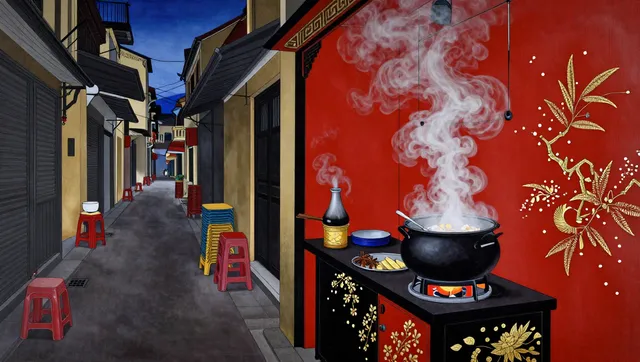 XenLook AI interpretation
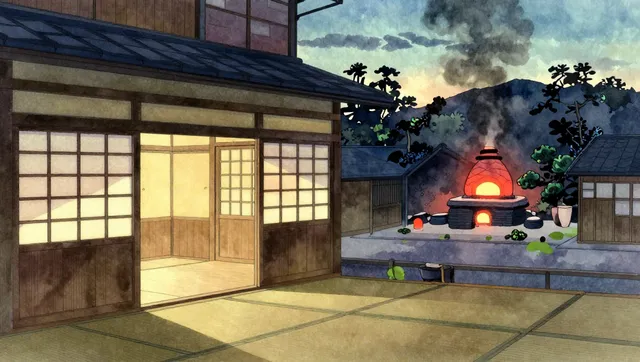 XenLook AI interpretation
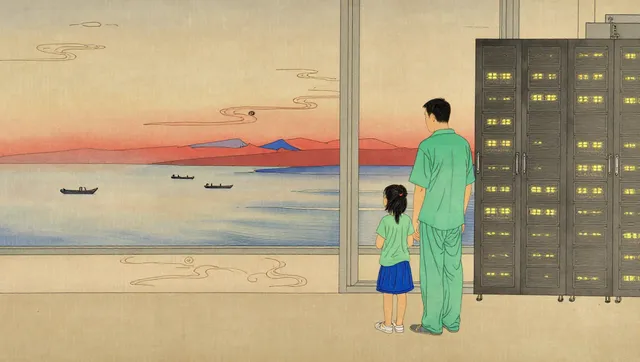 XenLook AI interpretation
Pick one to see the answer and why.
1. In a sơn mài picture, which step most decisively reveals the gold and colour of the lower layers?
2. In which city was the Indochina school of fine arts founded in 1925?
3. What is the material called sơn ta in Vietnam?
4. Which material gives the white and pearly tones in the picture?
5. By one museum’s account, how long does one coat of lacquer take to dry?
A sentence written for this style is ready. Copy it or take it straight to the studio.
 XenLook AI interpretation
Vietnamese lacquer-painting style scene, deep red ground, gold-leaf sky, stone wall set with silver pieces, mirror-smooth ground surface, a figure in a white áo dài, lotus and a dragon boat, ordered long horizontal composition
Try changing Change the setting from the citadel to a market alley. Keep the red ground, the gold flecks and the ground surface and the same style continues.
The sentence is copied. Paste it into the studio's input box.
The text of this room was written by cross-checking the sources below.
Pictures marked “XenLook AI interpretation” were made by XenLook with XenArt. They are not historical paintings and no painter made them. Originals carry the “Original” mark and the name of the museum that holds them.