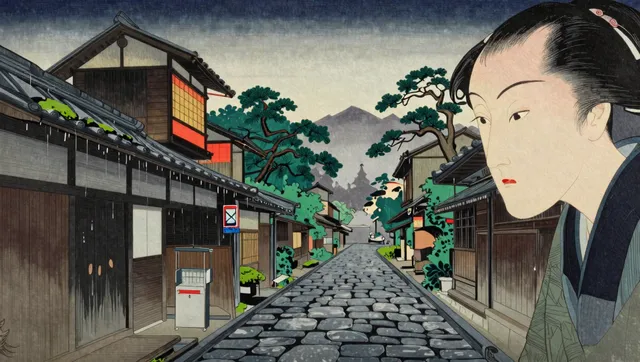
Ukiyo-e (浮世絵) means “pictures of the floating world”. The word ukiyo (浮世) comes from an older word, ukiyo (憂き世), “the sorrowful world”. People in the Edo period turned it into a lighter idea: life is fleeting, so enjoy today. The earliest known appearance of the word for a kind of picture is in a haikai book of 1681 (haikai are playful verse-capping games). Pictures of fashionable clothes, theatres, pleasure quarters and famous places all gathered under this name.
In 1603 Tokugawa Ieyasu founded the shogunate (bakufu, the warrior government), and Edo (江戸, today’s Tokyo) became the centre of power. Once the fighting stopped, merchants and craftsmen, the chōnin (町人), grew into the leading people of the city. They did not have a warrior’s rank, but they had money. After the Great Meireki Fire of 1657 (明暦の大火), as the city was rebuilt, the chōnin are said to have gained much more weight. They became the customers of theatres, bookshops and print shops. Pictures were no longer kept in noble rooms; they were sold in shops on the street.
At first, prints were made in black ink alone. Hishikawa Moronobu (菱川師宣, 1618–1694) began as a book illustrator and in the 1670s became famous for single-sheet prints, which is why he is called the founder of ukiyo-e. Colour was added by hand with a brush. Prints coloured with red lead, called tan (丹), are tan-e (丹絵), and those using the safflower red beni (紅) are beni-e (紅絵). In the 1740s printers began to cut a separate block for each colour: two or three colours at first, and about five by around 1760.
Around 1764, connoisseurs’ clubs began exchanging calendar pictures (絵暦, egoyomi) that changed every year. The clubs spared no expense, so the pictures carried many layers of colour. In 1765 Suzuki Harunobu (鈴木春信, c. 1725–1770) issued the first fully multicoloured prints. They were called nishiki-e (錦絵), “brocade pictures”, for their richness, and sometimes used more than ten blocks. Two things made this possible: the registration marks called kentō (見当), and a thick, tough paper from Echizen (越前奉書, Echizen hōsho) that withstood repeated printing.
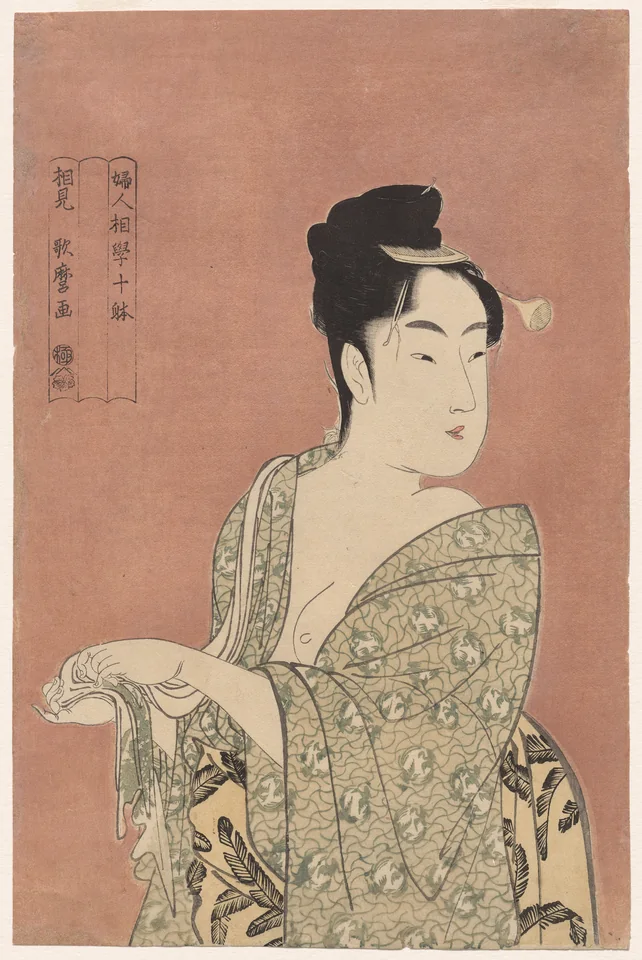
The 1780s and 1790s were a golden age for beauties and actors. Torii Kiyonaga (鳥居清長, 1752–1815) was known for tall, graceful women, and Kitagawa Utamaro (喜多川歌麿, born in the early 1750s, died 1806) for the ōkubi-e (大首絵), a picture with the face drawn very large. Tōshūsai Sharaku (東洲斎写楽) made more than 140 actor prints in about ten months of 1794–95 and then vanished; his identity is still not settled. A leading publisher of these artists was Tsutaya Jūzaburō (蔦屋重三郎). Yet from 1790 the shogunate demanded a censor’s seal, and in 1804 Utamaro is said to have been arrested over prints of Toyotomi Hideyoshi and punished with fifty days in manacles.
In the 19th century landscape took centre stage. Katsushika Hokusai (葛飾北斎, 1760–1849) published Thirty-Six Views of Mount Fuji (冨嶽三十六景) in the early 1830s; it sold so well that ten more prints were added, making 46. The newly imported blue pigment “Berlin blue” (ベロ藍, Prussian blue) was used for the blues of the series. Utagawa Hiroshige (歌川広重, born Andō Tokutarō, 1797–1858) painted the air of rain, snow and mist in the Fifty-three Stations of the Tōkaidō (1833–34) and One Hundred Famous Views of Edo (1856–58). A large print is described as costing about as much as a bowl of soba, so almost anyone could buy one.
After the Meiji Restoration of 1868, newspapers, photography and Western printing spread, and the single-sheet woodblock print lost much of its role. Yet ukiyo-e became known in Europe, partly through the Paris Exposition of 1867, and painters such as Manet, Monet and Van Gogh were thrilled. This movement is called Japonisme. Van Gogh copied two prints from Hiroshige’s One Hundred Famous Views of Edo in oil, and one of them is the picture of a bridge in the rain. In 1915 the publisher Watanabe Shōzaburō gave the name shin-hanga (新版画, “new prints”) to a revival that carried the tradition forward.