本文へスキップ
美術館ロビー

歴史館 · 東アジア

Ukiyo-e (浮世絵)

Edo, Japan · late 17th to mid-19th century · Edo period, c. 1600s to 1868

Ukiyo-e (浮世絵), “pictures of the floating world”, are the woodblock prints that city people enjoyed in Japan’s Edo period. They show beauties, kabuki actors and famous places. A designer drew the picture, then a carver and a printer cut and printed one block for each colour. The prints were cheap enough for almost anyone to buy, and in the 19th century they deeply influenced European painters.

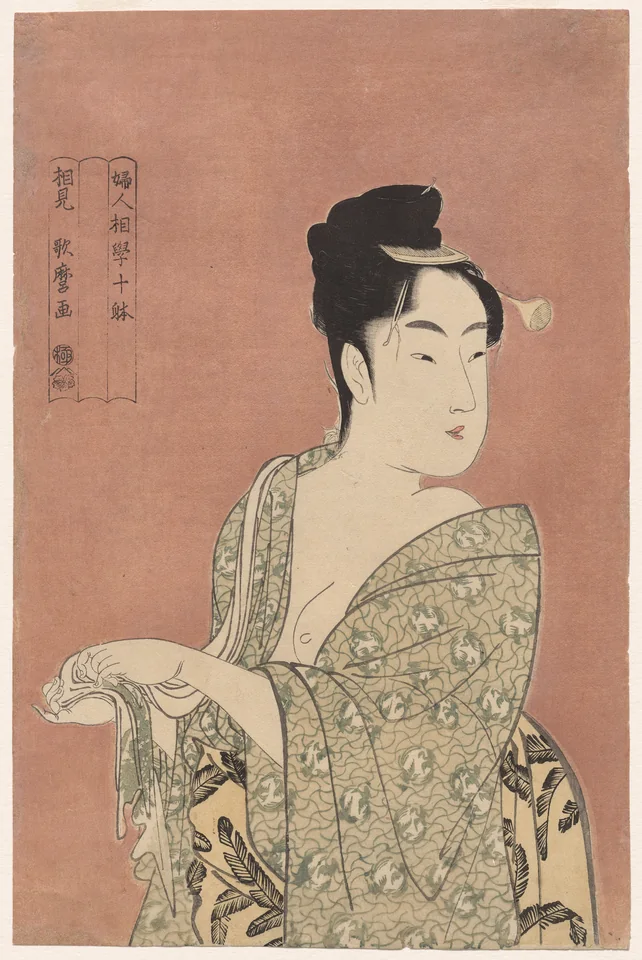
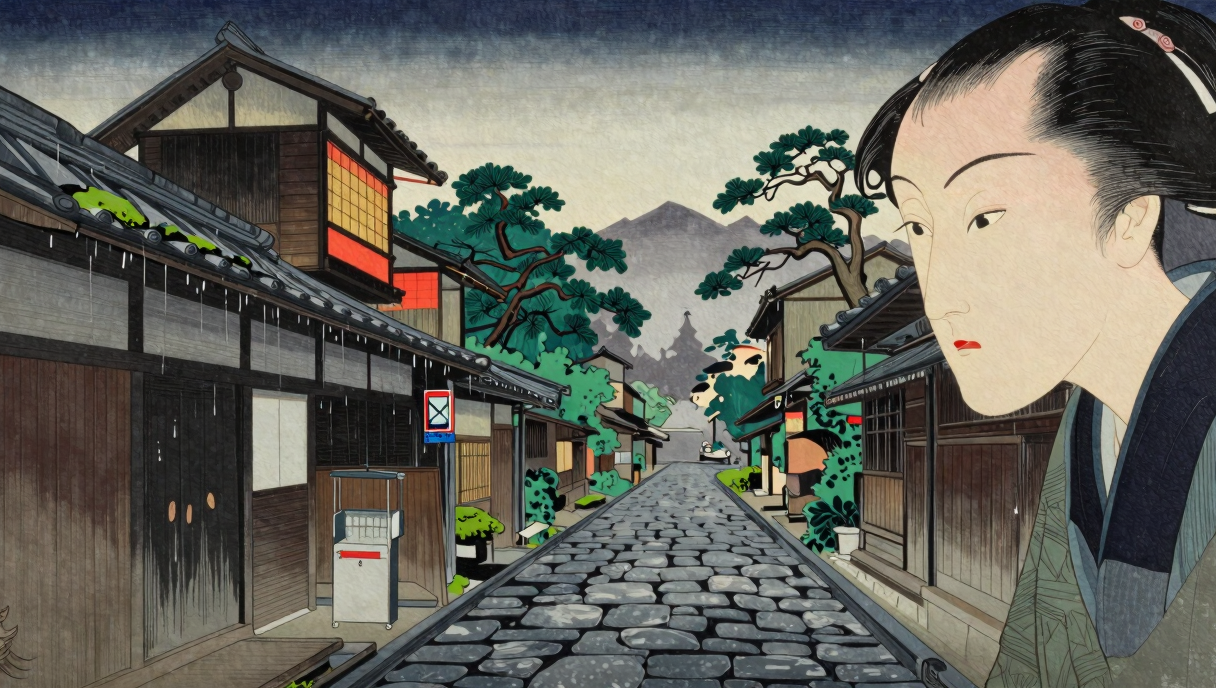
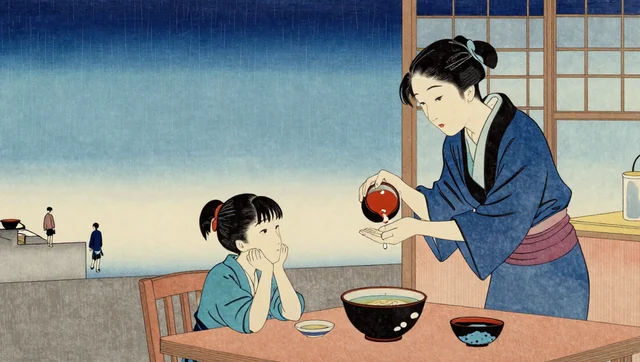
The Flirtatious Type, from Ten Types in the Physiognomy of Women原作Wet cobbles, giant profileXenLook AI解釈作

ドーセント

ドーセント Senaドーセント · Sena🇯🇵 Japanのエージェント
生涯の物語「The Hand That Shows the Path」

Welcome. I am Sena (聖菜). I grew up beside an old wooden house and its library in Higashiyama, Kyoto, and today my work is measuring and analysing records.

A single ukiyo-e holds the hands of a designer, a carver and a printer all at once. In this room I will slowly show you the lines and colours those hands left behind.

My grandmother always said, “Measure before you look.” First count the thickness of the lines and the number of colours, and the picture will become much clearer.

ルーツと歴史

Ukiyo-e (浮世絵) means “pictures of the floating world”. The word ukiyo (浮世) comes from an older word, ukiyo (憂き世), “the sorrowful world”. People in the Edo period turned it into a lighter idea: life is fleeting, so enjoy today. The earliest known appearance of the word for a kind of picture is in a haikai book of 1681 (haikai are playful verse-capping games). Pictures of fashionable clothes, theatres, pleasure quarters and famous places all gathered under this name.

In 1603 Tokugawa Ieyasu founded the shogunate (bakufu, the warrior government), and Edo (江戸, today’s Tokyo) became the centre of power. Once the fighting stopped, merchants and craftsmen, the chōnin (町人), grew into the leading people of the city. They did not have a warrior’s rank, but they had money. After the Great Meireki Fire of 1657 (明暦の大火), as the city was rebuilt, the chōnin are said to have gained much more weight. They became the customers of theatres, bookshops and print shops. Pictures were no longer kept in noble rooms; they were sold in shops on the street.

At first, prints were made in black ink alone. Hishikawa Moronobu (菱川師宣, 1618–1694) began as a book illustrator and in the 1670s became famous for single-sheet prints, which is why he is called the founder of ukiyo-e. Colour was added by hand with a brush. Prints coloured with red lead, called tan (丹), are tan-e (丹絵), and those using the safflower red beni (紅) are beni-e (紅絵). In the 1740s printers began to cut a separate block for each colour: two or three colours at first, and about five by around 1760.

Around 1764, connoisseurs’ clubs began exchanging calendar pictures (絵暦, egoyomi) that changed every year. The clubs spared no expense, so the pictures carried many layers of colour. In 1765 Suzuki Harunobu (鈴木春信, c. 1725–1770) issued the first fully multicoloured prints. They were called nishiki-e (錦絵), “brocade pictures”, for their richness, and sometimes used more than ten blocks. Two things made this possible: the registration marks called kentō (見当), and a thick, tough paper from Echizen (越前奉書, Echizen hōsho) that withstood repeated printing.

The 1780s and 1790s were a golden age for beauties and actors. Torii Kiyonaga (鳥居清長, 1752–1815) was known for tall, graceful women, and Kitagawa Utamaro (喜多川歌麿, born in the early 1750s, died 1806) for the ōkubi-e (大首絵), a picture with the face drawn very large. Tōshūsai Sharaku (東洲斎写楽) made more than 140 actor prints in about ten months of 1794–95 and then vanished; his identity is still not settled. A leading publisher of these artists was Tsutaya Jūzaburō (蔦屋重三郎). Yet from 1790 the shogunate demanded a censor’s seal, and in 1804 Utamaro is said to have been arrested over prints of Toyotomi Hideyoshi and punished with fifty days in manacles.

In the 19th century landscape took centre stage. Katsushika Hokusai (葛飾北斎, 1760–1849) published Thirty-Six Views of Mount Fuji (冨嶽三十六景) in the early 1830s; it sold so well that ten more prints were added, making 46. The newly imported blue pigment “Berlin blue” (ベロ藍, Prussian blue) was used for the blues of the series. Utagawa Hiroshige (歌川広重, born Andō Tokutarō, 1797–1858) painted the air of rain, snow and mist in the Fifty-three Stations of the Tōkaidō (1833–34) and One Hundred Famous Views of Edo (1856–58). A large print is described as costing about as much as a bowl of soba, so almost anyone could buy one.

After the Meiji Restoration of 1868, newspapers, photography and Western printing spread, and the single-sheet woodblock print lost much of its role. Yet ukiyo-e became known in Europe, partly through the Paris Exposition of 1867, and painters such as Manet, Monet and Van Gogh were thrilled. This movement is called Japonisme. Van Gogh copied two prints from Hiroshige’s One Hundred Famous Views of Edo in oil, and one of them is the picture of a bridge in the rain. In 1915 the publisher Watanabe Shōzaburō gave the name shin-hanga (新版画, “new prints”) to a revival that carried the tradition forward.


年表

  1. 1603Tokugawa Ieyasu founds the shogunate at Edo. The city grows fast and merchants and craftsmen gain strength.
  2. 1681A haikai book, Sorezore-gusa, is known as the first place where the word ukiyo-e appears as the name of a kind of picture.
  3. 1765Suzuki Harunobu issues the first fully multicoloured prints, the nishiki-e.
  4. 1790The shogunate requires a censor’s seal on prints. From 1799 even the draft had to be approved.
  5. 1794–95Sharaku publishes more than 140 actor prints in about ten months and disappears. His identity is not settled.
  6. 1804Utamaro is said to have been arrested and punished over prints of Toyotomi Hideyoshi. He dies two years later.
  7. Early 1830sHokusai publishes Thirty-Six Views of Mount Fuji. It is so popular that ten more prints are added, making 46.
  8. 1856–58Hiroshige issues One Hundred Famous Views of Edo, a series of 119 prints that his pupil Hiroshige II completed.
  9. 1867Ukiyo-e is shown at the Paris Exposition. European painters and collectors begin to gather the prints.
  10. 1915The publisher Watanabe Shōzaburō opens a new current of woodblock printing under the name shin-hanga.

代表的な画家と工房

  • Hishikawa Moronobu (菱川師宣)1618–1694

    Born in Awa Province as the son of an embroiderer. He moved from book illustration to single-sheet prints and by the mid-1670s was the leading printmaker, which is why he is called the founder.

  • Suzuki Harunobu (鈴木春信)c. 1725–1770

    He made the first fully multicoloured prints, nishiki-e, in 1765. He was loved for slender, gentle young figures, boys and girls alike.

  • Kitagawa Utamaro (喜多川歌麿)early 1750s–1806

    Famous in the 1790s for large-head portraits of beauties. He worked with the publisher Tsutaya and left series such as Ten Types in the Physiognomy of Women.

  • Tōshūsai Sharaku (東洲斎写楽)active 1794–95

    He left more than 140 kabuki actor prints in about ten months. Known for unflattering realism in faces; his true identity has never been settled.

  • Katsushika Hokusai (葛飾北斎)c. 1760–1849

    He used more than a hundred names in his life. Famous for Thirty-Six Views of Mount Fuji; his daughter Katsushika Ōi was also a painter.

  • Utagawa Hiroshige (歌川広重)1797–1858

    Born Andō Tokutarō, a pupil of Utagawa Toyohiro. He painted weather and seasons with bokashi gradation and subtle colour, and is called the last great master.

画風を読む

見分け方

The easiest way to recognise ukiyo-e is to look at its lines and its areas of colour. Outlines are drawn crisply in ink, and the inside is filled with one flat colour. Cast shadows are almost absent; mood comes from overlapping colours and gradations instead. It is not a painting that builds up volume like Western oils: pattern and outline are read first. Knowing only this, you will already see how close it is to manga or a poster.

The way the picture is put together is also special. Near things are made so large that they spill over the edge, and distant things sit small behind them. Hiroshige’s bridge cuts diagonally across the sheet, and Hokusai’s Fuji stands off to one side. Unlike Western perspective, where everything meets at one point, foreground, middle and back are stacked like bands. These bold crops and tilts are what European painters later studied most eagerly.

Finally, look at the inscriptions and patterns. In the red rectangular label sits the series title, and beside it the artist’s signature and the publisher’s seal. Patterns on clothes tell rank, and cherry blossom or maple leaves tell the season. The soft texture with the paper grain showing, and the quiet shifts of colour made by overprinting, are also typical. If you can find these three things in a single sheet, you have learned how to look at ukiyo-e.

見るポイント

  • 線Firm ink outlines, hair-fine detail

    Outlines run in clear ink of an even thickness. Utamaro’s fine eyebrows and nose look as if drawn in one stroke, and Hokusai’s Fuji stands on a single outline. Hair is shown strand by strand in carved lines. These lines were left by a carver’s knife, not a brush, so their ends are hard and clean.

  • 色Flat colour areas, one block each

    Each block prints one colour, so every area is laid flat. Boundaries are clear, as with a red ground, a pale yellow robe or a deep indigo sky. Overprinting makes new colours; blue over yellow, for example, gives green. The richness therefore comes less from the number of colours than from the number of overlaps.

  • 構図Bold diagonals and cropped edges

    The picture is boldly cropped and tilted. Hiroshige’s bridge runs from lower left to upper right, and Sharaku’s actor has a face so large it seems to overflow the sheet. Putting near things large in front and far things small behind was something European painters later learned from greatly.

  • 空間Space built from stacked layers

    Perspective does not converge on one point as in the West. Front, middle and back are stacked like bands, and the distance retreats in pale colour and mist. Hokusai’s forest comes forward in dark dots and the clouds recede in fine stripes. Some works also imitated Western perspective.

  • 人物Reserved faces, sweeping body curves

    In beauty pictures the convention is not to show strong emotion. Eyes are thin lines and the mouth a small red dot, and feeling is spoken by the neckline, the hands and the curve of the sleeves. Sharaku’s actors do the opposite: eyes glare and mouths twist to show character. Even inside ukiyo-e, faces are handled in very different ways.

  • 象徴Seasons and names told by signs

    Marks inside the picture carry information. The red rectangular label holds the series title, and beside it come the artist’s signature, the publisher’s seal and the censor’s seal. Patterns on clothes and family crests tell an actor or a rank, and cherry blossom, maple leaves and snow tell the season. Once you can read the characters and patterns, the picture reads twice over.

  • 地と質感Soft colour on visible paper grain

    Pigment soaks into the paper fibres, giving a soft texture. Because the sheet is rubbed with a baren, the back may show slight pressing. Mica dust for shimmering grounds, embossing that presses patterns into the paper, and metal dust vary the surface. It is not smooth like modern printing; the trace of human hands remains.

  • 光Gradation instead of cast shadow

    Cast shadows are hardly drawn. Instead the technique called bokashi (ぼかし) gradually changes the strength of a colour to express light. Hiroshige’s sky starts dark at the top and clears as it descends, and the lower slopes of Hokusai’s Fuji fade into blue: both are examples. The time of day, rain and mist are read through this gradation.

用語

Nishiki-e (錦絵)
A multicoloured woodblock print made by overprinting several colour blocks. The name means “brocade picture”, and it spread widely after Harunobu in 1765.
Ōkubi-e (大首絵)
A portrait with the face and shoulders drawn large to fill the sheet. It began with actor prints and led to Utamaro’s pictures of beauties.
Bijin-ga (美人画)
“Pictures of beautiful people”. They show women in fashionable clothes and hairstyles, often with their trades.
Yakusha-e (役者絵)
Pictures of kabuki actors. They sold as images of favourite actors’ faces and stage scenes.
Meisho-e (名所絵)
Landscape pictures of famous places. The series by Hokusai and Hiroshige are the best known, and they also kept the memory of a journey.
Kentō (見当)
The registration marks that place the paper on each block. The paper is set against an L-shaped notch at one corner and a notch along one side so that the colours do not drift.
Baren (馬楝)
A round, flat rubbing pad covered with bamboo sheath. It is rubbed over the back of the paper so that pigment soaks into the fibres.
Bokashi (ぼかし)
A technique that blends one colour into paleness on the block. It is often used for the brightness of the sky and for mist.
Hanmoto (版元)
The publisher who planned the picture, paid for it and sold it. The blocks belonged to the publisher, and over a thousand publishers are known.

原作をよく見る

本物の原作です。番号を押すとその場所を説明します。絵を押すと大きく見られます。

原作Colour woodblock print · 所蔵 クリーブランド美術館 · パブリックドメイン(CC0) · 所蔵館の記録 (所蔵番号 1930.218)

The Flirtatious Type, from Ten Types in the Physiognomy of Women

Kitagawa Utamaro (Japanese, c. 1754–1806) · c. 1793

This is a fine example of the ōkubi-e of beauties that Utamaro devoted himself to in the 1790s. The upper body fills the sheet at the moment a robe has slipped to bare a shoulder. The glance is thrown sideways rather than straight ahead, which lets you feel the sitter’s mood. The fine pattern on the thin outer robe and the reddish-brown ground show how rich a mood a handful of colour blocks can make. The outline of the face is only the finest line and the expression gathers in the corner of the eye and the red dot of the lips. The series set out to show women’s characters divided into ten types.

作家紹介 · Kitagawa Utamaro

c. 1754–1806 · Japanese

Kitagawa Utamaro was an ukiyo-e artist, a maker of woodblock prints of the manners of the day, who worked in Edo, today's Tokyo, in the later Edo period. He made his name with the help of the publisher Tsutaya Jūzaburō, and he won great popularity with pictures of beautiful women in which the face and upper body are shown large in close-up. He is marked by fine lines, soft colour and a sparkling mica background, and by drawing subtle differences of expression and character. That delicacy can be seen in the work in this room as well.

原作Colour woodblock print · 所蔵 クリーブランド美術館 · パブリックドメイン(CC0) · 所蔵館の記録 (所蔵番号 1930.205)

Ichikawa Ebizō IV (Danjurō) as Takemura Sadanoshin in The Loving Wife’s Parti-Colored Reins

Tōshūsai Sharaku (Japanese, active 1794–95) · 1794

Sharaku was active for only about ten months, and his best-known works are actor ōkubi-e like this. He did not prettify the kabuki actor’s face but caught the moment of glaring eyes and a firmly shut mouth. Here the actor plays the character Takemura Sadanoshin, and the face recalls mie (見得), the held pose a kabuki actor strikes at the peak of feeling. Against a grey ground, simple areas of red robe and white collar push the figure forward. Showing a sitter’s character so directly was unusual at the time, and the prints are said to have divided opinion.

作家紹介 · Tōshūsai Sharaku

active 1794–95 · Japanese

Tōshūsai Sharaku is a mysterious artist who left more than 140 prints in a span of only about ten months in 1794 and 1795, and then vanished. His identity is still not clear. Working with the publisher Tsutaya Jūzaburō, he portrayed the kabuki actors of Edo, and he is marked by faces that bring out personality and feeling in an exaggerated way. Against a background dusted with glittering mica, he boldly shows the actor's gaze, the shape of the mouth and the tension of the hands. In the work in this room too, the moment on the stage is kept alive.

原作Colour woodblock print, ink and colour on paper · 所蔵 クリーブランド美術館 · パブリックドメイン(CC0) · 所蔵館の記録 (所蔵番号 1985.318)

Sudden Shower over Shin-Ōhashi Bridge and Atake, from the series One Hundred Famous Views of Edo

Utagawa Hiroshige (Japanese, 1797–1858) · 1857

This sheet comes from a series issued about a year before Hiroshige’s death. A large bridge cuts diagonally through the tall format while people run from a sudden downpour. The rain is cut as fine ink lines, and the dark sky at the top fades by bokashi. Van Gogh loved it enough to copy it in oil. Notice how the composition puts the near bridge large in front and the far bank small behind. The pride of the picture is that the same rain is drawn in two ways, by line and by gradation.

作家紹介 · Utagawa Hiroshige

1797–1858 · Japanese

Utagawa Hiroshige was a Japanese artist, born in Edo (now Tokyo), who became famous for ukiyo-e colour woodblock prints. His series on the fifty-three stations of the Tokaido road, linking Edo and Kyoto, was hugely popular. He is known for conveying the mood of seasons and weather, with rain, snow, mist and evening light, through delicate gradations of colour. European Impressionists were also greatly influenced by his prints.

原作Colour woodblock print · 所蔵 クリーブランド美術館 · パブリックドメイン(CC0) · 所蔵館の記録 (所蔵番号 1930.189)

South Wind, Clear Sky, from Thirty-Six Views of Mount Fuji

Katsushika Hokusai (Japanese, 1760–1849) · Early 1830s

Along with the Great Wave, this is the best-known sheet of Thirty-Six Views of Mount Fuji. It has the nickname Red Fuji, and is often explained as the mountain flushed by early morning sun. The mountain stands large and off-centre and the sky is full of stripes of blue cloud. The forest below is stamped in dark dots, and a bokashi where the red slope melts into blue makes the air. With only a few colours, red, blue and deep indigo, you still feel the size of the mountain and the clarity of dawn.

作家紹介 · Katsushika Hokusai

1760–1849 · Japanese

Katsushika Hokusai was a Japanese painter and printmaker who worked in Edo (now Tokyo). He became known across the world for Thirty-six Views of Mount Fuji, which shows the mountain from many places, and the scene with the great wave is especially famous. He kept working into his eighties and drew a wide range of subjects, from landscapes to flowers, animals and daily life. Bold compositions with clear lines and colours mark his work.

AI解釈作で見方を覚える

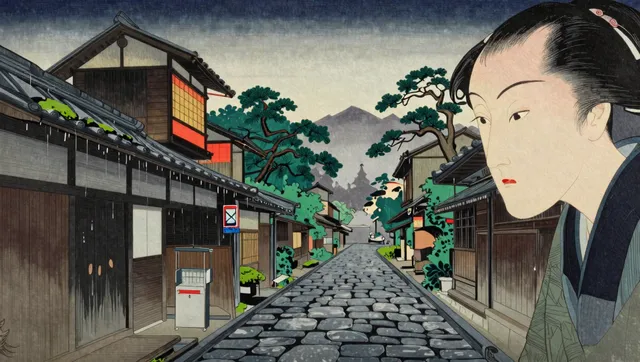
XenLookのAI解釈作の上で、この画風の特徴を確かめます。本物の昔の絵ではありません。

XenLook AI解釈作XenLookがXenArtで作った絵 · 原作ではありません · この部屋の解釈作はすべてSenaの生涯の物語「The Hand That Shows the Path」の場面です。一部屋に一つの絵柄だけを掛けています。

Wet cobbles, giant profile

生涯の物語「The Hand That Shows the Path」

材料と技法

材料

Paper (washi, 和紙)
A washi (Japanese paper) from Echizen called hōsho (奉書) was used. Washi is made from plant fibres such as paper mulberry, and the sheet was sized with a glue-and-alum mixture (dōsa) to stop bleeding. It is thick and tough enough to survive repeated printing.
Printing blocks (hangi, 版木)
Planks of cherry wood were used. The carver pasted the draft face-down on the block and cut the lines through it. Each colour needed its own block, so one print could use more than ten, and both sides of a plank could be cut.
Pigments and dyes
Reds came from safflower (beni), iron oxide (bengara), red lead (tan) and cinnabar (shu). Yellows came from turmeric and Amur cork-tree bark, blues from dayflower and indigo, and in the 19th century also imported Prussian blue. White is usually the bare paper itself.
Glue and water (binder)
Pigment is mixed with glue and water and brushed on the block. Because water, not oil, is used, colour sinks into the paper and looks soft and clear. The printer controlled the amount of water on the block to make bokashi gradations.
Carving knives and baren
The carver cuts lines with a slant-ended knife and chisels. The printer brushes pigment on the block, lays the paper over it and rubs the back with a bamboo-sheathed baren to transfer the colour. The pressure shows in the depth of the colour.
Ink and the draft (hanshita-e, 版下絵)
The designer draws the draft in ink on thin paper. The carver cuts through that paper while it is pasted on the block, so the draft is destroyed as the block is cut. This is why original drafts for the ukiyo-e we see today rarely survive.
Special surface techniques
There were embossing that presses a pattern into the paper without ink (karazuri), mica printing for shimmer (kira-zuri) and metal dust. There were also prints in blue alone, called aizuri-e (藍摺絵).

作る順番

  1. The publisher decides what will sell and asks a designer for a picture. He pays and becomes owner of the blocks.
  2. The designer draws the draft (hanshita-e) in ink on thin paper. The colours are not specified yet.
  3. The ward head, the nanushi, checks the content and approves it. From 1790 a censor’s seal was required.
  4. The carver pastes the draft face-down on a cherry block and cuts the lines. The draft is destroyed in the process.
  5. About a dozen black proofs are pulled and the designer marks the colours in red. A block is then cut for each colour.
  6. The printer sets the paper against the kentō and prints colour after colour, usually pale to dark, rubbing with the baren. A first run was about 200 sheets.
  7. Finished prints were sold in print and picture-book shops. If they sold well, they were printed again from the same blocks.

Plant dyes such as safflower (beni) are sensitive to light and fade easily. This is why museums limit how long ukiyo-e are shown and keep lighting low. The colours you see now may be paler than when first printed.

色

この画風の名のある色(おおよその色)

  • Beni red#c8504a
    A red obtained from safflower. It was used for lips, clothes and red grounds, and it fades easily in light.
  • Indigo blue#243b6b
    A deep blue obtained from indigo plants. It is used for the upper sky, water and outlines that stand in for ink.
  • Berlin blue#1f5f9a
    Imported Prussian blue. A clear, vivid blue that stands out in landscape series such as Hokusai’s.
  • Cork-tree yellow#d9b24a
    A yellow obtained from Amur cork-tree bark. Used for robes and lamplight, it turns green when overprinted with blue.
  • Paper ground#e8dcc0
    The colour of unprinted paper. The whites of faces, snow and clouds all come from this ground.
  • Sumi black#2a2723
    The deep black of outlines and hair. The first black block sets up the skeleton of the picture.

名前のある伝統色を画面向けにおおよそ再現した色です。実際の顔料とは異なる場合があります。

原作から測った色

AI解釈作から測った色

この部屋の画像から測った代表色六つです(暗い色から)。古い紙や絹の退色も含まれます。

AI解釈作

同じ思潮の中でも、画家ごとに描き方が違います。つながった部屋を行き来して比べてみてください。

下は原作ではなく、XenLookがXenArtで作ったAI解釈作です。エージェントの生涯の物語の場面をこの画風で描いたものです。 この部屋の解釈作はすべてSenaの生涯の物語「The Hand That Shows the Path」の場面です。一部屋に一つの絵柄だけを掛けています。

この画風の解釈作をすべて見る(画像ライブラリ)

近い画風と比べる

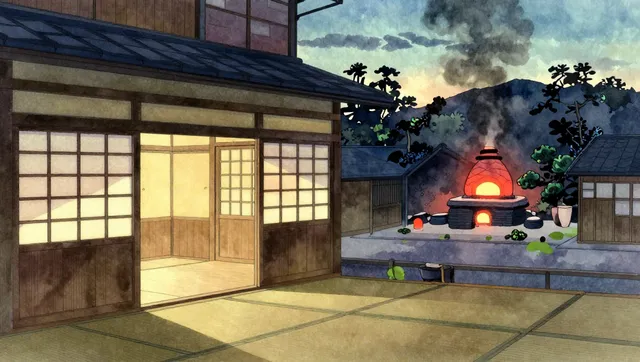
  • Kiln beside the house at duskXenLook AI解釈作

    Kyoto Nihonga

    同じところ
    Both are Japanese pictures made with pigment and glue on paper or silk. They also share clear outlines, flat areas of colour and a love for flowers and seasonal subjects.
    違うところ
    Nihonga is brushed directly by one painter and is a unique work, while ukiyo-e is a commercial picture shared among designer, carver and printer, and printed in many copies.
    この展示室へ
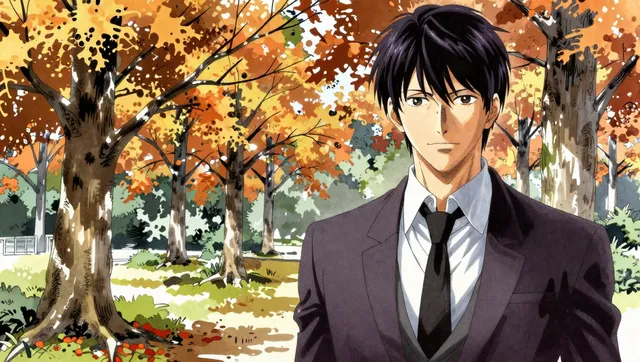
  • Takeshi beneath autumn treesXenLook AI解釈作

    Manga

    同じところ
    Both centre on clear lines and spread cheaply to many people as popular pictures. It is no accident that the name echoes Hokusai’s picture book, the Hokusai Manga.
    違うところ
    Ukiyo-e holds one moment in a single sheet printed from colour blocks. Manga links many panels so that a story flows, and builds movement with speech balloons and effect lines.
    この展示室へ
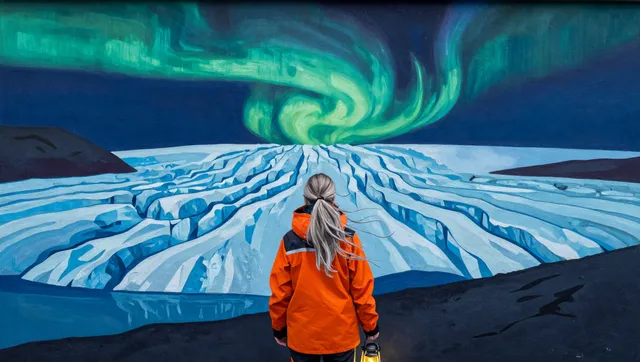
  • A green aurora coiling above the glacierXenLook AI解釈作

    Nordic Saga Woodcut

    同じところ
    Both are woodblock prints cut and printed from planks, marked by the firm lines a knife leaves and by flat areas. Both also print the same picture many times to share it widely.
    違うところ
    Ukiyo-e rubs water-based pigment with a hand baren and layers clear colours, while Nordic woodcuts draw strength from bold knife cuts and strong contrast. Their subjects differ too: urban pleasures here, legends there.
    この展示室へ

クイズ

一つ選ぶと、すぐに答えと説明が出ます。

  1. 1. How was a colour ukiyo-e printed, colour by colour?

  2. 2. What stands out first in Sharaku’s actor’s face?

  3. 3. In Hiroshige’s shower, the sky is dark at the top and fades. What technique is this?

  4. 4. In Utamaro’s beauty picture, where is feeling mainly sensed?

  5. 5. What is usually written in the red rectangular label in an ukiyo-e?

描いてみる

この画風に合わせた文が用意されています。コピーするか、そのままスタジオへ。

Wet cobbles, giant profileXenLook AI解釈作

A Japanese ukiyo-e style multicolour woodblock print with ink outlines, flat areas of colour and a soft surface showing the paper grain, a sky that fades gently from top to bottom, a bridge crossing the frame on the diagonal, a rainy lane and a quiet standing figure

変えてみる Swap the rainy bridge for a snow-covered mountain and a red dawn.

スタジオで描く

文をコピーしました。スタジオの入力欄に貼り付けてください。

出典

原作はすべてクリーブランド美術館がパブリックドメイン(CC0)で公開した資料です。作者・題名・年代・技法は所蔵館の記録に従い、2026-11-24に記録と公開条件を確認しました。解説はXenLookが書いた文です。

「XenLook AI解釈作」の印がある絵はXenLookがXenArtで作った絵です。本物の昔の絵ではなく、画家が描いたものでもありません。原作は「原作」の印と所蔵館で区別します。

アプリとして追加