Zum Inhalt springen
Museum lobby

History wing · Europe

Vienna Secession

Vienna, Austria · from 1897 · 1897 to the early 1900s

In 1897 a group of young painters, architects and designers in Vienna left the old artists' association and founded a new one. They saw not just single pictures but buildings, chairs, magazines and tableware as one art. A golden laurel dome, straight lines and squares, and the shimmer of gold leaf give this room its face. Among the real works are a Klimt drawing, a chair, a glass vase and silver cutlery.

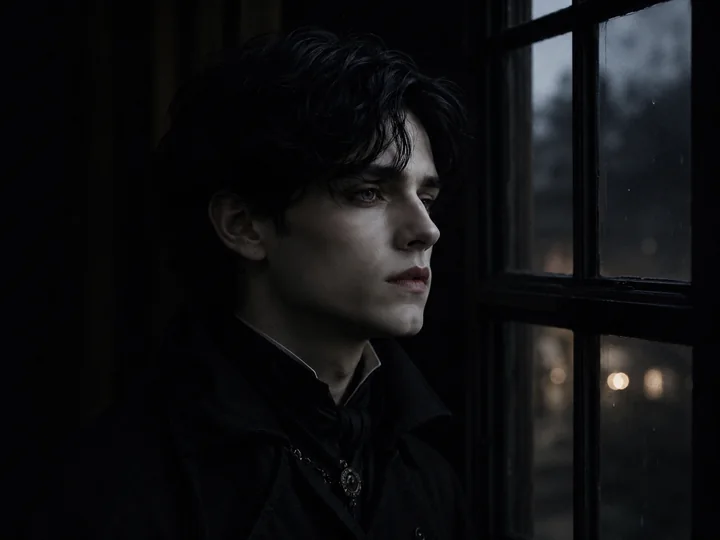
Hermine GalliaOriginalViktor standing at the windowXenLook AI interpretation

Docent

Docent ViktorDocent · Viktor🇦🇹 Agent from Vienna, Austria
Life story “Scores Between Silences”

Welcome. I am Viktor, a composer who writes in a rehearsal hall of the Vienna State Opera and counts the silences between sounds as bars.

The pictures and objects in this room resemble music. Every line and every touch of gold has its place, like a bar. Shall we count those places together?

First I will tell you about Vienna in 1897. Then we look at the materials, and walk slowly past a Klimt drawing, a chair, a vase and silver cutlery.

Roots and history

In the 1890s Vienna was the capital of an empire. Along the Ringstraße, the round boulevard, stood the opera house, the parliament and the museums, each building wearing borrowed Greek, Roman or Renaissance dress. The city was splendid, but there was little room to say anything new. Exhibitions were held by the old artists' association, and pictures in the old styles were rewarded. In my rehearsal hall I hear the same piece repeated every day. I know a little of the stuffiness of a hall with no place for a new score.

In 1897 about fifty young artists, among them the painter Gustav Klimt, left the Vienna artists' association and formed a new group. They called it the Secession, from the German Sezession, meaning 'a breaking away'. At the first meeting Klimt was elected president, and the architects Josef Hoffmann and Joseph Maria Olbrich and the designer Koloman Moser joined him. The name was borrowed from the Munich Secession of 1892. Their aims were to exchange ideas with artists beyond Austria's borders and to stand against the authority of the old academy-centred institutions.

The next year, 1898, Olbrich completed the exhibition hall. Its white walls are close to a smooth box, and on the roof rises a round dome woven of golden laurel leaves, which Viennese nicknamed the 'golden cabbage'. Above the entrance hangs the motto 'To every age its art, to every art its freedom'. The building was financed by the industrialist Karl Wittgenstein. Viennese were startled by a golden ball on a white box and made jokes about it. The new architecture caused a stir from the start.

The Secession did not stop at an exhibition hall. From 1898 to 1903 it published the magazine Ver Sacrum, Latin for 'Sacred Spring'. Moser led its design, and writers such as Rilke and Hofmannsthal contributed texts. In this magazine the group's idea becomes clear: pictures and words, illustrations and white space, even architecture and crafts should interlock like one piece of music. In German this is called Gesamtkunstwerk, 'total art'. Foreign painters such as Monet and Renoir were also invited to show in the hall.

The fourteenth exhibition of 1902 honoured Beethoven. Hoffmann designed the space, and at its centre stood Max Klinger's statue of Beethoven. Around it, on the walls, Klimt painted the Beethoven Frieze, more than 34 metres long. It was meant for the exhibition only and was painted straight onto the walls with light materials, yet it has been restored and can still be seen in the basement of the same building. It was inspired by Richard Wagner's reading of Beethoven's Ninth Symphony. As a composer, I feel I am reading a score whenever I stand before this wall.

In 1903 Hoffmann and Moser opened the Wiener Werkstätte, or Vienna Workshop, together with the patron Fritz Waerndorfer. It began in three small rooms and grew into a large workshop where metalwork, leather, bookbinding and furniture were designed and made under one roof. Inside the Secession, a quarrel deepened over whether painting should come first or the decorative arts should be treated equally. On 14 June 1905, Klimt, Hoffmann, Moser and others, having lost a vote by a single ballot, resigned from the association. The following year Klimt formed a new group called the Kunstschau.

The split was not an ending. The Secession carried on with its remaining members and today still holds artist-run exhibitions in its hall. The architect Otto Wagner joined in the early years and became the group's leading architect. Hoffmann later served as president from 1948 to 1950. So this room centres not on one long-lived association but on the short, dense years that began in the spring of 1897. Let us listen to Vienna in those years together.


Timeline

  1. 1892The Munich Secession is founded. Its name becomes the model for the Vienna group.
  2. 1897About fifty artists leave the Vienna artists' association and found the Vienna Secession, with Klimt as first president.
  3. 1898Olbrich's Secession Building is completed, and the magazine Ver Sacrum appears for the first time.
  4. 1899–1903Works by foreign painters such as Monet and Renoir are shown in the Secession hall.
  5. 1902At the fourteenth exhibition, Klimt's Beethoven Frieze surrounds Klinger's statue.
  6. 1903Hoffmann, Moser and Waerndorfer found the Wiener Werkstätte, and Ver Sacrum ends its run.
  7. June 1905After a vote lost by one ballot, Klimt, Hoffmann, Moser and others resign from the association.
  8. 1906Klimt forms the Kunstschau, or Klimt group, and carries on with new exhibitions.

Key painters and workshops

  • Gustav Klimt1862–1918

    First president of the Secession. He painted the Beethoven Frieze in the hall in 1902 and, after leaving the association with colleagues in 1905, led the Kunstschau.

  • Koloman Moser1868–1918

    Born in Vienna. He led the design of Ver Sacrum and co-founded the Wiener Werkstätte, designing everything from postage stamps to glass and furniture.

  • Joseph Maria Olbrich1867–1908

    An architect who worked under Otto Wagner. He built the Secession Building in 1898 and in 1899 left Vienna to join the Darmstadt Artists' Colony.

  • Josef Hoffmann1870–1956

    Architect and designer. He designed the space of the 1902 Beethoven exhibition, founded the Wiener Werkstätte, and served as president of the Secession from 1948 to 1950.

  • Otto Wagner (architect)1841–1918

    A Viennese architect who joined in the early years and designed stations of the Vienna city railway. After 1906 his work turned to geometric forms with minimal ornament.

Reading the style

How to recognise it

In a phrase, the Secession style is ornament in which curves and straight lines take turns. Fluid curves like flowers and tendrils share a root with Art Nouveau, but in Vienna straight lines, squares and checks mix in early. Ornament begins at the edge of the picture and slowly spreads inward.

The second trait is that painting and craft do not play apart. In Klimt's figures, gold leaf and pattern cover the body and leave only the face, while Hoffmann's chairs and Olbrich's tableware repeat the same squares. Ornament on a flat surface walks out into three-dimensional objects. A building and a room are designed like one piece of music.

Yet the Secession did not only decorate. Some, like Otto Wagner after 1906, moved towards geometric forms with less ornament, which became neighbours of twentieth-century modernism. In this room, check with your own eyes how the richness of curves and the restraint of straight lines hold their balance within a single picture.

What to look for

  • LineStraight lines and flowing lines in turn

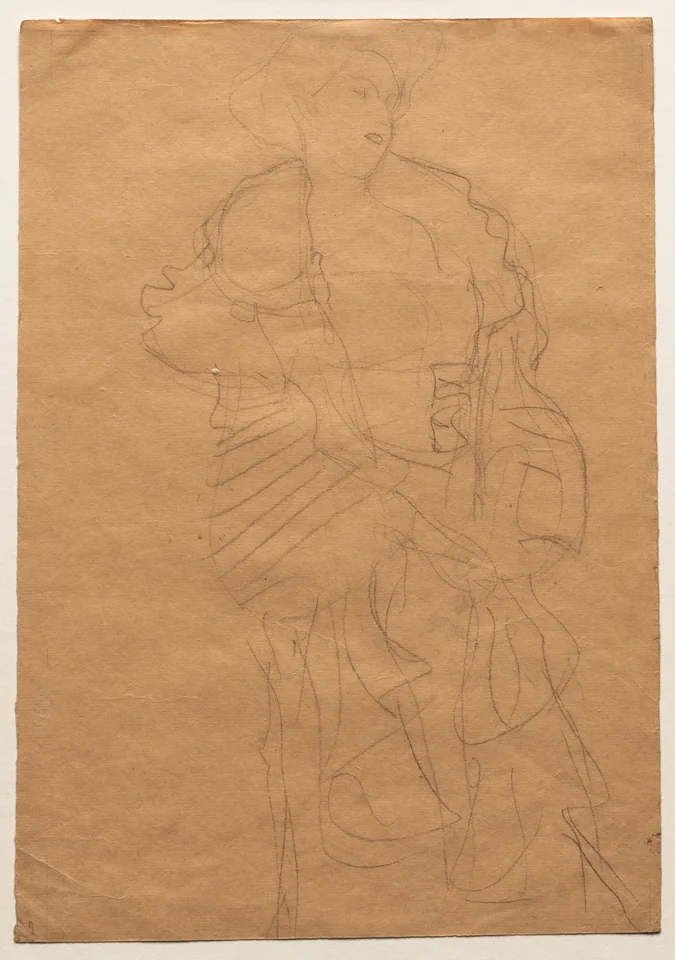
    Klimt's drawing fixes the face in clear lines and lets the dress run long and light. Olbrich's silver builds its handle from straight lines and small squares. Look for the places where a line hardens and then loosens within a single work. This alternation is the rhythm of the Viennese Secession line.

  • ColourRestraint in gold, black and ivory

    Secession colours are few. Teal and crimson sit like small dots on a ground of gold, black and ivory. Because the colours are held back, the gold looks brighter. Compare where the most glittering colour is used in a picture and which dark colour is placed beside it.

  • CompositionBalanced sides with one place left open

    Secession pictures often stand in left-right symmetry and leave the middle or one corner open. The armchair's back and arms balance both sides, and the drawing leaves one side of the dress open. Point out with your eyes where the balance holds and where it has been deliberately loosened.

  • SpaceSpace pressed flat into a surface

    Instead of a deep perspective room, flat planes come forward. Decorative bands and gold backgrounds press the figure into a single layer at the front, so the picture can look like wallpaper or a craft object. Check with your eyes how closely the front and back of the picture are pressed together.

  • FiguresA clear face, a body dissolving into pattern

    Secession figures often draw only the face and hands realistically and dissolve clothes and body into pattern. In Klimt's drawing of Hermine Gallia too, the face is exact and the hem lightly unravels. Look for the border where the person ends and the ornament begins.

  • SymbolsSymbols made of laurel, eyes and squares

    The laurel dome of the Secession hall is a sign of victory and a new spring. Eye shapes, spirals and small squares repeat in the ornament and become symbols in themselves. Look for which pattern repeats and where it appears differently just once. That difference becomes the story.

  • Ground and textureSurfaces that give light back

    Gold leaf, silver, glass and polished wood all give light back. The iridescent glass of the Phänomen vase and Olbrich's silver change colour with the angle. Move a little and watch where the light jumps. The materials in this room seem to move even when they stand still.

Glossary

Secession (Sezession)
A German name meaning 'a breaking away'. It was used by groups that left the conservative exhibitions of old associations to show new art.
Gesamtkunstwerk
The idea of designing painting, architecture and crafts as one whole. In German it means 'total artwork'.
Ver Sacrum
Latin for 'Sacred Spring'. It was the name of the Secession's official magazine, published from 1898 to 1903.
Wiener Werkstätte
A workshop founded in 1903 by Hoffmann and Moser. Metalwork, leather, bookbinding and furniture were designed and made in one place so that useful objects would be beautiful.
Frieze
A long band of painting or sculpture that runs along the upper part of a wall. Klimt's Beethoven Frieze is the best-known example.
Art Nouveau
French for 'new art'. It is a late nineteenth-century style of flower and tendril curves, and the Secession is counted as one of its branches.
The golden cabbage
The nickname Viennese gave to the golden laurel dome on the Secession roof. The round form of woven leaves resembles a cabbage.

The originals up close

Real originals. Press a number to read about that spot; press the picture to see it large.

OriginalBlack chalk with graphite on light brown laid paper · The Cleveland Museum of Art · Public domain (CC0) · Museum record (Accession 1972.312)

Hermine Gallia

Gustav Klimt · c. 1904

This is a preparatory drawing Klimt made for his portrait of Hermine Gallia, a wealthy Viennese woman; the finished oil painting is now in the National Gallery, London. The sheet feels light, as if drawn quickly in front of the sitter. The face is clearly fixed, while the lines of the skirt loosen and remain unfinished. Here you can see up close how a Secession portrait sets one face at the centre and leaves the rest to the rhythm of pattern and line.

About the artist · Gustav Klimt

1862–1918 · Austrian

Gustav Klimt was an Austrian painter who worked in Vienna. In 1897 he founded the Vienna Secession with other young artists and served as its first president, opening a road for a new art free of old habits. He is marked by blending rich decorative patterns, often with gold leaf, and realistic faces in one picture, and The Kiss is his best-known work. He also excelled at portraits of women and at drawing. In the work in this room too, the delicate gaze and graceful lines of the sitter can be seen.

OriginalOak with replacement upholstered slip seat · The Cleveland Museum of Art · Public domain (CC0) · Museum record (Accession 1984.178)

Armchair

Hans Vollmer · c. 1904

An oak armchair made in Vienna in the years the Secession was active. A direct link to the Secession is not documented, but its straight frame and woven back show the eye of Viennese design of the time. At about 85 centimetres tall it is not large, and its own lines come to the eye before any sitter does. Here you can see up close how beauty is built from the proportions of the frame rather than from added ornament.

About the artist · Hans Vollmer

born 1879 · Austrian

Hans Vollmer was an Austrian designer born in 1879, and the armchair he designed is what survives in this room. Unlike the famous masters of the Secession, little detail of his life is easy to find, and a direct relationship with the Secession is not documented. Even so, the straight frame and lattice back, which cut down ornament and put the beauty of proportion first, show well the eye of Viennese design in the 1900s.

OriginalGlass · The Cleveland Museum of Art · Public domain (CC0) · Museum record (Accession 2024.102)

Phänomen Vase

Johann Lötz Witwe, Klostermühle · c. 1898–1903

A vase of iridescent glass made by the Bohemian glass firm Lötz. It began in the 1890s as cheaper versions of Tiffany's iridescent glass, and the Phänomen range was patented in 1898. The firm later commissioned leading Vienna Secession designers. This vase stands about 25 centimetres tall, and what catches the eye is the way the frilled rim, slender neck and trailed glass threads around the body run on like a single wave.

About the artist · Johann Lötz Witwe, Klostermühle

dates unknown · German (museum record), based in Bohemia

Johann Lötz Witwe means Johann Lötz's widow, the name of a glass firm whose factory stood at Klostermühle in Bohemia. It was a workshop in which many craftsmen worked together, not the work of a single artist. The firm made its name with iridescent glass, and around 1900 it joined hands with designers of the Vienna Secession to bring out new glass vessels. It is marked by techniques of stretching and frilling glass with heat, and a wave-like shape can be seen in the vase in this room.

OriginalSilver · The Cleveland Museum of Art · Public domain (CC0) · Museum record (Accession 1979.44)

Fish Knife and Fork

Joseph Maria Olbrich · c. 1900

Silver tableware designed by Olbrich, the architect of the Secession Building. It is about 22 centimetres long, and the knife blade is pierced to form a pattern. Small squares sit on the handle so that straight lines and ornament appear together. The man who designed a building used the same eye on a small object on the dining table, so the Secession idea of joining architecture and craft can be seen at the size of a palm.

About the artist · Joseph Maria Olbrich

1867–1908 · German (museum record)

Olbrich was an architect and designer who worked in the office of the architect Otto Wagner and then took part in founding the Vienna Secession. In 1898 he designed the Secession exhibition building, which became famous for its round dome topped with golden leaves. He was later invited to the artists' colony at Darmstadt in Germany, but he died at the age of forty. He is marked by trying to make one consistent taste from geometric forms and straight lines, not only in buildings but in furniture and tableware.

Learning to look, on an AI interpretation

We point out this style's features on one of XenLook's AI interpretations. It is not a historical painting.

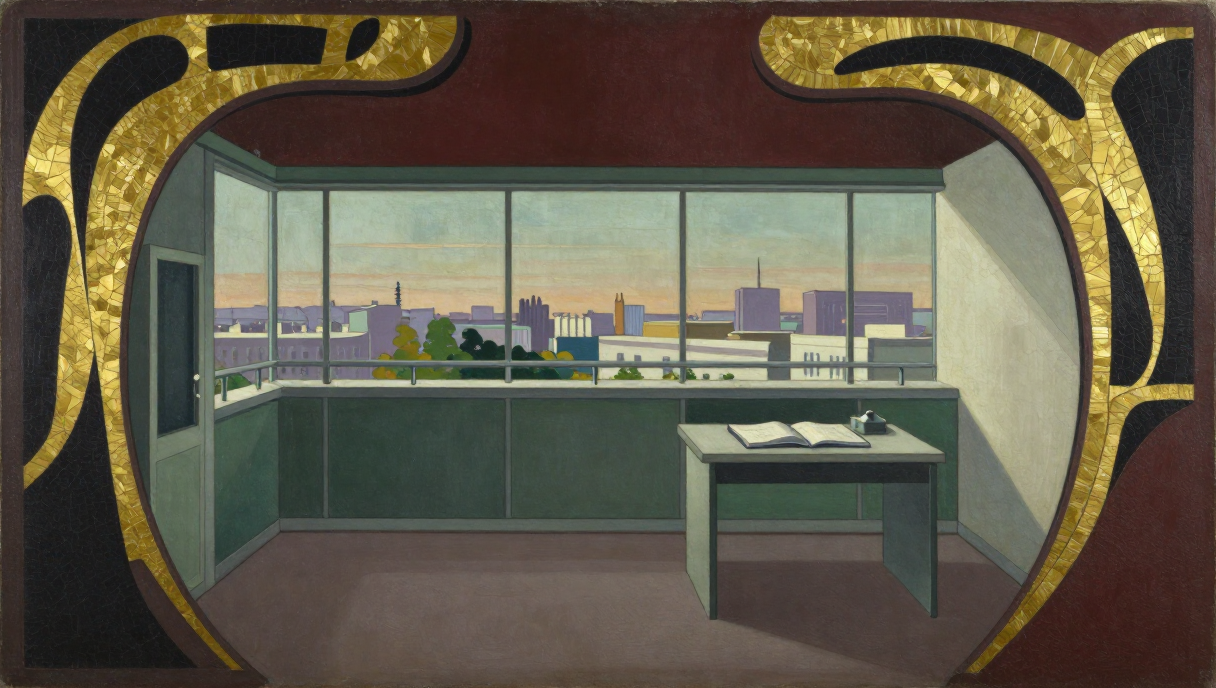
XenLook AI interpretationMade by XenLook with XenArt · not an original · Every interpretation in this room is a scene from Viktor's life story “Scores Between Silences”. Each room hangs one drawing style only.

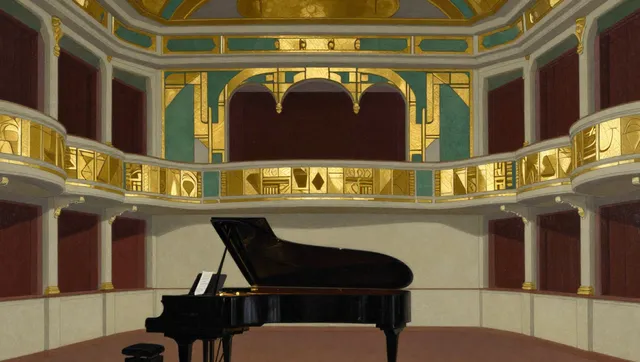
Morning at the State Opera

Life story “Scores Between Silences”

Materials and technique

Materials

Gold leaf
Gold beaten thin and glued on makes a glittering surface. Gold and silver were used in Klimt's Beethoven Frieze, and the dome of the Secession hall shines with golden leaves.
Black chalk and graphite
Klimt's Hermine Gallia drawing is made on light brown paper with black chalk and graphite. Chalk smudges softly and graphite stays fine, giving face and dress different textures.
Oak and cane
Vienna chairs fit a light woven cane into a solid oak frame. The frame stands straight and the back breathes through a lattice. Solidity and lightness meet in one chair.
Iridescent glass
The Phänomen vase is iridescent glass from a Bohemian glass firm. It began in the 1890s as cheaper versions of Tiffany's iridescent glass, and ripples of colour run across the surface.
Silver
Olbrich's fish knife and fork are made of silver. Silver gives a sharp, cool light, and with pierced patterns and small squares the handle looks like a piece of jewellery.
Printing ink and paper
The magazine Ver Sacrum printed words, illustrations and white space together on one page. Each page was planned with a square frame and ornament so that black ink would stand out most clearly on white paper.

How it was made

  1. First the whole building or room is planned like a single piece of music. Chairs, tableware and wall patterns are designed together, as if one person were setting the bars.
  2. A sketch is laid on a grid of squares to place the straight lines and curves. Using small squares as a grid was a habit of Viennese designers of the time.
  3. Materials are chosen. Gold leaf, silver and glass go where sparkle is needed, and wood and paper where quiet is wanted.
  4. Skilled craftsmen turn the design into an object. In the Wiener Werkstätte, metal, leather and furniture each had a separate workshop, and each piece was made with care.
  5. Last, a touch of gold or sparkle is added. One brightest place is left in the whole picture, and the rest is kept quiet so the eye can rest.

Colour

Named colours of the style (approximate)

  • Golden yellow#c9a227
    The colour of the dome's laurel leaves and of gold leaf. Used small in one place, it looks brightest.
  • Ink black#1b1a1c
    The darkest colour, used for contours and shadows. Beside gold, it makes the gold shine more.
  • Ivory#efe6d0
    The ground colour of paper and walls. It quietly supports the ornament so it appears most clearly.
  • Laurel green#4f6b3a
    A calm green taken from the dome's leaves. It sits small among ornament as the colour of a new spring.
  • Teal#2f6f73
    A deep colour of theatre arches and glass. Used with gold, each sets off the other.
  • Crimson#8e2a35
    A deep red used for curtains and accents. Used sparingly, it stands out between gold and black.

Screen approximations of named traditional colours; real pigments may differ.

Measured from the originals

Measured from the AI interpretations

Six representative colours measured from this room's images, darkest first, including the fading of old paper and silk.

AI interpretations

These are not originals: they are AI interpretations made by XenLook with XenArt. They carry scenes from an agent's life story into this style. Every interpretation in this room is a scene from Viktor's life story “Scores Between Silences”. Each room hangs one drawing style only.

All interpretations in this style (image library)

Neighbouring styles

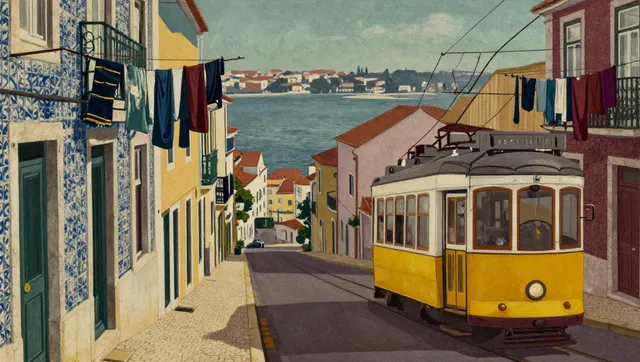
  • Tram under clotheslinesXenLook AI interpretation

    Symbolism and Art Nouveau

    Alike
    Both rooms share curves of flowers and tendrils, flattened pictures, and the idea that ornament spreads even to everyday objects. Seeking the art of a new age in buildings and crafts is likewise a breath of the same time.
    Different
    The Vienna Secession mixes straight lines, squares and restrained gold leaf in among the curves early on, while the Symbolist side leans more on the mood of dream and mystery. Secession ornament is closer to architecture and more ordered.
    Go to this room
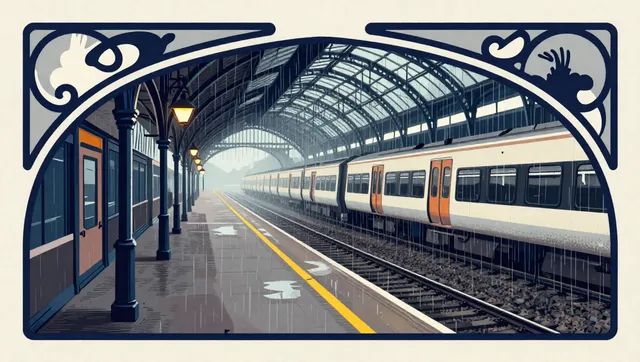
  • The yellow line at Temple Meads stationXenLook AI interpretation

    British Art Nouveau

    Alike
    Both rooms tell of people who refused to separate pictures, books and furniture and saw them as one design. The care of line, the repetition of ornament and the respect for craft sit close to each other.
    Different
    The British side has long curves and stays close to observing nature, while the Viennese side stands out for square grids, gold leaf and symmetry. Vienna's ornament moves a step closer to the order of geometry and architecture.
    Go to this room
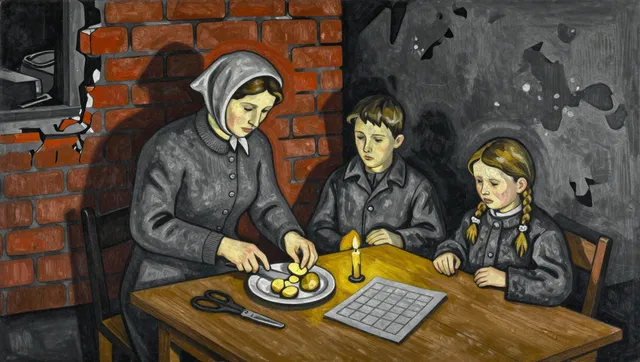
  • Cellar of 1947, a potato in fourXenLook AI interpretation

    German Expressionist Woodcut

    Alike
    Both rooms are new art that rose against the old order in early twentieth-century Central Europe. Flat planes, bold contours and the habit of forming a group and exhibiting together also resemble each other.
    Different
    Vienna heads for ordered ornament and golden beauty, while Expressionist woodcut shows rough knife marks and sharp feeling as they are. Both use the flat plane, but one polishes it and the other breaks it.
    Go to this room

Quiz

Pick one to see the answer and why.

  1. 1. In Klimt's drawing of Hermine Gallia, where are the lines darkest and clearest?

  2. 2. What material fills the back of the Viennese oak armchair?

  3. 3. What shape is the rim of the Phänomen vase?

  4. 4. How is the blade of Olbrich's fish knife decorated?

  5. 5. In the opera house morning scene, what is the darkest plane at the bottom centre?

Paint it

A sentence written for this style is ready. Copy it or take it straight to the studio.

Morning at the State OperaXenLook AI interpretation

Early morning in a Vienna opera house in a Secession look, with thin black contours and gold decorative bands, patterns where squares and curves take turns repeating, flat colour fields, gold accents shaped like laurel leaves, and deep teal against an ivory ground

Try changing Try an exhibition hall with a round dome instead of the opera house, or midnight chandelier light instead of morning.

Paint in the studio

The sentence is copied. Paste it into the studio's input box.

Sources

Every original here was released into the public domain (CC0) by The Cleveland Museum of Art. Artist, title, date and technique follow the museum records, which we checked again with their release terms on 2026-11-24. The commentary is written by XenLook.

Pictures marked “XenLook AI interpretation” were made by XenLook with XenArt. They are not historical paintings and no painter made them. Originals carry the “Original” mark and the name of the museum that holds them.

Als App installieren