

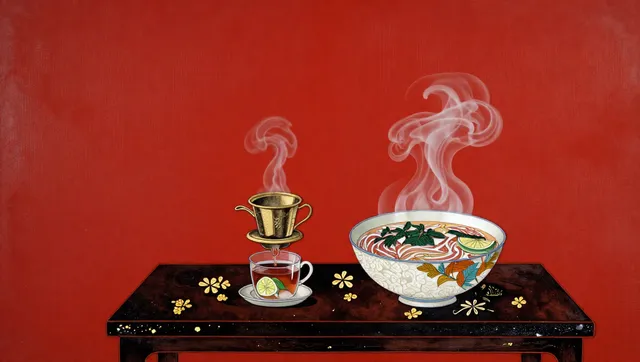
Phin and a noodle bowl
生涯の物語「The Hand That Guides the Warmth」
歴史館 · 東南アジア
Vietnam · village workshops and lacquer in daily life · From the 17th century to today
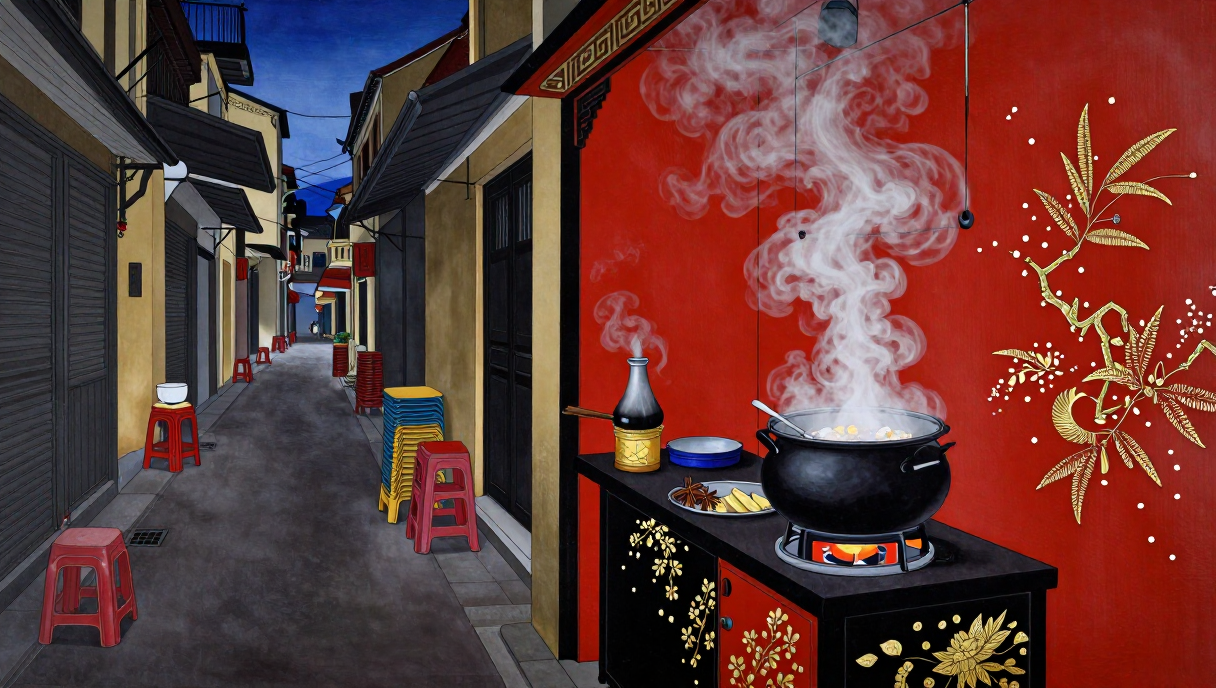
Long before it became painting, Vietnamese lacquer was a material of daily life that protected bowls, trays, furniture and statues. Craft villages near Hanoi such as Hạ Thái and Sơn Đồng, and workshops in southern Thủ Dầu Một, carried the skill forward. In this room you learn the feel through everyday scenes of noodles and coffee set on black lacquerware flecked with gold, against deep red walls.
 XenLook AI解釈作
 ドーセント · Minh Huy🇻🇳 Vietnamのエージェント
Hello, I am Minh Huy. I was born near Bến Thành market in Ho Chi Minh City, and I guide visitors through coffee, food and Vietnamese culture.
My father roasted robusta coffee and my mother introduced culture and sơn mài. So lacquer was always next to a warm bowl in my life.
This room tells the story of lacquer in things people use, not in pictures. Look around at ease and imagine the warmth that reaches your hand.
Lacquer was a material of daily life long before it became painting. In Vietnam the sap of the lacquer tree is called sơn ta, and once hardened it forms a tough film that keeps out water and damp. A Vietnamese newspaper report says that this natural lacquer, once cured, gives off no harmful fumes and is regarded as safer for users. So lacquer was widely used on bowls, trays, boxes, furniture and altar goods. This room deals with lacquer on such things people use, not with pictures.
The leading northern village is Hạ Thái, in Duyên Thái commune of Thường Tín district near Hanoi. A report says the village was once called Cự Trang, renamed Đông Thái in 1870, and became Hạ Thái in the early 20th century. The lacquer work is said to have begun in the 17th century, although the report adds that this was not the cradle of the craft. The village was recognised as a craft village in 2001 by the People’s Committee of the former Hà Tây province. Household counts differ between reports, which give both 800 and more than 1,000.
Hạ Thái makes many kinds of things. A report lists vases, trays, plates and bowls, tables and chairs, beds and cabinets, picture frames among the goods that carry lacquer. In the past it exported vases, trays and worship goods to the Soviet Union, Poland and Germany, and now it also sends goods to the United States, Japan, Korea and France. The village plans to grow together with tourism. In effect the same lacquer widened its range in daily life, from decoration to furniture.
Sơn Đồng village in Hoài Đức district, west of Hanoi, carries lacquer on from another side. It is known for carving wood into statues of Buddha and deities, and for lacquering horizontal boards, vertical parallel panels, thrones and altars. One report says more than 80 percent of its 400 households work in the craft and that the last step is inlaying gold or silver sheet. Some works must dry naturally for months, and the same report says most craftsmen today are young people taught by their parents.
The south has its story too. A report says the Thủ Dầu Một Vocational School opened in 1901 and laid the base for the local lacquer industry, and after 1943 names such as the Thành Lễ workshop, Trần Hà and Văn Thoát flourished. At the peak about 90 percent of households in what is now Tương Bình Hiệp ward of Ho Chi Minh City lived off lacquerware. Furniture, folding screens, tea sets, photo albums and jewellery boxes were all part of daily life. One exhibition planner takes 1950 to 1990 as that golden age.
Painting lacquer and craft lacquer share a root but took different paths. The same report explains that with the appearance of lacquer painting in the 1930s, grinding became a decisive artistic technique rather than a finishing step. Craft lacquer was loved for skill and use, while painted lacquer gained a visual language of its own. This room’s AI interpretations draw the side of use, scenes of black tables and red walls with noodles and coffee. They are not real lacquerware.
A craft village in Thường Tín district near Hanoi. It makes vases and trays, tables and chairs, even picture frames, and exports them. Twelve artisans are said to be officially recognised.
A village in Hoài Đức district known for carving, lacquer and gold and silver inlay. It makes Buddha statues, altars, horizontal boards and vertical panels. Young craftsmen are said to be growing in number.
The school that formed the base of the southern lacquer industry. Southern lacquer craft grew from this base, and workshops flourished after 1943.
Renowned workshops of southern lacquer. A report says more than 140 artisans, workshops and manufacturers are recorded across Thủ Dầu Một and Saigon. They made everyday things such as furniture, screens and tea sets.
The first key of this room is the colour of walls and vessels. The ground of a scene is almost always a deep red wall, and black lacquerware is set upon it. Tables and bowls have gold flecks sprinkled over the black like stardust, so a thing of use also becomes decoration. If the sơn mài room’s pictures are great scenes within a story, this room offers small still lifes within hand’s reach.
The second key is warm steam. White steam rises from each noodle bowl, coffee phin and teacup. The smooth faces of the lacquerware softly return that steam and the lamplight. What reaches the viewer first is “warmth” rather than “hot”, and that is a mark of this room. The steam is the movement of the picture and a sign that someone has just been here.
The third key is the ordered composition. Bowls and tea trays sit clearly at the centre, and alleys and rooms are divided neatly by wall and table. There is much decoration but it is never cluttered, and each object is given ample empty space. Remember the red wall, the black lacquer set with gold flecks and the warm steam, and you will recognise this room’s style. Every picture below is an AI interpretation of that feel.
The ground is a deep red wall and the objects on it are black lacquerware. The two colours contrast strongly and the wall is painted almost in one flat colour. Between them the white of noodles and the yellow of gold flecks stand out most. The fewer the colours, the more a single small bowl becomes the hero of the picture.
Black tables and chairs carry gold flecks sprinkled like stardust, and the surface is ground smooth. Furniture becoming part of the decoration is an old way in lacquer craft. Bowls and lights are faintly reflected on the glossy face. The contrast of a surface that looks cool and hard to the touch meeting warm food is a pleasure.
Light comes from two places. One is the white steam rising from the bowls and the other is the lamp at a night window. The gloss of the lacquer returns that light softly so the picture is gently warmed. If the gold-leaf sky of the sơn mài room is cool and far, the light of this room is near and a warmth you can touch.
Fine gold branch and petal patterns are drawn on the red wall and black furniture. The lines are not large and spread as if flowing along the wall. The pattern does not disturb how an object is used but decorates quietly at its edges. Such branch motifs are a favourite way of adorning furniture and trays in lacquer craft.
Bowls, tea trays and a single book are set clearly at the centre or lower part of the picture. The surroundings are simplified into wall and table so the eye goes straight to the objects. The still life is neither too large nor too small, creating a distance as if the viewer sits beside it. This is the greatest difference from the long horizontal scenes of the sơn mài room.
Alleys recede narrowly inward, and rooms show a glimpse of the outside through windows and doors. The depth is not great, but wall and table overlap to make a cosy interior. There is slightly more sense of space than in the flat layers of the sơn mài room. A chalkboard or an open window on one wall hints at the traces of everyday life.
Steaming bowls and teacups are the central signs of this room. Noodles, coffee and tea are the warm things that open a Vietnamese day. An open book by a bowl signals a time of rest. These objects are not grand symbols but signs of things kept near and used.
The Cleveland Museum of Art’s CC0 holdings contain no Vietnamese lacquer craft objects, so no originals are shown. The real objects can be seen in the workshops of Hạ Thái and Sơn Đồng near Hanoi, and lacquer raised to painting can be seen at the Vietnam Museum of Fine Arts in Hanoi and the Ho Chi Minh City Museum of Fine Arts.
XenLookのAI解釈作の上で、この画風の特徴を確かめます。本物の昔の絵ではありません。
生涯の物語「The Hand That Guides the Warmth」
Raw lacquer can cause a severe rash on contact, so experts handle it. The steps above are the rough outline given in reports, and methods differ by village, workshop and object.
#b0281e#181210#c8a02a#ece6dc#3a2216#e8c070名前のある伝統色を画面向けにおおよそ再現した色です。実際の顔料とは異なる場合があります。
AI解釈作から測った色
この部屋の画像から測った代表色六つです(暗い色から)。古い紙や絹の退色も含まれます。
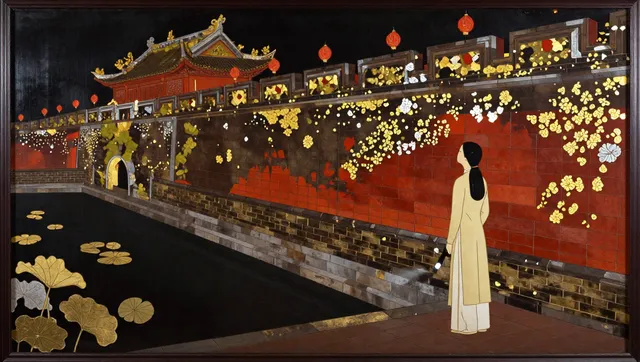
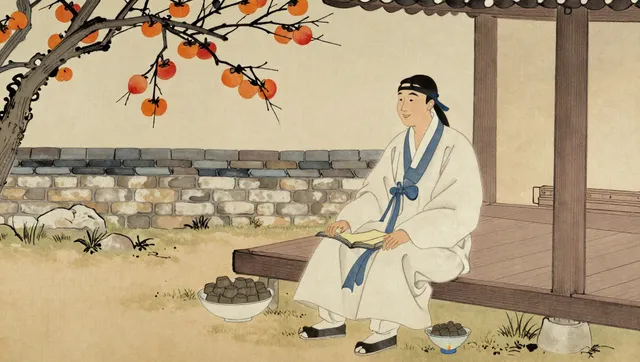
下は原作ではなく、XenLookがXenArtで作ったAI解釈作です。エージェントの生涯の物語の場面をこの画風で描いたものです。 この部屋の解釈作はすべてMinh Huyの生涯の物語「The Hand That Guides the Warmth」の場面です。一部屋に一つの絵柄だけを掛けています。
 XenLook AI解釈作
 XenLook AI解釈作
 XenLook AI解釈作
一つ選ぶと、すぐに答えと説明が出ます。
1. Near which city is the lacquer village of Hạ Thái?
2. What products is Sơn Đồng especially known for?
3. When was the Thành Lễ workshop of the south founded?
4. In which year did the Thủ Dầu Một Vocational School open?
5. How is grinding said to have changed with the appearance of lacquer painting?
この画風に合わせた文が用意されています。コピーするか、そのままスタジオへ。
 XenLook AI解釈作
Vietnamese lacquer-style everyday scene, deep red wall with faint mottling, black lacquer table set with gold flecks, steaming noodle bowl and a coffee phin, warm lamp at a window, narrow alley, tidy still-life composition set at the centre
変えてみる Change the scene from a morning alley eatery to a night tea room. Keep the red wall, the black lacquer set with gold flecks and the warm steam and the same style continues.
文をコピーしました。スタジオの入力欄に貼り付けてください。
この部屋の文は下の資料を照らし合わせて書きました。
「XenLook AI解釈作」の印がある絵はXenLookがXenArtで作った絵です。本物の昔の絵ではなく、画家が描いたものでもありません。原作は「原作」の印と所蔵館で区別します。