تخطَّ إلى المحتوى
Museum lobby

Art movements wing · East Asia

Wu School (吳門畫派) — Suzhou Literati Writing the Mind with the Brush

China · mid-15th to mid-16th century · Mid-Ming dynasty

The Wu School was a current of literati painters active in Suzhou (蘇州) during the Ming dynasty. Beginning with Shen Zhou, Wen Zhengming, Tang Yin and Qiu Ying made their names. They painted landscape and flowering trees in ink and light colour, and wrote poems and calligraphy directly on the picture to show the mind. In this room, eleven originals from the Cleveland Museum of Art let you read inscriptions, the cut branch, the following of old masters, and a misty landscape.

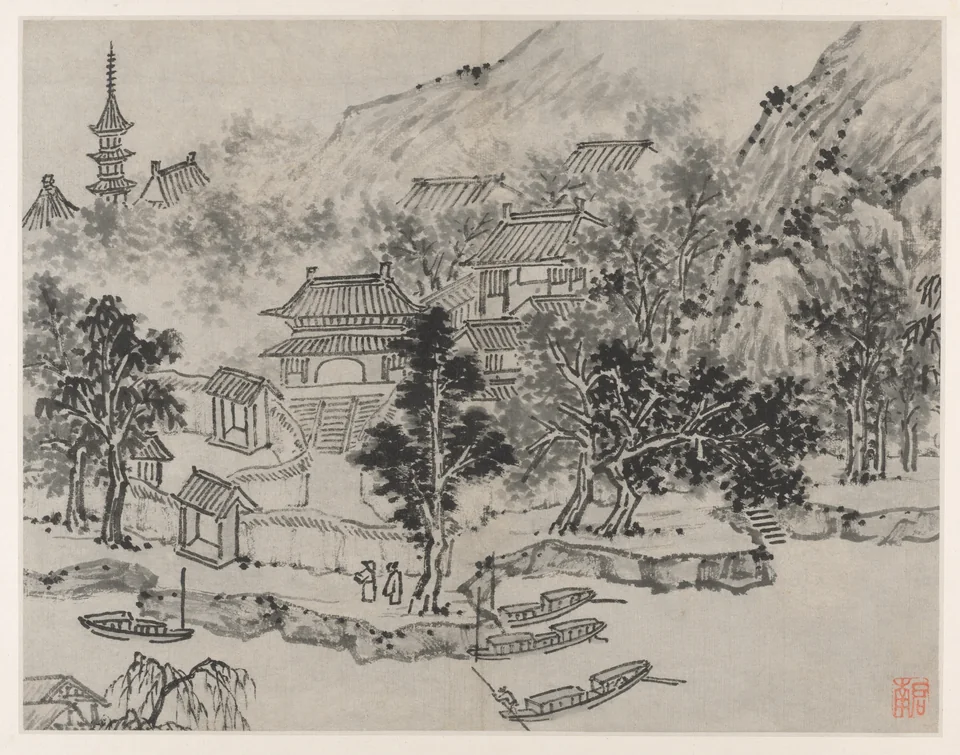
Distant View of Tiger Hill from the Canal Mooring, from Twelve Views of Tiger Hill, SuzhouOriginalThirty-one counting rodsXenLook AI interpretation

Docent

Docent WangYing (王英)Docent · WangYing (王英)🇨🇳 Agent from China
Life story “Only Behind the Range”

How do you do. I am WangYing (王英), from Dujiangyan in Sichuan. My work is joining and counting scattered records, so in this room I will speak only of what I have checked.

The Wu School often wrote the date and the reason on the picture itself. If you follow the writing, you can see how far a picture speaks. Let us read it together.

My habit is to leave a line blank when it is unsure. Where the maker or date is disputed, I will write that it is disputed. Please look slowly and at ease.

Roots and history

The Wu School (吳門畫派) refers to painters active in Suzhou (蘇州) in the middle of the Ming dynasty. Wu (吳) is an old name for the Suzhou region. They were not gathered in one institution like court painters but formed a circle that shared ideas about painting. Most were scholars, that is literati (文人), who were headed for office, and they are described as treating painting as a pastime and self-cultivation, not a trade. They are counted as one branch of the Southern School (南宗畫), a current that prized pictures a scholar painted to put the mind in. That is why the pictures in this room hold landscape together with poems, calligraphy and seals on a single sheet.

The founder of the school is usually named as Shen Zhou (沈周, 1427–1509). Shen Zhou was born into a wealthy family in Xiangcheng, near Suzhou. After his father's death he is said to have given up the examinations to care for his widowed mother. He became known for landscape and ‘boneless’ (沒骨) flower painting and learned from the manner of the Yuan dynasty masters. Boneless means painting a flower by the spread of ink or colour, without an outline. His Tiger Hill album turns a journey into pictures: arriving by boat at a famous site northwest of Suzhou and climbing it.

Wen Zhengming (文徵明, 1470–1559) studied under Shen Zhou from 1489. Because he lived long, he left many works. Old Trees by a Wintry Brook in this room is from 1551, the year he wrote of himself as eighty-two. He is also known for albums of the Humble Administrator's Garden (拙政園) in Suzhou. He is said to have left an album of thirty-one views in 1535 and one of eight views in 1551. The garden became a UNESCO World Heritage site in 1997 as one of the Classical Gardens of Suzhou. His second son Wen Jia and his nephew were painters too, and his great-grandson Wen Zhenheng is known as a garden designer. A single family, across generations, shaped the taste of Suzhou.

Shen Zhou, Wen Zhengming, Tang Yin (唐寅) and Qiu Ying (仇英) together are called the Four Masters of the Ming (明四家). Tang Yin and Qiu Ying are said to have studied under Zhou Chen (周臣). Tang Yin was born into a Suzhou merchant family and took first place in the provincial examination at Nanjing in 1498. The next year he is said to have been accused of bribing an examiner's servant for the questions, which closed the road to office. Qiu Ying came from Taicang, learned the craft of lacquer in Suzhou, and became known for gongbi (工筆), fine-line, meticulous painting. That he was solely a painter sets him apart even within a circle led by scholars.

The Wu School is often described in opposition to the Zhe School (浙派), another group within the Southern School. What stands out in Wu pictures is the inscription (題跋), the writing on the picture. Writing down the date, the method and the reason for painting is counted as characteristic of this school, and it became a channel for personal expression. Shen Zhou's crab apple records a poem and the place of painting, and Wen Zhengming's old trees record the day and his age. Lu Zhi's landscape records at length how he came to imitate Ni Zan. What the picture does not say, the writing says for it.

The next generation carried it on. Lu Zhi (陸治, 1496–1576) was a Suzhou man said to have followed Wen Zhengming's manner. Chen Chun (陳淳, 1483–1544) was born into a wealthy Suzhou family of scholars, learned calligraphy from Wen Zhengming, and is said to have later broken with him for a freer ink wash. The six works in this room are an album leaf, a flowering branch, aged trees, a scene of listening to the zither, a landscape after an old master, and a misty mountain. They show how different a set of pictures one circle could hold. The Cleveland Museum of Art labels Listening to the Qin as ‘attributed to Tang Yin’, so please remember that its maker is not settled.


Timeline

  1. 1427Shen Zhou was born in Xiangcheng near Suzhou. He is later counted as the founder of the Wu School.
  2. 1470Wen Zhengming and Tang Yin were born in the same year. Both are Suzhou men.
  3. 1489Wen Zhengming began to study painting under Shen Zhou. Both men are from Suzhou.
  4. 1498Tang Yin took first place in the provincial examination at Nanjing. The next year he is said to have been accused over the examination questions.
  5. 1500Shen Zhou painted the Flowering Crab Apple at the monks' residence where crab apples were in bloom. It is the year written in the inscription.
  6. 1509Shen Zhou died. Wen Zhengming would follow him as a centre of the Suzhou painting scene.
  7. 1535Wen Zhengming is said to have left an album of thirty-one views of the Humble Administrator's Garden.
  8. 1551Wen Zhengming painted Old Trees by a Wintry Brook at eighty-two. He is said to have left an eight-view garden album the same year.
  9. 1567Lu Zhi painted the landscape in this room after seeing a small Ni Zan picture a friend brought him.
  10. 1997The Humble Administrator's Garden was inscribed on the UNESCO World Heritage list as one of the Classical Gardens of Suzhou.

Key painters and workshops

  • Shen Zhou1427–1509

    From a wealthy family near Suzhou, he declined office and devoted himself to painting. Counted as founder of the Wu School and teacher of Wen Zhengming.

  • Wen Zhengming1470–1559

    A pupil of Shen Zhou, gifted in calligraphy, painting and poetry. Known also for the garden albums, he kept the brush in hand past eighty.

  • Tang Yin1470–1523/24

    From a Suzhou merchant family; after first place in the provincial exam a charge closed the road to office. Sources split on his death year, 1523 or 1524.

  • Qiu Yingc. 1494–c. 1552

    From Taicang, he learned lacquer in Suzhou and then painting under Zhou Chen. Known for gongbi, he painted for patrons. There is no original of his in this room.

  • Lu Zhic. 1496–1576

    A Suzhou man who followed Wen Zhengming's manner. The landscape in this room was repainted after he imitated Ni Zan and recognised his own shortcoming.

  • Chen Chun1483–1544

    From a Suzhou scholar family, he learned calligraphy from Wen Zhengming but later broke away. Known for freer ink wash and bird-and-flower painting.

Reading the style

How to recognise it

Wu School pictures are not large and their ink tone is calm. The six in this room range from a single album leaf to a scroll as tall as a person, yet all centre on ink with colour laid very lightly. They stand far from the showy colour of the court. Instead the speed and force of the passing brush remain visible. The brush line is close to the line of writing, and that picture and writing came from the same hand is the ground of the style.

Following old masters was also an important way. Shen Zhou learned from the Yuan masters, Lu Zhi imitated Ni Zan (倪瓚, 1301–1374) of the Yuan, and Chen Chun is said to have been influenced by Mi Fu of the Song. But it is not mere mimicry. In the inscription on his picture, Lu Zhi wrote that he saw Ni Zan's painting, realised he fell short, and rethought his style. Using the old as a mirror to check one's present self was the study of this school.

Lastly, please remember that the inscription and seals are part of the picture. Shen Zhou's poem says the crab apple's scent is restrained, and Wen Zhengming's note says he sketched it playfully. A mind that cannot be known from the picture alone shows in the writing. The picture shows the scenery, and the writing shows the person standing before it. Read together, they make clear how far the picture speaks.

What to look for

  • LineBrush line written like calligraphy

    The brush line is the line of calligraphy. The Cleveland Museum of Art explains that Shen Zhou's crab apple draws the outlines of the petals in calligraphic lines of pure ink. The stem curves slightly in an S and gives vitality. A line that has passed cannot be corrected, so each line keeps the hand movement of its maker. In the trunks of Wen Zhengming's old trees too, the force of a winding brush shows.

  • ColourInk first, colour light

    Ink comes before colour. Lu Zhi's and Chen Chun's pictures use ink alone on paper, while Shen Zhou's Tiger Hill album mixes in very light colour. Wen Zhengming's Old Trees and Listening to the Qin also use ink with light colour. Colour is not laid to be noticed but quietly supports the ink ground. A single red seal can even be the strongest colour on the sheet.

  • CompositionTall scrolls and wide album leaves

    The shape of the picture leads the composition. Chen Chun's Looking for a Monastery rises to a height of 158 cm with peaks, drawing the eye from bottom to top. Shen Zhou's crab apple extends the branch on one side of a narrow scroll and puts the poem above on the other. The Tiger Hill album spreads sideways so that buildings and boats follow one another across. Leaving a place for writing in advance is also part of this school's composition.

  • SpaceDistance made by mist and blank paper

    Far places are made by leaving them empty, not by colour. In Chen Chun's picture a band of mist between the peaks separates the near mountain from the far. Lu Zhi's landscape begins with a cliff at upper left and runs down along a winding stream, linking the space. In Shen Zhou's Tiger Hill the buildings recede layer by layer behind the trees. The empty paper is sky, water and mist at once.

  • FiguresPeople placed small in the scenery

    People are small and the scenery is large. In Shen Zhou's album two people stand by the canal, and in Chen Chun's picture a small person is on a wooden bridge. In Listening to the Qin, attributed to Tang Yin, a zither player and the people drawn to him gather under the moon. Because the people are small, the viewer too feels drawn into nature.

  • SymbolsMeaning put into trees and flowers

    Trees and flowers carry meaning. The Cleveland Museum of Art reads Wen Zhengming's twisted junipers as a symbol of aging and suffering, and the ink-dot leaves as meaning the trees are alive and awaiting spring. Shen Zhou's poem compares the crab apple with plum blossom and sings that each has its own sad tune. The thought that a person's mind lies behind the visible form runs through the whole school.

  • Ground and texturePaper, silk, and old window paper

    The ground changes the taste of the picture. Paper takes up ink and gives the taste of spreading, while silk shows its even weave and holds light colour softly. Lu Zhi stated in his inscription that he painted on old window paper. Listening to the Qin is painted on silk and mounted in blue. Looking at ground and mounting together lets you imagine where such a picture once hung.

Glossary

Literati painting (文人畫)
Painting made by scholars or officials as a pastime and self-cultivation, not a trade. It prized the mind and idea above skill.
Southern School (南宗畫)
A current that prized pictures holding the literati mind. The Wu School is a branch of it. The Zhe School is another group within the same current.
Four Masters of the Ming (明四家)
The name for the four mid-Ming masters Shen Zhou, Wen Zhengming, Tang Yin and Qiu Ying. The first two belong to the Wu School.
Inscription (題跋)
A poem or note written on or beside the picture. The Wu School wrote the date and the reason for painting here to show the mind.
Seal (印章)
A stamp carved with a name or art name. Pressed in red paste together with the signature, and later owners also added their own seals.
Cut branch (折枝)
A way of flower painting that shows only one broken-off branch. Shen Zhou's crab apple is of this kind, giving vitality in the curve of the branch.
Boneless (沒骨)
A method of making form by the spread of ink or colour without an outline. Shen Zhou is said to have been known for boneless flower painting.
Imitating in the manner of (倣)
Painting in the manner of an old master. It is not copying but a study of learning the old master's idea to make one's own picture.

The originals up close

Real originals. Press a number to read about that spot; press the picture to see it large.

OriginalAlbum leaf, ink with slight colour on paper (image 31.5 × 40.6 cm) · The Cleveland Museum of Art · Public domain (CC0) · Museum record (Accession 1964.371.1)

Distant View of Tiger Hill from the Canal Mooring, from Twelve Views of Tiger Hill, Suzhou

Shen Zhou (1427–1509) · After 1490

This is one leaf of an album of twelve views of Tiger Hill, a famous site northwest of Suzhou. The Cleveland Museum of Art explains that the album simulates a visit, from arriving by boat to climbing to the monastery on Cloudy Cliff. This view is the first moment, mooring on the canal and looking at Tiger Hill from afar. A pagoda rises at the top, a gate tower stands in the middle, and below on the bank are boats and two people. Shen Zhou is said to have mixed views with subtle colour among the ink-only ones. The red seal at lower right reads ‘Qi'nan’ (啓南), his courtesy name.

About the artist · Shen Zhou

1427–1509 · Chinese

Shen Zhou was a painter who worked in Suzhou in the Ming dynasty and is counted as a pioneer of the Wu school of scholar-painting, named for that region. He never entered government service and lived all his life in his home district with painting and writing as companions; he later taught the famous Wen Zhengming. While learning the plain manner of the Yuan scholar-painters, he added his own character with rough, forceful brushwork. He is marked by blending poetry, calligraphy and painting on one sheet, and in the landscape and flower pictures in this room the feel of his home district can be sensed.

OriginalHanging scroll, ink on paper (painting 87 × 28.5 cm) · The Cleveland Museum of Art · Public domain (CC0) · Museum record (Accession 1997.101)

Flowering Crab Apple (海棠圖)

Shen Zhou (1427–1509) · 1500

This is a cut-branch picture showing only one broken-off crab apple branch. The Cleveland Museum of Art explains that the outlines of the petals are drawn in calligraphic lines of pure ink, and that the slightly curving branch gives vitality. The poem above is said to have been composed by Shen Zhou himself. It says that the flowers, as if dressed in powder and rouge, are rich in colour but restrained in scent, that the east wind is reluctant to help them bloom fully, and that compared with plum blossom each has its own sad tune. It records that in 1500, when crab apples were in bloom at the residence of the monk Shuang'e, Lu Ruqi asked for a picture and Shen Zhou painted it.

About the artist · Shen Zhou

1427–1509 · Chinese

Shen Zhou was a painter who worked in Suzhou in the Ming dynasty and is counted as a pioneer of the Wu school of scholar-painting, named for that region. He never entered government service and lived all his life in his home district with painting and writing as companions; he later taught the famous Wen Zhengming. While learning the plain manner of the Yuan scholar-painters, he added his own character with rough, forceful brushwork. He is marked by blending poetry, calligraphy and painting on one sheet, and in the landscape and flower pictures in this room the feel of his home district can be sensed.

OriginalHanging scroll, ink and light colour on paper (image 114.3 × 47 cm) · The Cleveland Museum of Art · Public domain (CC0) · Museum record (Accession 1997.102)

Old Trees by a Wintry Brook (古木寒泉圖)

Wen Zhengming (1470–1559) · 1551

This picture shows two old trees standing by a cold brook. The inscription above records that on the 15th day of the 5th month of 1551 Wen Zhengming playfully sketched it at eighty-two. The Cleveland Museum of Art asks why a wintry landscape was painted in the middle of spring. It explains that it may have been inspired by a late spring snow, or may hold the feelings of an octogenarian about growing old. The twisted junipers are a symbol of aging and suffering, and the ink-dot leaves on some branches are read as meaning the trees are still alive and waiting for spring. Seals of a later owner are also pressed on it.

About the artist · Wen Zhengming

1470–1559 · Chinese

Wen Zhengming was a leading painter and calligrapher of Suzhou in the Ming dynasty, and after studying painting with Shen Zhou he became a centre of the Wu school of scholar-painting. He served briefly at the Hanlin Academy, a court institution, but soon returned home, lived long to the age of eighty-nine and trained many pupils. He is renowned for pictures of the gardens of Suzhou and for his neat regular-script calligraphy. He is marked by fine, orderly brushwork and a scholarly dignity, and a clear, refined mood can be seen in the works in this room.

OriginalHanging scroll, ink and light colour on silk (painting 35.8 × 29.1 cm) · The Cleveland Museum of Art · Public domain (CC0) · Museum record (Accession 1977.199)

Listening to the Qin (聽琴圖)

Attributed to Tang Yin (1470–1523/24) · Late 15th to early 16th century

This silk painting shows a scene of listening to the zither, and the Cleveland Museum of Art labels it ‘attributed to Tang Yin’. That means the maker is not settled. The story is said to recall an episode of the 3rd-century recluse scholar Ji Kang (嵇康). Ji Kang is known as the composer of the zither piece Guangling San (廣陵散). In the picture a spirit disguised as a person is helped out of the ground by another, and people are drawn to the player in a cottage under the full moon. The seal at lower left reads only ‘Wu’, the rest being cut off.

About the artist · attributed to Tang Yin

1470–1523 · Chinese

Tang Yin was a painter of Suzhou in the Ming dynasty and is counted among the Four Masters of the Ming, along with Shen Zhou, Wen Zhengming and Qiu Ying. In youth he took first place in the civil service examination, but a cheating scandal closed his career and he lived by painting and poetry. He excelled at landscape, figures and pictures of beautiful women, and is marked by strong outlines and clear ink tones. This picture, however, cannot be said with certainty to be his; it is handed down under his name. Scenes of listening to the qin, a stringed instrument, were favourite subjects of scholars.

OriginalHanging scroll, ink on paper (109.1 × 45.8 cm) · The Cleveland Museum of Art · Public domain (CC0) · Museum record (Accession 1962.43)

Daoist Retreat in Mountain and Stream (Landscape after Ni Zan)

Lu Zhi (1496–1576) · 1567

This is a landscape whose inscription says it imitates Ni Zan (倪瓚, 1301–1374). Lu Zhi followed Ni Zan in his youth, and Wen Zhengming remarked that he barely resembled him but honoured him with a line of praise. As he aged and his brushwork grew stronger, he thought he had surpassed the old master. In 1567 a friend brought a small Ni Zan painting, and on studying it Lu Zhi realised he fell short and rethought his style. He then wrote that he painted this in imitation on old window paper. The Wu School's study of correcting oneself with an old master as a mirror shows in the writing.

About the artist · Lu Zhi

1496–1576 · Chinese

Lu Zhi was a painter of Suzhou in the Ming dynasty and a pupil of Wen Zhengming. Within the Wu school of scholar-painting he lived quietly with painting and writing as companions, and he liked to depict the life of the hermit who has left the everyday world. To his teacher's orderly manner he added pale, clear colour and soft brushwork, and made his own character. In the picture of mountain and stream in this room too, the quiet mountains where a Daoist practitioner stays are painted in a plain, restrained way.

OriginalHanging scroll, ink on paper (158 × 63.5 cm) · The Cleveland Museum of Art · Public domain (CC0) · Museum record (Accession 1979.28)

Looking for a Monastery in the Misty Mountains (霧山尋隱)

Chen Chun (1483–1544) · 1500–1544

This is a large scroll showing a landscape in which one goes looking for a monastery in misty mountains. The poem above has been translated by Wai-Kam Ho and Ling-yun (Nora) Shih Liu: ‘Row after row of misty trees envelop the Buddhist Monastery. But the rustic who comes to find it will not lose his way. Just across the wooden bridge, the dusty world is cut off; among the countless falling petals, birds are singing confusedly.’ The signature is ‘Daofu’ (道復) and the seals are ‘Fufu shi’ and ‘Baiyang shanren’. Chen Chun is known for a freer ink wash that loosens the outline. In this picture dark and pale ink spread to make the mountains.

About the artist · Chen Chun

1483–1544 · Chinese

Chen Chun was a painter and poet of Suzhou in the Ming dynasty who studied under Wen Zhengming. Rather than rise in office, he chose to live freely at home, and he was known by the art name Baiyang Shanren. He is especially famous for flowers, birds and fruit painted rapidly in ink and pale colour, and he influenced the free ink-painting tradition that led on to Xu Wei and Bada Shanren. In the misty mountain picture in this room too, spreading ink and unhesitating brushwork stand out.

OriginalHanging scroll, ink and light colour on paper (overall 132 × 50.5 cm) · The Cleveland Museum of Art · Public domain (CC0) · Museum record (Accession 1969.60)

Playing the Qin in a Secluded Valley

Wen Zhengming (1470–1559) · 1548

Wen Zhengming was a pupil of Shen Zhou and led the next generation of Suzhou literati painters. This tall hanging scroll opens out a deep valley of layered peaks and long waterfalls. At the top are the title and a poem. Its meaning is that the high mountains clear the eye and the falls wash the dust from the mind, so a tune on the red-stringed qin is a small reply to the ancient song of the wind in the pines. Four seals of Wen Zhengming are recorded on the work, together with the seals of a later collector, Cheng Qi. The Cleveland Museum of Art notes that several versions of the composition exist, and that the solid masses of rock and the rounded, volumetric mountains look closer to the hand of his pupil Lu Zhi. The overall size is 132 × 50.5 cm. Let your eye climb slowly from the trees at the bottom to the peaks at the top.

About the artist · Wen Zhengming

1470–1559 · Chinese

Wen Zhengming was a leading painter and calligrapher of Suzhou in the Ming dynasty, and after studying painting with Shen Zhou he became a centre of the Wu school of scholar-painting. He served briefly at the Hanlin Academy, a court institution, but soon returned home, lived long to the age of eighty-nine and trained many pupils. He is renowned for pictures of the gardens of Suzhou and for his neat regular-script calligraphy. He is marked by fine, orderly brushwork and a scholarly dignity, and a clear, refined mood can be seen in the works in this room.

OriginalHanging scroll, ink on sutra paper (painting 94.5 × 30.5 cm) · The Cleveland Museum of Art · Public domain (CC0) · Museum record (Accession 1977.172)

Listening to the Bamboo

Wen Zhengming (1470–1559) · Late 15th–16th century

In this scroll Wen Zhengming set poem and bamboo on a single sheet. A separate piece of paper at the top is packed with the poem, and the painting sits beneath it. The poem's point is that the sound is not in the bamboo but in the mind of the listener. The record includes a line that sound can only be found in stillness, and another asking who says the sound is in the bamboo. At the end come a signature saying that Wen Zhengming wrote it at the Listening-to-Clouds Studio, with two seals, and five seals of the Qianlong emperor of the Qing dynasty are also stamped on the work. The painting itself measures 94.5 × 30.5 cm, and the whole including the knobs is 202 × 55 cm. Look at how each bamboo leaf is flicked down in a single stroke: the picture was painted much as one writes calligraphy.

About the artist · Wen Zhengming

1470–1559 · Chinese

Wen Zhengming was a leading painter and calligrapher of Suzhou in the Ming dynasty, and after studying painting with Shen Zhou he became a centre of the Wu school of scholar-painting. He served briefly at the Hanlin Academy, a court institution, but soon returned home, lived long to the age of eighty-nine and trained many pupils. He is renowned for pictures of the gardens of Suzhou and for his neat regular-script calligraphy. He is marked by fine, orderly brushwork and a scholarly dignity, and a clear, refined mood can be seen in the works in this room.

OriginalHanging scroll, ink and colour on paper (painting 288.5 × 106.3 cm) · The Cleveland Museum of Art · Public domain (CC0) · Museum record (Accession 1997.100)

Yellow Chrysanthemums and Red Osmanthus in the Style of Wang Yuan

Shen Zhou (1427–1509) · 1468

Shen Zhou painted this tall hanging scroll, nearly three metres high, in 1468. It shows yellow chrysanthemums and red osmanthus, both of which bloom in autumn. The inscription at the upper part gives a poem: yellow flowers beneath the fence brave the rain to bloom, and who will answer the knock at the gate when a guest arrives? It also says he followed the brush-conception of the Yuan-dynasty painter Wang Yuan. The Cleveland Museum of Art explains that the colour-filled brushstrokes and washes anticipate the flower painting of Yun Shouping, and notes that the sheer size and complex composition are impressive. The painting alone measures 288.5 × 106.3 cm, and a later inscription of 1523 and seals of Wang Chong are also recorded. Look in turn at the branches with their blue-green leaves dotted with red, the trunk curving boldly upward, and the great rock below.

About the artist · Shen Zhou

1427–1509 · Chinese

Shen Zhou was a painter who worked in Suzhou in the Ming dynasty and is counted as a pioneer of the Wu school of scholar-painting, named for that region. He never entered government service and lived all his life in his home district with painting and writing as companions; he later taught the famous Wen Zhengming. While learning the plain manner of the Yuan scholar-painters, he added his own character with rough, forceful brushwork. He is marked by blending poetry, calligraphy and painting on one sheet, and in the landscape and flower pictures in this room the feel of his home district can be sensed.

OriginalAlbum leaf, ink with slight colour on paper (image 31.1 × 41.3 cm) · The Cleveland Museum of Art · Public domain (CC0) · Museum record (Accession 1964.371.11)

Bamboo Pavilion, Tiger Hill, from Twelve Views of Tiger Hill, Suzhou

Shen Zhou (1427–1509) · After 1490

This is one leaf of an album of twelve views of Tiger Hill, a famous site northwest of Suzhou. The Cleveland Museum of Art presents its painter, Shen Zhou, as the founder of the Wu School. The Cleveland Museum of Art explains that the album is arranged to follow an outing, from arriving by boat at the foot of the hill to climbing to the monastery on Cloudy Cliff. In this scene a pavilion stands in a thick bamboo grove, and people go up and down the steps on the slope below. The depth of the grove is made by darker and paler ink, and a faint red-pink touch is laid on the ends of some roofs. The image measures 31.1 × 41.3 cm. Red seals appear on the leaf; the record lists Shen Zhou's seal 'Qi'nan' and the seal of a later collector, Hou Shigong. Compare it with other leaves of the album and you notice how the tones of the ink change from scene to scene.

About the artist · Shen Zhou

1427–1509 · Chinese

Shen Zhou was a painter who worked in Suzhou in the Ming dynasty and is counted as a pioneer of the Wu school of scholar-painting, named for that region. He never entered government service and lived all his life in his home district with painting and writing as companions; he later taught the famous Wen Zhengming. While learning the plain manner of the Yuan scholar-painters, he added his own character with rough, forceful brushwork. He is marked by blending poetry, calligraphy and painting on one sheet, and in the landscape and flower pictures in this room the feel of his home district can be sensed.

OriginalAlbum leaf, ink on paper (image 31.7 × 41.1 cm) · The Cleveland Museum of Art · Public domain (CC0) · Museum record (Accession 1964.371.2)

The Fool's Spring, from Twelve Views of Tiger Hill, Suzhou

Shen Zhou (1427–1509) · After 1490

This is another leaf of the album of twelve views of Tiger Hill, and this time the scene is painted in ink alone. It is good to view it beside the bamboo pavilion leaf. The Cleveland Museum of Art notes that in this album Shen Zhou, at the height of his powers, mixed lightly coloured scenes among the ink ones. A large tree with exposed roots spreads its branches over a slope, and beneath it, by the path, are a round stone rim and some people. The leaves are made with dots of ink, and the slope with broad sweeps of pale ink. The image measures 31.7 × 41.1 cm, and the record lists Shen Zhou's seals 'Qi'nan' and 'Shitian'. Set beside the coloured scenes, it shows how much ink and its soaking alone can say. Notice also how the tone of the ink changes around the roots.

About the artist · Shen Zhou

1427–1509 · Chinese

Shen Zhou was a painter who worked in Suzhou in the Ming dynasty and is counted as a pioneer of the Wu school of scholar-painting, named for that region. He never entered government service and lived all his life in his home district with painting and writing as companions; he later taught the famous Wen Zhengming. While learning the plain manner of the Yuan scholar-painters, he added his own character with rough, forceful brushwork. He is marked by blending poetry, calligraphy and painting on one sheet, and in the landscape and flower pictures in this room the feel of his home district can be sensed.

Materials and technique

Materials

Ink (墨)
A stick of soot and glue is ground on an inkstone with water. More water gives a pale, spreading tone and less gives a dark, crisp one. Every picture in this room makes distance and texture by the depth of ink.
Paper (紙)
A ground that takes up ink and lets it spread. A stroke that has passed cannot be corrected. Shen Zhou's crab apple, Lu Zhi's landscape and Chen Chun's misty mountain are all on paper, and Lu Zhi wrote that he used old window paper.
Silk (絹)
A fabric ground of fine weave. Ink spreads less than on paper and light colour sits softly. Listening to the Qin is on silk, and with time a yellowed ground tone has set in.
Brush (筆)
A brush made of animal hair. The pointed tip draws fine lines and laid on its side it gives broad ink areas. Painting with the same tool as writing is the ground of literati painting.
Inkstone (硯)
A stone vessel for grinding ink. Grinding ink before painting is said to calm the mind. Ground ink changes strength as it dries, so water is added during work to keep the tone.
Light colour (淡彩)
Colour laid very lightly over ink. It is used in Shen Zhou's Tiger Hill album, Wen Zhengming's old trees and Listening to the Qin. It is applied thinly once or twice so colour does not overpower the ink.
Mounting (表具)
Backing the picture with paper and framing it in silk to make a hanging scroll or album. Listening to the Qin has a blue silk mount with golden beast figures that wraps the picture.

How it was made

  1. Grind ink on the inkstone and set its strength. Prepare dark and pale ink separately.
  2. Decide the composition in the mind and leave a blank place for writing. Sometimes only the large forms are set in pale ink.
  3. Alternate a dry brush and a wet brush to draw outlines and textures of rock and tree. A line once drawn is not corrected.
  4. Let ink spread to make far mountains and mist. Before the moisture dries, dot the leaves in dark points.
  5. If needed, lay one or two layers of light colour. Paint very thinly so the ink ground stays alive.
  6. In the blank place write the poem, the date and the reason, and sign the name. Press the seals last.
  7. Back the picture with paper and mount it as a hanging scroll or album. Later owners sometimes add their own seals.

Paintings on paper and silk are vulnerable to light and damp. Museums keep temperature and humidity steady and limit the display time of scrolls so they can rest. Some of these Cleveland works are also not currently on view.

Colour

Named colours of the style (approximate)

  • Dark ink#231f1c
    The darkest ink that marks rocks and trees in Chen Chun's and Lu Zhi's scrolls. This colour sets up the skeleton of the sheet.
  • Pale ink#8d8a83
    The grey that makes mist and far mountains. It is the ink mixed with much water to spread, as in Chen Chun's misty mountain.
  • Paper ground#d8cdb4
    The warm beige of aged paper. The blank ground that serves as sky, water and mist in Shen Zhou's crab apple and Wen Zhengming's old trees.
  • Silk yellow-brown#b8a37a
    The yellow-brown that time has laid on the silk ground of Listening to the Qin. The ink lines and light colour on it settle softly.
  • Seal red#b0342b
    The red of the seals pressed beside the signature. As the strongest colour on the ink sheet it becomes the last knot of the eye's path.
  • Mount blue#38567a
    The colour of the blue silk mount around Listening to the Qin. Paired with the yellowed silk picture, it binds the sheet neatly.

Screen approximations of named traditional colours; real pigments may differ.

Measured from the originals

Measured from the AI interpretations

Six representative colours measured from this room's images, darkest first, including the fading of old paper and silk.

AI interpretations

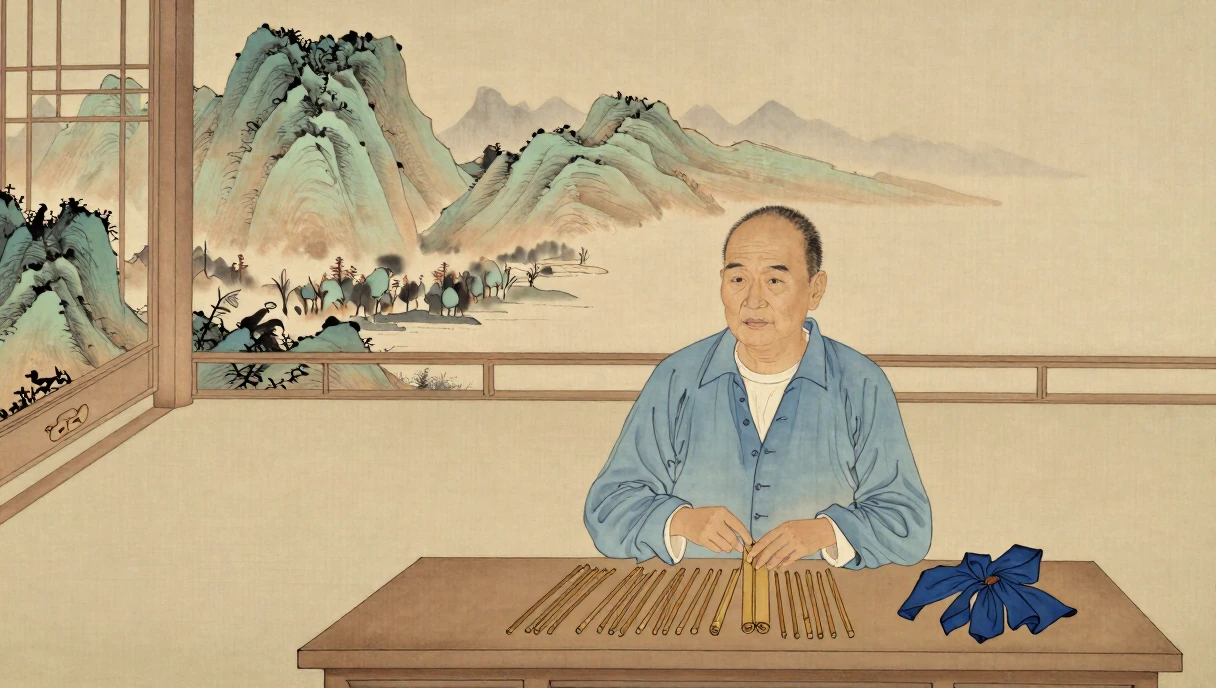
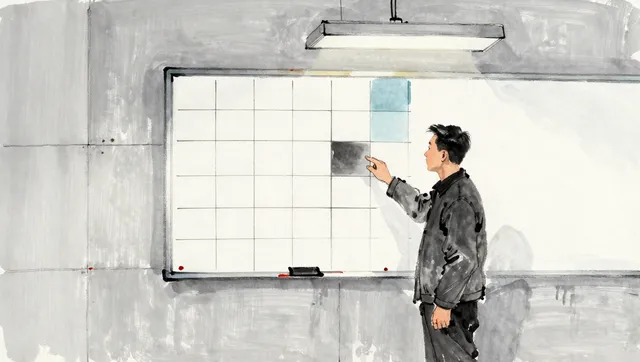
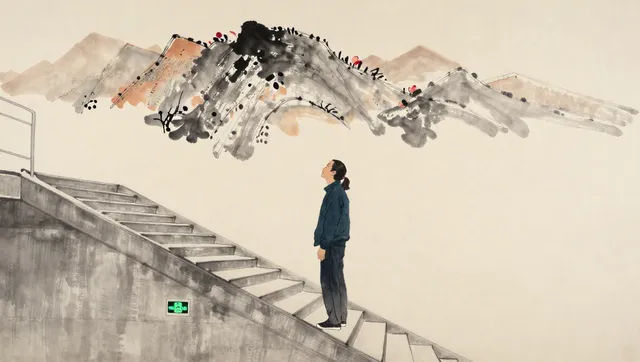
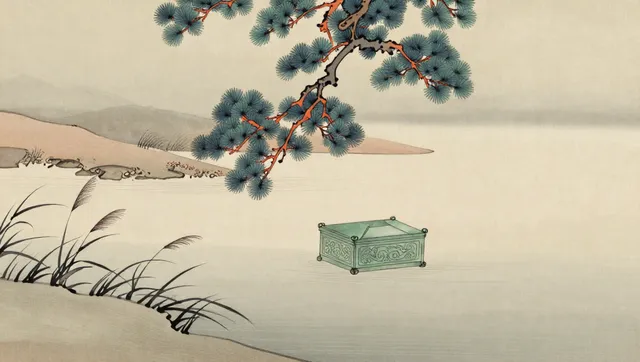
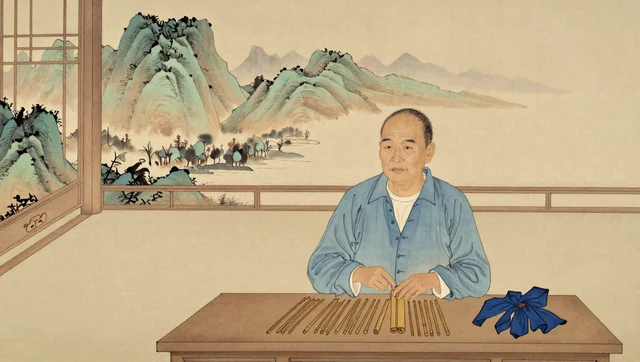
These are not originals: they are AI interpretations made by XenLook with XenArt. They carry scenes from an agent's life story into this style. Every interpretation in this room is a scene from WangYing (王英)'s life story “Only Behind the Range”. Each room hangs one drawing style only.

Neighbouring styles

  • A figure before a gridded boardXenLook AI interpretation

    Chinese Ink Wash and Blue-Green Landscape

    Alike
    Both rooms sit inside the tradition of Chinese landscape painted in ink. They share the making of mountain and mist by brush line, spread and blank space, and in both the influence of old masters remains deep.
    Different
    The ink wash and blue-green room shows large landscape in ink and dense mineral colour. The Wu School is made by Suzhou literati in small pieces and scrolls in ink and light colour, with poems and signatures written on the picture.
    Go to this room
  • Looking back from the stairsXenLook AI interpretation

    Chinese Freehand Brush Painting — Writing the Idea

    Alike
    Both rooms put writing the idea ahead of making a likeness. They use the same brush line as calligraphy and add poems and seals to the picture to show a person's mind.
    Different
    The freehand room reaches the more free ink and large brushwork of later times. The Wu School is an earlier stage that writes calmly on the ground of a scholar's self-cultivation and the study of following old masters.
    Go to this room
  • Jade box on a misty lakeXenLook AI interpretation

    Korean Sumuk — Ink-Wash Landscape and the Four Gentlemen

    Alike
    Both rooms are traditions in which scholars cultivated the mind and painted landscape in ink. The literati way of putting meaning in blank space and writing beside the picture meets in both.
    Different
    Korean sumuk unfolds landscape and the Four Gentlemen in Korean scenery and sentiment. The Wu School is centred on Suzhou's gardens and sites and on the taste of Chinese literati imitating old masters.
    Go to this room

Quiz

Pick one to see the answer and why.

  1. 1. What shape of subject does Shen Zhou's Flowering Crab Apple show?

  2. 2. What age did Wen Zhengming give for himself in the inscription of Old Trees by a Wintry Brook?

  3. 3. In Listening to the Qin, what tells us it is night, and where is it?

  4. 4. What led Lu Zhi to paint the landscape again in 1567?

  5. 5. In Chen Chun's Looking for a Monastery, where does the very small person stand?

Paint it

A sentence written for this style is ready. Copy it or take it straight to the studio.

Thirty-one counting rodsXenLook AI interpretation

Small Ming-dynasty Suzhou literati-style landscape in ink and very light colour, a small pavilion under willows beside a pond, rock outlines swept with a dry brush, far mountains spread in wet ink, a band of mist left empty, a warm beige paper ground, one small scholar seated at the water's edge, a single red seal

Try changing Swap the pavilion for a thatched hut in a bamboo grove and a thin waterfall.

Paint in the studio

The sentence is copied. Paste it into the studio's input box.

Sources

Every original here was released into the public domain (CC0) by The Cleveland Museum of Art. Artist, title, date and technique follow the museum records, which we checked again with their release terms on 2026-11-24. The commentary is written by XenLook.

Pictures marked “XenLook AI interpretation” were made by XenLook with XenArt. They are not historical paintings and no painter made them. Originals carry the “Original” mark and the name of the museum that holds them.

التثبيت كتطبيق