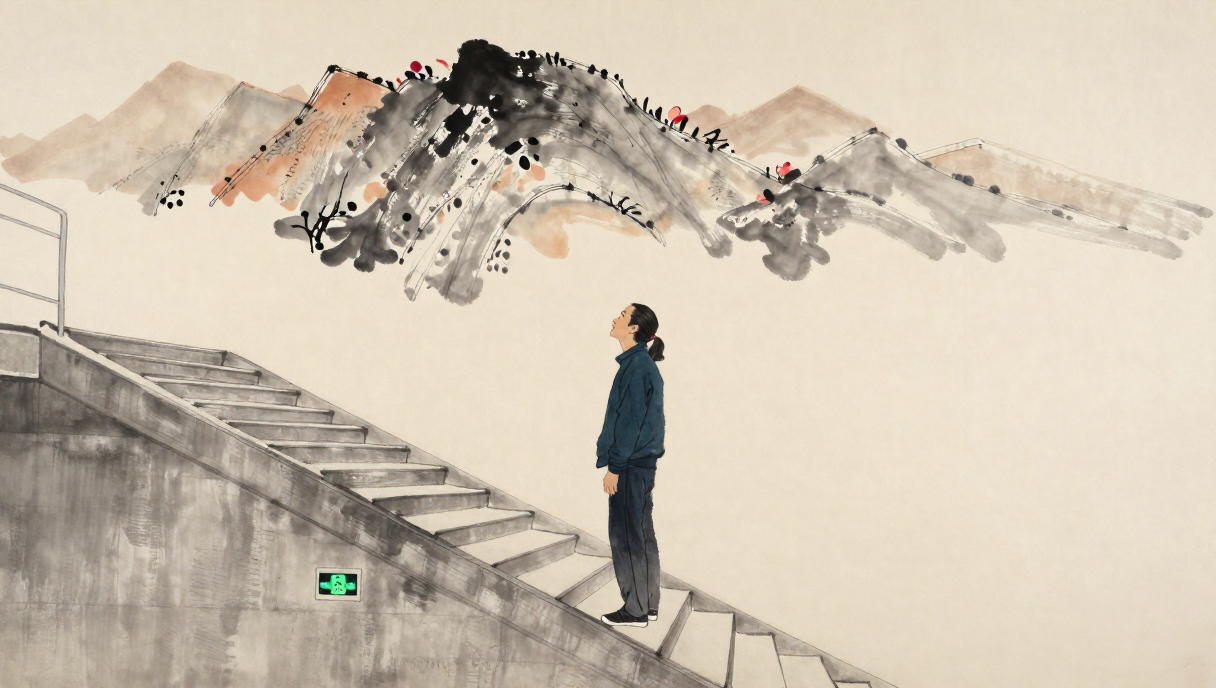
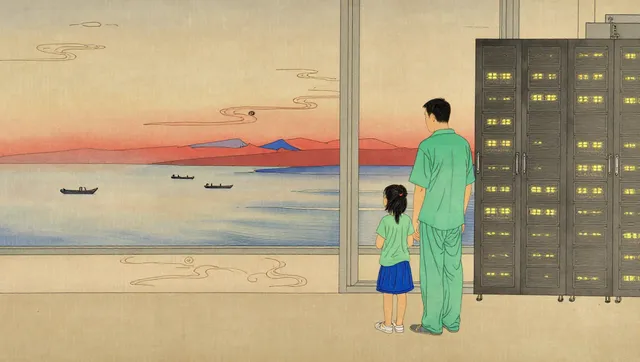
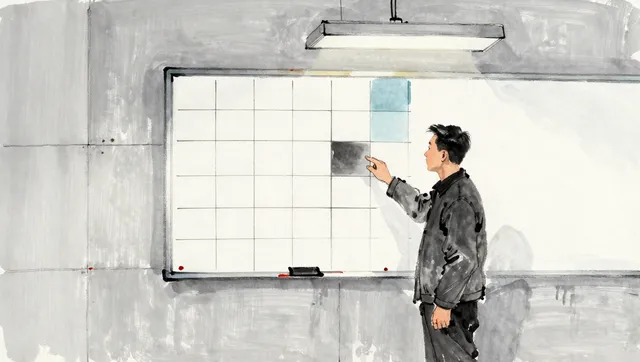
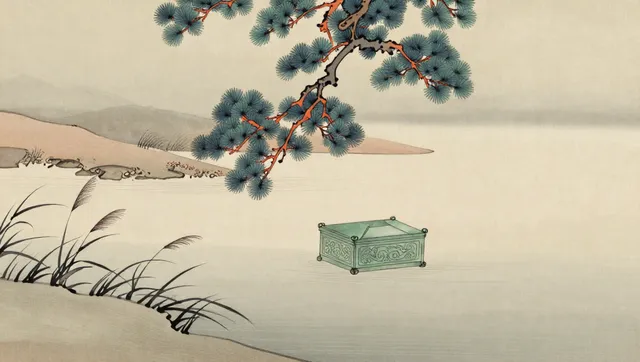
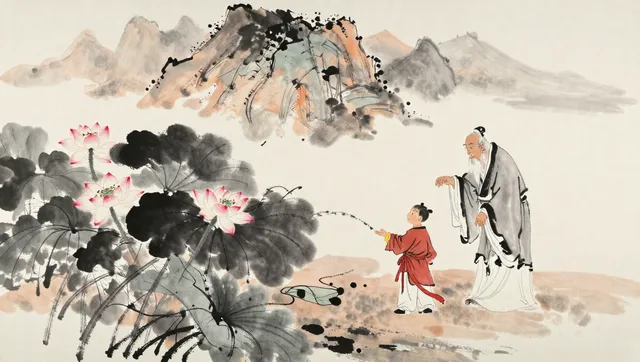
The xie (寫) of xieyi means both to copy and to write, and yi (意) means idea or mind. So xieyi means writing the idea. Instead of transferring every outward detail of a subject, the painter writes down with the brush the spirit and feeling received from it. At the other pole stands gongbi (工筆), which paints with fine lines and delicate colour, carefully and to the end. A freehand painter draws a bamboo leaf in one stroke and finishes a fish in a few lines. In China this painting has long been counted close to calligraphy, so a poem is written beside the picture and a seal is pressed. The meeting of poem (詩), calligraphy (書), painting (畫) and seal (印) on one sheet is counted as the charm of freehand painting. It rests on the brush, the ink slab, the ink and Xuan paper (宣紙), a thin paper that drinks water well.
The roots of freehand painting are old. In the fifth century Xie He (謝赫) wrote down six rules for judging paintings, and the first is spirit resonance (氣韻). It is read as telling the viewer to look first for the spirit and echo that flow through a picture before looking for likeness. Under the Yuan dynasty (元, 1271–1368), scholars who held no office, or had withdrawn from it, made painting an expression of the mind. This current is called literati painting (文人畫). Ni Zan (倪瓚, 1301–1374) is renowned as the painter who drew a lonely mood with sparse trees and open space. Late Ming's Dong Qichang (董其昌) raised such scholars' painting high under the name Southern school (南宗畫). Freehand painting grew on this literati ground, and under the Qing it became still bolder. That is the base of xieyi.
In the sixteenth century Xu Wei (徐渭, 1521–1593) is credited with opening the rough power of freehand painting by splashing and pouring ink. He was a man who spent seven years in prison. In the seventeenth century Bada Shanren (八大山人, born Zhu Da 朱耷, 1626–1705) was a descendant of the Ming imperial house. When the Ming fell, he is said to have become a monk and hidden himself. In his pictures fish and birds float on bare paper with no setting, their eyes turned upward. The Cleveland Museum of Art explains that the fish of the handscroll Fish and Rocks can be read as people who lost their country and their place in life, the loyalist remnants (yimin, 遺民). What is certain is that the paper left bare tells half of the picture.
Shitao (石濤, 1642–1707) also came from the Ming imperial clan, became a monk, turned to Daoism in 1693, and later returned to Yangzhou (揚州) to paint. The painters active in Yangzhou in the eighteenth century who were known for unconventional pictures are called the Eight Eccentrics of Yangzhou (揚州八怪). Zheng Xie (鄭燮, 1693–1765) was one of them and loved to paint orchids, bamboo and rocks. He is said to have served as a local magistrate in Shandong for some twelve years before leaving office. The Cleveland Museum of Art records its Bamboo and Rock as a work of 1765, the year he died. The scholar's habit of putting an upright mind into a single bamboo is clearest here.
Toward the late nineteenth and the twentieth century, Shanghai and Beijing became the centres. Wu Changshuo (吳昌碩, 1844–1927) was a leading painter of the Shanghai School and painted plum blossom and peonies with a forceful brush. Qi Baishi (齊白石, 1864–1957) came from Xiangtan in Hunan, worked in Beijing, and was loved for his shrimp and birds. He is said to have been influenced by Wu Changshuo. In this way freehand painting met new masters in each age. The way of using ink differs, but the promise of writing the idea with the brush is the same. Thanks to that promise, a viewer today can still read a bamboo or a fish from three or four strokes.
So what is the Sichuan (四川) in the room's name? This room does not mean a school called Sichuan freehand painting. The Sichuan of this room is a place taken from Nezha's life story. There is, however, a painter truly tied to Sichuan. Zhang Daqian (張大千, 1899–1983) was born in Neijiang, Sichuan, and lived in Sichuan from 1937. In the early 1940s he devoted himself to copying the Dunhuang murals, and in the late 1950s, as his eyesight failed, he is said to have developed pocai (潑彩), the splashing of colour that spreads. He was not only a freehand painter but worked widely, from copies of old paintings to bold splashed colour. The originals shown in this room are not by Zhang Daqian.